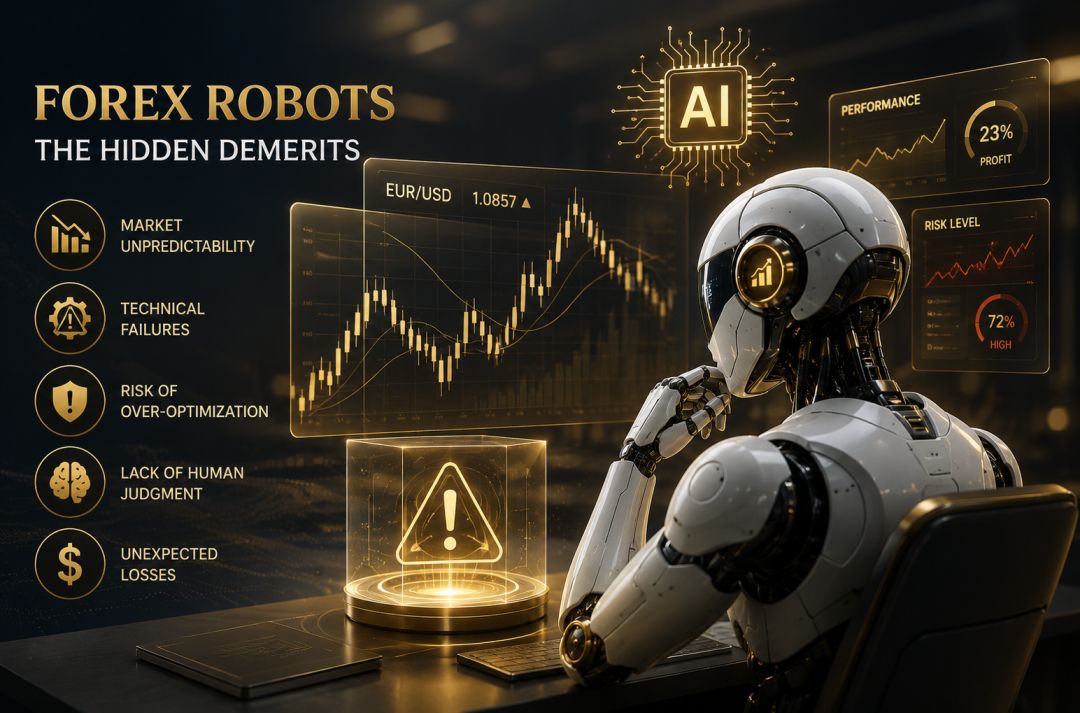
The Allure — and the Illusion — of Forex Trading Robots
Every week, thousands of forex traders search for a magic solution — a piece of software that will trade for them while they sleep, grow their account on autopilot, and eliminate the stress of watching charts all day. Trading robots (also called Expert Advisors or EAs) promise all of this and more.
And honestly? The appeal makes perfect sense. In a market that runs 24 hours a day, five days a week, across every time zone on the planet, having a machine handle the grunt work sounds like a dream. But here's what most promotional material conveniently forgets to mention: forex robots carry serious, often overlooked demerits that can — and regularly do — cause significant financial loss.
In this article, we'll break down the real-world pitfalls of relying on automated trading systems, explore what the research actually shows, and help you build a smarter, more balanced approach to trading forex in 2025 and beyond.
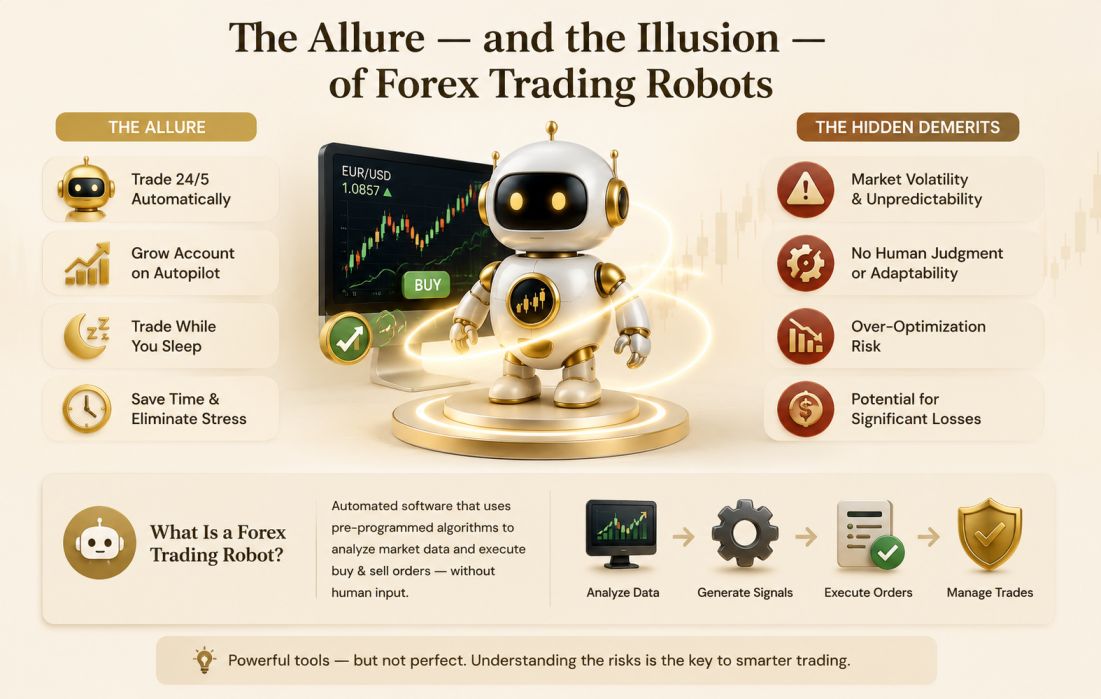
What Exactly Is a Forex Trading Robot?
A forex trading robot is an automated software program that uses pre-programmed algorithms to execute buy and sell orders in the forex market on behalf of the trader. These systems analyze price data, technical indicators, and historical patterns to make decisions — all without human input. Some run inside platforms like MetaTrader 4 or MetaTrader 5; others operate as standalone cloud-based systems.
The key phrase here is "without human input." That's both the greatest selling point and the most critical flaw. Let's explore why.
1. Robots Have Zero Emotional Intelligence
This might sound like a benefit at first. "Robots don't panic! They don't FOMO into bad trades!" And there's truth in that — emotional discipline is genuinely hard for human traders. But emotional intelligence is a two-sided coin, and robots only see one side.
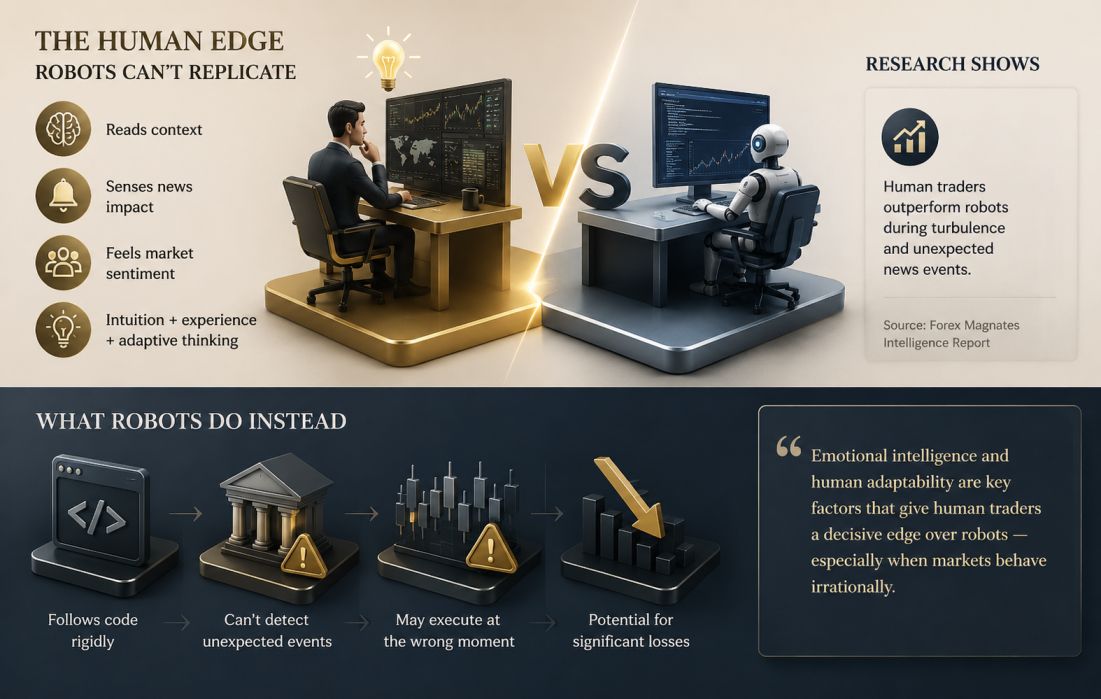
The Human Edge Robots Can't Replicate
Experienced human traders rely on far more than chart patterns. They read context. They sense when a news release is creating a trap. They intuitively recognize when market sentiment has shifted before the indicators catch up. This combination of intuition, experience, and adaptive thinking is what emotional intelligence actually looks like in professional trading — and no robot can replicate it.
According to findings from the Forex Magnates Intelligence Report, automated trading systems consistently underperform human traders during periods of market turbulence and unexpected news events. The report noted that human traders outperformed automated systems by a significant margin precisely when it mattered most.
"Emotional intelligence and human adaptability are key factors that give human traders a decisive edge over robots — especially when markets behave irrationally."
What Robots Do Instead
Without emotional intelligence, a robot follows its code — rigidly. When the GBP suddenly spikes 200 pips on a surprise Bank of England statement, the robot doesn't "know" that this isn't the beginning of a new trend. It executes its logic — often at exactly the wrong moment.
Use robots as a filter or screener tool, not as your primary decision-maker. Let the algorithm identify setups, but let a human eye validate the trade context before execution — especially around scheduled news events.
2. Automated Systems Struggle With the Unexpected
Markets don't follow scripts. A single tweet, geopolitical crisis, or surprise interest rate decision can send the market into a tailspin that no algorithm predicted — because no algorithm could. The forex market is fundamentally shaped by human decisions, human fears, and human greed. An algorithm trained on yesterday's data is always one surprise away from catastrophe.
The Brexit Example: A Wake-Up Call
Cast your mind back to June 2016. The United Kingdom voted to leave the European Union in a referendum that most pollsters — and most trading algorithms — predicted would go the other way. The result? Sterling collapsed overnight. The GBP/USD dropped nearly 2,000 pips in hours.
Thousands of forex robots, programmed to trade the range, to fade breakouts, or to follow trend signals on the hourly chart, simply had no framework to handle what happened. Human traders who understood what was happening adapted — some even profited enormously. Most robots did not.
Key Risks of Inflexible Automation
- Robots cannot interpret breaking news or geopolitical developments in real time
- Black swan events — pandemics, flash crashes, sudden sanctions — fall entirely outside their training data
- Algorithms may increase position sizes into a collapsing market, compounding losses
- Stop-loss hunting in thin liquidity conditions can wipe out accounts before the robot pauses
- System lag during high-impact news means execution occurs at the worst possible prices
Always set your trading robot to pause or disable automatically 30 minutes before and after major economic releases such as Non-Farm Payrolls, central bank decisions, and CPI data. Manual oversight during these windows is non-negotiable.
3. Over-Reliance on Historical Data Is a Double-Edged Sword
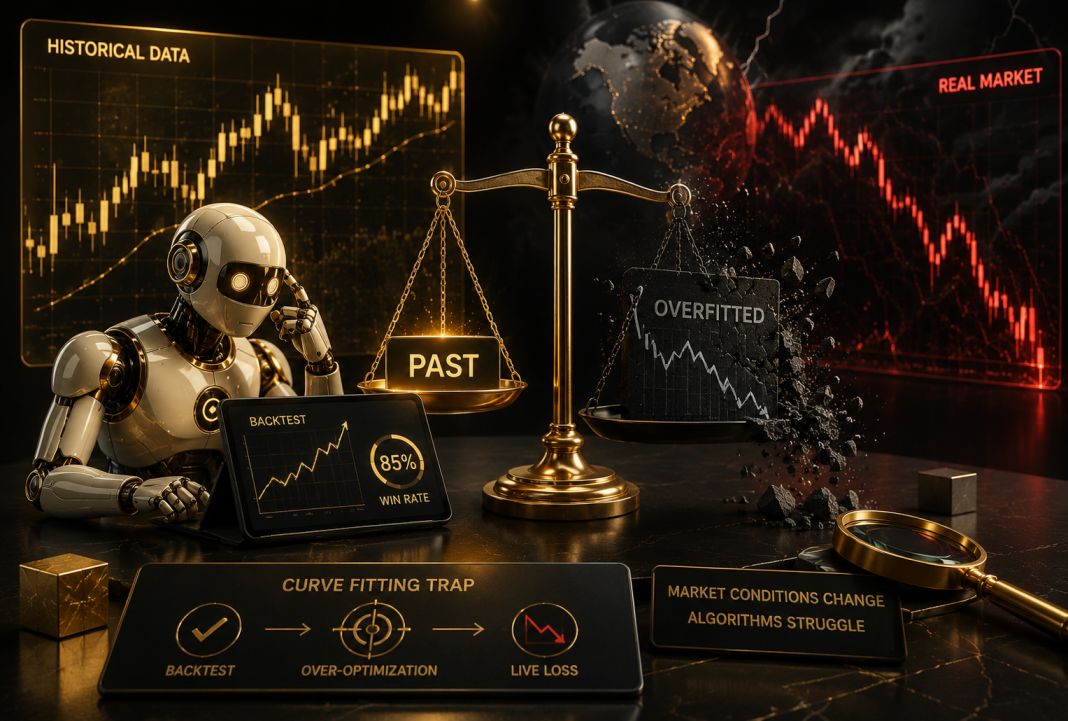
Every forex robot is, at its core, a pattern-recognition engine trained on historical price data. The assumption is that what worked in the past will continue to work in the future. In stable, trending markets, this can hold true for months. But the forex market is a living, evolving system — and it regularly enters regimes that look nothing like the past.
The Curve-Fitting Trap
One of the most dangerous problems in algorithmic trading is over-optimization, also called curve fitting. A developer backtests a strategy on five years of data, tweaks the parameters obsessively until the backtest looks pristine — 85% win rate, incredible Sharpe ratio, tiny drawdowns — and then deploys it live. Within weeks or months, it starts losing. Why? Because the strategy was fitted to historical noise, not real market structure.
Research from the European Central Bank found that forex robot performance is highly dependent on stable and consistent market conditions. Once those conditions change — as they inevitably do — the algorithm's effectiveness deteriorates sharply. This isn't a fringe finding; it's a core structural limitation of rule-based systems.
What Historical Data Can't Tell Robots
- How a new central bank governor will communicate policy changes in tone
- When an emerging market crisis will spill into major currency pairs
- How correlations between assets shift during risk-off market episodes
- What happens when two unprecedentedly large events occur simultaneously
- Whether a breakout is real or a stop-hunt engineered by institutional players
"Robots in forex trading are fundamentally limited by their dependence on historical data and algorithmic constraints, making them far less adaptable to the dynamic, real-time reality of live markets."
5. Finding the Right Balance: Automation + Human Expertise
None of this means robots are useless. Far from it. When used correctly — as a tool rather than a replacement for skill — automation can genuinely enhance your trading. The problem isn't the technology; it's the expectation that it will do everything for you.
What Robots Do Well
- Executing pre-defined strategies without hesitation or second-guessing
- Scanning multiple currency pairs simultaneously for specific setup criteria
- Managing position sizing and risk parameters consistently
- Operating around the clock in markets you physically can't monitor
- Removing emotion from mechanical, rule-based trade management
Where Human Judgment Is Irreplaceable
- Interpreting macroeconomic context and fundamental news flow
- Recognizing when market conditions have shifted and a strategy should pause
- Managing risk during black swan events with discretionary judgment
- Evolving and adapting strategy frameworks as market dynamics change
- Building intuition about institutional order flow and market microstructure
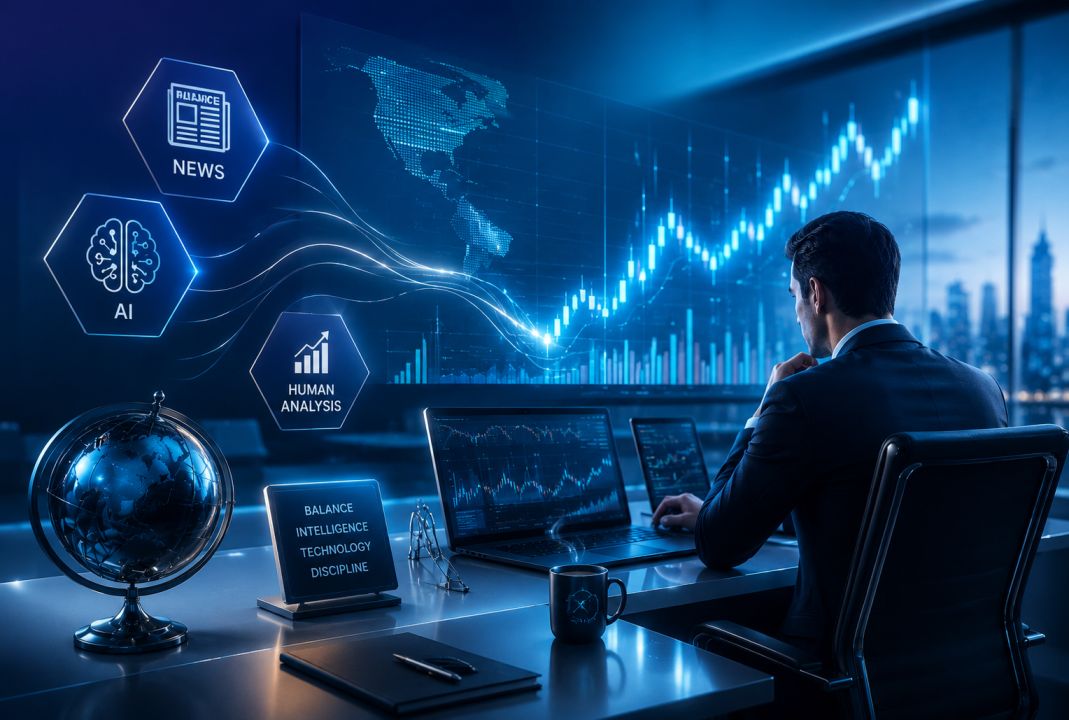
The most consistently profitable traders in today's market aren't purely discretionary and they're not purely algorithmic. They're hybrid traders — people who use technology intelligently while retaining human oversight where it matters most. That's the model worth aspiring to.
"Finding the right balance between automation and human expertise isn't just best practice — it's the foundation of sustainable, long-term forex trading success."
A Smarter Approach for Every Forex Trader
Start by being brutally honest about what a robot can and cannot do. Test any system on a demo account for a minimum of three to six months across genuinely different market conditions — not just the back-tested periods the vendor highlights. Understand the logic behind the strategy, not just the results. And never deploy automation without a clear emergency protocol for when things go wrong.
At fxTsignals.com, our signals are built on the conviction that intelligent, informed human analysis outperforms blind automation — especially at the moments that define long-term profitability. We give you the edge that no robot can replicate.