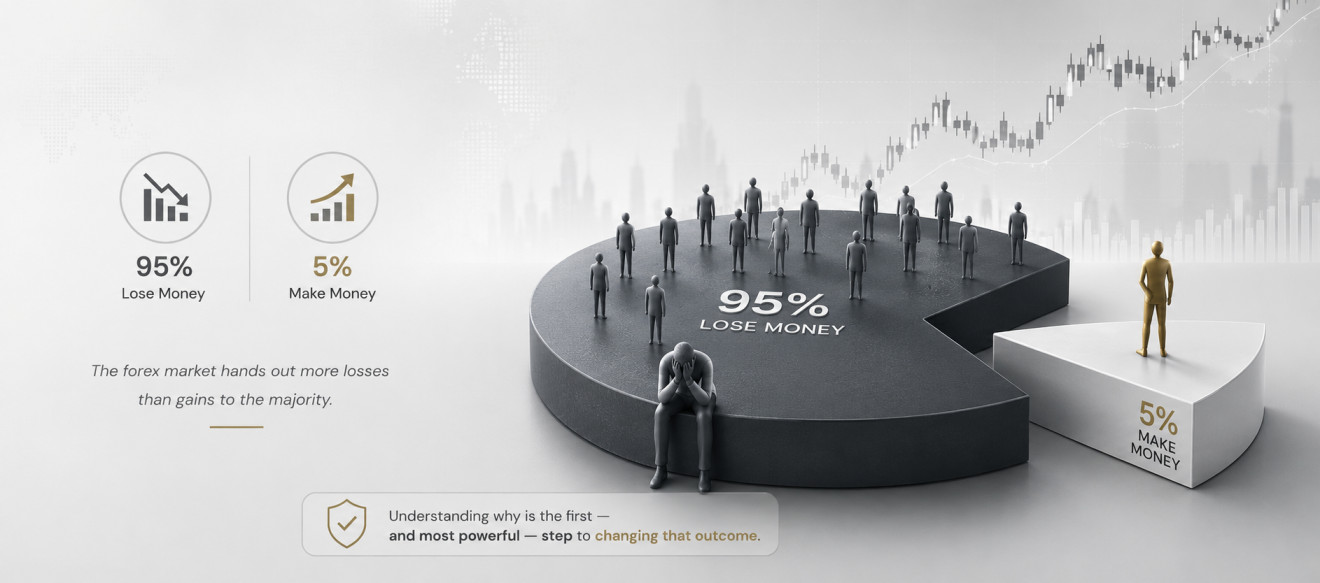
Forex trading draws millions of hopeful investors every year with promises of financial freedom, flexible hours, and unlimited upside. Yet, the uncomfortable truth is this: the overwhelming majority walk away with lighter wallets and bruised egos. The market itself isn't rigged — but the habits, mindset, and preparation most traders bring to it might as well be working against them.
This isn't just another doom-and-gloom warning. Consider it a map. The traders who consistently profit understand the pitfalls deeply enough to avoid them. At fxTsignals.com, we've compiled the most honest breakdown of why forex traders fail — and more importantly, what actually works.

1. Lack of Education: Trading Without a Map
Imagine showing up to a surgery without medical school. That's essentially what many new forex traders do — they open a live account, deposit real money, and start pressing buttons without ever studying how the market actually works.
Not Knowing What Moves the Market
Forex isn't just charts and candles. Currency prices reflect the entire economic heartbeat of nations — interest rate decisions, inflation data, employment figures, geopolitical tension. A trader who can't interpret a central bank statement or a Non-Farm Payroll report is effectively flying blind during some of the market's most volatile moments.
Most beginners skip fundamental analysis entirely, leaning on "a friend's tip" or a flashy indicator they found online. Technical analysis matters — but it works best when paired with a genuine understanding of what's driving price on the macro level.
Before you touch a live account, commit to 90 days of demo trading combined with daily study of economic calendars, price action theory, and one clear trading methodology. Knowledge compounds — and so does ignorance.
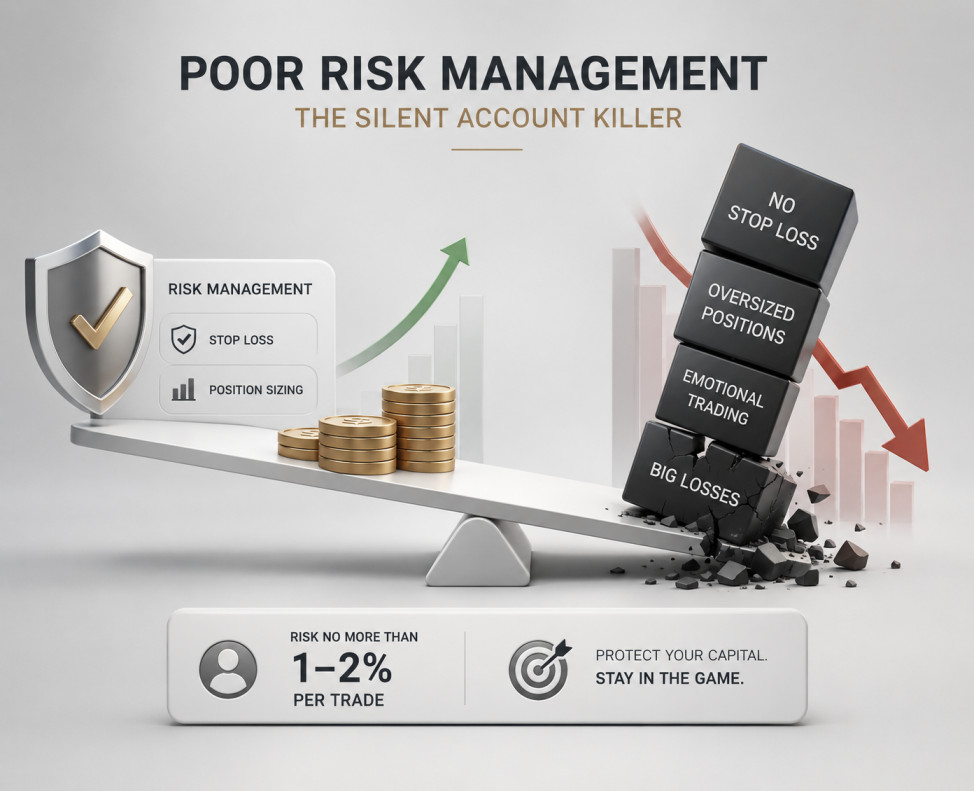
2. Poor Risk Management: The Silent Account Killer
Ask any experienced trader what separates the survivors from the casualties, and they'll say the same thing: risk management. It's not the most glamorous topic, but it's the difference between a bad week and a blown account.
The Stop-Loss Problem
Many traders either don't use stop-loss orders at all, or place them so wide that a single losing trade wipes out weeks of gains. Risking 10–20% of your account on one trade isn't aggressive — it's reckless. Professional traders typically risk no more than 1–2% per trade.
The logic is simple but powerful. If you risk 2% per trade, you can lose 10 consecutive trades and still have 80% of your capital intact. But if you risk 20% per trade, three losses in a row can end your career before it starts.
- →Risks 10–20% per trade "to make it worth it"
- →No stop-loss, or stops placed emotionally
- →Doubles down on losing positions
- →Over-leverages to "speed up" profit
- →Risks 1–2% maximum per trade
- →Stop-loss set before entering any trade
- →Cuts losses fast, lets profits run
- →Uses leverage conservatively and deliberately
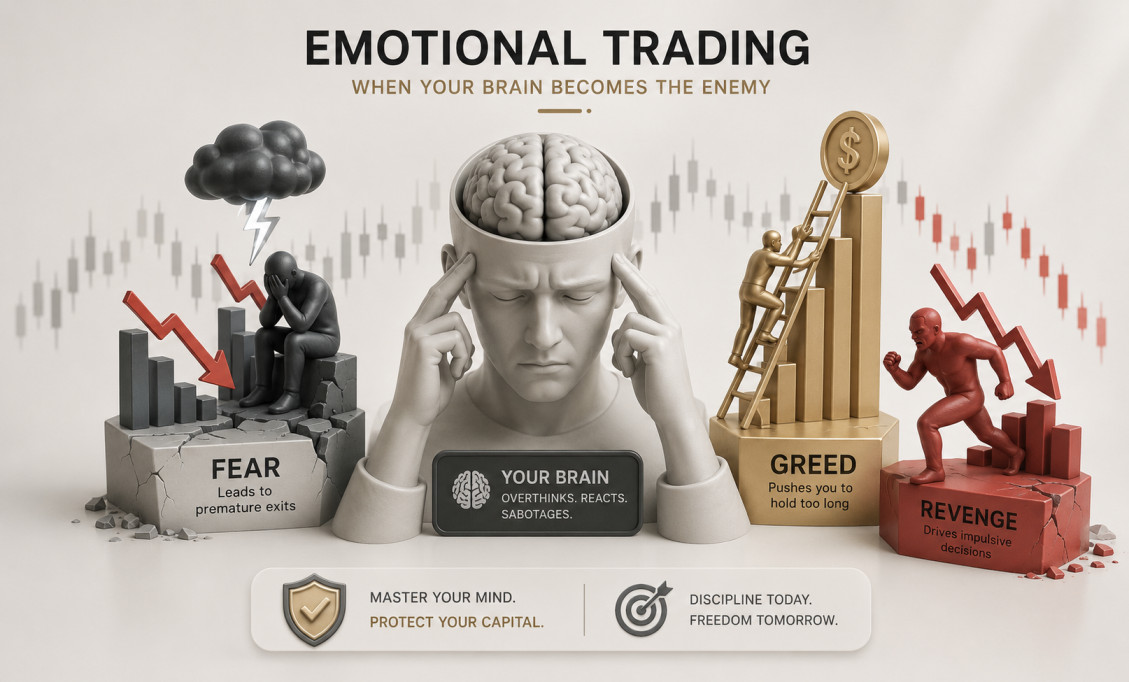
3. Emotional Trading: When Your Brain Becomes the Enemy
The forex market is a masterclass in psychological warfare. It doesn't just test your strategy — it tests your identity, your self-control, and your ability to act rationally when your money is on the line. Most traders aren't prepared for that.
Fear, Greed, and Revenge Trading
The three most destructive emotions in trading are fear (leading to premature exits), greed (pushing traders to hold too long or overtrade), and revenge (taking impulsive trades after a loss to "win it back"). All three short-circuit rational thinking and override even a solid strategy.
The market doesn't know you lost. It doesn't care. Taking a revenge trade is not a negotiation with the market — it's a negotiation with your ego. And your ego will always lose.
Confirmation Bias: Seeing What You Want to See
Confirmation bias is particularly dangerous in forex because the charts are open to interpretation. When a trader has already made up their mind about a trade, they unconsciously cherry-pick data that supports their view while ignoring warning signs. The result? Trades that look great on paper — because every contradictory signal was quietly dismissed.
Before entering any trade, write down at least two reasons the setup could fail. This forces objective thinking and neutralizes confirmation bias before it costs you money.
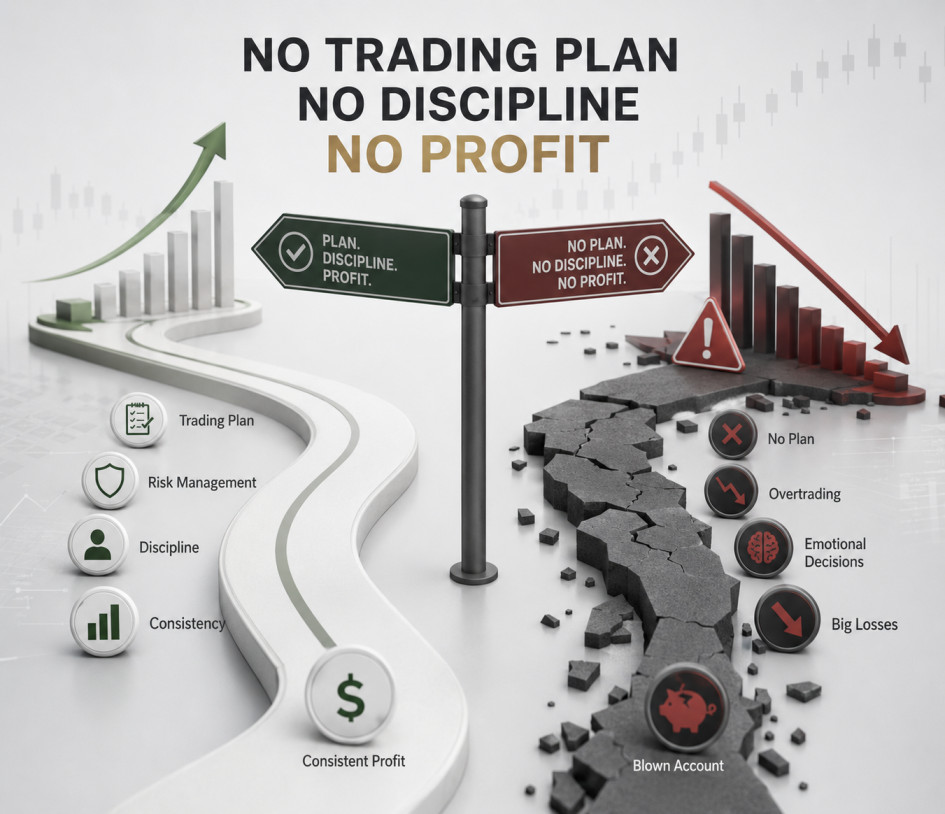
4. No Trading Plan, No Discipline — No Profits
You wouldn't open a restaurant without a business plan. Yet thousands of traders open funded accounts every day with nothing more than a vague intention to "buy low, sell high." A trading plan isn't optional — it's your entire framework for surviving in the market.
What a Real Trading Plan Includes
- ◆Specific entry and exit criteria — not vague feelings
- ◆Maximum risk per trade and per day
- ◆Clear rules for when NOT to trade (news events, low liquidity, bad mental state)
- ◆A journaling system to track performance and patterns
- ◆Defined trading hours matched to your preferred sessions
Impulsive Trading Destroys Consistency
Even traders with a plan often abandon it the moment the market does something unexpected. This is where discipline becomes the hardest skill to develop — and the most valuable. Consistently executing a mediocre plan beats inconsistently executing a great one. The market rewards repetition and patience above all else.
5. Market Forces Beyond Individual Control
Even experienced traders can be caught off guard. The modern forex market is a complex ecosystem where algorithmic trading systems, central bank interventions, and black-swan geopolitical events can reshape price action in seconds.
Algorithms and High-Frequency Trading
The rise of algorithmic and high-frequency trading has fundamentally changed the market. These systems react to news and patterns thousands of times faster than any human can. Individual retail traders who don't understand how these systems work often find themselves on the wrong side of a sudden move that was entirely systematic — not fundamental.
Ignoring the Economic Calendar
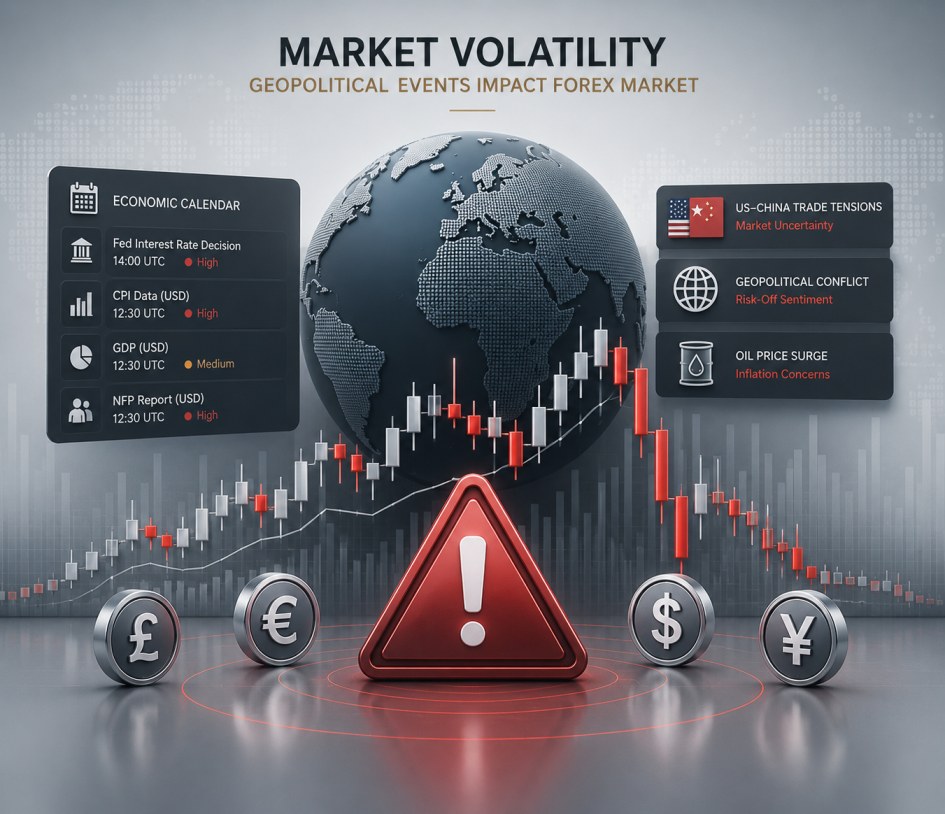
One of the most avoidable mistakes traders make is holding positions through major economic releases — Fed meetings, CPI data, GDP reports. These events can cause 50–200 pip moves in minutes. If you don't know when they're coming, you're not trading the market. You're gambling in it.
The solution is straightforward: check the economic calendar every single day. Know which releases affect your pairs. Either exit before the event, or trade the volatility with a clearly defined risk plan. Never get surprised by a calendar event that was published weeks in advance.
The Path Forward: How to Join the 5%
The statistics around forex trading failure can feel overwhelming. But here's the perspective shift that changes everything: if 95% of traders lose because of identifiable, repeatable mistakes — then avoiding those mistakes is a concrete and achievable strategy.
The 5% who succeed aren't geniuses or insiders. They're disciplined learners who treat trading like a professional practice, not a lottery ticket. They study the market, manage risk obsessively, control their emotions through tested routines, follow a written plan, and stay informed about macro events.
- ✓Educate continuously — treat every trade as a lesson, win or lose
- ✓Protect capital first — you can't trade without a funded account
- ✓Trade the plan, not the feeling — consistency compounds over time
- ✓Respect the calendar — never be surprised by a scheduled event
- ✓Review your journal weekly — your data tells you where you're leaking money
Patience and perseverance — not luck — are what build profitable trading careers. The market will always be there. The traders who last are the ones who protect themselves until their edge compounds into real, consistent returns.