A deep-dive into the principles that power the world's most sophisticated investment vehicles — and exactly what forex traders can borrow from them to sharpen their edge.
fxTsignals.comForex & Hedge Fund Strategy~8 min read1,500+ words
$4.5TGlobal Hedge Fund AUM
3×Alpha vs S&P 500 (top quartile)
20%Performance fee industry standard
Introduction
What Makes Hedge Funds So Powerful?
There's a reason hedge funds sit at the top of the financial food chain. While retail investors follow the crowd and mutual funds track indices, hedge funds are quietly operating with a completely different rulebook — one built on flexibility, discipline, and relentless pursuit of alpha.
For forex traders, understanding how hedge funds think isn't just intellectually interesting — it's strategically vital. The very principles that allow these elite funds to generate consistent returns in bull and bear markets alike are the same principles that can transform how you approach currency markets. Whether you trade major pairs, EM currencies, or carry strategies, there's something in the hedge fund playbook you haven't fully applied yet.
This guide breaks it all down: from sophisticated risk frameworks and alternative strategies, to fee structures and investor psychology. By the end, you'll have a clearer picture of how the smartest money in the world operates — and how you can align your own trading philosophy with it.
Core Principle #1
Risk Management Is Not Optional — It's an Art Form
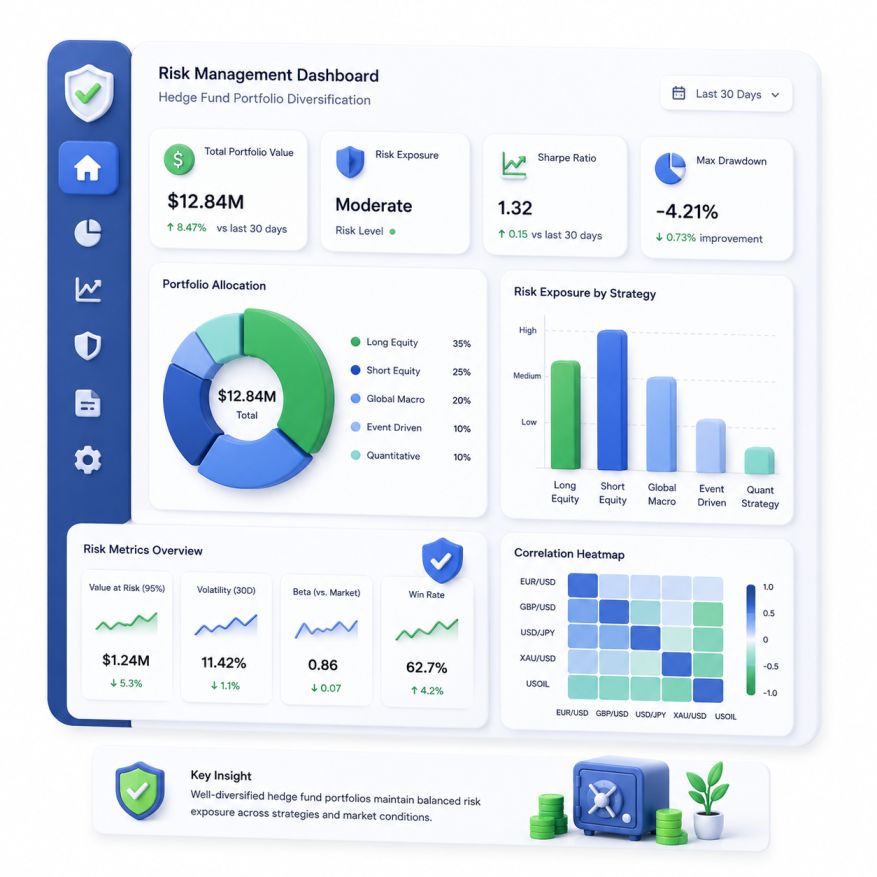
Ask any seasoned forex trader what separates a consistently profitable trader from one who blows up their account, and the answer is almost always the same: risk management. Hedge funds have turned this discipline into a science — and then elevated it further into an art.
Diverse Strategies for Every Market Condition
Hedge funds are not shackled by a single investment approach. They rotate between long/short equity, global macro, event-driven, and quantitative strategies, depending on where the best risk-adjusted opportunities exist. This is a direct lesson for forex traders: rigid trading systems fail over time. Markets evolve, correlations shift, and the trader who can adapt survives.
Adopting a multi-strategy mindset means you don't fight the market. You read it. When volatility spikes ahead of an NFP release, your playbook changes. When a central bank signals a pivot, your macro lens activates. This is exactly how hedge fund managers think.
"In the world of hedge funds, risk management is not an afterthought; it is an art form that separates the great from the good."
— John Smith, Hedge Fund Manager
Core Principle #2
Active Management: Never Set and Forget
One of the most defining characteristics of successful hedge funds is their culture of continuous portfolio monitoring. Fund managers don't open a position and walk away. They actively reassess, re-evaluate, and reposition as new data enters the market. This is in stark contrast to the passive "buy and hold" philosophy.
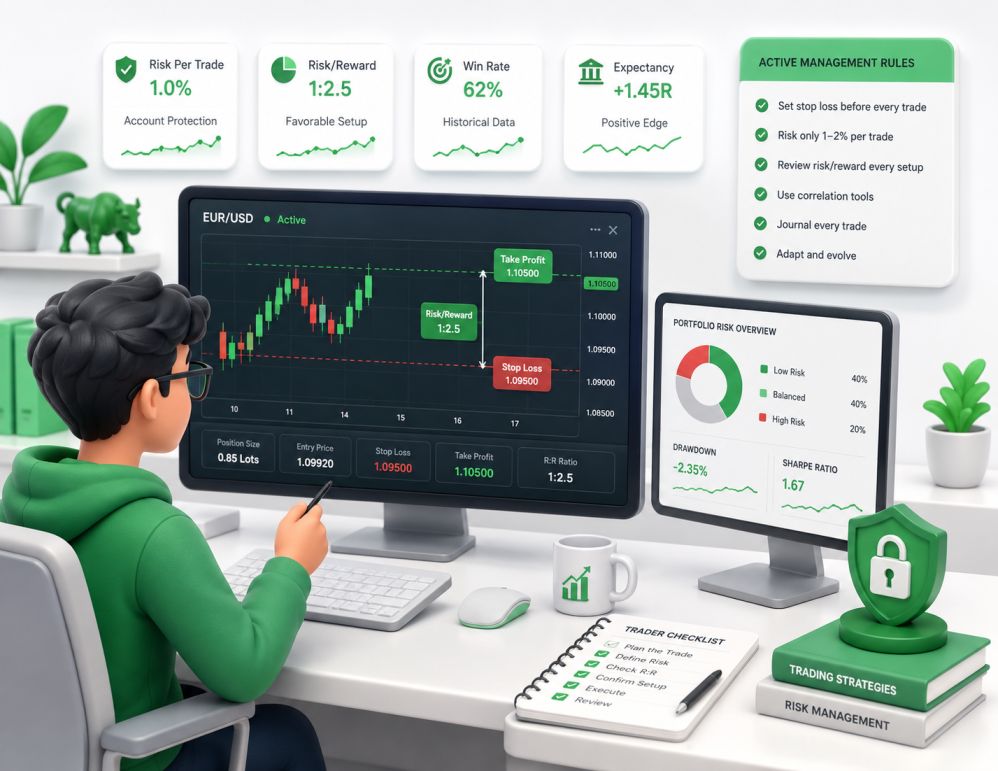
For forex traders, this translates into a habit of active trade management — adjusting stop losses as a trade develops, scaling in or out of positions based on price action confirmation, and never letting a winning trade turn into a loser out of complacency.
Stress Testing Your Positions
Hedge funds regularly run stress tests — simulating extreme scenarios to see how portfolios would perform. Forex traders can mirror this by asking: "What happens to my trade if the ECB surprises with a 50bps hike?" or "How does this position behave if USD/JPY moves 300 pips against me overnight?"
Predefined Risk Tolerances
Before any capital is deployed, hedge funds define maximum drawdown limits, position size caps, and volatility thresholds. As a forex trader, having hard rules for maximum daily loss, maximum open positions, and pip-risk-per-trade is your version of this framework.
Hedging Against Downside
Hedge funds use short-selling, options, and futures contracts to offset exposure. In forex, this could mean holding a long EUR/USD position while simultaneously being short USD/CHF — using the natural negative correlation as a portfolio hedge rather than two independent bets.
Rigorous Due Diligence
Before entering any trade, hedge fund analysts tear apart financial statements, assess management credibility, and scrutinize macro conditions. Before you enter a forex trade, do the same: read the central bank minutes, check the economic calendar, and understand the narrative behind price movement.
💡 Actionable Tip for Forex Traders
Create a "Risk Checklist" you run before every trade: What is my maximum loss in USD? What correlation risk exists with other open positions? What macro events could invalidate this setup within 24 hours? This is your personal hedge fund due diligence protocol.
Set a maximum daily drawdown limit and honor it without exception
Never risk more than 1–2% of your account on a single forex trade
Review open positions after every major economic release
Use correlation tools to avoid doubling your risk unknowingly
Journal every trade with a post-trade review — hedge funds call this a "post-mortem"
Core Principle #3
Striving for Alpha: The Relentless Pursuit of Superior Returns
Alpha is the holy grail of investing — returns that exceed market benchmarks and cannot be explained by general market movement. Hedge funds dedicate enormous resources to generating alpha, and the strategies they use contain powerful lessons for forex traders chasing consistent profitability.
The Unconstrained Investment Universe
Hedge funds invest globally across equities, bonds, commodities, derivatives, and currencies. They have no geographic or asset class restrictions. This freedom is something forex traders inherently possess — the forex market is the world's largest and most liquid, offering opportunities across major, minor, and exotic currency pairs 24 hours a day.
The alpha-generating insight here is: stop limiting yourself to two or three currency pairs. Skilled forex traders, like hedge fund managers, scan the entire universe of opportunities and deploy capital where the edge is strongest — not where they're most comfortable.
Leverage: The Double-Edged Sword
Hedge funds use leverage judiciously — amplifying returns on high-conviction trades while maintaining rigorous risk controls. This is fundamentally different from retail forex traders who reach for maximum leverage as a default rather than a tool.
"In the quest for alpha, hedge fund managers tread a fine line, skillfully harnessing the power of leverage while keeping risk in check."
— Emily Adams, Hedge Fund Analyst
Use higher leverage only on setups with the highest confluence of technical and fundamental signals
Treat leverage as a performance multiplier — not a shortcut to larger profits
Reduce leverage during high-uncertainty events (central bank meetings, geopolitical risk)
Always calculate position size based on pip risk, not on margin availability
Alternative Opportunities in Forex
Just as hedge funds explore distressed debt and private equity as alternative alpha sources, skilled forex traders explore exotic currency pairs, carry trade strategies, and cross-pair opportunities that most retail traders ignore. The AUD/NZD carry trade, for instance, or structural trends in EM currencies like the MXN or ZAR, can offer edge that overcrowded majors simply don't.
Core Principle #4
True Alignment of Interests: Why Incentives Matter
One of the most overlooked — yet most powerful — principles behind hedge fund success is the alignment of incentives between fund managers and their investors. Unlike traditional mutual funds that collect fees regardless of performance, hedge funds typically operate on a "2 and 20" model: 2% management fee and 20% of profits. This creates shared stakes in outcomes.
The High-Water Mark Principle
The high-water mark provision ensures that fund managers only earn performance fees on new profits — not on recovering previous losses. This aligns the manager's incentive with long-term capital preservation, not just short-term gain chasing.
For forex traders, this is a mindset shift. Think like a fund manager, not a gambler. Your "high-water mark" is your all-time equity peak. When you're in drawdown, your job is capital preservation — not doubling down to recover losses quickly.
Transparency and Investor Communication
Top-tier hedge funds maintain detailed investor reporting — regular updates, performance attribution, and honest communication about risks. For individual traders, this means keeping a thorough trading journal that tracks not just P&L, but decision quality, emotional state, and execution accuracy.
"For hedge funds, success lies not just in generating returns but in fostering lasting investor relationships built on transparency, responsiveness, and empathy."
— Samantha Carter, Investor Relations Consultant
Core Principle #5
The Power of Diversification Without Dilution
Hedge funds are masters of diversification — but not the passive kind. They don't diversify just to reduce risk; they diversify to maximize risk-adjusted returns. This is a critical distinction. A forex trader holding 10 USD-correlated positions hasn't diversified. They've concentrated.
True diversification in forex means holding positions across genuinely uncorrelated pairs, balancing risk-on and risk-off exposure, and being aware of macro themes that might cause all your positions to move in lockstep during a risk event.
Think of your trading portfolio the way a hedge fund thinks of its book: each position should play a distinct role. Some are trend-following setups. Some are mean-reversion plays. Some are macro thematic trades. Together, they create a resilient portfolio that doesn't collapse when one narrative breaks down.
FAQ
Frequently Asked Questions
Hedge funds have far greater flexibility than traditional investment funds. They can go long and short, use leverage, invest across multiple asset classes globally, and employ complex derivatives strategies. Traditional mutual funds are typically long-only, restricted to specific asset classes, and benchmarked against an index. This freedom is what allows hedge funds to generate alpha regardless of market direction — a key reason they appeal to sophisticated investors.
Forex traders can adopt hedge fund-style risk management by establishing predefined risk tolerances (maximum daily loss, maximum position size), running scenario analysis before major events, using correlation awareness to prevent hidden concentration risk, and maintaining a rigorous post-trade review process. The key shift is moving from reactive risk management to proactive risk management — defining exactly how much you're willing to lose before a trade is placed.
Alpha in forex means returns that exceed what you'd earn by simply following the broader market trend or a passive strategy. For a forex trader, generating alpha could mean identifying currency mispricings driven by central bank policy divergence, exploiting carry trade opportunities before the crowd, or finding asymmetric risk-reward setups on less-watched exotic pairs. It requires an edge — a repeatable, well-researched reason why your trade will work.
The "2 and 20" model is primarily relevant for forex traders who manage accounts for others or are considering prop trading. However, the underlying principle — that incentives should be tied to performance rather than activity — is universally applicable. It teaches individual traders to think in terms of quality over quantity: focus on setups with high probability and strong risk-reward ratios, rather than trading frequently just to feel active.
Absolutely. While retail traders lack the capital scale and institutional access of hedge funds, the underlying principles are fully accessible. Global macro analysis, long/short positioning across correlated pairs, rigorous risk management, and disciplined diversification are all strategies that can be applied with a standard retail forex account. What differentiates successful retail traders from the rest is this mindset: thinking like an institutional manager rather than a speculative gambler.
Conclusion
The Hedge Fund Edge Is Available to Every Trader Who Seeks It
Hedge funds aren't successful because of magic or exclusivity. They're successful because they commit to a set of principles — rigorous risk management, relentless alpha-seeking, genuine flexibility, and disciplined alignment of incentives — and they execute those principles consistently, day after day, market cycle after market cycle.
As a forex trader, you're operating in the same markets these funds trade. The same currency pairs, the same macro forces, the same technical structures. What separates the professional from the amateur isn't access to information — it's the framework applied to that information.
Start by treating your trading account like a hedge fund portfolio. Define your risk tolerance. Diversify properly. Seek genuine edge rather than comfortable familiarity. Manage your positions actively. And above all, align your behavior with your long-term success — not your short-term emotions.
The principles are here. The market is open. Now it's your move.
Ready to Trade with a Hedge Fund Mindset?
Join thousands of forex traders who use fxTsignals.com to access institutional-grade signals, market analysis, and risk management frameworks — all designed to give you the edge the pros use.