
Walk into any trading room — physical or digital — and you'll find two types of traders. One is glued to every tick, reacting to every candle with a racing heartbeat. The other sits back, calm, calculated, and precise. Both have access to the same charts, the same indicators, the same data. So what separates them?
The answer is trading psychology. At fxTsignals.com, we've spent years studying what makes seasoned forex traders consistently profitable. It's not a secret indicator. It's mastery of the mind. In this guide, we break down the core psychological pillars that separate hobbyists from professionals — and give you actionable tools to start applying them today.
The Power of Emotional Intelligence in Forex Trading
Fear. Greed. Overconfidence. Panic. These aren't just words — they're forces that move markets and destroy accounts. Every experienced forex trader will tell you that managing your emotions is not a soft skill; it's your most critical trading skill.
Recognize and Control Your Emotions
The first step to emotional mastery in trading is simply awareness. You need to catch yourself in the moment — feeling that urgency to chase a trade, or that paralysis when a position moves against you. Experienced traders build a personal emotional vocabulary around their trading habits.
- Practice deep breathing or a 3-minute pause before entering any trade during volatile market sessions
- Take deliberate breaks after a series of wins or losses — both extremes cloud judgment equally
- Use pre-trade checklists to shift from emotional to analytical decision-making
- Identify your personal "tilt triggers" — the specific conditions that push you toward impulsive trades

Build a Resilient Trading Mindset

Resilience in trading doesn't mean ignoring losses — it means reframing them. Every losing trade holds data. Every drawdown reveals a weakness in your system or your psychology that, once fixed, makes you a more formidable trader.
Professionals don't mourn a losing trade. They log it, study it, and move on. Maintaining a growth mindset in the forex market means you're constantly evolving — adjusting your strategy as market conditions shift rather than forcing the same approach in all environments.
- Reframe losses as tuition fees for your trading education
- Set realistic expectations: even the best traders win only 55–60% of trades
- Focus on process quality, not outcome — a good process will produce results over time
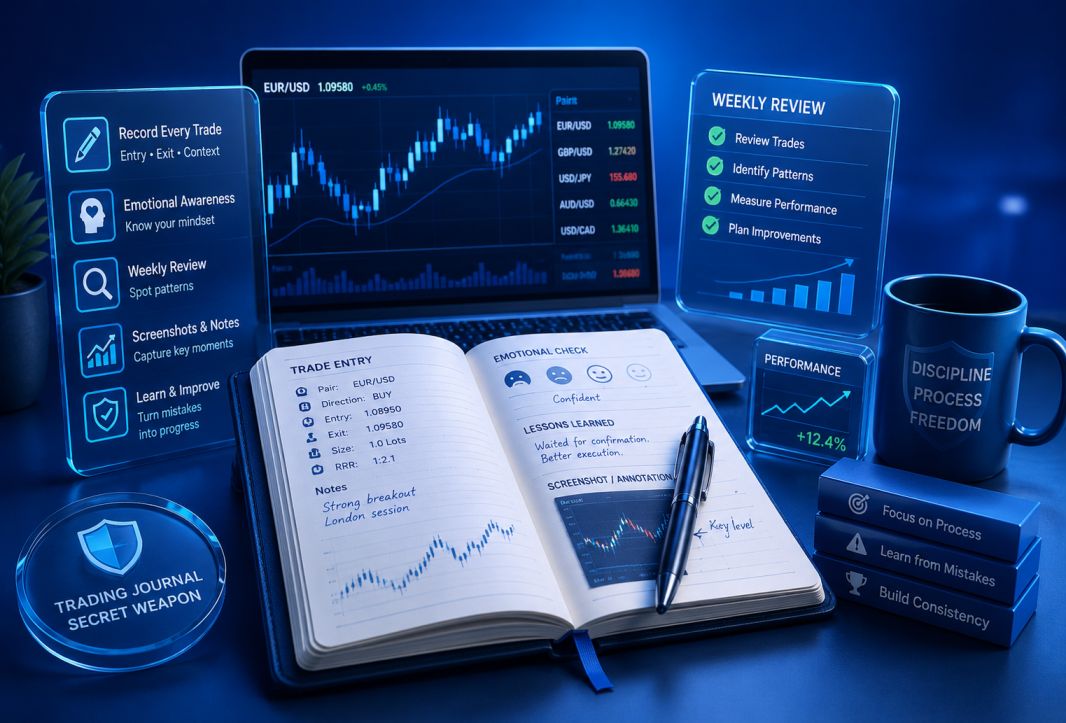
Why a Trading Journal Is Your Secret Weapon
Ask any consistently profitable trader what single habit accelerated their growth the most, and a surprising number will say: the trading journal. It sounds unglamorous. It's not an indicator or a signal service. But it is the most honest mirror your trading will ever have.
- Record not just entry/exit prices, but why you took the trade — your emotional state, the market context, and your confidence level
- Review weekly to spot recurring mistakes before they become expensive patterns
- Track your best trades as rigorously as your worst — understanding what you do right is equally important
- Use screenshots of your charts with annotations so future-you can see exactly what past-you was thinking
💡 Practical Tip
Dedicate just 10 minutes after each session to journal entries. Over 3 months, you'll have a goldmine of self-data that no external signal can replace.
Rational Decision-Making: Overcoming Cognitive Biases
Even the most emotionally controlled trader can be sabotaged by cognitive biases — those invisible mental shortcuts that warp your perception of reality. In forex trading, these biases translate directly into money lost.

The Biases That Cost Traders Most
- Confirmation bias — Only reading news or analysis that supports your existing trade idea, ignoring warning signs
- Anchoring bias — Getting fixated on an entry price you "missed" and waiting for it to return, even when market structure has changed
- Recency bias — Assuming the market will keep doing what it just did, leading to late entries and chasing trades
- Loss aversion — Holding losing trades far longer than winning ones, hoping they'll recover, causing disproportionate damage to your account
How to Counter Cognitive Bias Systematically
Experienced traders don't rely on willpower alone to fight bias — they build systems that make biased decisions harder to execute. Backtesting your strategy over hundreds of historical trades is one of the most powerful ways to objectively evaluate performance without the emotional filter of live trading.
Actively seek out the opposing argument to your trade thesis. If you're bullish on EUR/USD, spend five minutes building the bear case. If you can't counter your own argument, your conviction might be bias rather than analysis.
"The market is a device for transferring money from the impatient to the patient." — The wisdom every forex trader must internalize.
Risk Management: The Psychological Foundation of Longevity
Every experienced forex trader treats risk management not as a rule imposed from outside, but as a deeply internalized value. It is the practice that keeps you in the game long enough for your edge to play out.
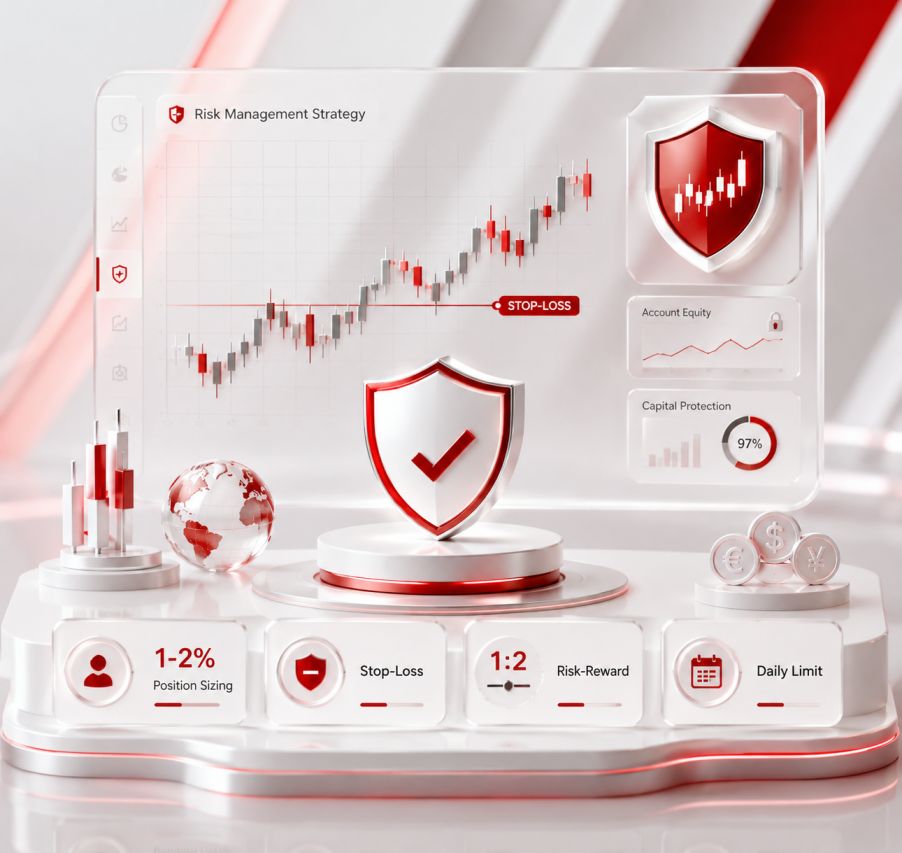
The Risk Management Toolkit
- Position sizing — Never risk more than 1–2% of your account per trade, no matter how confident you feel
- Stop-loss orders — Set them before you enter, not after, when emotions are neutral
- Risk-to-reward ratio — Minimum 1:2 on every trade means you can be wrong half the time and still be profitable
- Daily loss limits — Decide in advance the maximum you'll lose in one day; when hit, shut down the platform entirely
The psychological benefit of a strict risk management system is profound. It removes the terror from individual trade outcomes. When you know that no single trade can severely damage your account, you trade with clarity rather than desperation.
Patience and Discipline: The Forgotten Superpowers
The forex market is open 24 hours a day, five days a week. It is constantly whispering opportunities in your ear — most of them traps. The professional trader's greatest competitive advantage is knowing how to wait.
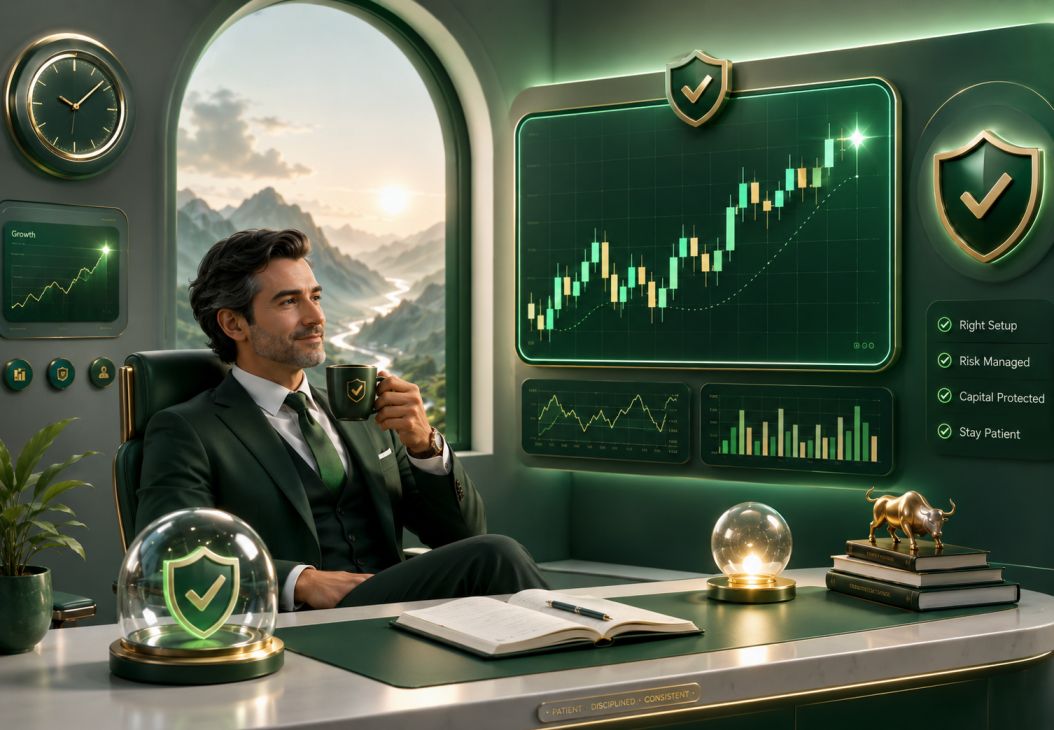
Waiting for the Right Setup
FOMO — the Fear of Missing Out — is perhaps the most expensive psychological trap in trading. Seasoned traders understand that not trading is a valid, often wise, position. When market conditions don't align with your strategy, capital preservation is the highest-value action you can take.
- Define 2–3 specific trade setups you will take, and only take those
- Treat every non-qualifying setup as a test of your patience — and celebrate passing the test
- Understand that high-probability trades often come only 2–3 times per week on daily charts
The Trading Plan as Your Anchor
A written trading plan is your psychological insurance policy. When the market moves erratically and your emotions are spiking, the plan becomes the rational voice that overrides impulse. It should include your entry criteria, exit criteria, risk parameters, and the market conditions under which you will not trade at all.
Traders who follow a documented plan consistently outperform those who "go with the feel" — not because the plan is magic, but because consistency creates the data needed to improve. You cannot optimize what you cannot measure.
✅ Quick Discipline Check — Before Every Trade, Ask:
- Does this trade match my pre-defined setup criteria exactly?
- Have I set my stop-loss before entering?
- Am I trading because of genuine analysis, or because I feel bored/anxious/excited?
- Am I comfortable losing the risk amount on this trade?
Frequently Asked Questions
Real questions from forex traders at every level — answered with clarity.
There's no fixed timeline, but most traders report meaningful psychological improvement after 6–12 months of deliberate practice — meaning intentional journaling, reflection, and applying techniques like pre-trade checklists. The key is treating your mindset as a skill to train, not a personality trait you're stuck with.
Absolutely learned. While some people are naturally more disciplined or emotionally stable, every trader can significantly improve their psychological game through awareness, journaling, and deliberate habit-building. Many of the best traders today started as highly impulsive, emotional traders who chose to change.
Revenge trading — the act of immediately re-entering a trade after a loss with larger size to "make it back." This is driven by ego and loss aversion and is one of the fastest ways to blow an account. The fix is a firm rule: after any loss exceeding your pre-set daily limit, you stop trading for the day, full stop.
Good risk management is essentially applied psychology. When you know your maximum downside before entering a trade, fear loses its grip. You can't be devastated by a loss you already priced in mentally. Position sizing and stop-losses don't just protect capital — they protect your mental state, which protects your next trade.
Completely normal — even experienced traders feel stress. The difference is they've built routines that manage it: pre-market meditation or breathing exercises, strict position sizing so no single trade feels catastrophic, and regular breaks away from screens. Many top traders also step back entirely for a day or two after significant drawdowns to reset mentally.
Conclusion: Your Mind Is Your Most Valuable Asset
In the world of forex trading, the market doesn't care about your intelligence, your technical analysis skills, or your economic degree. It cares about your decisions — and your decisions are made by your mind under pressure.
The traders who thrive long-term are those who invest as seriously in their mental development as they do in their technical skills. They manage emotions with the same discipline they apply to managing risk. They follow plans when impulse screams otherwise. They treat every loss as data and every win as a confirmation of process — not proof of genius.
Trading psychology isn't a soft addition to your strategy — it is the strategy. Master it, and everything else clicks into place. At fxTsignals.com, we believe in building complete traders — ones who are as sharp mentally as they are technically.
"Success in trading is achieved by making sound decisions based on analysis rather than emotions." — The mantra of every consistent trader.
Ready to Trade Smarter?
Join thousands of forex traders who've sharpened their edge with fxTsignals. Get professional signals, real-time analysis, and a community that trades with discipline — not emotion.