How Hedge Funds Trade Forex — Secrets Every Trader Should Know
From global macro to algorithmic execution, uncover the exact strategies the world's most powerful funds use to dominate currency markets — and what you can apply to your own trading today.

The Players That Move Markets

You've watched price spike 80 pips in two minutes and wondered: who did that? More often than not, it was a hedge fund. These are the giants of global finance — privately managed investment vehicles that pool capital from high-net-worth individuals and institutions, then deploy it across the world's financial markets with military precision.
Unlike your retail trading account, a hedge fund operates with near-unlimited flexibility. It can go long or short simultaneously, use extreme leverage, trade across dozens of currency pairs at once, and hold positions for anywhere from microseconds to years. The forex market, with its $7.5 trillion in daily volume, is the perfect playground for these sophisticated operators.
Understanding how hedge funds trade forex isn't just academic. The patterns they create, the liquidity they consume, and the trends they drive directly shape every trade you take. As a forex trader on fxTsignals.com, knowing their playbook puts you closer to being on the right side of the market — rather than becoming the liquidity they hunt.
What Exactly Is a Forex Hedge Fund?
A forex hedge fund is an investment vehicle that pools capital from multiple sophisticated investors and directs it into currency markets through the expertise of professional fund managers. The word "hedge" is telling — these funds are built to balance and offset positions, managing risk even as they pursue aggressive returns.
"The primary objective of a forex hedge fund is to generate consistent returns while simultaneously mitigating potential risk — profiting in rising markets, falling markets, and sideways chop."
What separates a hedge fund from a mutual fund is the sheer freedom of strategy. Mutual funds are largely constrained to buying assets. Hedge funds can short currencies, use complex derivatives, apply heavy leverage, and deploy algorithms that execute thousands of trades per second. This flexibility is both their greatest advantage and their greatest source of risk.
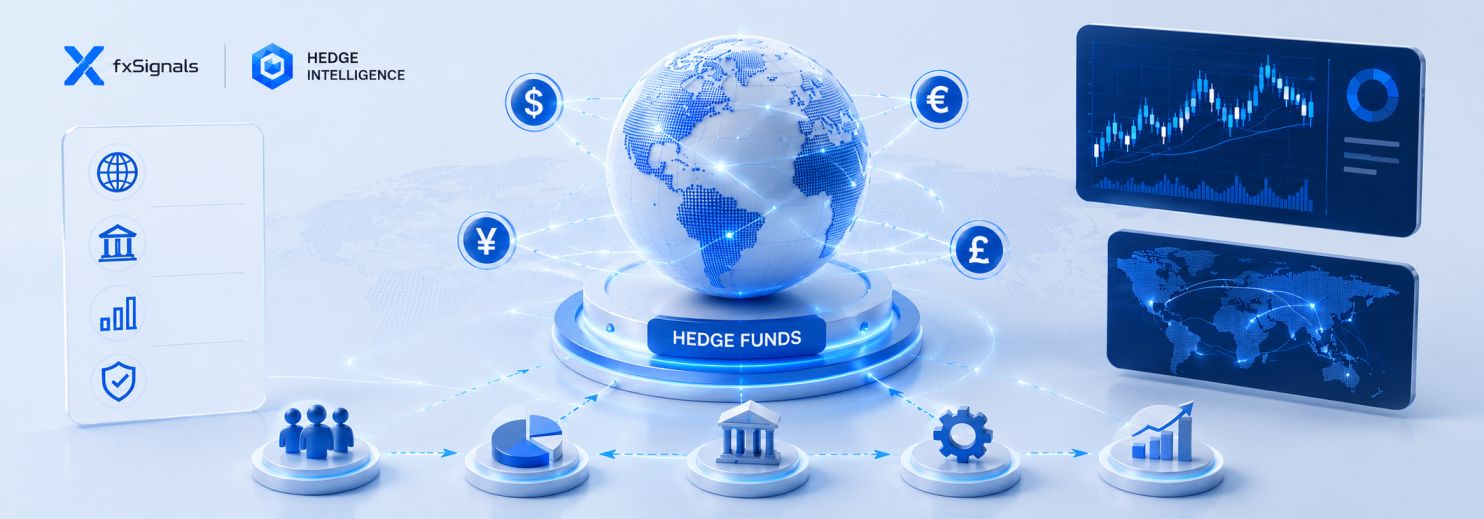
The minimum investment threshold is typically steep — often $1 million or more — which is why retail traders can't directly access these funds. But that's exactly why understanding how they operate is so valuable. Their size means they leave footprints in the market, and tracking those footprints is one of the oldest edges in professional trading.
How Hedge Funds Actually Trade Forex
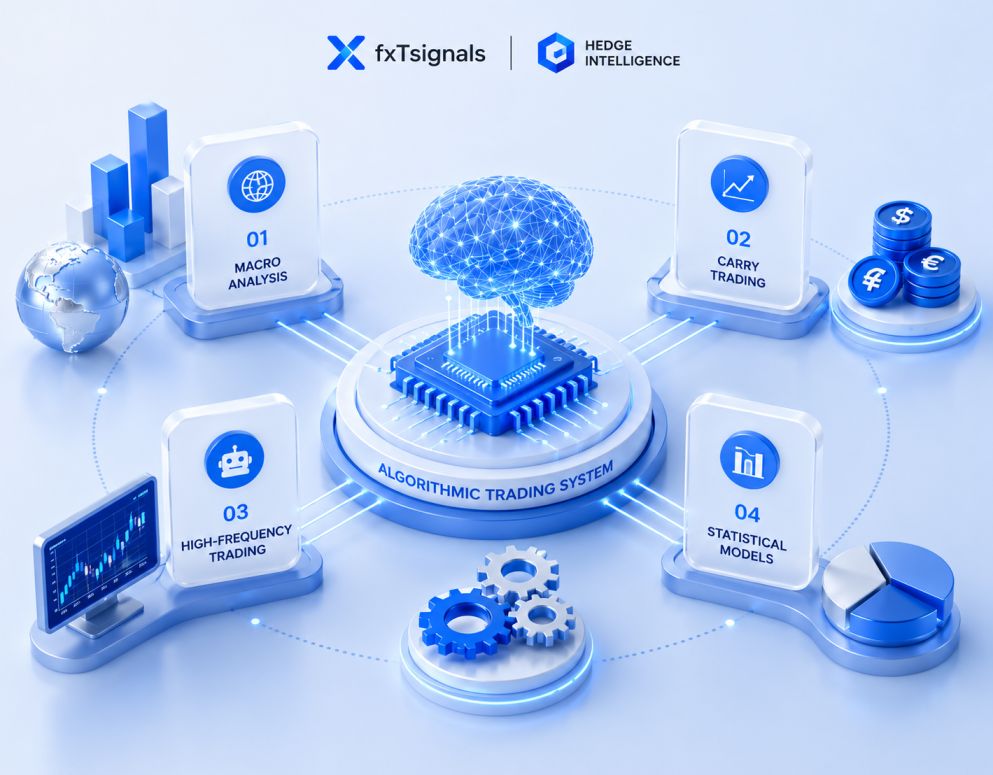
There's no single "hedge fund strategy." Different funds specialize in different approaches, and many deploy multiple strategies simultaneously. Here are the four core methods that dominate institutional forex trading.
Global Macro Trading
Fund managers analyze economic data, central bank policy, geopolitical events, and macroeconomic trends to predict which currencies will move — and by how much. Think of George Soros breaking the Bank of England in 1992. Pure top-down analysis at the highest level.
Carry Trading
Borrowing in a low-interest-rate currency (like JPY) and investing in a higher-yielding one (like AUD or NZD). The profit comes from the interest rate differential. Simple in theory, but requires mastery of timing and risk management to execute safely at scale.
High-Frequency Trading
Sophisticated algorithms fire thousands of trades per second, exploiting tiny price inefficiencies across multiple exchanges. By the time you see the candle, the HFT bot has already entered and exited dozens of positions. Speed is the entire edge here.
Statistical Arbitrage
Using mathematical models to identify mispricings between correlated currency pairs. When two normally correlated pairs diverge from their historical relationship, the fund bets on a reversion to the mean — often with very tight risk tolerance and high win rates.
The Role of Technology in Execution
Technology isn't just helpful for hedge funds — it's the foundation of everything they do. Advanced trading platforms, co-location services (placing servers physically close to exchange infrastructure for microsecond advantages), and AI-driven analytics tools are standard equipment.
Algorithmic trading, in particular, has redefined execution quality. Complex algos scan hundreds of currency pairs simultaneously, identify patterns invisible to the human eye, and execute with precision no manual trader can match. Big data analytics layers on top — processing economic releases, central bank language, and geopolitical signals in real time.
The practical takeaway for retail traders? Understanding when algorithmic flow is likely to enter the market — around major economic releases, session opens, and key technical levels — can help you time entries and exits far more effectively.
Benefits and Risks — The Honest Picture
Whether you're a retail trader trying to understand the market or an accredited investor considering allocation into a forex hedge fund, knowing both sides of the equation matters.
- Professional management by experts who live and breathe forex
- Sophisticated diversification across dozens of currency pairs
- Ability to profit in both bull and bear currency markets
- Access to institutional-grade risk management tools
- Potential for above-market returns when strategies fire correctly
- High leverage can magnify losses as fast as gains
- Market volatility from geopolitical shocks is impossible to fully hedge
- Liquidity risks in emerging market currency pairs
- Complex regulatory environments across different jurisdictions
- Performance and management fees can significantly erode returns
How to Choose a Forex Hedge Fund
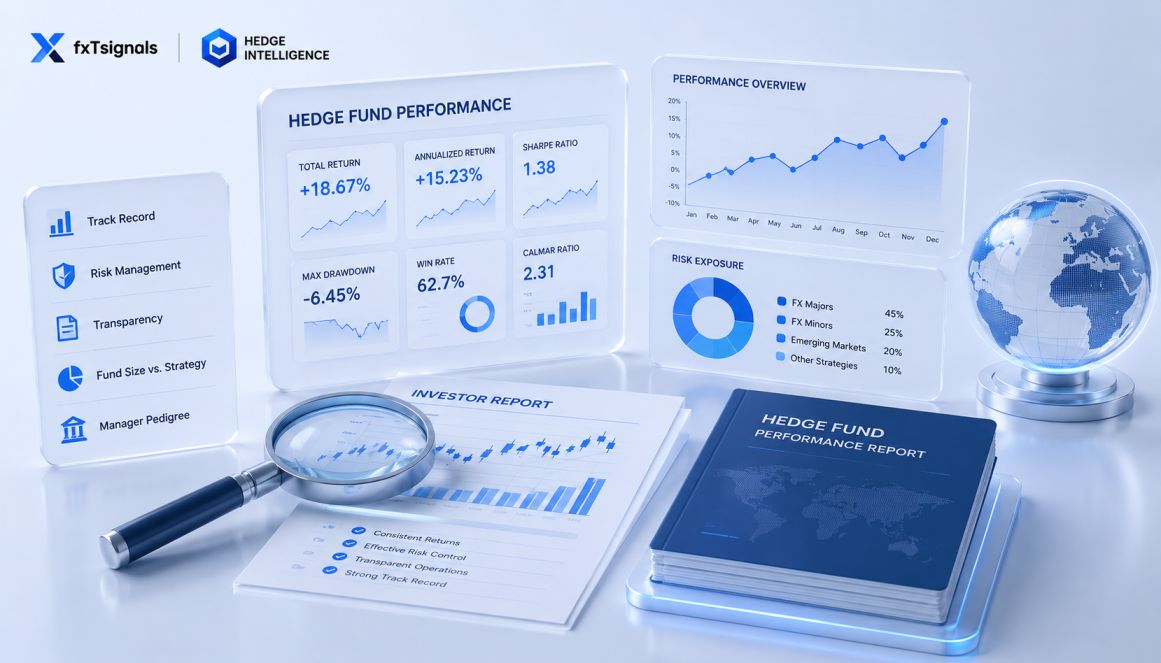
If you're exploring this as an investment option and meet the accredited investor criteria, here's what serious due diligence looks like. Don't be dazzled by headline returns — dig deeper.
- Track Record: Look for consistency across different market cycles, not just one banner year. A fund that made 80% in a bull run but drew down 60% in a crisis isn't impressive.
- Risk Management Framework: How does the fund handle drawdowns? Do they use stop-loss systems, portfolio diversification, and position sizing rules? Ask for detailed documentation.
- Transparency and Reporting: Monthly reporting, clear fee disclosure, and audited financials are non-negotiable. Opacity is a red flag at every level.
- Fund Size vs. Strategy: Smaller funds can be more nimble, particularly in carry or statistical arb strategies. Very large funds may face liquidity constraints in less-liquid pairs.
- Manager Pedigree: Where did the manager trade before? What institutions did they come from? A track record at a major bank or top-tier fund carries weight.
What Retail Traders Can Learn from Hedge Funds Right Now
You don't need a $10 billion AUM to apply hedge fund thinking to your own trading. These principles translate directly to any account size.
5 Actionable Lessons from the Pros
- Think in probabilities, not certainties. Hedge funds don't bet on being right every trade. They bet on expected value over hundreds of trades. Build your system around R:R ratios, not prediction accuracy.
- Follow the macro narrative. Even if you're a pure technician, know what the central banks are saying. Interest rate differentials drive carry flows that create sustained trends — the kind worth holding for weeks.
- Respect liquidity cycles. HFT and algorithmic activity surges around London open, New York open, and major data releases. These are when institutional flows hit. Either trade these moments or stay out of them.
- Think in correlations. Statistical arbitrage teaches you to watch how pairs move together. When EURUSD and GBPUSD diverge sharply, one is often mispriced. Understanding correlation gives you trade ideas the crowd misses.
- Control drawdown like your career depends on it. The number one difference between retail and institutional traders isn't entries — it's drawdown management. Define your maximum risk per trade, per week, per month. Hard limits are non-negotiable.
The Future of Forex Hedge Funds
The hedge fund space is evolving fast, and the next decade promises to be even more interesting. Artificial intelligence and machine learning are being integrated at every level — from signal generation to execution and portfolio risk management. Funds that deploy these technologies effectively are already pulling ahead of purely discretionary competitors.
ESG (Environmental, Social, and Governance) factors are also entering the picture. Currency flows increasingly reflect the sustainability profile of economies, and forward-thinking funds are building these factors into their macro models. Meanwhile, as retail access to forex continues to grow, the best hedge funds are adapting to shifting liquidity patterns rather than relying on the same market microstructure they exploited a decade ago.
Regulatory evolution is constant. Different jurisdictions impose different frameworks, and the most resilient funds are those that build compliance infrastructure early rather than scrambling to adapt. For retail traders, this matters because regulatory changes affect spreads, leverage limits, and the overall liquidity environment you operate in every day.
Frequently Asked Questions
Ready to Trade Smarter — Like the Institutions Do?
At fxTsignals.com, we translate institutional market intelligence into clear, actionable forex signals for traders at every level. No more guessing which way the big money is moving. Join thousands of traders who are finally on the right side of the market.
Trusted by forex traders worldwide · Real-time analysis · Professional-grade signals
The Big Picture
Hedge funds aren't mysterious black boxes. They're disciplined operators using time-tested strategies — global macro analysis, carry trades, algorithmic execution, and statistical arbitrage — backed by enormous capital and institutional-grade technology. The forex market is their arena, and understanding how they operate gives every trader an edge.
Whether you're refining your own trading strategy or considering investing in a forex hedge fund, the principles remain the same: rigorous analysis, disciplined risk management, and a deep respect for market liquidity. The traders who thrive over the long term are those who trade with the institutional flow, not against it.
Stay sharp, stay informed, and keep learning at fxTsignals.com — where professional-level forex intelligence meets everyday traders.