Imagine building a diversified investment portfolio with a single trade — no stock-picking headaches, no complex fund research, and no waiting until the end of the day to see your price. Exchange-Traded Funds (ETFs) make this a reality, and they are quietly reshaping how modern investors — including forex traders — think about building long-term wealth.
At fxTsignals.com, we believe that great trading doesn't stop at the forex chart. It extends into how you protect and grow capital across multiple asset classes. That's exactly where ETFs come in.
 ETFs offer instant diversification across global asset classes
What Exactly Is an ETF?
An ETF, or Exchange-Traded Fund, is an investment fund that trades on a stock exchange — just like a regular share. Unlike traditional mutual funds that are priced once daily after markets close, ETFs can be bought and sold throughout the entire trading session at live market prices.
Think of an ETF as a basket that holds dozens, sometimes hundreds, of individual assets — stocks, bonds, commodities, or even currencies. When you buy one ETF share, you're instantly gaining exposure to all of those assets simultaneously. It's elegant, efficient, and surprisingly powerful.
For example, the S&P 500 ETF (SPY) lets you own a tiny slice of all 500 of America's largest companies in one click. No picking winners, no guessing games.
The Five Pillars That Make ETFs Stand Out
Before we dive deeper, here are the core characteristics that set ETFs apart from every other investment vehicle on the market:
- Diversification on Demand: A single ETF can hold hundreds of assets, instantly spreading your risk across sectors, geographies, or asset classes — reducing the impact of any single investment performing poorly.
- Real-Time Liquidity: ETFs trade live on exchanges throughout the day, giving you the same flexibility as individual stocks. Need to exit a position quickly? No problem.
- Crystal-Clear Transparency: Most ETFs publish their complete holdings daily. You always know exactly what you own. No hidden surprises lurking in a fund manager's portfolio.
- Remarkably Low Costs: ETF expense ratios are a fraction of what traditional mutual funds charge. Some broad-market ETFs cost as little as 0.03% annually — that's just $3 per $10,000 invested.
- Tax Efficiency by Design: ETFs are structured in a way that typically generates fewer taxable events than mutual funds, meaning more of your gains stay with you at the end of the year.
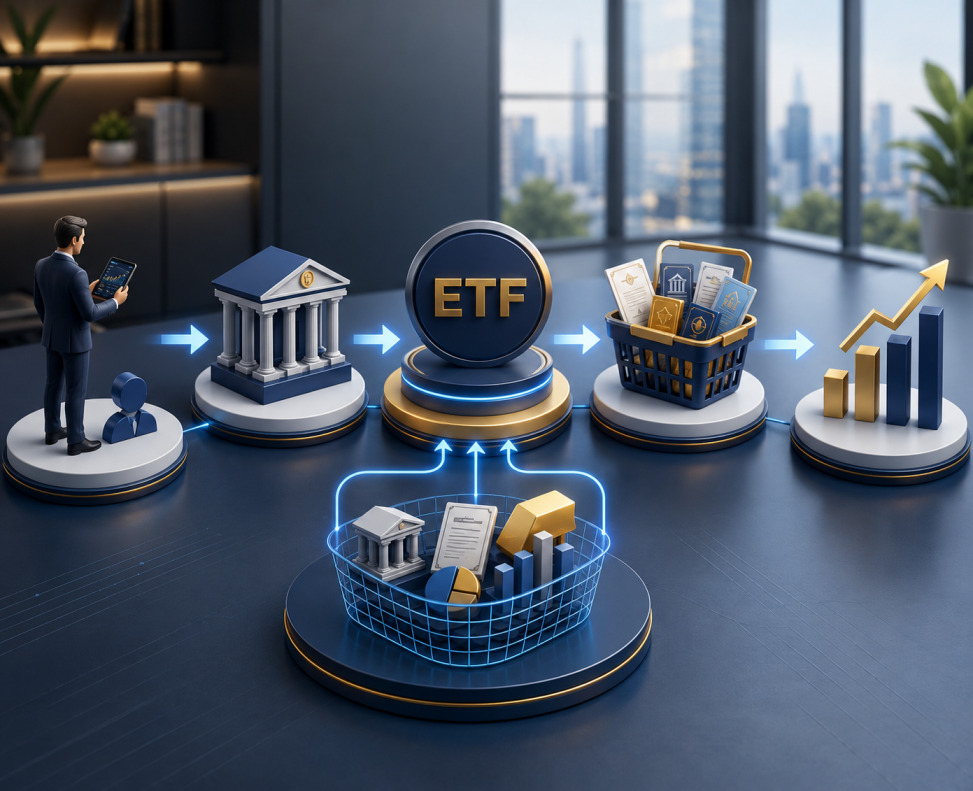 The ETF creation and redemption mechanism keeps prices fair
How Do ETFs Actually Work?
Understanding the mechanics behind ETFs gives you a real edge as an investor. Here's how the whole system functions:
Step 1 — Creation by Authorized Participants
Large financial institutions called Authorized Participants (APs) — think big banks and broker-dealers — gather the underlying assets of an ETF and deliver them to the fund issuer. In exchange, they receive newly created ETF shares. This creation process keeps the ETF price closely aligned with the actual value of its holdings.
Step 2 — Intraday Trading on Exchanges
Once ETF shares are created, they flow onto a stock exchange where any investor can buy or sell them at any moment during market hours. This is the key difference from mutual funds — you're not locked into an end-of-day price. You trade at the current live price, just like a stock.
Step 3 — Market Makers Keep It Liquid
Market makers continuously quote buy and sell prices for ETF shares, ensuring tight bid-ask spreads and abundant liquidity. For investors, this means you can generally enter and exit positions without significant price impact — even in less popular ETFs.
"ETFs are one of the most democratizing innovations in financial history — they give everyday investors the same diversification tools once reserved for institutional giants."
The ETF Universe: Which Type Is Right for You?
Not all ETFs are built the same. The market has evolved to offer specialized products for virtually every investment thesis imaginable. Here are the primary categories:
📈 Equity ETFs
These track stock indices like the S&P 500, NASDAQ-100, or regional benchmarks. Perfect for investors wanting broad market exposure without hand-picking individual companies. A single equity ETF can hold 500+ stocks simultaneously.
💼 Fixed Income ETFs
Bond ETFs provide access to government debt, corporate bonds, high-yield instruments, and more. They're a popular choice for capital preservation and income generation, especially during volatile market periods.
🥇 Commodity ETFs
Want exposure to gold, oil, silver, or agricultural products without dealing with physical delivery or futures contracts? Commodity ETFs make this straightforward. Gold ETFs, in particular, are a favourite hedge against currency inflation — something every forex trader should understand.
🏭 Sector ETFs
These concentrate on specific economic sectors — technology, healthcare, energy, financials — allowing precise portfolio tilts based on macroeconomic themes or your own market convictions.
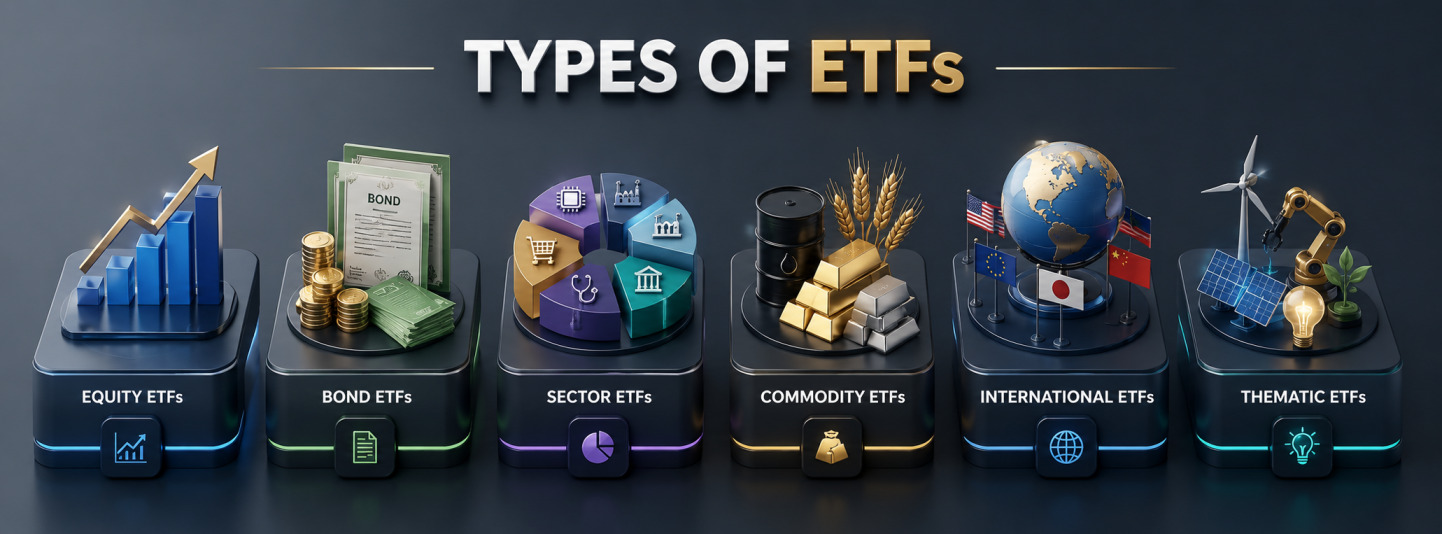 From equities to commodities — ETFs span every corner of global markets
Why Forex Traders Are Paying Attention to ETFs
As a forex trader, you're already comfortable with global markets, macroeconomic forces, and dynamic price movements. ETFs represent a natural extension of that knowledge — and they can serve several strategic purposes in a trader's broader financial life.
- Currency ETFs: Some ETFs directly track currency pairs or baskets of currencies, giving you a slow-burn, position-sized exposure to forex dynamics without the leverage risk of spot trading.
- Portfolio Hedging: Commodity ETFs — particularly gold — act as a hedge when currency markets turn volatile. Many experienced forex traders allocate a portion of their capital to gold or treasury ETFs as insurance.
- Capital Growth Between Trades: Rather than leaving idle capital sitting in cash, many traders invest it in broad-market ETFs, keeping it working while they await high-probability forex setups.
- Macro Alignment: Understanding equity sector ETF flows can give forex traders an edge. Capital rotating into US tech signals USD strength. Emerging market ETF inflows often track commodity currencies like AUD and CAD.
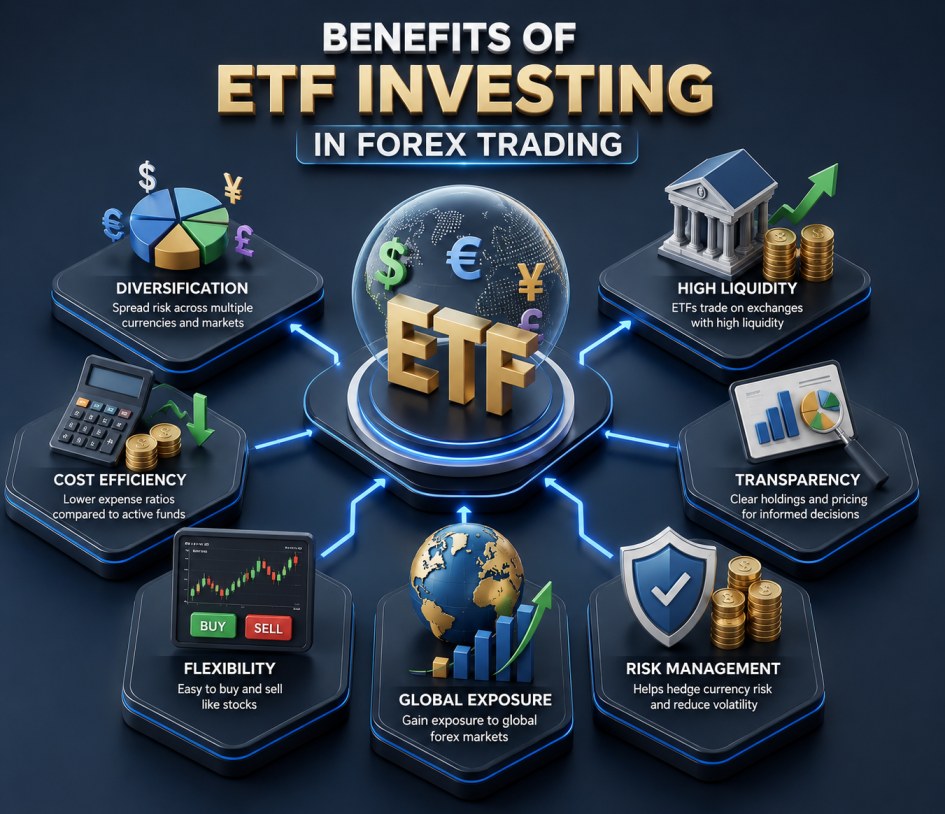 Forex traders increasingly use ETFs for capital preservation and diversification
Benefits of ETF Investing: A Practical Breakdown
1. Instant Diversification
Buying one ETF can mean owning positions in hundreds of companies across multiple industries and countries. This dramatically reduces the risk of any single stock wiping out your investment — a lesson every trader knows too well from watching individual positions go against them.
2. Unmatched Flexibility
You can execute ETF trades at 9:31 AM or 3:59 PM — whenever price conditions suit you. This flexibility aligns naturally with the active-trading mindset that forex traders already have.
3. Significant Cost Savings
Active mutual funds might charge you 1–2% annually. Many ETFs charge 10–40 times less. Over a 20-year horizon, those cost savings compound into tens of thousands of dollars on a moderately sized portfolio.
4. Transparency You Can Trust
Every day, you can see exactly what your ETF holds. In a world where financial opacity is common, this level of openness is refreshing — and critically important for making informed decisions.
Is an ETF Strategy Right for You?
Before adding ETFs to your portfolio, consider these key questions:
- What's your objective? Are you seeking broad market returns, income from bonds, commodity hedging, or sector-specific growth? Each goal points to a different ETF category.
- What's your time horizon? ETFs can serve both short-term tactical plays and decades-long wealth building strategies. Knowing your timeline shapes which ETFs you choose.
- How much risk can you absorb? Sector ETFs can be volatile. Broad-market ETFs tend to be more stable. Commodity ETFs can swing dramatically on geopolitical events — all of which sound familiar to experienced forex traders.
- Are you cost-conscious? If keeping fees low is a priority (and it always should be), ETFs are almost always the more efficient vehicle compared to actively managed funds.
Conclusion: ETFs Are a Trader's Best Friend
Exchange-Traded Funds aren't just a financial product — they're a philosophy. A belief that investing should be accessible, transparent, low-cost, and intelligent. For forex traders who already understand how global markets interconnect, ETFs represent a logical and powerful next step in building comprehensive financial wealth.
Whether you're using them to preserve idle capital, hedge currency risk with gold, or build a long-term retirement nest egg alongside your trading activities — ETFs belong in your financial toolkit. Start simple, stay informed, and let compounding do the heavy lifting.
At fxTsignals.com, we're dedicated to giving forex traders every advantage — from real-time signals to educational content like this. Your financial education is your most powerful trading edge.