XAUUSD Market Open Time: When Smart Gold Traders Strike Big
Timing your entries is half the battle in gold trading. Understand which sessions light up the XAUUSD market — and you'll stop chasing price and start anticipating it.
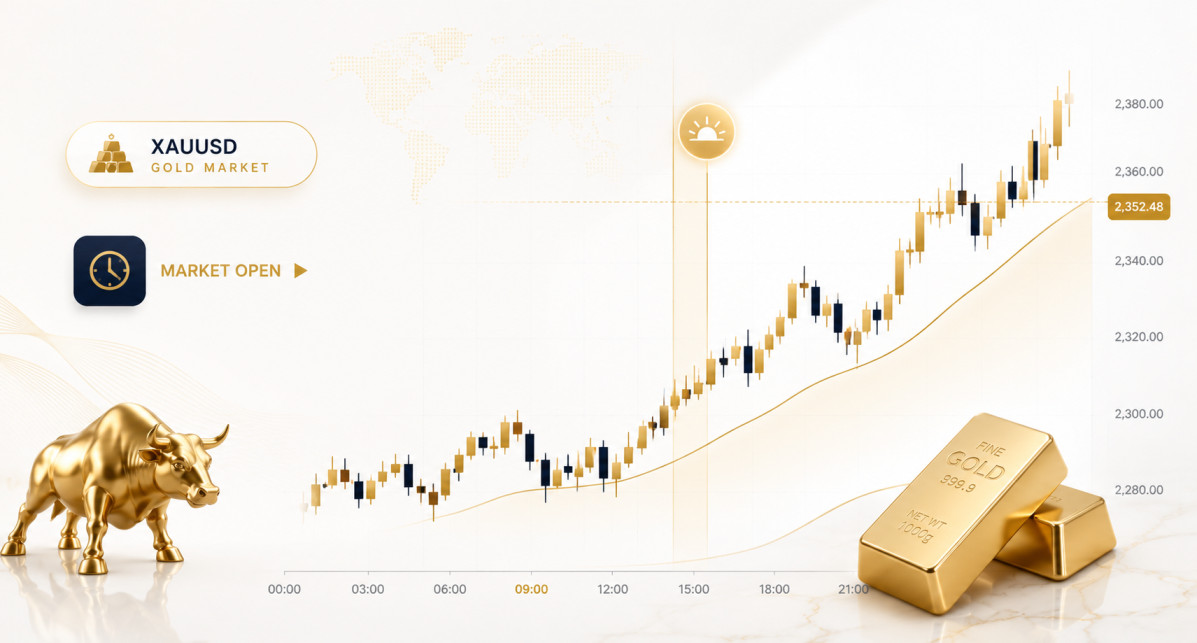
What Is the XAUUSD Market — and Why Should You Care?
XAUUSD is the trading symbol pairing gold (XAU) against the US dollar (USD). It's one of the most actively traded instruments in the entire forex ecosystem — and for good reason. Gold carries a rare combination of attributes: it's a safe-haven asset, an inflation hedge, and a speculative vehicle all rolled into one.
Unlike stocks or bonds, you don't need to physically hold a gold bar to profit from price movements. Spot contracts and futures contracts allow traders to capitalise on every tick, whether prices are rising or falling. The challenge? Knowing when to be in front of your screen.
"Gold doesn't sleep — but the market's intensity varies wildly depending on the hour. Trade at the wrong time and you're fighting a thin, sluggish market. Trade at the right time and liquidity does half the work for you."
That's exactly what this article is about. We're going to break down every major trading session, explain what drives volatility during each window, and give you practical tools to build a smarter XAUUSD routine starting today.
The Three Trading Sessions That Shape Gold Prices
The global gold market runs almost 24 hours a day, but not every hour is created equal. Three major sessions — Asian, European, and American — each bring their own flavour of volatility, liquidity, and price behaviour.
Tokyo, Hong Kong, and Singapore lead this session. Volatility is relatively low, price ranges are tighter, and volumes are modest. However, surprise data from China — the world's largest gold consumer — can jolt the market awake without warning.
Frankfurt, London, and Zurich power this window. London is the heartbeat of global gold trading — institutional desks go live, bid-ask spreads tighten, and volume surges. This is where serious price action begins most days.
New York and Chicago dominate here. COMEX futures open at 13:30 GMT, flooding the market with liquidity. Fed announcements, CPI prints, and jobs data all tend to land during this session — often producing the biggest single-candle moves of the day.
Why the London-New York Overlap Is Gold's Prime Time
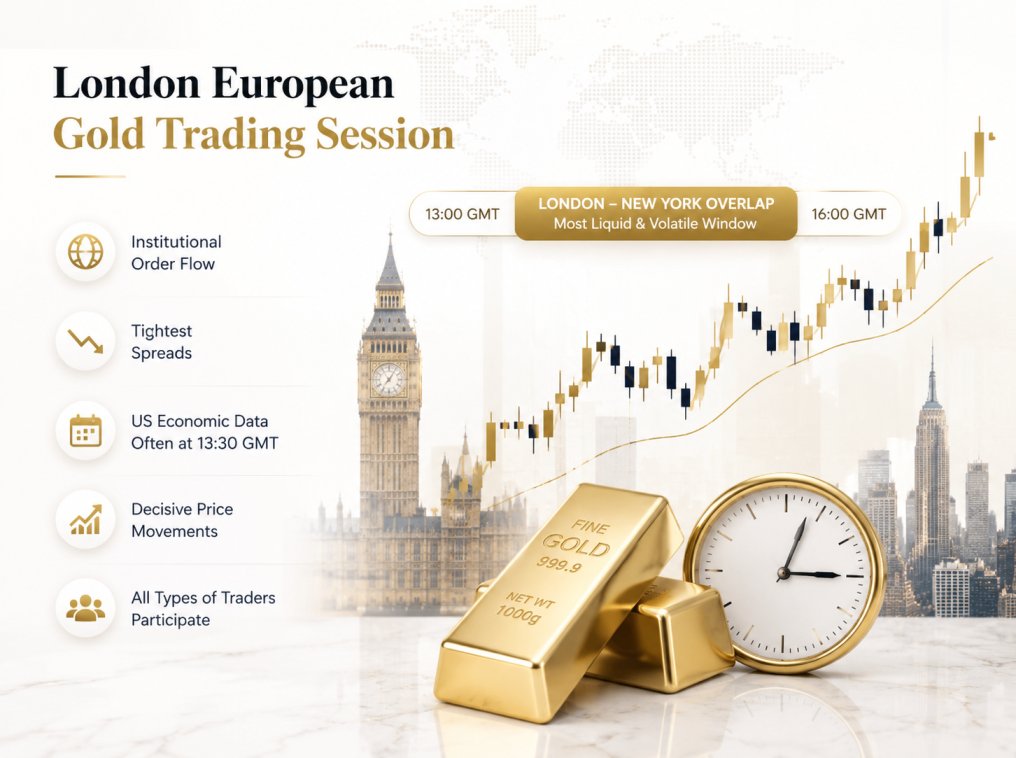
Between 13:00 and 16:00 GMT, both London and New York are simultaneously active. This two-to-three hour window is widely considered the most liquid and volatile period for XAUUSD trading each day.
- Institutional order flow from both continents collides
- Spreads are at their tightest — lower trading costs
- US economic data is released, often at 13:30 GMT
- Price movements are decisive and trend-worthy
- Scalpers, day traders, and swing traders all participate
If you can only trade for a limited time each day, this overlap window deserves the majority of your attention.

Economic News Releases: The Invisible Hand Moving Gold
No discussion of XAUUSD market open time is complete without acknowledging the explosive role of macro news. Certain calendar events can single-handedly determine whether gold makes a 20-pip drift or a 200-pip surge within minutes.
- Non-Farm Payrolls (first Friday each month)
- US Consumer Price Index (CPI) — inflation data
- Federal Reserve interest rate decisions
- Geopolitical events and central bank gold purchases
- US Dollar Index (DXY) movements — inverse correlation
Smart traders bookmark an economic calendar and check it every morning before placing a single trade. Entering XAUUSD five minutes before a major news release without a plan is not trading — it's gambling.
Reading Market Sentiment Around Open Times
Price alone won't tell you the whole story. Sentiment tools give you a second opinion — and in gold trading, a second opinion can mean the difference between a winning and a losing session.
The Fear and Greed Index measures broader risk appetite. When fear spikes, money floods into gold as a safe haven — this is especially relevant at market open when institutional desks reset their positions.
The Commitment of Traders (COT) Report reveals how commercial hedgers, large speculators, and small traders are positioned in gold futures. A large speculative long build-up near market open often precedes a short-term reversal once those longs need to be unwound.
Sentiment Checklist Before Every Session
- Check the DXY direction — gold trades inversely to the dollar
- Note if US 10-year Treasury yields are rising or falling
- Look at overnight futures price action from CME Group
- Scan for geopolitical headlines — wars, sanctions, elections
- Review the Fear & Greed Index for overall risk mood
- Check if XAUUSD is trading above or below the 200-day MA
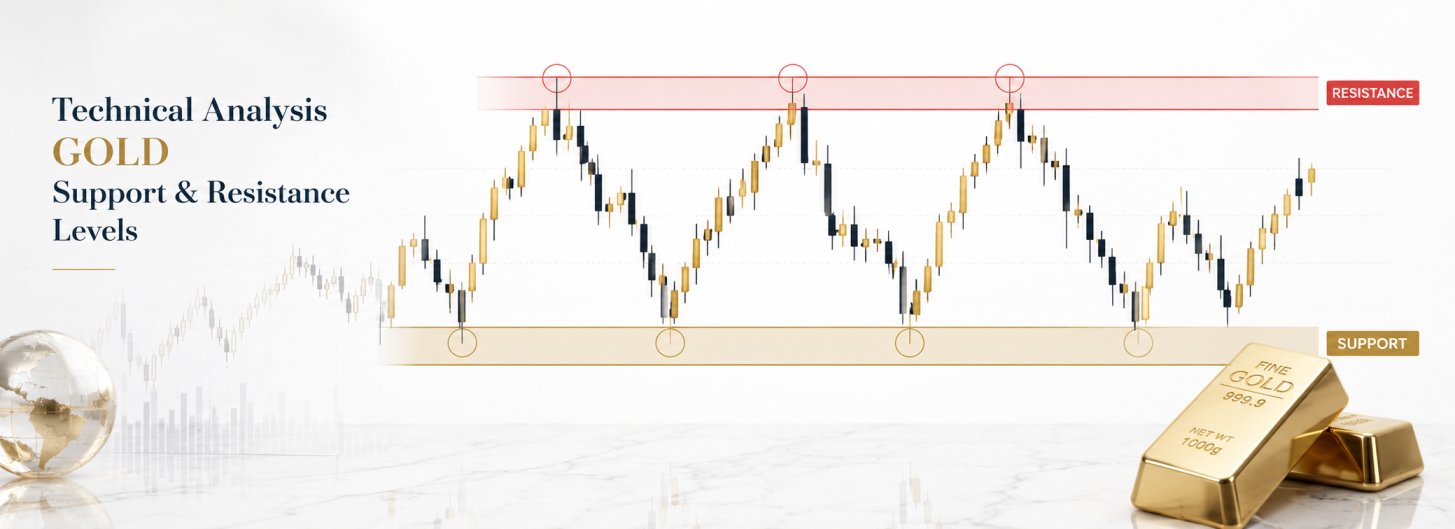
Technical Analysis: Your GPS at Market Open
Knowing when to trade is only valuable if you also know what to look for on the chart. At each market open, certain technical structures behave in predictable — and profitable — ways.
Asian Range
Mark the high and low of the Asian session. London often breaks one of these levels first — this is a classic breakout setup used by professional traders worldwide.
Session Opening Price
The London and New York opening prices often act as intraday support or resistance. Price frequently returns to test these levels before continuing its trend.
Round Numbers
Gold is unusually respectful of round numbers ($2,000, $2,100, $2,500). These psychological levels attract stop-loss clusters and trigger reactions at session opens.
Combining session timing with technical structure is what separates reactive traders from proactive ones. When you know the London session is opening into a major resistance level with bearish divergence on the 1-hour chart, you don't need to guess — you have a thesis.
Three Proven Strategies Aligned with XAUUSD Market Hours
The session you trade in should directly shape your strategy. Here's how to match your approach to the clock.
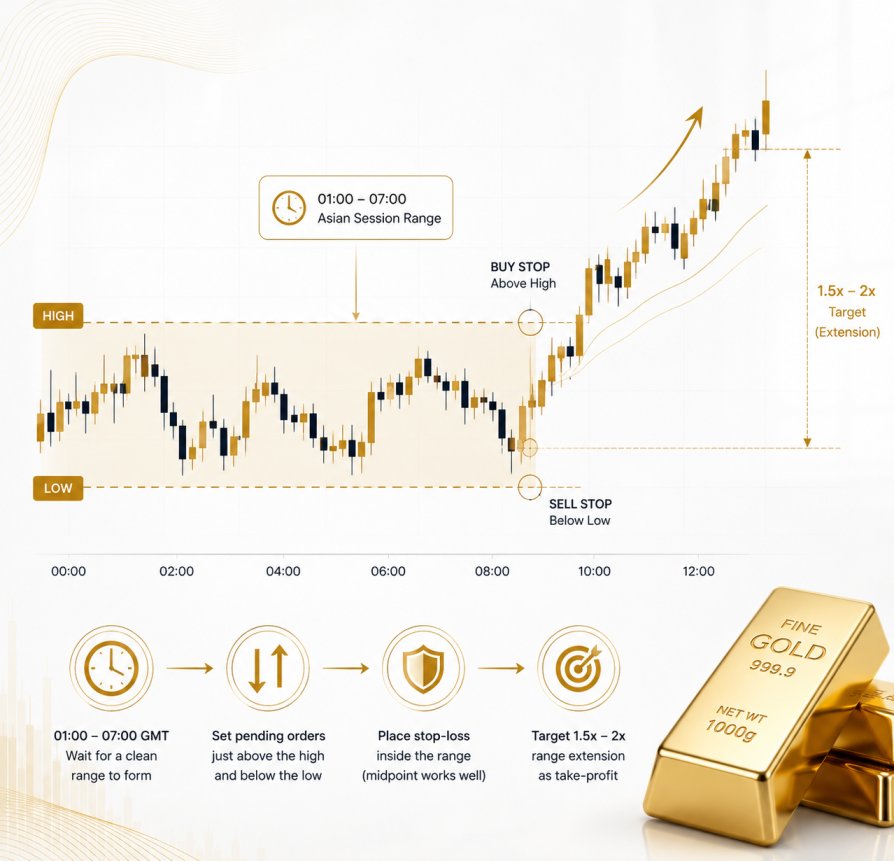
Strategy 1 — Asian Session Range Trading
During Asian hours, XAUUSD typically consolidates within a defined range. Patient traders mark the session's high and low, then wait for a breakout as London opens. This is called the "Asian Breakout" strategy, and it's one of the most consistently reliable setups in gold trading.
- Wait for a clean range to form between GMT 01:00 and 07:00
- Set pending orders just above the high and below the low
- Place stop-loss inside the range (midpoint works well)
- Target the 1.5x–2x range extension as take-profit
Strategy 2 — London Open Scalping
The first 60 minutes after the London open (07:00–08:00 GMT) are some of the most explosive in gold trading. Institutional players move the market with purpose, and momentum-based scalpers thrive in this environment.
- Use 5-minute or 15-minute charts for entry timing
- Look for a clear directional break with high volume
- Avoid trading against the early direction — the first push is usually genuine
- Keep risk tight: 15–25 pip stop-loss is appropriate for scalping gold
- Exit half the position at 1:1 reward-to-risk; trail the rest
Strategy 3 — Swing Trading Across Sessions
If you can't monitor charts all day, swing trading is your friend. Enter on the daily chart after a clean pullback to a key level — ideally timed around a session open for better fills. Hold for 2–5 days as the trend plays out.
Swing traders benefit most from the increased volatility at session opens because it tests — and often confirms — the structural levels they're trading from. A bounce off a weekly support level that occurs during London open carries far more conviction than one that happens in a dead Asian session at 03:00 GMT.
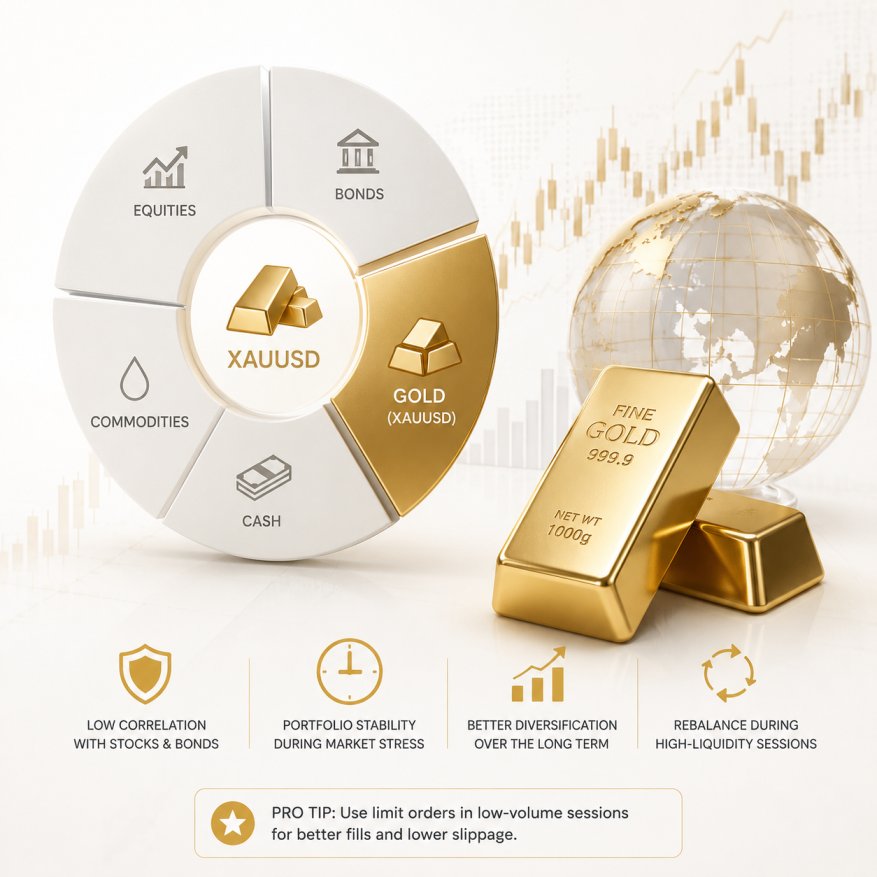
XAUUSD as a Portfolio Diversifier
Beyond active trading, many investors hold a steady allocation to XAUUSD as a long-term hedge. Gold's historically low correlation with equities and bonds makes it a powerful diversification tool — particularly during periods of stock market stress.
For these investors, market open time still matters. Portfolio rebalancing during high-liquidity sessions (especially at NY open) ensures better execution prices and lower slippage. If you're adding to a gold position, don't do it at 03:00 GMT on a Tuesday — the wide spreads will cost you.
Pro tip: Use limit orders instead of market orders when entering during low-volume sessions. You'll often get filled 5–10 pips better than market price.
Frequently Asked Questions
-
The best window is the London-New York overlap between 13:00 and 16:00 GMT. During this period, both the world's largest gold trading centres are simultaneously active, producing maximum liquidity, tighter spreads, and the most significant intraday price moves. The London open itself (07:00–08:00 GMT) is a close second, especially for breakout strategies.
-
Yes, though it requires a different approach. The Asian session is generally quieter, with tighter ranges and lower volume. However, it's ideal for range-trading strategies and for marking key levels that London will later test. Chinese economic data — particularly manufacturing PMI or gold import figures — can also trigger sharp moves during Asian hours, so it's worth monitoring the calendar even during this quieter window.
-
Gold and the US dollar have a strong inverse correlation — when the dollar strengthens, gold typically weakens, and vice versa. This relationship becomes most pronounced at the NY session open (13:30 GMT), when US economic data drops and the dollar reacts. Watching the DXY chart alongside your XAUUSD chart at the New York open gives you an additional layer of directional confirmation before entering any position.
-
Generally, no — unless you have a specific news-trading strategy with pre-defined risk parameters. The minutes before high-impact releases like NFP or CPI are often characterised by low liquidity and erratic price spikes that stop out positions unfairly. A better approach is to wait for the initial reaction to pass (5–15 minutes post-release), identify the direction the market has chosen, and enter on a pullback with clear structure on your side.
-
GMT (Greenwich Mean Time) is the universal standard for forex market sessions. All professional economic calendars, session indicators, and broker platforms reference GMT as the baseline. Whether you're trading from Doha, London, or New York, converting session times to GMT first and then to your local time zone is the most reliable and least confusing approach. Note that daylight saving changes in the US and Europe can shift some session times by one hour.
Conclusion: Time Your Trades, Trade Your Edge
The XAUUSD market is open almost around the clock, but that doesn't mean every hour deserves your capital. The traders who consistently profit from gold aren't necessarily smarter — they're simply more disciplined about when they show up.
To recap: the Asian session offers range-trading setups in quieter conditions. The European session — particularly London — is where institutional momentum begins. And the American session, especially the NY open and its overlap with London, is where the biggest moves happen and where your sharpest trading should take place.
Layer your session awareness with an economic calendar, sentiment tools, and solid technical analysis — and you'll have a complete framework for navigating the world's most traded precious metal with confidence and precision.
Get real-time XAUUSD signals, session alerts, and actionable trade setups delivered directly to you. Join thousands of forex traders who trust FxTsignals to keep them on the right side of the market.
Explore fxTsignals Signals →