The single most important rule is to limit your risk per trade to 1–2% of your total account balance. This one rule, applied consistently, prevents any single losing trade or losing streak from destroying your account. Combined with a positive risk-to-reward ratio, it creates the mathematical foundation for long-term profitability.
fxTsignals.com · Forex Education
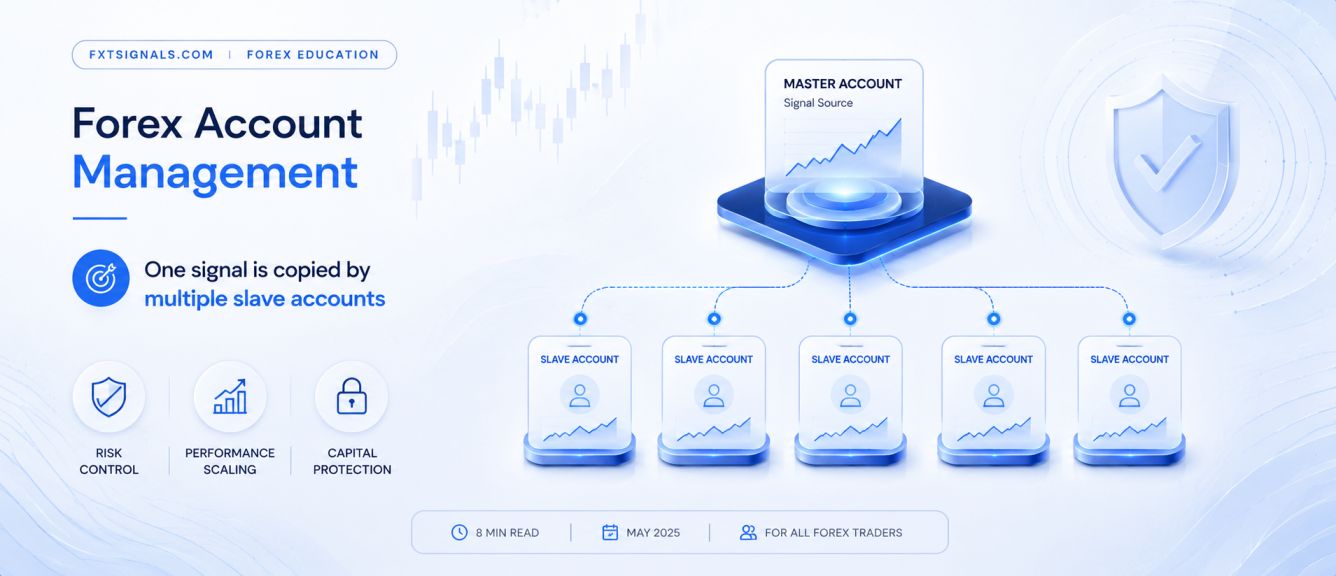
Forex Account Management: The Art & Science of Growing Your Trading Capital
$7.5T
Daily Forex Market Volume
70%
Traders Fail Due to Poor Money Management
2:1
Minimum Risk-Reward Ratio Recommended
1–2%
Max Risk Per Trade for Sustainable Growth
Let's be completely honest — most traders spend more time hunting the perfect entry signal than they do managing their account. That's backwards. The traders who consistently succeed in the forex market aren't always the best analysts. They're the best managers. Forex account management is the backbone of every long, profitable trading career, and yet it's the piece of the puzzle that gets the least attention.
Whether you're just opening your first live account or you've been navigating currency pairs for years, this guide will give you the actionable foundation to protect your capital, manage risk intelligently, and grow your trading equity over time — the right way.
What Is Forex Account Management — and Why Does It Matter?
Forex account management is the practice of making deliberate, structured decisions about how you allocate your trading capital, how much risk you take on each trade, and how you measure your overall performance. It's not just about placing trades — it's about running your trading activity like a business.
Think of it this way: a casino doesn't win every hand, but it has a mathematical edge and a strict set of rules that guarantee it wins over time. Successful forex traders operate the same way. They put process above prediction and discipline above emotion.
Without a solid account management framework, even the most accurate trading strategy will eventually blow up an account. With one, even a strategy with a 50% win rate can be highly profitable.

Capital Preservation: The First Law of Forex Trading

Your Capital Is Your Business Asset
Before chasing returns, your first obligation is to protect what you have. Capital preservation means keeping enough equity in your account to stay in the game — even when the market goes against you for a stretch. And it will. Drawdown periods are a normal part of trading, and a well-managed account survives them where others don't.
Here's the brutal math traders often ignore: if you lose 50% of your account, you need a 100% return just to break even. Lose 20%, and you need a 25% return. The relationship is non-linear — which makes protecting your downside critically more important than maximising your upside.
"A forex trader's primary job is not to make money. It is to not lose money. The profits follow naturally from that foundation."
Risk Management: The Engine Behind Every Successful Forex Account
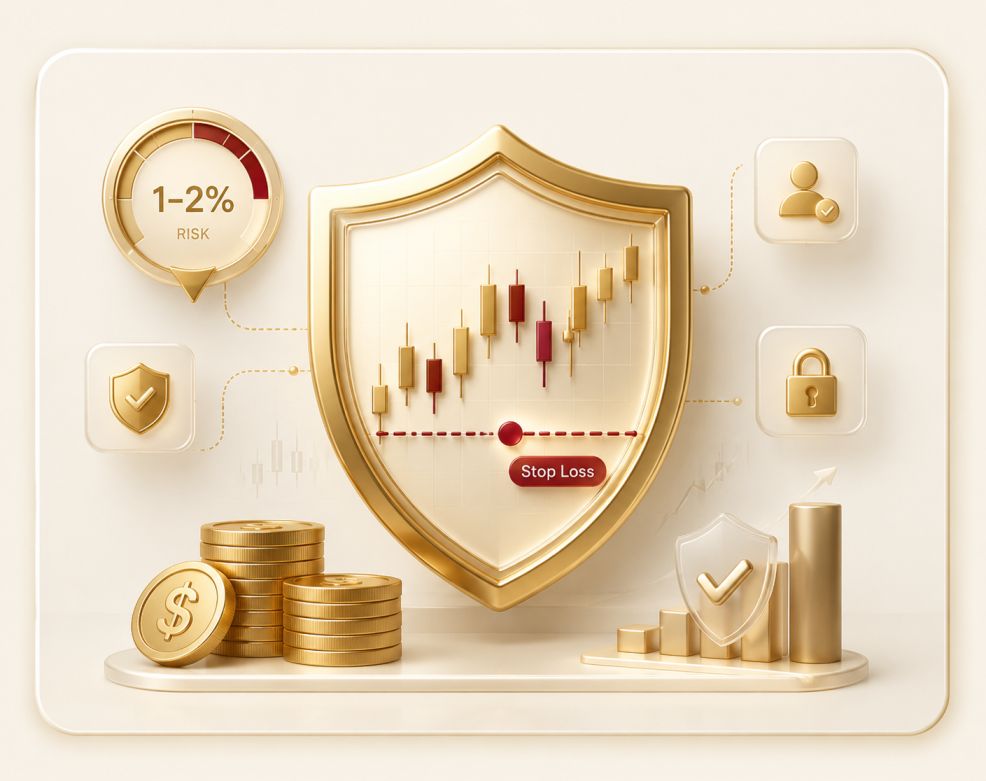
The 1–2% Rule
One of the most widely accepted rules in forex account management is to never risk more than 1–2% of your total account on a single trade. On a $10,000 account, that's $100–$200 per trade. It sounds conservative — and it is. That's the point.
This single rule can prevent a losing streak from wiping out your account. With 2% risk per trade, you'd need to lose 50 consecutive trades to lose your account. With 10% risk per trade, five bad trades can cut your capital in half. The math is unforgiving.
Stop-Loss Orders: Your Safety Net
A stop-loss order is your most important tool. It closes your position automatically when the market moves against you by a defined amount — before the loss becomes catastrophic. Never enter a trade without one. Place it at a technically significant level (below support for longs, above resistance for shorts), not an arbitrary dollar amount.
- Set stop-loss before entering the trade, not after
- Calculate your position size based on where your stop is — not the other way around
- Trail your stop-loss as the trade moves in your favour to lock in profits
- Never widen a stop-loss mid-trade to avoid being stopped out — that's how small losses become large ones
- Use a hard stop in your platform, not just a mental note
Position Sizing: The Skill Most Traders Skip
How to Calculate Your Position Size
Position sizing connects your risk tolerance to the size of each trade. Here's a simple formula: divide the dollar amount you're willing to risk by the distance to your stop-loss in pips (multiplied by the pip value). This ensures every trade respects your 1–2% rule regardless of which currency pair you're trading or how volatile the market is that day.
For example, if your account is $10,000, you're willing to risk 1% ($100), and your stop-loss is 50 pips away on EUR/USD where the pip value is $1 per mini lot, then your position size is 2 mini lots. Clean, logical, consistent.
Avoid Overleveraging
Leverage is a double-edged sword. While it amplifies gains, it equally amplifies losses. Beginners especially fall into the trap of using maximum leverage — turning small accounts into rollercoasters. Keep leverage moderate, and let compounding do the heavy lifting over time.
Adjusting for Volatility
During high-volatility news events (NFP, rate decisions, CPI), spreads widen and stop-losses are more easily triggered. Consider reducing position sizes or standing aside entirely during major announcements until price action settles.
Diversify, Plan, and Define Your Objectives
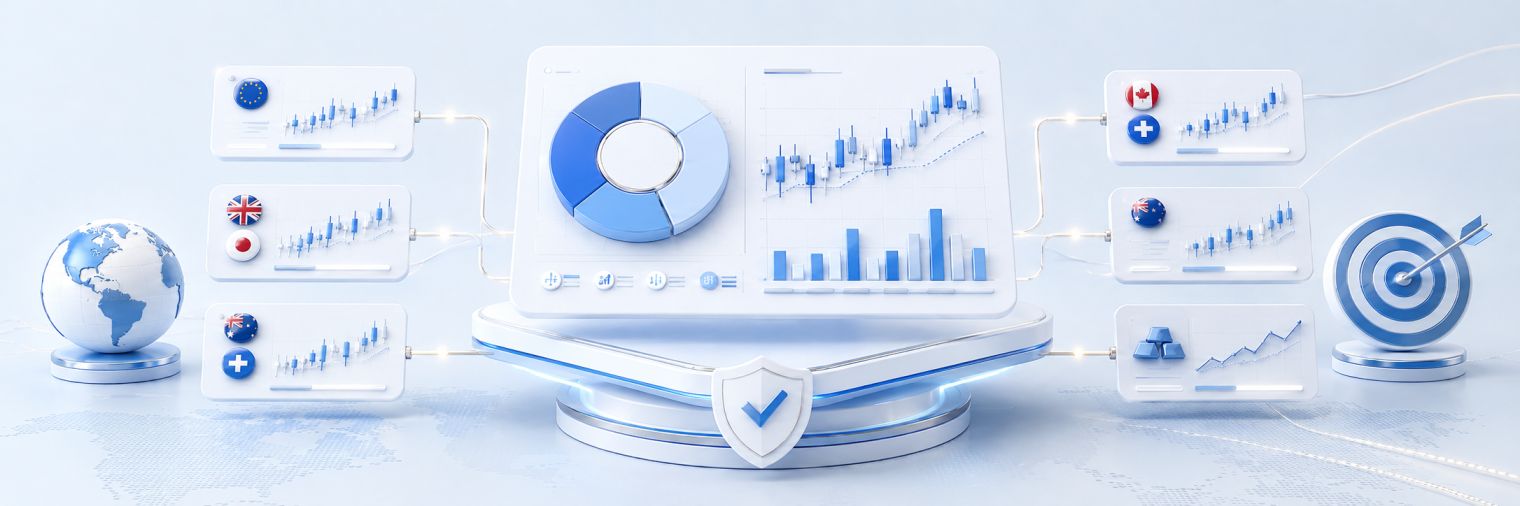
Define Your Trading Objectives First
Before you place a single trade, ask yourself: what am I actually trying to accomplish? Are you looking to build a second income stream over the next two years? Replace your salary in five? Grow a retirement nest egg slowly and safely? Your answer changes everything — your time frame, your strategy, your acceptable drawdown, and your position sizing approach.
Vague goals produce vague results. Set specific, measurable targets: "I want to grow my $5,000 account by 15% annually with a maximum drawdown of 10%." That's a plan. That's something you can manage to.
Diversify Your Exposure
Don't put all your trades into a single currency pair or a single strategy. Different pairs have different volatility profiles and different correlations to global events. EUR/USD behaves differently from USD/JPY or GBP/USD. Trading correlated pairs in the same direction effectively multiplies your risk — which defeats the purpose of position sizing.
- Trade a mix of major, minor, and occasionally exotic pairs based on opportunity
- Avoid having five open trades all shorting USD at the same time — that's one concentrated bet
- Use different strategy types (trend-following, mean reversion, breakout) to reduce drawdown correlation
- Keep your total open risk across all positions within your overall drawdown tolerance
Continuously Monitor, Analyse, and Adapt
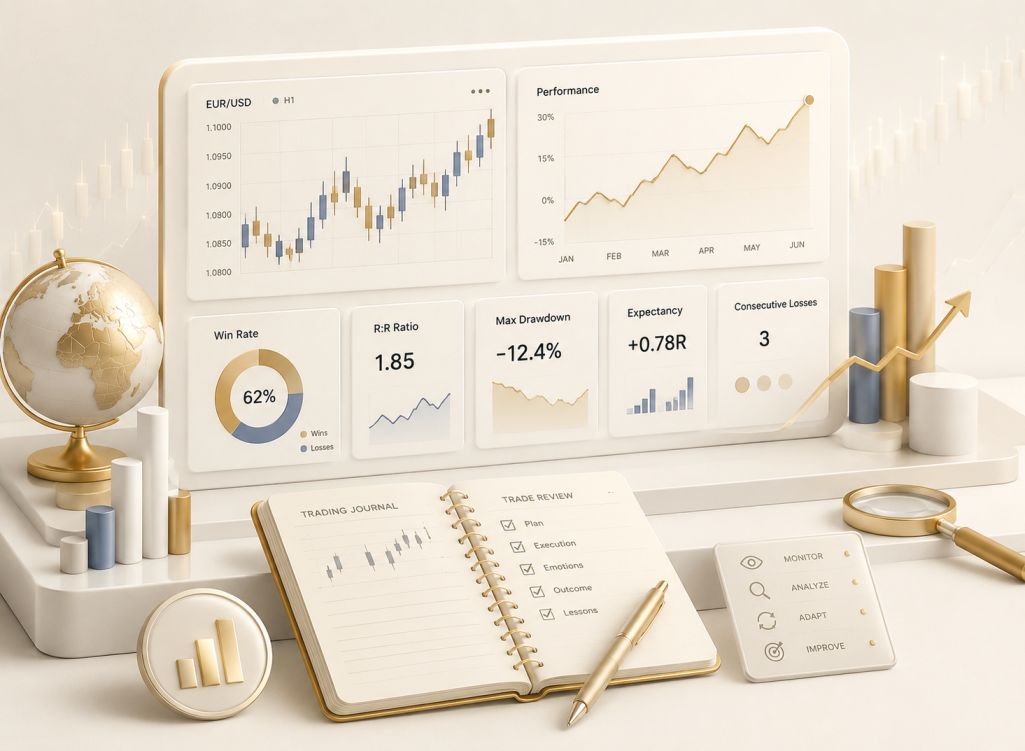
Successful forex account management isn't a set-and-forget process. Markets evolve. Volatility regimes shift. Your edge today might not be your edge a year from now. The traders who survive and thrive are those who treat their trading like a professional endeavour — reviewing results, identifying weaknesses, and adapting intelligently.
Keep a Detailed Trading Journal
Log every trade: entry, exit, setup type, reason for entry, emotional state, and outcome. Over time, patterns emerge. You'll discover which setups are actually profitable, which ones you're forcing, and how your psychology is impacting results. Many traders are surprised to find that their losing trades come disproportionately from a specific market session or a specific currency pair — data they'd never have without journaling.
Review Key Performance Metrics
- Win rate — How often you're right (doesn't need to be above 50% if your R:R is strong)
- Average R:R ratio — What you make on wins vs what you lose on losses
- Maximum drawdown — The deepest equity dip; tells you how a bad streak affects you
- Expectancy — The average profit per trade, combining win rate and R:R
- Consecutive losses — Understand your psychological and financial breaking point
Building for Long-Term Growth: Compounding Is Your Greatest Ally
Here's the truth no one talks about enough: you don't need big wins to grow a trading account. You need consistent, disciplined small wins compounded over time. A 2% monthly return on a $10,000 account doesn't sound exciting — but over five years, that's an account worth over $32,000 without adding a single extra dollar. Add contributions and the effect multiplies.
The traders who become wealthy from forex aren't the ones hitting 50% months. They're the ones hitting 3–5% months consistently, year after year, without blowing up. Consistency beats intensity every time in this market.
"Forex account management is not glamorous — but it is the difference between a trader who burns through three accounts in a year and one who is still profitably trading a decade later."
Frequently Asked Questions
Everything forex traders commonly ask about account management, answered clearly.
A trading strategy tells you when and where to trade. Account management tells you how much to risk, how to size positions, when to stop trading after losses, and how to measure performance. You can have an excellent strategy and still lose all your money through poor account management. Both are essential — but account management is the foundation everything else is built on.
Self-management gives you full transparency and control, which is ideal for learning. Professional managed accounts (via regulated fund managers or MAM/PAMM accounts) can work well for passive investors who want exposure to forex without trading themselves. If you choose a managed service, only work with fully regulated providers and always verify their track record independently. Never hand over funds to unregulated "signals + management" operations.
Professional fund managers typically target a maximum drawdown of 10–20%. For retail traders, a 20% drawdown should prompt serious review of your strategy and risk settings. A drawdown above 30–40% is a warning sign that risk management has broken down. Define your own maximum drawdown threshold before trading — and stick to it, which may mean stepping away and reassessing when hit.
To a degree, yes. Excellent money management can stretch a mediocre strategy and prevent it from causing catastrophic losses. However, it cannot manufacture profits from a strategy with a negative edge. The ideal is both: a genuine trading edge combined with disciplined account management. Think of account management as the engine efficiency, and the strategy as the fuel quality — you need both to drive far.
Conclusion: Manage the Account, Not Just the Trade
Forex trading is one of the most accessible financial markets in the world — but accessible doesn't mean easy. The traders who last are the ones who treat account management as their craft, not an afterthought. Defining clear objectives, respecting your risk tolerance, sizing positions correctly, using stop-losses without exception, diversifying exposure, and reviewing performance honestly — these are the habits of professionals.
The exciting part? These are learnable skills. You don't need to be born with a trading gene. You need discipline, a documented process, and the patience to let the math work in your favour over time. Start applying these principles to your trading today, and you'll find that long-term growth becomes less of a hope and more of an expected outcome.
Ready to Trade Smarter with Better Account Management?
Join thousands of traders at fxTsignals.com who combine professional-grade signals with disciplined account management for consistent, long-term results.
Explore Copy Trading →