The Professional Forex Trader's
Daily Routine:
Habits That Separate
Winners from the Rest
Discover the exact morning rituals, trading frameworks, mindset disciplines, and evening habits that elite forex traders use every single day — so you can model them, refine them, and make them your own.
Why Your Daily Routine Is Your Most Powerful Trading Tool
Here's a truth most traders learn the hard way: strategy alone does not make you profitable. You can have the most beautifully backtested system in the world, and still blow your account in six months — simply because your daily habits are working against you.
Professional forex traders understand this deeply. What separates a consistently profitable trader from someone stuck in a cycle of wins and losses isn't always superior knowledge of technical analysis. It's discipline. It's preparation. It's a repeatable forex trading routine that removes guesswork, reduces emotional decisions, and keeps performance steady even when the market throws curveballs.
"Give me six hours to chop down a tree and I will spend the first four sharpening the axe." — In trading, that preparation IS your edge.
This guide walks you through a full professional forex trader's daily routine — from the moment you wake up to the moment you close your laptop. By the end, you'll have a complete framework you can adapt and own.

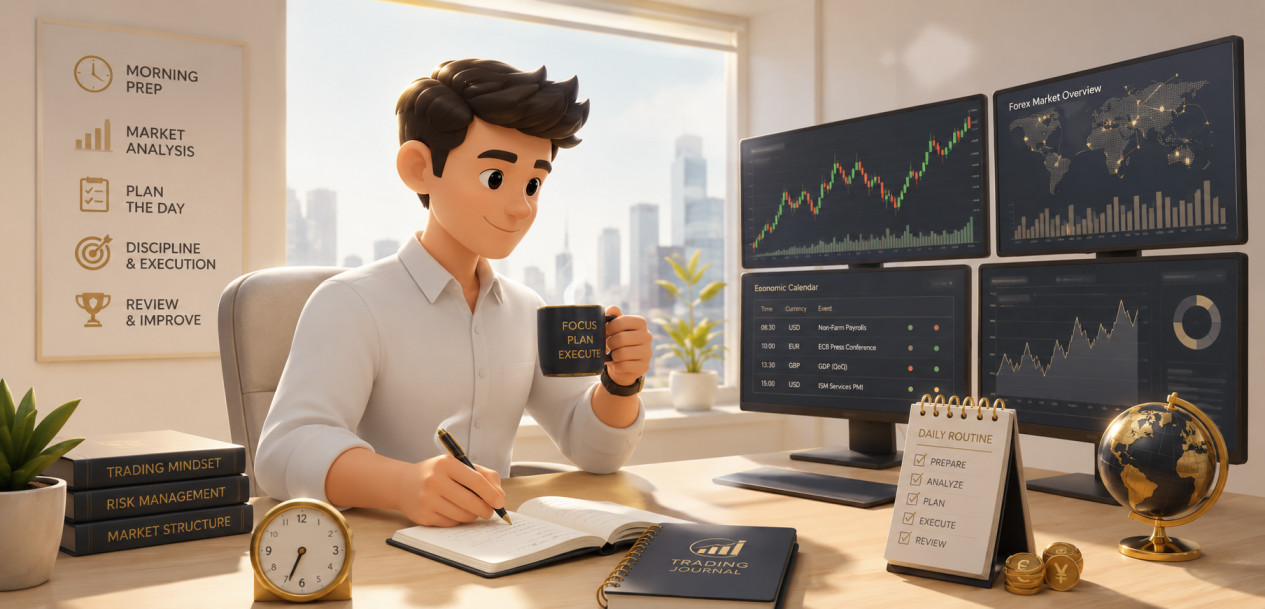
The Morning Routine: Setting the Stage for a Winning Day
Elite traders don't roll out of bed and immediately open MetaTrader. They treat their mornings the same way an athlete treats warm-up — it's non-negotiable, structured, and purposeful.
🌅 Start With Intention, Not a Screen
The first 15–30 minutes of a professional's morning have nothing to do with currency pairs. Many successful traders incorporate light exercise, a few minutes of mindfulness or journaling, and a decent breakfast into their pre-market routine. Why? Because the forex market is a psychological battlefield, and you need your mind sharp before you step in.
This isn't "wellness fluff." Cortisol levels, decision fatigue, and emotional regulation all affect trading performance in measurable ways. The professionals know this. A calm, focused mind makes rational trading decisions. A reactive, tired mind chases the market.
📰 Morning Market Briefing
Before placing a single trade, pros spend 30–45 minutes reviewing what happened overnight. This includes:
- Checking the economic calendar for high-impact news events (NFP, CPI, central bank decisions)
- Reviewing overnight price action on major pairs (EUR/USD, GBP/USD, USD/JPY)
- Noting any geopolitical developments that could move the market
- Updating key support and resistance levels from yesterday's close
- Reading a brief market summary from a trusted forex news source
This morning analysis is not about predicting the market. It's about understanding the context you're trading in — so you're not blindsided by a 2% EUR/USD spike at 8:30 AM because you didn't know the ECB was speaking.
Risk Management Before the Bell
Every professional forex trader reviews their risk parameters each morning. This means confirming position sizes for any trades they plan to take, checking open positions from the previous day, and ensuring stop-loss levels are properly set. Think of it as putting on your seatbelt — boring, automatic, and absolutely essential.
The Trading Session: How Pros Actually Execute

Once the morning prep is done, it's time for action — but controlled action. Professional forex traders don't sit in front of charts for 12 hours refreshing candlesticks. They operate with surgical precision during specific market windows.
🖥️ The Trading Environment
Your workspace is your cockpit. Top traders are meticulous about their setup: a clean desk with minimal distractions, multiple monitors (or a well-organized single screen), reliable internet, and a dedicated trading account separate from personal finances. Notifications from social media? Off. Phone calls? Silent. News websites that haven't been vetted? Closed.
Small environmental tweaks like this reduce cognitive load — and in a market where milliseconds and mental bandwidth matter, that's a real performance edge.
📊 Chart Analysis: Structure Before Signal
Professional forex traders never fire off trades based on a gut feeling. They follow a structured analysis process — typically top-down: starting with the weekly chart to identify the long-term trend, moving to the daily for market structure, then drilling into the 4H or 1H chart to look for entries. Only when all three timeframes align does a trade become a high-probability setup.
Moving averages (20, 50, 200 EMA), Fibonacci retracement levels, Bollinger Bands, RSI for confirmation, and volume analysis — used in combination, never in isolation.
Professional traders understand that not trading IS a position. On days with no clean setups, they simply don't trade. Protecting capital on slow days is how they protect profits on active ones.
⚖️ Adapting Strategy to Market Conditions
A professional doesn't use one rigid system in every market environment. In trending markets, they ride momentum with trailing stops. In range-bound conditions, they fade extremes with tighter targets. During high-volatility events, they often step back entirely and wait for clarity.
This adaptability is what separates a solid forex trading routine from a robotic, rule-following machine that eventually blows up. The market changes. Your approach needs to change with it.
During the London–New York overlap (typically 8 AM – 12 PM EST), liquidity is highest and spreads are tightest. Most professionals do the bulk of their active trading during these four hours and step away once New York activity dies down.
Emotional Discipline: The Hidden Skill
Even the best technical setup can be sabotaged by a poor emotional state. Professional traders are ruthless about emotional hygiene during the session. If they hit their daily loss limit — they stop. Full stop. No revenge trades. No "just one more." The plan was set pre-market, and the plan is followed.
The Mid-Day Break: Why the Best Traders Step Away

Most amateur traders treat lunch as something that happens while staring at charts. That's a mistake. By mid-day, mental fatigue accumulates — and fatigued minds make poor risk decisions. Professional traders build a deliberate break into their forex trading routine.
This 30–60 minute window away from the screen serves several purposes. It gives the nervous system time to reset. It allows the market to "breathe" during the slower midday lull. And it creates space for an honest performance review of the morning session.
🔍 The Mid-Day Review Checklist
- Were my executed trades aligned with my pre-market analysis?
- Did I follow position sizing rules, or did I increase size after a loss?
- Were there moments where I hesitated on a clean setup? Why?
- Is the market moving as expected, or has sentiment shifted?
- Do any open positions need their stops adjusted?
This honest self-reflection is a hallmark of the professional forex trader's daily routine. It's not about beating yourself up. It's about building self-awareness — the skill that compounds quietly in the background and quietly makes you a better trader every week.

Continuous Learning: The Compounding Edge
The forex market evolves constantly — monetary policies shift, new correlations emerge, algorithmic trading reshapes the order flow. Professional traders treat ongoing education not as a hobby, but as a professional obligation.
Top traders dedicate 20–30 minutes daily to structured learning — reviewing a book chapter, watching a trade breakdown, or analyzing a past trade with fresh eyes.
Active traders in profit consistently cite community as a key factor. Discussing setups, getting accountability, and learning from others' mistakes accelerates growth dramatically.
The learning doesn't have to be heavy or academic. Some days it's just reviewing a failed trade from last week and asking "what would I do differently?" That one question, asked consistently, is worth more than most trading courses.
The Psychology of a Professional Trader: Your Most Underrated Asset
No amount of technical knowledge will save you from yourself. This is perhaps the most uncomfortable truth in all of trading — and the most important one. Professional forex traders spend as much energy managing their psychology as they do reading charts.
The market doesn't know you exist. Losses are not personal attacks. They are data. The professional trader's job is to respond to data — not to emotions.
Fear causes premature exits. Greed causes oversizing. Frustration causes revenge trading. Each of these emotional states has a real, measurable cost in pips and account balance. The traders who thrive long-term have built systems to recognize and interrupt these states before they become expensive.
- Pre-trade checklist: Eliminates impulsive entries by forcing a structured review before clicking "buy" or "sell"
- Daily loss limit: A hard, non-negotiable rule — once hit, the trading session ends, no exceptions
- Trading journal: Written records of not just what happened, but what you felt and why you made the decision you made
- Mindfulness practice: Even 10 minutes of meditation has been shown in studies to improve impulse control and decision quality
- Social support: Talking through rough patches with other traders removes the isolating weight of losses
The Evening Routine: Preparing Tomorrow's Edge Tonight
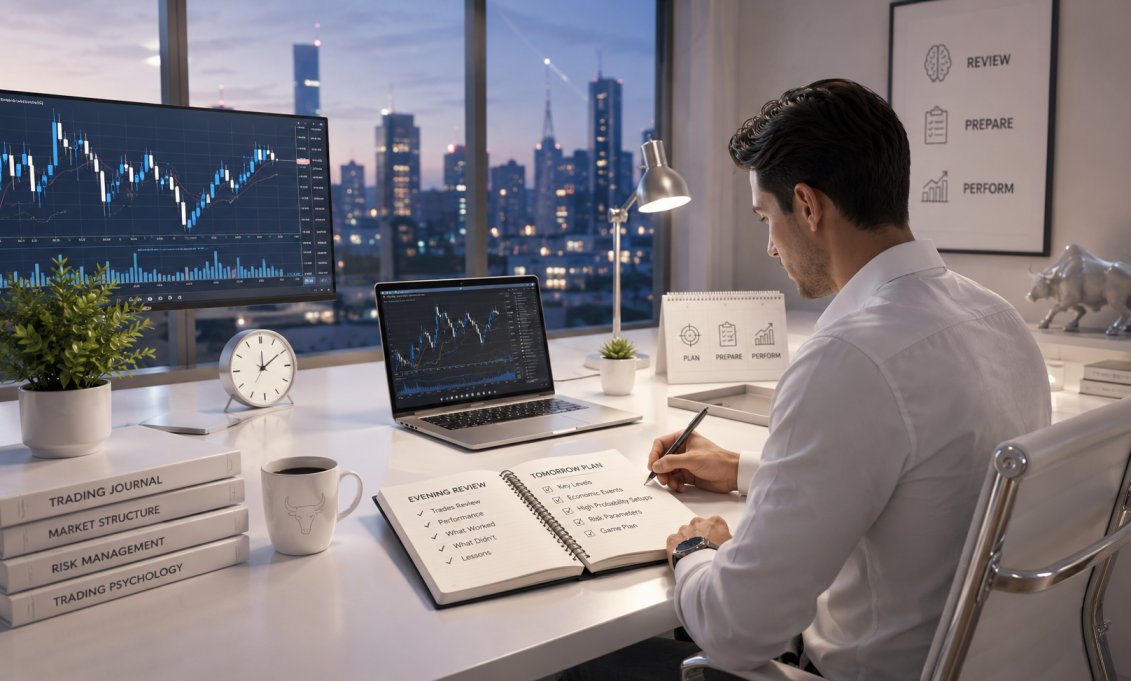
The best trading days start the evening before. After markets close, professional traders spend a focused 30–45 minutes reviewing the day and setting up for tomorrow. This is where the forex trading routine completes its loop.
📓 The Evening Journal
A trading journal is the single most underused tool in retail trading. Professional traders log every trade — entry, exit, setup reason, emotional state, and outcome. Over time, this data reveals patterns invisible in the moment: which setups perform best on Mondays, which news events consistently shake you out, which currency pairs suit your personality.
You can't improve what you don't measure. The journal is how performance compounds silently in the background, week after week.
📅 Pre-Market Setup for Tomorrow
- Mark key support/resistance levels on H4 and D1 charts for major pairs
- Note upcoming economic calendar events (especially early-morning releases)
- Identify 2–3 high-probability setups to watch — not trade, just watch
- Confirm risk parameters and account exposure are within limits
- Step away from all screens at least 90 minutes before sleep
Never set pending orders just before sleeping unless you have a fully automated risk management system in place. Markets can gap overnight during major news events — and waking up to a blown trade you couldn't manage is one of the most avoidable mistakes in a professional forex trader's daily routine.
FAQ: Professional Forex Trader's Daily Routine
Most professional forex traders actively trade for 2–4 hours during high-liquidity windows, such as the London–New York overlap. The remaining time is spent on research, journaling, learning, and preparation. Total work including prep and review typically runs 5–7 hours daily — but it's highly structured, not screen-staring marathons.
Risk management, hands down. No matter how good your analysis is, protecting your capital is what allows you to stay in the game long enough to profit consistently. Every professional forex trader's daily routine revolves around knowing their maximum acceptable loss before the day begins — and sticking to it religiously.
No — and this surprises many beginners. Professionals are highly selective. On days where there are no clean, high-probability setups, or during choppy, directionless market conditions, they simply don't trade. Sitting on your hands and protecting capital is itself a skill — and one that separates disciplined professionals from reactive amateurs.
It varies, but most traders who commit to a structured routine see measurable improvement in consistency within 3–6 months. The key is iteration: tracking your routine, reviewing what's working, and refining it over time. Joining a community like fxTsignals.com significantly accelerates this process by giving you feedback and accountability you can't get trading alone.
Absolutely. Many part-time traders adapt the framework by focusing on higher timeframes (daily and 4-hour charts), spending 20–30 minutes on morning preparation, and using pending orders with defined risk. The core principles — preparation, discipline, journaling, and emotional management — apply regardless of how many hours you have available. Start with what you can manage consistently, and scale from there.
Conclusion: Your Routine Is Your Reputation — Build It Deliberately
The market rewards preparation and punishes improvisation. A professional forex trader's daily routine isn't glamorous — it's mostly quiet discipline, careful analysis, honest self-reflection, and consistent action. But compounded over months and years, it is the single most powerful edge available to any trader.
You don't need to copy someone else's routine perfectly. What you need is your own version — tested, refined, and owned. Start with the morning briefing and journaling habits. Build in pre-trade checklists. Define your daily loss limit and respect it. Step away from screens regularly.
Do these things consistently, and you'll be living what most people only read about: the disciplined, profitable, purposeful life of a professional forex trader.
Ready to Build a Routine That Actually Works?
Join thousands of traders at fxTsignals.com who are trading smarter, more consistently, and with far less emotional stress. Get daily signals, live analysis, and a community built for serious traders.
🚀 Join fxTsignals Today