Master Your Forex Account Management:
The Complete Playbook for Consistent Profits

Let's be real: most traders don't lose money because of bad strategy — they lose because of poor forex account management. Whether you've just funded your first account or you've been navigating the markets for years, how you manage your capital, risk, and mindset is ultimately what separates consistently profitable traders from the rest.
At FxTsignals.com, we've worked with thousands of traders across every experience level. One thing is consistently clear: technical analysis alone won't save you. Real, lasting success comes from treating your forex account like a professional business — with rules, discipline, and a long-term game plan.
In this guide, you'll discover the exact principles, tools, and psychological frameworks that top-performing traders use every single day. From position sizing to emotional discipline, we cover it all — clearly, practically, and without the fluff.

1. Risk Management — The Foundation You Cannot Skip
If forex account management had a holy grail, it would be risk management. Every professional trader you've ever heard of has one rule they never break: protect your capital first, profits second.
The moment you stop thinking of a losing trade as a failure and start seeing it as a calculated cost of doing business, everything shifts. Risk isn't something to be feared — it's something to be precisely defined before every single trade.
Risk-Reward: Your Profit Roadmap
The risk-reward ratio is the most underutilised tool in retail trading. A 1:2 risk-reward ratio means that for every $100 you risk, you're targeting $200 in profit. Even with a modest 50% win rate, you end up comfortably profitable. Most new traders ignore this — and it costs them everything.
- Always define your risk before entering a trade — not after
- Target a minimum 1:2 risk-reward ratio; professionals often aim for 1:3 or higher
- Never move your stop-loss further away just to avoid being stopped out
- Use take-profit levels based on technical structure, not arbitrary numbers
Stop-Loss & Take-Profit: Your Safety Net
Placing a stop-loss is non-negotiable. Think of it as your insurance policy — you pay a small premium (the stop) to protect against a catastrophic loss. Trailing stops lock in profits as price moves in your favour while giving the trade room to breathe.
Place stop-loss at a technically valid level — below a swing low for longs, above a swing high for shorts. Avoid round numbers where large order clusters tend to sit.
2. Position Sizing — Finding the Right Balance Every Time
Even a perfect trade setup means nothing if your position size is wrong. Too large, and a normal market pullback wipes out weeks of gains. Too small, and meaningful growth becomes nearly impossible. Position sizing is where the math of trading meets the psychology of it.
The Percentage Risk Model in Practice
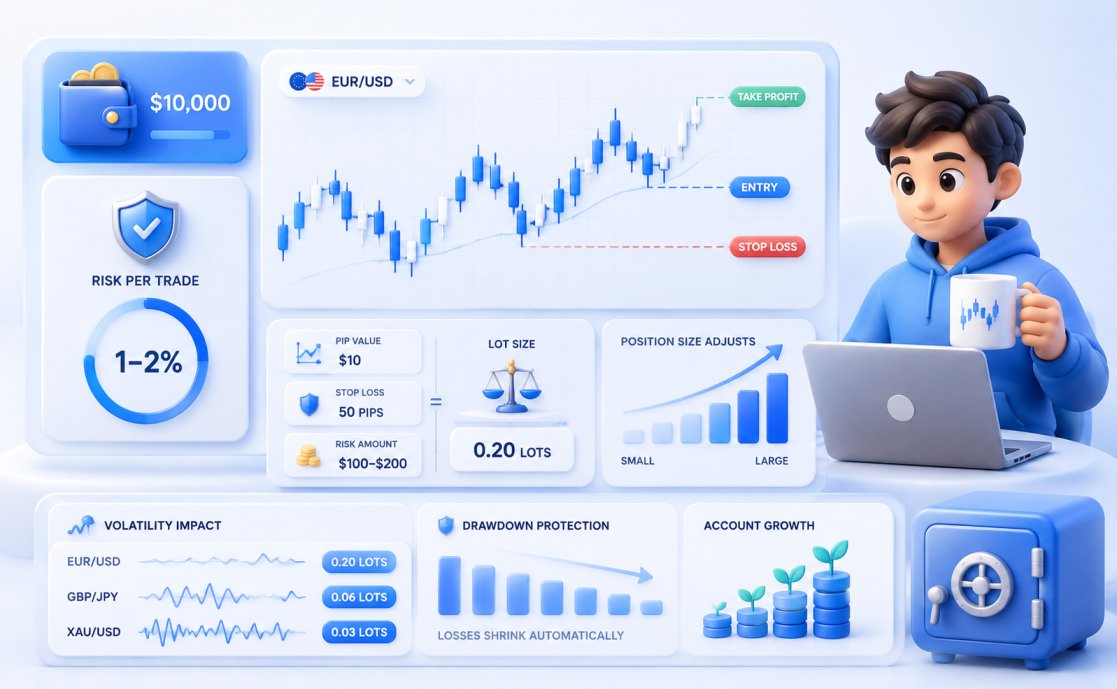
The most widely trusted approach is to risk no more than 1–2% of your total account balance on any single trade. Here's how it looks in the real world:
- Account balance: $10,000 → max risk per trade: $100–$200
- Calculate your lot size based on pip value and stop-loss distance
- As your account grows, your position size scales proportionally
- During drawdown, your losses automatically shrink — protecting against catastrophic decline
Volatile pairs like GBP/JPY or XAU/USD demand smaller position sizes than the majors. This isn't optional — it's pure arithmetic. Ignoring volatility in your sizing is one of the quickest ways to blow an account.
3. Smart Diversification — Spreading Risk Without Spreading Thin
Diversification in forex doesn't mean trading every pair on the board. It means building a portfolio of trades that don't all move in lockstep. If your entire book is in USD-correlated pairs and the dollar makes a sudden move, you're exposed everywhere at once.
- Trade across different currency groups: majors, minors, and commodities
- Check correlations — EUR/USD and GBP/USD often move together; don't double your exposure unknowingly
- Blend trend-following strategies with range-bound approaches
- Keep total open exposure manageable — 8 trades at 2% each is still 16% at risk


4. Essential Tools for Smarter Forex Account Management
The right toolkit doesn't just help you find trades — it protects you from costly mistakes and keeps your decision-making consistent under pressure.
Technical Analysis: Reading the Charts
Technical analysis is your primary language with the market. Layer in a few key indicators and you have a robust, repeatable framework:
- Moving Averages: Identify trend direction and dynamic support/resistance
- MACD: Spot momentum shifts and potential trend reversals early
- RSI: Identify overbought/oversold conditions with precision
- Chart Patterns: Head and shoulders, double tops, flags — high-probability setups when confirmed
Automated Trading & Expert Advisors
Expert Advisors (EAs) remove emotional bias and execute rules consistently — but only when used correctly. Always backtest thoroughly on historical data, forward-test on demo, and optimise before going live. An untested EA on a live account is not automation, it's gambling.
The Economic Calendar — Your Early Warning System
High-impact news events — NFP, CPI, central bank decisions — can move markets violently in seconds. Many experienced traders simply step aside during major releases. If you do trade the news, make sure your position size reflects the heightened risk.
Bookmark a reliable economic calendar and check it every morning before your session. Mark high-impact events in red. Plan around them — not through them.
5. The Psychology of Winning — Managing Your Mind
Here's something most trading courses won't tell you: you can have the best strategy in the world and still consistently lose if your psychology isn't in order. Fear, greed, overconfidence, and revenge trading are human responses every trader faces. The difference is in how you manage them.
Emotion Control: The Real Edge
When a trade goes against you, the instinct is to hold and hope. When it goes in your favour, the temptation is to close too early. Both are driven by emotion, not logic. Developing self-awareness is the first step to trading with a clear, decisive mind.
- Take a break after two consecutive losses — emotional trading compounds errors
- Meditation and mindfulness are legitimate tools used by hedge fund managers
- Build a pre-trade checklist: if the setup doesn't tick every box, skip it
- Review trades weekly — patterns of emotional trading become obvious in your journal
Patience: Your Most Profitable Virtue
The most profitable traders often take fewer trades, not more. They wait. They watch. They let the setup come to them rather than forcing action out of boredom or FOMO. A week without trading isn't a failed week — if there were no A-grade setups, it's a disciplined week.
Keep Learning — The Market Never Stops Changing
Forex evolves with global economies, central bank policies, and geopolitical shifts. A strategy that worked brilliantly in 2022 may underperform in today's conditions. Stay curious, read widely, engage with trading communities, and never stop refining your approach.
6. Track Everything — Your Journal Is Your Greatest Asset
If you're not keeping a trading journal, you're leaving the most valuable feedback tool on the table. It's a window into your decision-making process, your emotional state, and the specific conditions under which you perform best.
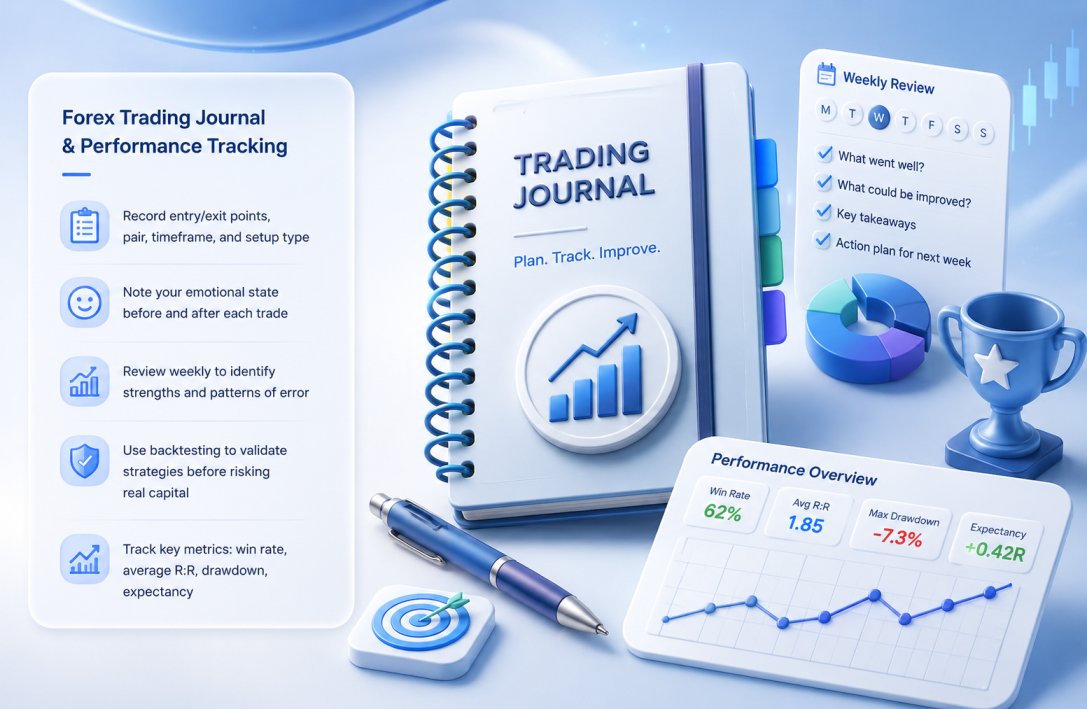
- Record entry/exit points, pair, timeframe, and setup type
- Note your emotional state before and after each trade
- Review weekly to identify strengths and patterns of error
- Use backtesting to validate strategies before risking real capital
- Track key metrics: win rate, average R:R, drawdown, expectancy
Over time, your journal becomes a personalised trading manual — built from real experience rather than theory.
Frequently Asked Questions
Everything you wanted to know about forex account management — answered simply.