Scalping vs Swing Trading:
Which Forex Strategy Will Make You More Money?
Two powerful approaches. One right answer — for you. Discover which trading style fits your personality, schedule, and profit goals.
Why Your Strategy Choice Matters More Than You Think
Every aspiring forex trader eventually hits the same crossroads: scalping or swing trading? It sounds like a simple question. But in reality, it's one of the most consequential decisions you'll make in your trading career — because the wrong choice doesn't just slow your progress. It can drain your account, your energy, and your confidence.
 Active traders monitor multiple timeframes simultaneously.
The forex market runs 24 hours a day, five days a week. Within that vast ocean of price movement, two very different fishing techniques exist. Scalpers cast their nets every few minutes, catching hundreds of tiny fish. Swing traders wait patiently for the big catch — fewer trades, bigger moves, longer time horizons.
Neither is inherently better. But one is almost certainly better for you. This guide will help you figure out which one that is — and how to execute it well.
What Is Scalping in Forex Trading?
Scalping is the art of speed. A scalper enters and exits trades within seconds to minutes, aiming to harvest tiny price movements — often just 2 to 10 pips per trade. The logic is simple: do it enough times throughout the day, and those small wins stack into meaningful profits.
Scalpers typically operate on 1-minute or 5-minute charts. They need lightning-fast execution, ultra-low spreads, and a broker who doesn't frown on high-frequency trading. It's intense. It's fast. And for some traders, it's absolutely electric.
Quick Tip: If you're drawn to scalping, test it first on a demo account during high-liquidity sessions like the London-New York overlap (1:00 PM – 5:00 PM GMT). This is where price moves fastest with tightest spreads.
Key Characteristics of Scalping
- Trades last seconds to a few minutes — rarely longer
- High trading frequency: 10 to 50+ trades per day is common
- Small profit targets (2–10 pips) with tight stop-losses
- Requires complete focus during active trading sessions
- Heavily dependent on low spreads and fast order execution
- Less exposure to overnight risk or macro events
What Is Swing Trading in Forex?
 Swing traders study higher timeframe setups for bigger moves.
Swing trading is patience personified. Instead of chasing dozens of micro-moves each day, swing traders identify meaningful price trends on higher timeframes — the 4-hour chart, daily chart, or even weekly — and ride those moves for days or weeks.
The goal isn't frequency. It's quality. A well-timed swing trade on EUR/USD might yield 80 to 200+ pips. One good trade per week can outperform a hundred rushed scalps. Swing trading fits naturally into a busy life — you analyse the market in the morning, set your trade, and check in later. No need to stare at screens all day.
Key Characteristics of Swing Trading
- Trades held for 2 to 14+ days depending on momentum
- Lower trade frequency: 3 to 10 setups per week
- Larger profit targets (50–200+ pips per trade)
- Requires patience and strong technical/fundamental analysis
- Wider stop-losses to account for normal price fluctuations
- Exposure to overnight risk but manageable with proper sizing
Scalping vs Swing Trading: Head-to-Head Comparison
Let's cut through the noise with a direct, honest comparison. No fluff — just the facts every trader needs to know before committing to a strategy.
| Feature | ⚡ Scalping | 🌊 Swing Trading |
|---|---|---|
| Timeframe | 1–5 minute charts | 4H, Daily, Weekly charts |
| Trade Duration | Seconds to minutes | Days to weeks |
| Trades Per Day | 10–50+ | 1–5 per week |
| Profit Target | 2–10 pips | 50–200+ pips |
| Stop-Loss Size | Very tight (2–5 pips) | Wider (20–80 pips) |
| Time Required | High — active all session | Low to medium |
| Stress Level | Very high | Moderate |
| Skill Level | Advanced | Beginner-friendly |
| Best For | Full-time traders | Part-time / busy traders |
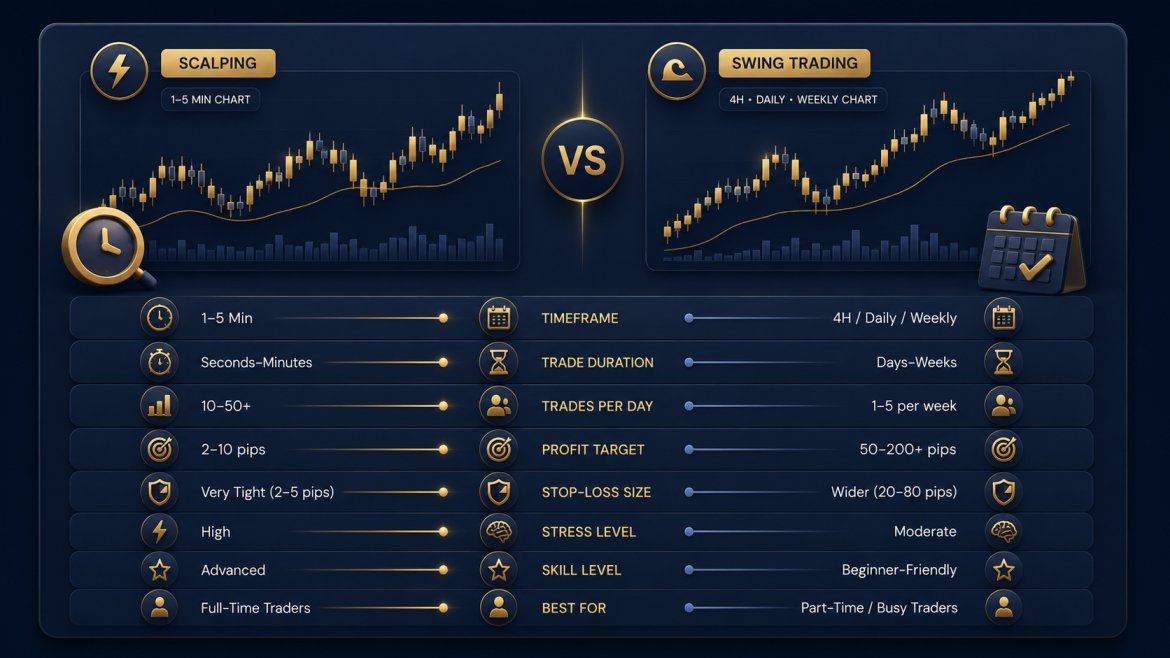 Side-by-side chart comparison: scalping entries vs swing trade setups on EUR/USD.
Scalping: The Real Pros and Cons
✅ Pros of Scalping
- Frequent profit opportunities throughout every session
- No overnight risk — positions closed before market close
- Adrenaline-fuelled environment that suits fast-paced personalities
- Capitalises on short-term market inefficiencies and liquidity spikes
- Lower margin requirements per individual trade
❌ Cons of Scalping
- High transaction costs — spreads and commissions add up fast
- Requires intense focus and discipline — mentally exhausting
- Vulnerable to market noise, slippage, and false signals
- Not supported by all brokers — requotes can be a real problem
- One emotional decision can wipe out hours of accumulated gains
📈 Real-World Example: The Disciplined Scalper
Meet James, a full-time forex scalper who trades GBP/USD and EUR/USD during the London session. He targets just 5 pips per trade with a 4-pip stop. His edge? Consistency. James places 20–30 trades per day, wins roughly 60% of them, and ends most months in profit. His secret: a strict rule to stop trading after three consecutive losses. Discipline, not talent, is his edge.
Swing Trading: The Real Pros and Cons
 Swing trading lets you trade professionally without being glued to screens.
✅ Pros of Swing Trading
- Suitable for traders with limited time — no screen-watching required
- Targets larger price moves, meaning fewer trades needed for solid returns
- Lower transaction costs due to fewer trades overall
- Less emotionally demanding — more time to think before acting
- Works well with a solid technical analysis system or signal service
❌ Cons of Swing Trading
- Exposure to overnight risk, weekend gaps, and news events
- Requires wider stop-losses — larger drawdowns per trade
- Demands patience that many new traders struggle to maintain
- Needs strong understanding of trend analysis and market structure
- Fewer trades can mean long periods of waiting — psychologically tough
🌊 Real-World Example: The Patient Swing Trader
Meet Sarah, a part-time swing trader who works full-time in finance. She analyses charts for 30 minutes each morning, identifies high-probability setups on the daily EUR/USD and AUD/JPY charts, then goes to work. She targets 120+ pips with a 40-pip stop — a 3:1 reward-to-risk ratio. In a good month, she places just 8 trades and still outperforms many full-time scalpers. Her edge is selectivity.
Which Strategy Is Right for You? (Be Honest)
Here's the truth most trading educators won't say: choosing a strategy based on what sounds exciting is a recipe for disaster. The right strategy is the one that matches your actual life.
Choose Scalping If…
- You can dedicate 4–8 uninterrupted hours per day to trading
- You thrive under pressure and enjoy rapid decision-making
- You're using a low-spread ECN broker with instant execution
- You've already mastered risk management on a demo account
- You handle losses quickly and emotionally bounce back fast
Choose Swing Trading If…
- You have a job, family, or other daily commitments limiting screen time
- You prefer thoughtful, strategic decisions over rapid-fire execution
- You want to reduce transaction costs and emotional burnout
- You're still building your trading skills and need more thinking time
- You're looking for a sustainable, long-term trading lifestyle
Expert Insight: Many professional traders at fxTsignals.com recommend new traders start with swing trading. It allows you to learn price action, trend analysis, and risk management without the cognitive overload of high-frequency scalping. Master the slow game first — then speed up if you want to.
Frequently Asked Questions
Final Thoughts: Strategy Is Personal
Scalping and swing trading are two legitimate, proven paths to forex profitability. But they're not interchangeable. One demands your full attention and rapid-fire mindset. The other rewards patience, preparation, and strategic thinking.
The biggest mistake new traders make is chasing what looks exciting on YouTube rather than what suits their real life. Be honest with yourself. Do you have 6 hours a day to watch 1-minute charts? Or do you need a strategy that works around your schedule?
Whichever path you choose, commit to it fully. Master your entry and exit criteria. Manage your risk ruthlessly. And never stop learning. The traders who succeed aren't the ones with the flashiest strategy — they're the ones with the most consistent discipline.
Ready to Trade Smarter?
Join thousands of forex traders who get high-probability swing trade signals, expert analysis, and real-time market insights — delivered daily through fxTsignals.com.
🚀 Get Premium Forex Signals NowRisk disclaimer: Forex trading involves significant risk of loss. Trade responsibly.