
Forex markets never sleep — but the most consistent profits rarely come from traders glued to their screens around the clock. They come from traders who understand where the market is going, not just where it is right now. That's the quiet power of position forex trading.
Position forex trading is a long-term investment approach where you ride significant currency trends over weeks, months, or even years. It's less about reacting and more about anticipating. Instead of chasing every tick on the chart, position traders step back, read the bigger picture, and let the market do the heavy lifting.
In this guide, we'll walk you through everything you need to know — from the core concepts and benefits to step-by-step strategy development and essential tools. Whether you're a seasoned trader or just getting started, there's something valuable here for you.
What Is Position Forex Trading — And Why Does It Matter?

Position forex trading — also known as positional trading — is a strategy where you hold currency pair trades for an extended period, ranging from a few weeks to several months or even longer. The core idea is simple: identify a strong macro trend in the currency markets and ride it to its natural conclusion.
Unlike day traders who open and close multiple positions within a single session, or scalpers who hunt for tiny price movements every few minutes, position traders operate on a completely different time horizon. They're not concerned with the noise of daily volatility — they're focused on the underlying forces shaping a currency's value over time.
Think of it this way: a day trader is like a short-distance sprinter, while a position trader is more like a marathon runner. The marathon runner paces themselves, conserves energy, and trusts the process. The reward at the finish line is often far greater.
The Real Advantages of Position Trading in Forex
There's a reason experienced traders are drawn to position trading. The benefits go far beyond just making more money. Here's what makes it uniquely attractive:
- Less Screen Time, More Life: Once you've entered a position based on your analysis, you don't need to babysit the trade. Position trading gives you freedom — ideal if trading isn't your full-time job.
- Fundamental Analysis Works Best Here: Economic data, interest rate decisions, and geopolitical events have their biggest impact on currencies over weeks and months — exactly the timeframe position traders operate in.
- Bigger Price Moves = Bigger Opportunities: By targeting multi-week or multi-month trends, position traders can capture large swings that short-term traders completely miss.
- Reduced Transaction Costs: Fewer trades mean lower spreads, commissions, and swap fees across the board — costs add up fast with high-frequency approaches.
- Psychological Edge: You're less influenced by minute-to-minute market noise, which helps you make calmer, more rational decisions rooted in research rather than emotion.
Pro Tip: Position trading is especially powerful during sustained macroeconomic trends — like a central bank's multi-year rate hiking cycle or a prolonged period of currency weakness driven by trade imbalances.

Key Considerations Before You Start Position Trading
Position trading isn't for everyone — and it's important to enter it with clear eyes. Here are two critical factors you must address before placing your first long-term trade.
1. Risk Management Is Non-Negotiable
The longer you hold a position, the more potential volatility you're exposed to. A currency pair can move hundreds — sometimes thousands — of pips over weeks and months. Without a well-defined stop-loss strategy and a carefully calculated risk-to-reward ratio, a single bad trade can wipe out months of gains.
Position traders typically use wider stop-loss levels than short-term traders. This isn't reckless — it's intentional. Wide stops allow the trade to breathe through minor pullbacks while still protecting against catastrophic losses. The key is knowing exactly how much you're willing to risk before you enter the trade, not after.
2. Capital Requirements Are Higher
Holding positions for weeks or months means your margin is tied up for extended periods. You need enough capital not only to sustain current positions but also to weather short-term drawdowns without a margin call. Undercapitalization is one of the most common reasons position traders fail — not poor analysis, but simply not having enough financial runway.
Position trading offers the potential for substantial profits, but it demands patience, discipline, and a thorough understanding of the market.
— Experienced Forex TraderBuilding a Winning Position Trading Strategy: 5 Essential Steps

A winning position trading strategy isn't something you improvise — it's a carefully constructed framework that tells you exactly when to enter, when to exit, and how much to risk. Here's how to build yours from the ground up.
The most successful position traders aren't necessarily the ones who know the most complex indicators. They're the ones who have a process — a repeatable, disciplined system they execute with confidence regardless of short-term market noise.
Identify Long-Term Trends
Use weekly and monthly charts to spot dominant trends. Tools like moving averages (50-week, 200-week), trendlines, and Ichimoku clouds are particularly effective at filtering out noise and revealing the true direction of a currency pair over time.
Conduct Thorough Fundamental Analysis
This is the backbone of position trading. Monitor GDP growth rates, inflation data, central bank interest rate decisions, and geopolitical stability. If the Federal Reserve is aggressively raising rates while another central bank is cutting, a long USD trade often makes fundamental sense.
Set Clear Entry and Exit Points
Don't enter a position just because you feel the direction is right. Wait for technical confirmation — a break of a key resistance level, a moving average crossover, or a candlestick pattern on the weekly chart. Define your profit targets and stop-loss levels before entering the trade.
Apply Smart Risk Management
A general rule: never risk more than 1–2% of your total account on a single position. Use position sizing calculators to determine your lot size based on your stop-loss distance. Diversify across multiple, uncorrelated currency pairs to reduce overall exposure.
Practice Patience and Discipline
This is where most traders stumble. Position trading requires you to watch your trade go against you by hundreds of pips and do nothing — because your analysis says the trend is intact. Emotional discipline is a skill you develop over time, but it separates profitable position traders from the rest.
A Practical Example: Position Trading the USD/JPY in 2022–2023
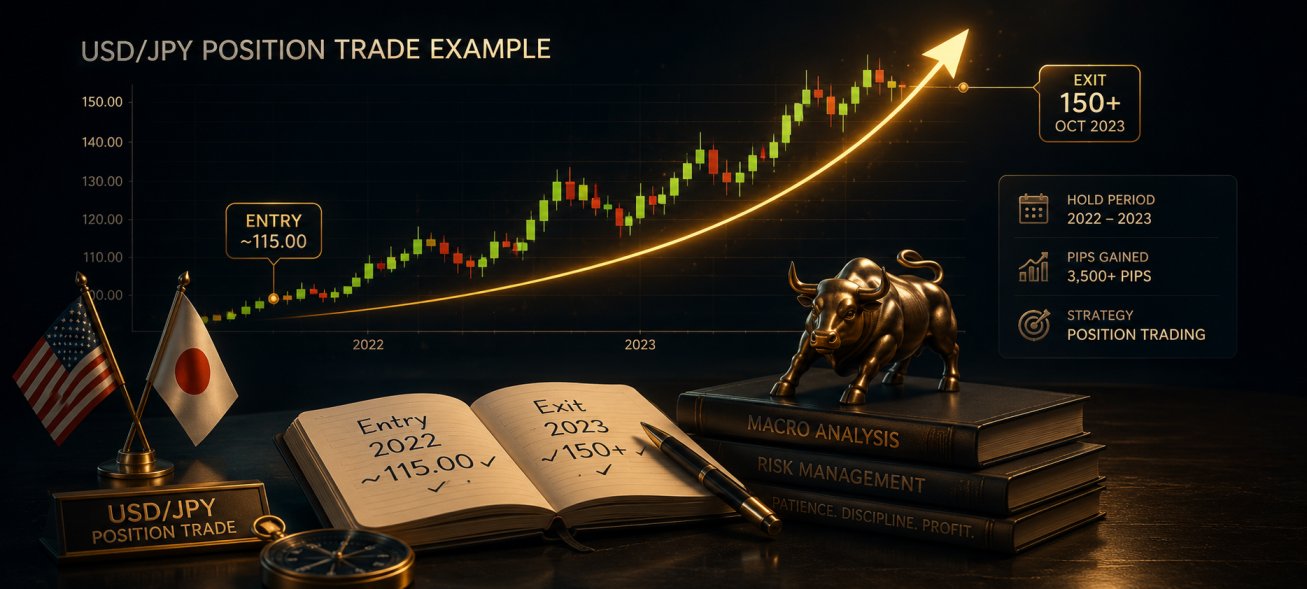
To make this concrete, let's look at a real-world scenario. Through 2022 and into 2023, the US Dollar surged aggressively against the Japanese Yen. The catalyst? The Federal Reserve raised interest rates at one of the fastest paces in decades, while the Bank of Japan maintained its ultra-loose monetary policy, keeping rates near zero.
A position trader who identified this fundamental divergence early in 2022 — and entered a long USD/JPY position around the 115 level — could have held that trade all the way to around 150+ by October 2022. That's roughly 3,500 pips in a single position held over months.
Day traders were getting chopped up by the volatility along the way. The position trader, trusting the macro story, kept their stop well below major support and let the trend play out. This is the power of position trading done right.
Actionable Tip: Before entering any position trade, write down your thesis in plain language. "I am long EUR/USD because the ECB is hiking rates while the Fed is pausing." If your thesis changes based on new data, reassess the trade. If it hasn't, hold your ground.
Essential Tools and Resources for Position Forex Traders
Having the right tools doesn't guarantee success, but they remove friction and improve your decision-making. Here's what every serious position trader should have in their toolkit:
- Economic Calendar: Stay ahead of major market events — central bank meetings, NFP data, CPI releases, and GDP reports. Sites like Investing.com or Forex Factory offer detailed economic calendars with impact ratings.
- Charting Software with Multi-Timeframe Analysis: TradingView is excellent for position traders — you can easily switch between daily, weekly, and monthly charts and overlay multiple indicators.
- Central Bank Communication Trackers: Follow Fed statements, ECB press conferences, and Bank of England reports. The tone of central bank communication often signals policy shifts months before they officially happen.
- Forex Community and Forums: Communities like BabyPips, ForexFactory forums, and fxTsignals.com offer valuable peer insights, strategy discussions, and signal services that complement your own analysis.
- Trading Journal: Document every trade — your thesis, entry, exit, what worked, and what didn't. Over time, this becomes your most valuable resource for improving your strategy.
Frequently Asked Questions About Position Forex Trading
While there's no hard minimum, most experienced position traders recommend starting with at least $5,000–$10,000 in trading capital. This gives you enough room to properly size your positions, absorb short-term drawdowns, and maintain margin requirements without being forced out of trades prematurely. With less capital, the risk of overleveraging and margin calls becomes significantly higher.
Swing trading typically involves holding trades for a few days to a couple of weeks, targeting medium-term price swings within a larger trend. Position trading goes further — trades are held for weeks to months or longer, focusing on major macro-driven trends rather than individual price swings. Position traders tend to rely more on fundamental analysis, while swing traders balance both technical and fundamental factors.
Major currency pairs like EUR/USD, USD/JPY, GBP/USD, and USD/CHF are generally best for position trading. They offer the highest liquidity, tighter spreads, and the most reliable fundamental data to base long-term decisions on. Some traders also position-trade commodity-linked pairs like USD/CAD or AUD/USD when there are strong trends in oil or metals markets.
Overnight swap rates can become a significant cost — or even a source of profit — when holding trades for weeks or months. Before entering a position trade, check the swap rates for that pair. If you're trading in the direction of a positive carry (e.g., being long on a higher-yielding currency), you may actually earn swap interest daily. Negative swaps need to be factored into your overall profit calculation when setting targets.
Yes — in fact, some of the best position trading opportunities arise during periods of significant volatility, such as interest rate cycles or geopolitical shifts. The key is to use wider stop-losses to accommodate the volatility, reduce position sizing to maintain proper risk management, and ensure your fundamental thesis is still intact. Volatility is simply noise if the underlying macro story hasn't changed.
Conclusion: Play the Long Game and Win
Position forex trading isn't about being the fastest trader or having the most sophisticated algorithm. It's about having the clearest view of where the market is heading — and the patience to wait for the market to confirm you're right.
The fundamentals of position trading are straightforward: identify a strong macro trend, align your technical analysis, manage your risk with precision, and hold your position with discipline. Do those four things consistently, and you give yourself every advantage the forex market has to offer.
Whether you're just starting out or looking to evolve beyond short-term trading, position forex trading offers a path to meaningful, sustainable profits — one that rewards research, patience, and strategic thinking over impulsive reaction.
Position forex trading is the art of capturing long-term trends for greater profits.
— Expert TraderReady to sharpen your edge? Visit fxTsignals.com for daily trading insights, professional signal services, and a community of traders who think long-term just like you.