Why Most Forex Traders Struggle — And What Separates the Ones Who Don't
Every day, trillions of dollars flow through the forex market. Yet the majority of retail traders walk away from their screens with losses they never saw coming. The reason isn't bad luck. It's a lack of understanding of three foundational pillars: order types, trade execution, and leverage.
Whether you've just opened your first brokerage account or you've been trading for years, mastering these three elements is what moves you from reactive guesswork to calculated, consistent performance. This guide breaks it all down — not in abstract theory, but in the practical, real-world way that actually shapes trading outcomes. Let's get into it.
Order Types in Forex Trading: Your Roadmap to Smarter Entries
Think of order types as the language you speak with the market. Using the wrong one at the wrong time is like showing up to a negotiation without knowing how to communicate. Once you fluently understand each order type, you gain a level of precision that most traders never develop.

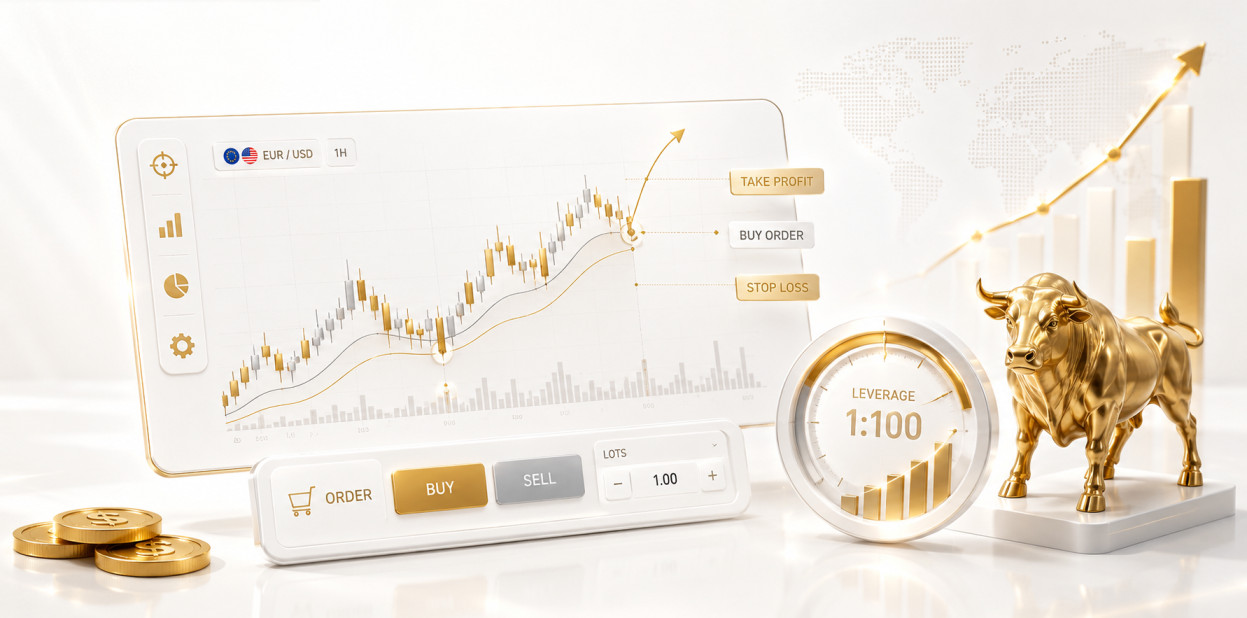
Order panel on a live trading platform.
Market Orders
Buy or sell instantly at the current market price. Perfect for fast-moving conditions when getting in matters more than the exact price.
Limit Orders
Set your preferred entry or exit price in advance. The trade only executes if the market reaches your level — giving you full control.
Stop Orders
Activate a trade when price hits a trigger level. Used primarily for stop-losses and breakout entries to manage downside risk.
Trailing Stops
A dynamic stop that moves with price as your trade goes in profit — locking in gains automatically while keeping you in the trend.
Market Orders: Speed Over Precision
When volatility spikes — around a Non-Farm Payroll release or a central bank decision — every second counts. A market order gets you into the trade immediately at whatever the current price is. The trade-off? You won't always get the cleanest entry, especially in illiquid conditions where slippage can widen your effective spread. Use market orders when timing is everything and you're willing to absorb a few extra pips for certainty of fill.
Limit Orders: The Patient Trader's Best Friend
Say EUR/USD is trading at 1.0950 and you believe a pullback to 1.0890 would present the ideal long entry. Rather than staring at your screen all day, you simply set a limit buy at 1.0890 and walk away. If price gets there, your order fills automatically. If it doesn't, nothing happens. Limit orders are ideal for swing traders who know their levels and don't want to be glued to a monitor.
Stop & Trailing Stops: Your Risk Management Arsenal
Stop-loss orders are non-negotiable for serious traders. Placing one on every trade means you've defined your maximum acceptable loss before emotions can interfere. Trailing stops take this a step further — imagine you're long GBP/USD and it moves 80 pips in your favor. A trailing stop automatically follows 30 pips behind, so if the pair reverses sharply, you exit with a profit rather than giving it all back.
Trade Execution: The Art of Timing the Market Without Chasing It

Technical analysis combined with macro awareness = sharper execution.
Execution is where strategy meets reality. You can have the world's most detailed trading plan, but if you're pulling the trigger at the wrong moment — or worse, hesitating when the setup is right in front of you — results will suffer. Good execution is a skill, and like any skill, it's developed through deliberate practice.
Combine Fundamental and Technical Analysis
The traders who execute with the most confidence are those who've done their homework on both fronts. Fundamentally, that means knowing when major economic data is due — GDP prints, CPI numbers, Fed minutes — and having a view on what they might mean for currency flows. Technically, it means identifying key levels: support and resistance zones, moving average confluences, trend lines, and momentum indicators. When both signals align, execution confidence goes up considerably.
Don't Let Emotions Make the Trade
Fear of missing out pushes traders into entries that haven't fully set up. Greed keeps losing trades open long after stop levels have been breached. These are the silent killers of trading accounts. The fix isn't to feel nothing — it's to build a rules-based system that removes as many discretionary decisions as possible during live market hours. Here's how disciplined traders stay on track:
- Define entry criteria, stop-loss level, and target before placing any trade
- Never move a stop-loss to avoid a loss — only move it in the direction of profit
- Set a maximum daily loss limit and stop trading once reached
- Use a trading journal to review decisions and spot emotional patterns
- Avoid trading within 15 minutes of major economic announcements unless specifically designed for it
Practice on a Demo Account — Then Graduate Gradually
Demo trading isn't just for beginners. Experienced traders use it to test new strategies, fine-tune execution timing, and adapt to changing market regimes — all without capital at risk. The key is treating it with the same seriousness as a live account. Many platforms, including those available at FxTsignals.com, allow seamless switching between demo and live environments.
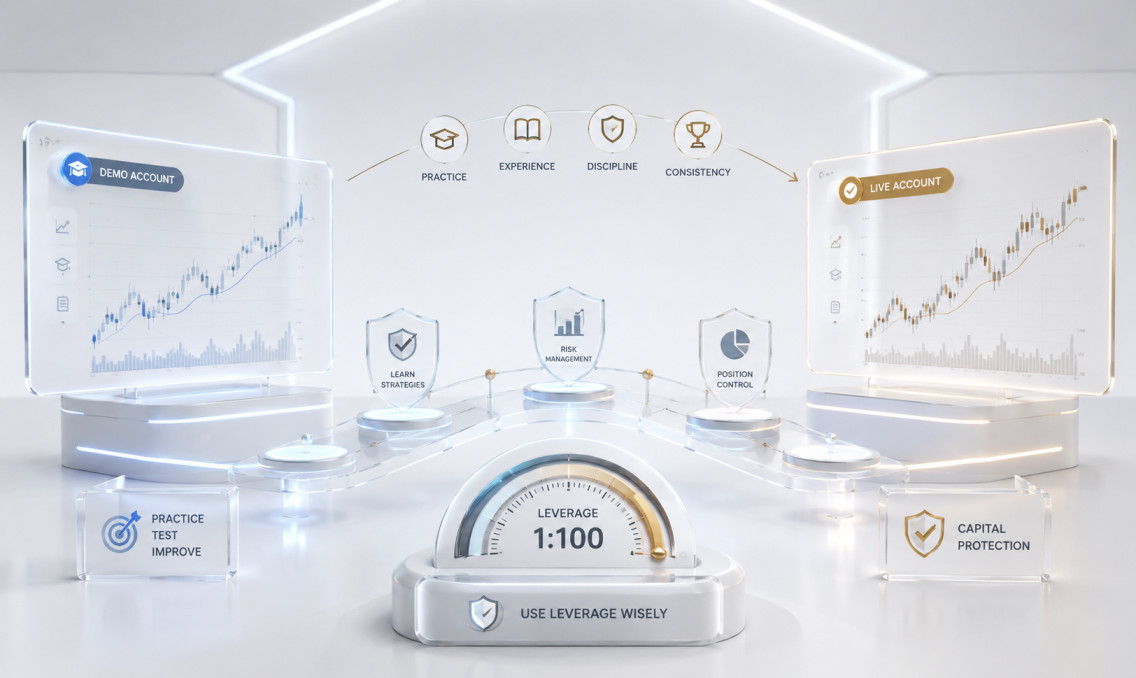
Leverage amplifies both opportunity and exposure — handle it wisely.
Leverage in Forex: The Power Tool That Demands Respect
No single concept in forex trading carries as much potential — or as much peril — as leverage. Retail traders are often drawn to the forex market precisely because of leverage. The ability to control a $100,000 position with just $1,000 in your account sounds extraordinary. And it is. But only when handled properly.
How Leverage Actually Works
At a leverage ratio of 1:100, a 1% move against your position wipes out your entire margin. That's the reality most brokers don't put in the headline. On the flip side, a 1% move in your favor doubles your invested capital. This amplification is what makes leverage both magnetic and dangerous. The key variable isn't the leverage ratio itself — it's how much of your account you put at risk per trade.
- Risk 1–2% per trade — never more than 5% on any single position, regardless of conviction
- Use leverage as a tool, not a target — just because 1:500 is available doesn't mean you should use it
- Calculate position size first — determine your stop-loss in pips, then work back to appropriate lot size
- Start conservative — new traders should begin at 1:10 or lower and scale up only with experience
- Monitor margin levels actively — never let a trade run unchecked into a margin call situation
Risk Management: The Bridge Between Leverage and Longevity
Professional traders don't chase big wins — they prioritize capital preservation above all else. A trader who consistently risks 2% per trade and achieves a 55% win rate with a 1:1.5 risk-reward ratio will compound steadily over months and years. Compare that to the trader chasing 10x returns with maximum leverage, who likely blows their account within weeks. The math of compounding works powerfully in the disciplined trader's favor.
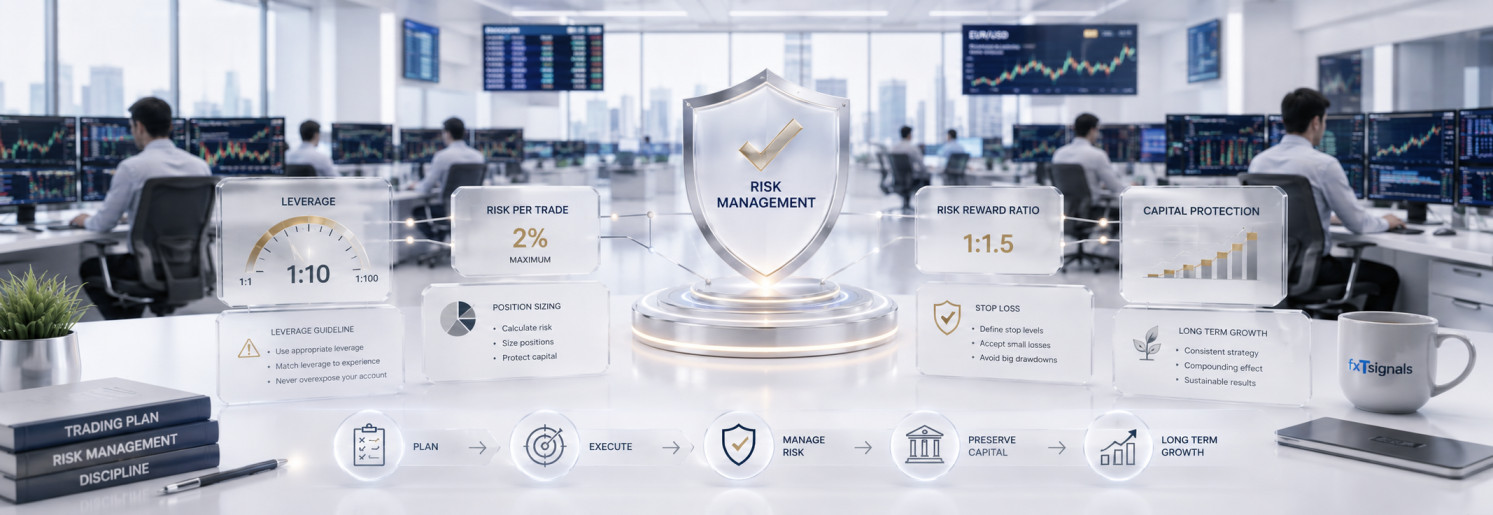
Consistent profitability comes from systems, not luck.
Conclusion: The Forex Traders Who Win Play the Long Game
The forex market doesn't reward the smartest people in the room — it rewards the most disciplined ones. Order types give you the vocabulary to communicate with the market on your terms. Execution transforms your analysis into decisive action at the right moment. Leverage, when respected, amplifies your edge rather than your exposure.
Bring these three together with consistent practice, honest self-review, and an unwavering commitment to risk management, and you have the foundation of a trading approach that can genuinely generate long-term results. The traders who make it aren't the ones who never lose — they're the ones who lose small, win consistently, and keep showing up with the same disciplined mindset every single day.
Start by reviewing your last 20 trades through the lens of this guide. Were your order types optimal for your strategy? Did emotions influence your execution? Were you using leverage proportionate to your risk tolerance? The answers will tell you exactly where to focus next.
Frequently Asked Questions
Limit orders combined with stop-loss orders form the safest foundation for beginners. A limit order ensures you only enter at your planned price, while the stop-loss protects your capital if the trade moves against you. Market orders are simpler but leave you exposed to slippage during volatile conditions.
Beginners should keep leverage at 1:10 or lower. This gives enough amplification to make trading viable on smaller accounts while limiting the speed at which losses can accumulate. As you build a consistent track record over 3–6 months, you can gradually increase leverage — but never beyond what your risk management plan allows per trade.
A stop-loss is a fixed price level where your trade closes if hit — it doesn't move. A trailing stop follows the price as it moves in your favor, maintaining a set distance behind current price. When price reverses and touches the trailing stop level, the trade closes. This allows you to lock in profits dynamically without setting a rigid profit target.
The most effective approach is pre-planning every trade parameter — entry, stop, and target — before the market opens. Once your orders are placed with predefined levels, you remove real-time decision pressure. Keeping a trading journal, setting daily loss limits, and reviewing your emotional state after each session also builds the self-awareness that prevents reactive mistakes.
Absolutely. The 24-hour nature of the forex market makes it one of the most accessible financial markets for part-time participants. Swing trading and position trading strategies — which hold trades for days or weeks rather than minutes — are especially well-suited to traders who can't monitor screens throughout the day. Limit orders and stop-loss orders do the heavy lifting when you're away from your platform.
Ready to Trade Smarter, Not Harder?
Join thousands of forex traders who sharpen their edge with FxTsignals — where professional-grade signals, real-time analysis, and expert education converge into one powerful platform.