Whether you are a seasoned forex trader diversifying your portfolio or a newcomer trying to understand the financial landscape — the mutual fund vs hedge fund debate is one you cannot afford to ignore.
Every investor eventually faces this question: where do I put my money for the best return without losing sleep at night? The investment world offers a huge menu of choices, but mutual funds and hedge funds remain two of the most talked-about vehicles — and for good reason. They both pool capital, employ professional managers, and aim to grow your wealth. But that is almost where the similarities end.

At fxTsignals.com, we help forex traders make smarter financial decisions — from live signal management to understanding the broader investment ecosystem. In this guide, we break down mutual funds and hedge funds with clarity, real examples, and actionable insights, so you can align your investments with your actual goals.
What Is a Mutual Fund? The Everyday Investor's Gateway
A mutual fund is exactly what the name suggests — a pool of money collected from many investors and managed collectively. Think of it as a shared investment basket where professional fund managers do the heavy lifting: researching assets, timing entries, and rebalancing the portfolio on your behalf.

The beauty of a mutual fund is its accessibility. You do not need to be a Wall Street analyst or have a million dollars sitting around. With a few hundred dollars, you gain instant access to a diversified portfolio spanning stocks, bonds, money market instruments, or sector-specific securities. That kind of instant diversification is one of the most powerful risk management tools available to ordinary investors.
How Mutual Funds Are Structured
Mutual funds are classified as regulated investment companies and must comply with strict rules designed to protect investors. Most are structured as open-end funds, meaning the number of shares is not fixed — it expands or contracts as investors buy in or redeem. This gives you the flexibility to enter and exit the fund at any time, usually at the fund's net asset value (NAV) calculated at market close each trading day.
- Instant diversification across hundreds of securities with a single purchase
- Low minimum investment thresholds — some funds start at just $100
- Daily liquidity: redeem shares at NAV at the end of any trading day
- Professional management removes the burden of daily market monitoring
- Available in equity, bond, balanced, money market, and sector-specific categories
- Regulated by financial authorities — offering strong investor protection
For a forex trader who already juggles complex currency pairs and macro data, a mutual fund offers a hands-off way to build long-term wealth in parallel. You focus on pip movements during New York session — the fund manager handles your equity exposure.
What Is a Hedge Fund? Wall Street's Exclusive Playground
Hedge funds are an entirely different animal. Originally designed to "hedge" market risks through offsetting positions, modern hedge funds have evolved into sophisticated investment vehicles that pursue absolute returns through virtually any strategy available — including leverage, short selling, derivatives, global macro plays, and quantitative algorithms.

Unlike mutual funds, hedge funds operate as private investment partnerships. Investors become limited partners while the fund manager serves as the general partner. This structure gives hedge fund managers extraordinary latitude — they are not bound by the same regulatory constraints that govern mutual funds, allowing them to implement complex, multi-layered strategies that would simply not be possible within a regulated fund structure.
Strategies Hedge Funds Actually Use
The strategy universe inside a hedge fund is vast. Understanding these approaches helps you evaluate whether the return potential justifies the elevated risk and cost:
- Long-Short Equity: Buy stocks expected to rise, short sell those expected to fall — profiting in both directions
- Global Macro: Take positions based on macroeconomic trends — interest rates, currencies, commodities (sound familiar, forex traders?)
- Event-Driven: Capitalise on corporate events like mergers, acquisitions, earnings surprises, or bankruptcy restructurings
- Quantitative Strategies: Algorithm-driven models that identify statistical mispricings across thousands of securities simultaneously
- Distressed Debt: Invest in the bonds or equity of financially troubled companies at a deep discount

Mutual Fund vs Hedge Fund: Head-to-Head Comparison
Now that we understand each vehicle on its own terms, let us put them side by side across the dimensions that matter most to an investor making a real decision.
- Open to any investor — no net worth minimums
- Strictly regulated by financial authorities
- Daily liquidity at net asset value (NAV)
- Low to moderate fees (typically 0.1%–1.5% annually)
- Transparent holdings disclosed regularly
- Conservative to moderate risk profile
- Ideal for long-term, passive wealth building
- Restricted to accredited / high-net-worth investors
- Lightly regulated — far greater strategic flexibility
- Lock-up periods common (quarterly or annual redemption)
- High fees: typically 2% management + 20% performance
- Limited transparency — strategies often proprietary
- High risk — but targets absolute, uncorrelated returns
- Suitable for sophisticated investors seeking alpha
The distinction is not merely about wealth level. It is about sophistication, time horizon, and the degree of risk you are genuinely prepared to absorb. Knowing the difference could save — or make — you a fortune.
— fxTsignals Editorial DeskThe Fee Structure: Where the Real Difference Lives
If you have ever traded forex, you understand how much fees eat into your returns over time. The same principle applies here — and the contrast between mutual fund and hedge fund fee structures is stark.
Mutual Fund Costs
Mutual funds typically charge an annual expense ratio that covers management, administrative, and operational costs. Actively managed funds might charge between 0.5% and 1.5% annually. Index funds and ETFs have compressed this further — some charge as little as 0.03% per year. There may also be sales loads (front-end or back-end commissions), though many modern funds have eliminated these entirely.
The Hedge Fund "Two and Twenty"
Hedge funds are famous — some would say notorious — for their "2 and 20" fee structure. This means investors pay a 2% annual management fee on their total assets under management, plus a 20% performance fee on any profits generated. On a $1,000,000 investment generating 20% returns ($200,000), you would owe $20,000 in management fees plus $40,000 in performance fees — totalling $60,000, leaving you with $140,000 net gain. The logic is that this structure aligns the fund manager's interests with yours — they only earn big when you do.
Imagine two investors each put $100,000 to work. Investor A chooses a mutual fund with a 1% expense ratio and earns 10% gross return — netting roughly $9,000. Investor B joins a hedge fund, earns the same 10% gross, but pays 2% management plus 20% of profits — netting around $6,400. The hedge fund would need to consistently deliver significantly higher gross returns to justify the additional cost. This is why performance consistency matters enormously when evaluating hedge funds.
Risk, Liquidity, and Who Should Invest in What
Risk tolerance is personal. A forex trader who comfortably holds a leveraged position overnight through a major economic event has a different risk appetite than someone who panics when their savings account interest rate drops. Understanding your own profile is the first step before choosing between these two investment vehicles.
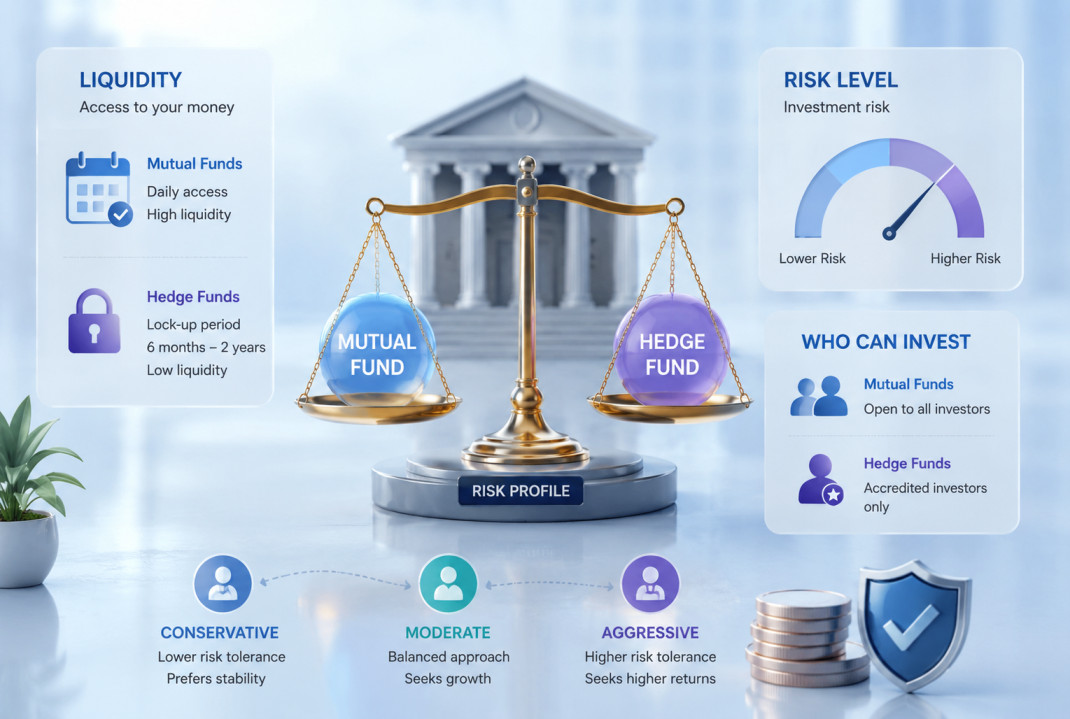
Liquidity: Access to Your Money
Mutual funds offer excellent liquidity. You can redeem your shares at the end of virtually any trading day at the current NAV. This makes them ideal for investors who may need access to their capital within a relatively short timeframe.
Hedge funds are a different matter entirely. Most impose lock-up periods — typically ranging from six months to two years — during which you cannot withdraw your capital. After the lock-up, redemptions are usually allowed only at quarterly or annual intervals with advance notice. If you need fast access to your funds, a hedge fund is almost certainly not the right fit.
Investor Qualification: Who Can Access Each?
Mutual funds are democratised investments — anyone with money to invest can participate, regardless of net worth or financial expertise. Regulatory agencies worldwide have ensured that mutual funds carry enough transparency and protection for the general public.
Hedge funds, on the other hand, are generally restricted to "accredited investors" — a regulatory classification requiring individuals to have a net worth exceeding $1 million (excluding their primary residence) or annual income above $200,000 for the past two consecutive years. This threshold is intentional: regulators assume that wealthier individuals possess greater financial sophistication and can absorb potential losses without catastrophic personal consequences.
A Forex Trader's Perspective: Where Do These Fit Your Portfolio?
As a forex trader, you already participate in one of the world's most liquid and dynamic markets. Your portfolio may already be generating returns through spot trading, signal services, or managed accounts. So how do mutual funds and hedge funds complement — or compete with — your existing strategy?
For most forex traders, a balanced approach works best: use mutual funds to build steady long-term wealth with low fees and easy liquidity, while keeping your active forex trading capital separate for higher-return, skill-based opportunities. Hedge funds may become relevant later — once your capital base and risk appetite qualify you for accredited status and you want exposure to more sophisticated, uncorrelated strategies.
Frequently Asked Questions
Conclusion: Choose Your Investment Path with Precision
The mutual fund vs hedge fund debate does not have a universal winner. The right choice depends entirely on where you are in your financial journey, how much risk you can genuinely absorb, and what level of involvement you want in managing your wealth.

Mutual funds are democratised, regulated, and designed for the long haul. They are the sensible backbone of any diversified investment portfolio — accessible, liquid, and professionally managed without demanding a fortune in fees. For forex traders building passive wealth alongside active trading income, they are often the ideal complement.
Hedge funds are the high-octane, high-cost, high-reward option for accredited investors who are prepared to lock their capital up, tolerate significant volatility, and bet on a fund manager's alpha-generating ability. When they work, the returns can be spectacular. When they do not, the losses can be equally dramatic.
At the end of the day, the most sophisticated investors use multiple tools simultaneously — active trading for high-frequency returns, mutual funds for steady compounding, and potentially hedge funds for uncorrelated alpha when the time and capital are right. Build your financial strategy with the same discipline you bring to your forex trades: understand the instrument, manage the risk, and execute with conviction.
Ready to Let Your Money
Work Smarter?
Join thousands of forex traders who trust fxTsignals.com for precision live account management — professionally executed, transparent, and results-driven.
Join our Trial & Premium Signal Service →