
Margin Accounts Demystified:
The Forex Trader's Power Guide to Leverage, Risk & Real Profits
What if you could control a $20,000 forex position with just $10,000 in your account? That's exactly what margin trading makes possible — but it comes with a catch most traders learn the hard way. This guide breaks it all down so you don't have to.
Every forex trader has heard the words "margin account" thrown around. But ask most traders to explain exactly how one works, and you'll get a shrug. That gap in knowledge is expensive. Understanding your margin account isn't optional — it's the difference between growing your capital and getting wiped out in a single bad trade.
Whether you've just opened your first brokerage account or you've been trading for years and want to sharpen your edge, this guide covers everything — from the basics of how margin accounts work, to advanced strategies, common mistakes, and the red flags that trigger margin calls. Let's get into it.
What Exactly Is a Margin Account?
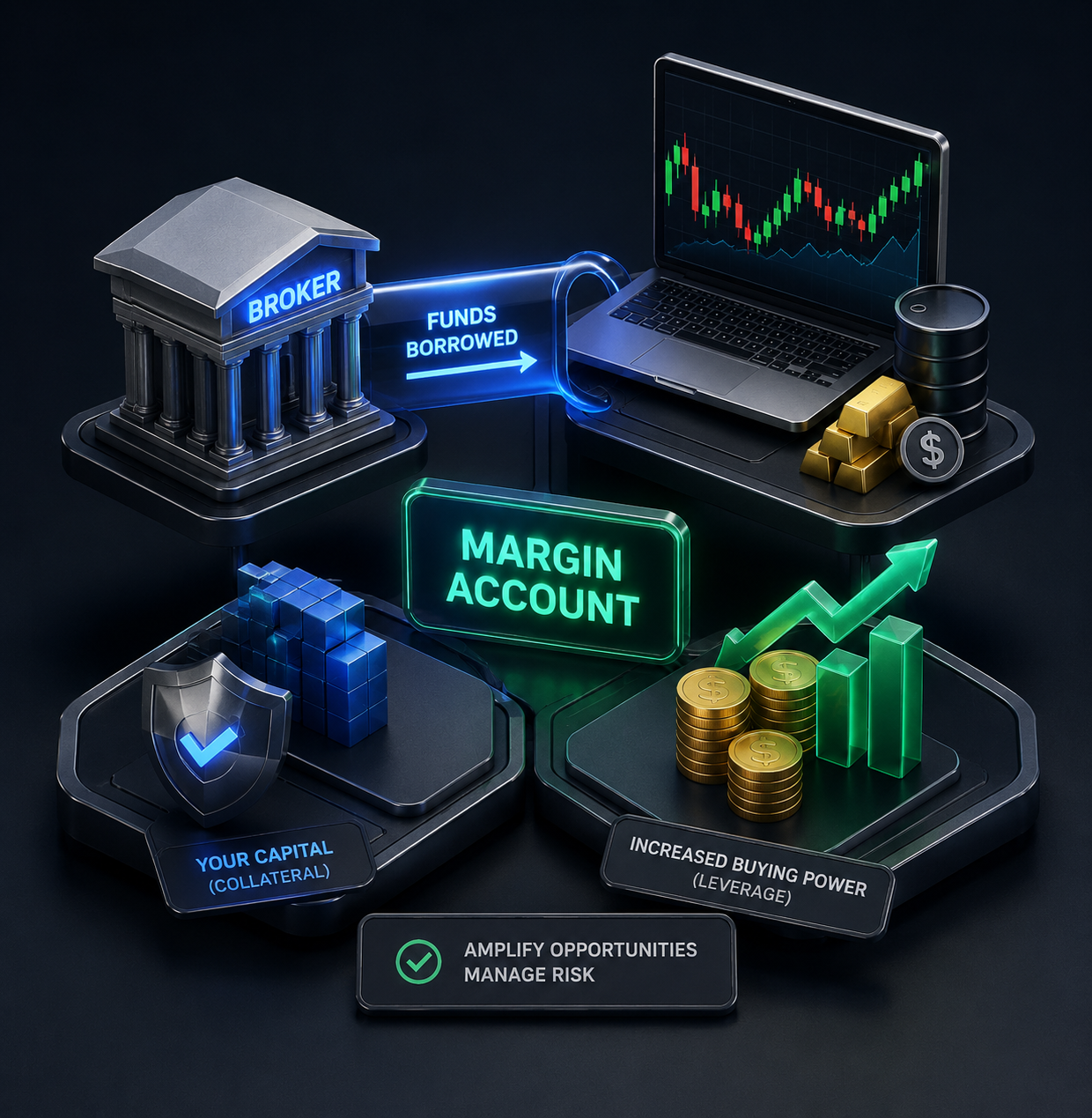
Margin trading amplifies both opportunities and risk.
A margin account is a type of brokerage account that allows you to borrow money from your broker to buy financial assets — stocks, forex pairs, commodities, or other securities. Unlike a standard cash account where you can only trade with what you deposit, a margin account essentially gives you a credit line backed by your existing holdings.
Think of it like a home equity line of credit, but for trading. You already own something of value (your securities), and you're using that value as collateral to borrow more capital and increase your market exposure.
In the forex world, margin accounts are the norm rather than the exception. Every leveraged forex trade you've ever placed was executed inside a margin framework — even if you didn't realise it at the time. Knowing how the mechanics work gives you a sharper edge over traders who just click "buy" without thinking about what's underneath the hood.
How Does a Margin Account Actually Work?
Opening a Margin Account
Opening a margin account isn't quite the same as a standard brokerage account. Brokers require you to meet certain eligibility criteria — generally a minimum account balance (often starting at $2,000 in the US, though this varies by jurisdiction) and a review of your financial background. The broker needs confidence that you can handle the risks involved.
Once approved, you're granted a margin limit — a percentage of your portfolio's total value that you can borrow. This is set by both regulatory bodies (like FINRA in the US or FCA in the UK) and by your individual broker's internal risk policies.
Leverage: Doubling Your Buying Power

Leverage is the core mechanic behind margin accounts.
Here's where margin accounts get powerful — and dangerous. Say you have $10,000 in your margin account and your broker sets a 50% margin requirement. That means for every dollar you have, you can borrow a dollar more. You now control $20,000 worth of assets using only $10,000 of your own money.
If your positions gain 10%, you're up $2,000 on a $10,000 outlay — a 20% return on your actual capital. That's the power of leverage at work: it multiplies your exposure and therefore your potential gains.
But here's the flip side. If your position drops 10%, you're down $2,000 — that's a 20% loss on your actual capital. Losses, just like gains, are amplified by leverage. This is why disciplined risk management isn't optional when you're trading on margin.
Margin Calls: The Alarm Bell Every Trader Dreads
Every margin account has a "maintenance margin" — a minimum equity threshold your account must maintain at all times. The moment your account equity drops below this line, your broker issues a margin call.
Margin accounts can offer tremendous buying power, but the margin call is your broker's way of saying the game has changed. Meet it fast, or your positions get liquidated — on the broker's timeline, not yours.
When a margin call hits, you have two choices: deposit additional funds to bring your equity back above the maintenance margin, or close some positions to reduce your margin usage. Fail to act quickly enough, and your broker will do it for you — through forced liquidation, often at the worst possible prices.
In fast-moving forex markets, this can happen within hours. Many traders have woken up to find their positions force-closed overnight during high-volatility sessions. The only defence is monitoring your account consistently and keeping a comfortable buffer above your maintenance margin.
Pros and Cons of Margin Accounts for Forex Traders
Before you start trading on margin aggressively, it helps to weigh both sides of the equation clearly. Here's an honest breakdown.
✅ The Advantages
- Amplified buying power with less upfront capital
- Ability to short-sell and profit from falling markets
- Greater flexibility across diverse asset classes
- Higher potential returns on successful trades
- Access to larger position sizes than capital alone allows
⚠️ The Risks
- Losses are amplified just as much as gains
- Interest charges on borrowed funds erode returns
- Margin calls can force liquidation at bad prices
- Emotional pressure increases with leveraged exposure
- Potential to lose more than initial deposit
4 Margin Account Strategies That Actually Work

Disciplined strategy is the backbone of successful margin trading.
1. Define Your Risk Parameters Before You Trade
The most successful margin traders don't decide how much risk to take after entering a position. They set their rules before the trade ever executes. Decide upfront: what's the maximum percentage of your account you're willing to commit to any single trade? Many experienced traders cap this at 1–2% of total capital per position.
Set your margin utilisation ceiling — for example, never using more than 30–40% of your available margin at any one time. This leaves you with breathing room if the market moves against you and prevents panic-driven decisions when volatility spikes.
2. Diversify Across Pairs and Instruments
Putting your entire margin exposure into one forex pair is how traders get wiped out on a single news event. Spreading your positions across uncorrelated pairs — say, EUR/USD and USD/JPY simultaneously — means a sharp move in one pair won't devastate your entire margin balance.
- Mix major, minor, and commodity-linked pairs for natural hedging
- Avoid overloading on USD-correlated trades simultaneously
- Consider multi-asset diversification into gold or indices when margin allows
- Keep correlation analysis part of your pre-trade routine
3. Monitor Your Account Actively — Every Single Day
Margin accounts aren't a set-it-and-forget-it arrangement. They demand consistent attention. Check your margin levels, unrealised P&L, and open exposure every trading day — ideally at the open, mid-session, and close.
Set alerts on your trading platform when your margin utilisation exceeds 60% or when account equity drops to a predefined warning level. Catching problems early means you have options. Catching them late means your broker has the options instead.
4. Treat Interest Costs as a Real Trade Expense
Borrowed margin funds aren't free. Brokers charge interest — often called the "financing rate" or "overnight swap" — on positions held beyond a day. Over time, these charges compound and quietly eat into your returns. Factor the daily interest cost into every trade you plan to hold for more than a session. For swing trades held over several weeks, this expense can become significant.
Pro Tip from fxTsignals.com
The best margin traders aren't the ones who use the most leverage. They're the ones who use the right amount of leverage for each specific market condition — aggressive when the setup is high-conviction, minimal when the market is choppy or uncertain. Flexibility in margin usage is itself a skill worth developing.
Common Margin Mistakes That Cost Traders Their Capital

Overleverage is the most common path to a margin call.
Most margin-related losses aren't caused by bad analysis. They're caused by poor margin management. Here are the mistakes that show up again and again:
- Overlevering from the start: New traders max out their available margin immediately, leaving zero buffer for normal market fluctuation
- Ignoring interest costs: Holding high-margin positions for weeks without accounting for daily financing charges
- No stop-loss protection: Relying on manual monitoring instead of hard stops to cap downside on leveraged trades
- Averaging down with borrowed money: Adding to losing margin positions amplifies the loss instead of reducing the average entry cost meaningfully
- Trading through high-impact news events with full margin: News spikes can move pairs hundreds of pips in seconds, easily triggering margin calls
Frequently Asked Questions About Margin Accounts
Conclusion: Margin Is a Tool — Wield It Wisely
Margin accounts are neither inherently good nor bad. They're financial instruments — powerful ones — that respond directly to the skill and discipline of the trader using them. In the right hands, margin trading can meaningfully accelerate capital growth and open up trading opportunities that simply aren't available in a cash account. In the wrong hands, it can wipe out months of gains in a single bad session.
The traders who thrive with margin aren't the ones chasing the biggest leverage multiples. They're the ones who respect the mechanics, monitor their exposure relentlessly, and treat risk management as the foundation of every decision — not an afterthought.
Start with less leverage than you think you need. Build consistent habits around monitoring your margin levels. Understand what triggers a margin call before you ever get close to one. And always — always — know your exit plan before you enter a trade.
Master these principles, and your margin account becomes one of the most powerful tools in your trading arsenal. Ignore them, and it becomes one of the fastest ways to exit the market permanently.
Ready to Trade Smarter with Margin?
Join thousands of forex traders who rely on fxTsignals.com for real-time signals, expert analysis, and strategies that actually work in live markets. Your edge starts here.
Get Premium Signals Today →