How Central Banks Secretly Control Your Forex Trades — And What Smart Traders Do About It

If you've ever watched the forex market make a sudden, sharp move — seemingly out of nowhere — there's a good chance a central bank was behind it. Whether it's the US Federal Reserve hiking rates, the Bank of Japan intervening in currency markets, or the ECB signalling a shift in monetary policy, these institutions are the silent architects of every major currency trend.
For forex traders, understanding how central banks work isn't just interesting — it's essential. Miss a central bank signal and you could get caught on the wrong side of a 200-pip move. Read it right and you could ride one of the cleanest, most predictable trends the market ever produces.
The Role of Central Banks in the Forex Market
Think of a central bank as the head of a country's financial nervous system. It sets the rules, controls the money supply, and — most importantly for traders — decides how much it costs to borrow money in that country. These decisions ripple outward, touching everything from mortgage rates to the value of the currency in the international market.
The world's most watched central banks include the US Federal Reserve (the Fed), the European Central Bank (ECB), the Bank of England (BoE), the Bank of Japan (BoJ), the Swiss National Bank (SNB), and the Reserve Bank of Australia (RBA). Each holds scheduled policy meetings, publishes minutes, and sends signals through the speeches of their governors — all of which the forex market analyses obsessively.
Their primary mandate is usually price stability — keeping inflation within a target band, typically around 2%. But achieving that mandate means constantly adjusting the levers of monetary policy, and every adjustment has a direct, measurable effect on exchange rates.
Interest Rates: The Most Powerful Tool in the Arsenal
If there's one thing every forex trader must understand, it's the relationship between interest rates and currency values. When a central bank raises its benchmark interest rate, it makes holding that country's currency more attractive. Foreign investors chase higher yields, which means they buy more of that currency — and demand pushes the price up.
Flip the scenario: a central bank cuts rates to stimulate a sluggish economy, and suddenly holding that currency becomes less rewarding. Capital flows out, demand falls, and the currency weakens against its peers.
A Real-World Example
Between 2022 and 2023, the US Federal Reserve embarked on one of the most aggressive rate-hiking cycles in decades, raising rates from near zero to above 5% in just over a year. The result? The US dollar surged against almost every major currency — EUR/USD fell to 20-year lows, and GBP/USD dropped below 1.10 for the first time since 1985.
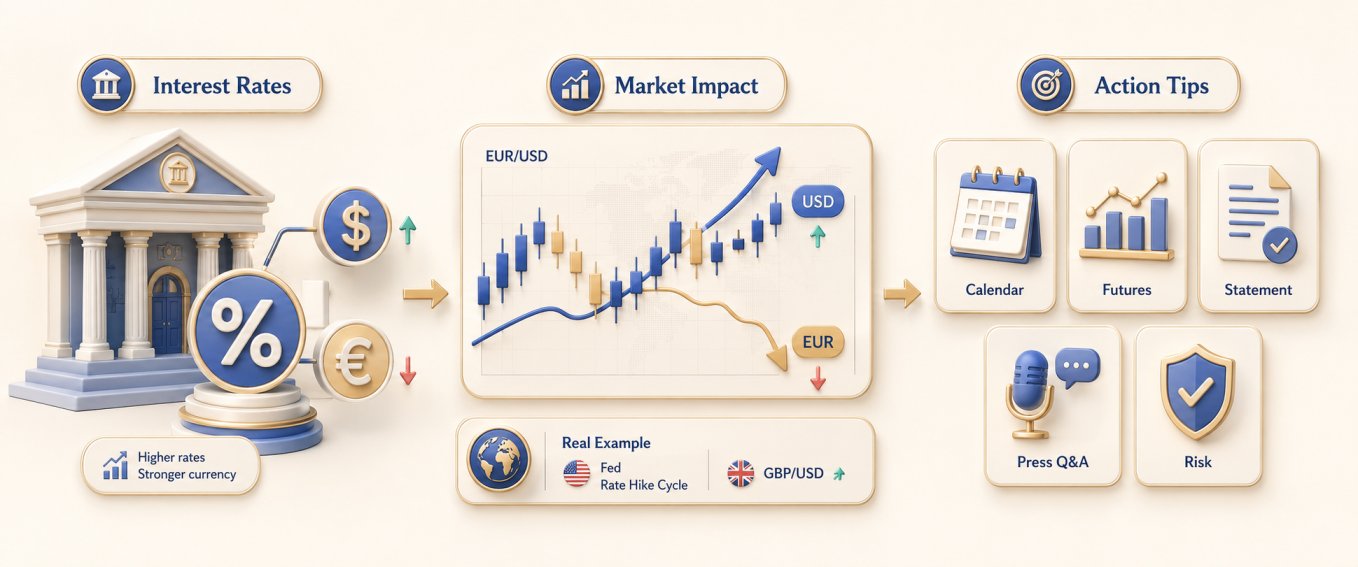
Balancing monetary policy tools is a constant challenge for central bank governors
Key insight: It's not just the rate decision itself that moves markets — it's the expectation. Forex prices are forward-looking. If the market already priced in a 0.25% hike and the central bank delivers exactly that, the currency might barely move. A surprise hike of 0.50%, however, can trigger a massive rally.
Actionable Tips for Rate-Decision Trading
- Mark every central bank meeting date on your economic calendar — these are the highest-impact events you'll trade around.
- Watch interest rate futures and OIS (Overnight Index Swap) markets before the meeting — they show you what's already priced in.
- Pay attention to language in the statement. Words like "gradual" or "patient" signal a slower policy path; "resolute" or "determined" signal urgency.
- The post-decision press conference often moves markets more than the decision itself. Listen for hints about future rate paths.
- Avoid entering large positions right before a central bank announcement unless your risk management is rock solid.
Quantitative Easing and Currency Devaluation
When standard interest rate cuts aren't enough — typically during a severe recession or financial crisis — central banks reach for a more unconventional weapon: quantitative easing, or QE. In simple terms, QE involves a central bank creating new money electronically and using it to buy government bonds or other financial assets from the market.
The goal is to inject liquidity, lower borrowing costs across the economy, and encourage lending and investment. It worked to varying degrees after the 2008 Global Financial Crisis and again during the COVID-19 pandemic, when central banks around the world deployed trillions in QE.
Central Bank Digital Currencies (CBDCs) represent the next evolution in monetary policy tools
The Forex Consequence
For forex traders, QE is a bearish signal for the currency in question — and often a significant one. When a central bank dramatically expands the money supply, the increased volume of that currency in circulation tends to dilute its value. Combine that with artificially suppressed interest rates and you have a recipe for sustained currency weakness.
Japan provides the most extreme example. The Bank of Japan maintained ultra-loose monetary policy — including negative interest rates and massive bond purchases — for years while other central banks tightened. The result was a relentless weakening of the Japanese yen, with USD/JPY climbing from around 100 in 2021 to over 150 in 2023.
- When QE is announced by a major central bank, look for sustained downward pressure on that currency — particularly against higher-yielding alternatives.
- QE phases can last months or years, creating long-term trends ideal for position traders and trend-followers.
- Watch for Quantitative Tightening (QT) — the central bank selling bonds back into the market. QT is generally bullish for the currency.
Central Bank Interventions: When the Market Gets a Jolt
Sometimes, central banks decide the market needs a more direct push. Foreign exchange intervention occurs when a central bank steps into the market and physically buys or sells its own currency to influence the exchange rate. These moments can be explosive — and dangerous for traders caught on the wrong side.
Foreign Exchange Reserves as a Weapon
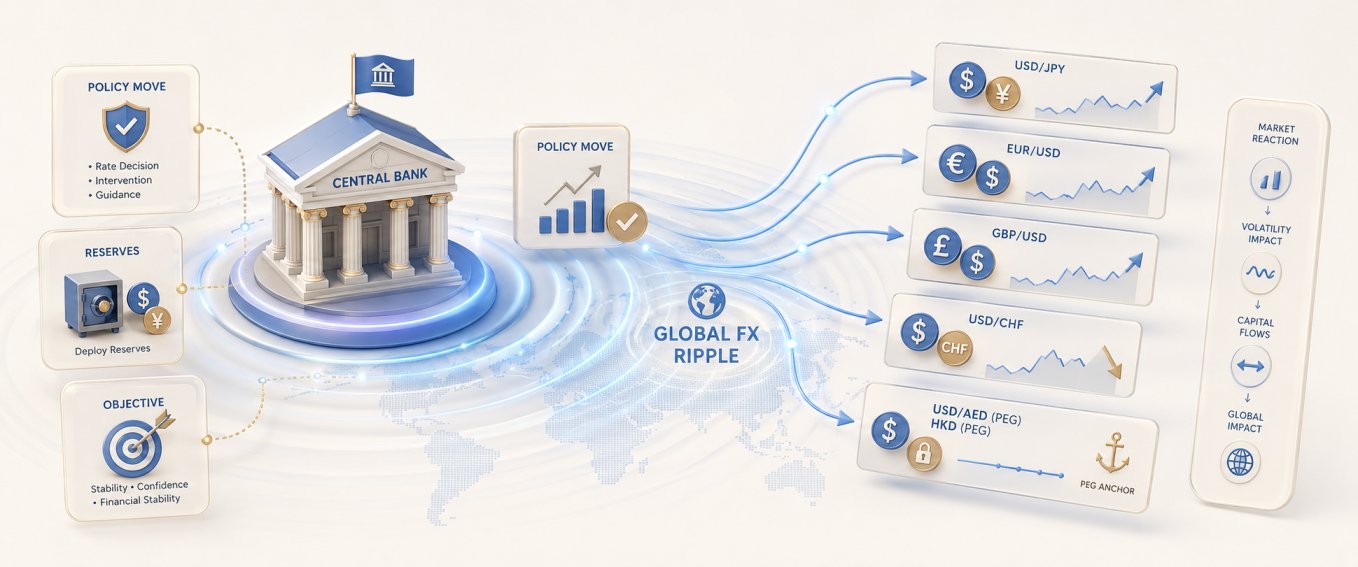
Central banks hold reserves of foreign currencies — primarily US dollars — which they can deploy to defend their domestic currency or prevent excessive appreciation. When a currency falls too far, too fast, the central bank can buy it back, creating an artificial floor. When it rises too quickly and threatens export competitiveness, the bank can sell it to cap the rally.
In 2022, Japan's Ministry of Finance authorised the Bank of Japan to intervene in the FX market for the first time since 1998, buying yen when USD/JPY breached 145 and again near 150. Each intervention triggered sharp, sudden reversals that caught many speculative short-yen positions off guard.
Currency Pegs and Fixed Exchange Rates
Some nations go a step further, pegging their currency to another — usually the US dollar — to maintain stability and predictability for trade and investment. The Saudi riyal, UAE dirham, and Hong Kong dollar are well-known examples. Managing a peg requires continuous central bank activity in the forex market and can create enormous pressure when market forces push hard against the fixed rate.
When a peg breaks — as the Swiss National Bank's EUR/CHF floor did in January 2015 — the consequences can be swift and catastrophic for traders holding positions in the wrong direction. The franc appreciated roughly 30% against the euro in minutes.
Trader warning: Never underestimate a central bank's ability to move a market. When a bank with virtually unlimited resources decides to act, individual traders cannot overpower it. Always respect intervention risk, especially in currencies with known peg defences.
The Interconnectedness of Central Banks
We live in a deeply interconnected global economy, and central banks don't operate in isolation. The decisions made in Washington, Frankfurt, or Tokyo send shockwaves around the world — and savvy traders follow these cross-border effects closely.
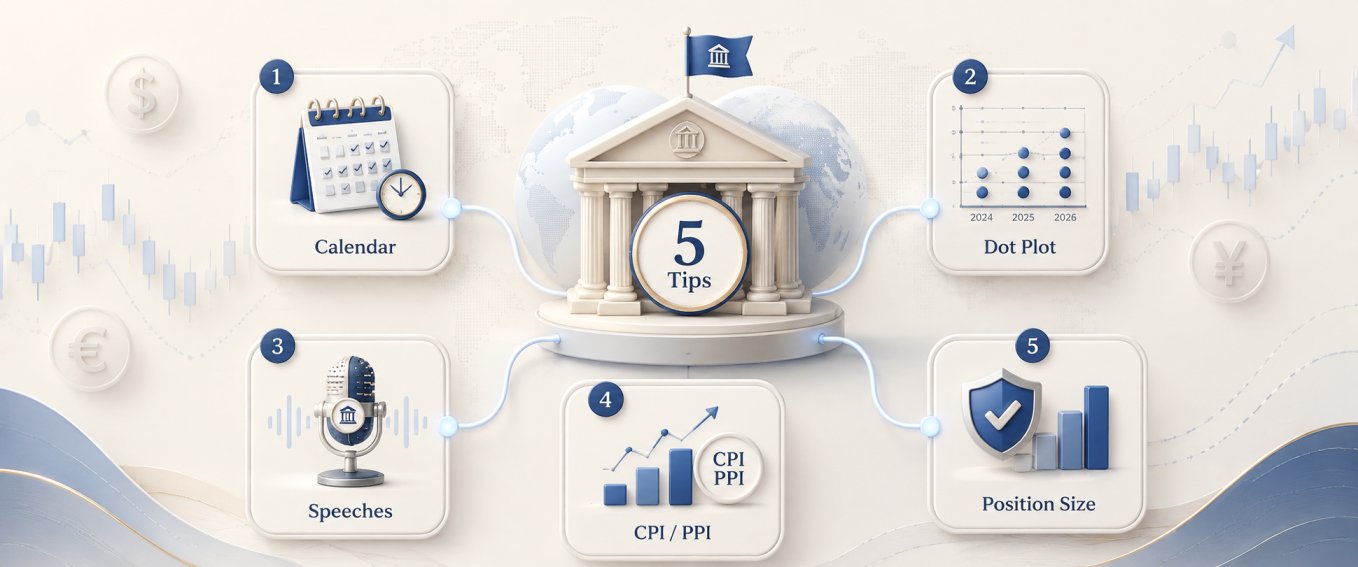
Central bank decisions create ripple effects across all global currency pairs
The Power of Coordination
During major global crises, central banks sometimes act in concert. After the 2008 financial crisis, the Federal Reserve set up currency swap lines with multiple other central banks, allowing them to access dollar liquidity and prevent panic in their own financial systems. These coordinated actions helped stabilise exchange rates and restored confidence to frozen forex markets.
Similarly, during the early stages of the COVID-19 pandemic, multiple central banks slashed rates simultaneously and expanded swap arrangements. The collective signal was clear: liquidity would not be allowed to seize up. Traders who recognised this early moved quickly to buy risk assets and higher-yielding currencies.
Spillover Effects and Carry Trades
When one major central bank diverges significantly from others in its policy direction, it creates powerful carry trade opportunities. Traders borrow in low-interest-rate currencies (like the yen or Swiss franc) and invest in high-interest-rate currencies (like the Australian or New Zealand dollar). When interest rate differentials are wide and stable, carry trades can generate consistent returns — but they can unwind violently when central banks pivot unexpectedly.
- Build a central bank calendar: Know every meeting date for the Fed, ECB, BoE, BoJ, SNB, RBA, RBNZ, and BoC. These dates define your trading month.
- Track the "dot plot" and forward guidance: The Fed's dot plot shows where policymakers expect rates to go over the next two to three years — often more market-moving than the rate decision itself.
- Follow central bank governor speeches: A single speech can shift market expectations by 50+ basis points. Set alerts for scheduled remarks from the Fed Chair, ECB President, and their counterparts.
- Watch inflation data as a leading indicator: CPI and PPI data shape central bank decisions. If inflation is running hot, expect hawkish signals and a stronger currency.
- Use position sizing discipline around high-impact events: Even if you have a strong view, widen your stops or reduce size before a major announcement to protect yourself from the initial volatility spike.
Central banks act as the conductors of the financial symphony, guiding currencies and influencing the melody of global trade.
— Market Wisdom, fxTsignals.comConclusion: Trade With the Central Banks, Not Against Them
The most successful forex traders don't fight central banks — they align with them. By understanding how central banks use interest rates, quantitative easing, foreign exchange reserves, and currency pegs to shape the monetary environment, you gain a massive analytical edge over traders who only look at technical charts.
Central bank policy creates the macro backdrop against which all currency pairs move. The trend is your friend — and central banks are the ones who set the trend. Whether it's a multi-month dollar bull run fuelled by Fed rate hikes, or a persistent yen decline driven by BoJ ultra-accommodation, the biggest and most reliable moves in forex almost always trace back to central bank policy divergence.
Stay informed, stay disciplined, and let the central banks show you the direction. Then ride it with proper risk management and a clear trading plan.
Frequently Asked Questions
When a central bank raises interest rates, it increases the return on investments denominated in that currency, attracting foreign capital and increasing demand. This drives the currency higher against peers. Rate cuts have the opposite effect — reducing the currency's appeal and causing it to weaken. The magnitude of the move depends on whether the decision was expected or a surprise relative to market pricing.
Quantitative easing (QE) is a process where a central bank creates new money to purchase bonds and other financial assets, injecting liquidity into the economy. This expands the money supply significantly, which dilutes the value of each unit of currency already in circulation. Combined with the lower interest rates that typically accompany QE, this makes holding the currency less attractive, causing it to depreciate in the forex market.
Look for verbal intervention first — central bank officials will often use press conferences and speeches to warn that a currency is moving "too fast" or is "misaligned with fundamentals." When a currency approaches historically significant levels or breaks through key technical thresholds, intervention risk rises sharply. Also watch for unusual spikes in trading volume accompanied by sharp reversals, which often signal official buying or selling.
A carry trade involves borrowing in a low-interest-rate currency and investing in a higher-yielding one, profiting from the interest rate differential. Central banks drive these trades by maintaining divergent policy rates. When central banks converge — for example, a low-rate bank suddenly hikes aggressively — carry trades can unwind rapidly, causing sharp, violent moves in the currencies involved. The yen carry trade is the most widely followed example.
The US Federal Reserve is unquestionably the most influential central bank in the world for forex traders. Since the US dollar is involved in roughly 88% of all forex transactions, any shift in Fed policy sends ripples across every major and emerging market currency pair. Serious traders also closely monitor the ECB (for EUR pairs), the BoJ (for JPY pairs), and the BoE (for GBP pairs).
Ready to Trade Smarter With Central Bank Intelligence?
At fxTsignals.com, our expert analysts monitor central bank policy shifts, rate decisions, and monetary policy divergences in real time — so you're always one step ahead of the market.