Algorithmic Trading
Forex Strategy
fxTsignals.com
How to Build Your Own Auto Trading Algorithm: A 4-Step Blueprint Every Forex Trader Needs
Stop guessing. Start executing. Discover the exact framework that transforms raw trading ideas into a fully automated, profit-seeking algorithm — built by you, for you.
By fxTsignals Team | Forex Automation | 8 min read
73%
of daily forex volume driven by algorithms
4
clear steps from idea to live execution
24/7
markets your algorithm never sleeps
$7.5T
daily forex market liquidity
Why Every Serious Forex Trader Should Consider Automation
Let's be real — emotions destroy most trading accounts. Fear makes you exit too early. Greed keeps you in too long. Fatigue causes you to miss the best setups entirely. Sound familiar? That's exactly why automated trading algorithms are no longer just for Wall Street hedge funds or institutional desks.
Today, a forex trader with solid market knowledge and a bit of patience can build a rule-based algorithm that executes trades with zero emotional interference — 24 hours a day, five days a week. And the best part? You don't need to be a computer scientist to get started.
This guide walks you through four practical steps to develop your own auto trading algorithm — from defining your strategy to watching it trade in live markets. Whether you're trading EUR/USD, Gold, or exotic currency pairs, the process is the same.
"The market doesn't reward hard work — it rewards correct systems. Automation is how you make your system consistent."
Before you write a single line of code — or hand anything over to a developer — you need absolute clarity on your trading strategy. This is the brain of your algorithm. Everything else is just execution.
Set Clear, Measurable Trading Goals
Ask yourself a few honest questions: Are you chasing short-term scalping profits, or are you building a swing trading system for longer-term trends? Do you want to target 2–5% monthly returns with tight drawdowns, or are you comfortable with higher volatility for bigger gains? Your answers shape everything — entry timing, position sizes, holding periods, and the kind of indicators your algorithm will rely on.
Pro Tip
Write your strategy as if explaining it to a friend. If you can't describe it clearly in plain language, you can't code it. Vague strategies produce vague — and often unprofitable — algorithms.
Choose Your Instruments and Market Focus
Different markets move differently. Forex pairs like EUR/USD tend to have tight spreads and predictable behaviour during news events. Crypto is volatile and trades round-the-clock. Commodities like Gold and Oil carry different correlations to risk sentiment. Your algorithm should be designed for the specific instrument you know best — don't try to build a universal machine on your first attempt.
Define Your Risk Appetite Upfront
Risk management isn't an afterthought — it's a core design decision. Determine in advance:
- Maximum loss per trade (e.g., 1% of account balance)
- Daily drawdown limit before the algorithm pauses
- Risk-to-reward ratio targets (e.g., minimum 1:2)
- Position sizing method — fixed lot, percentage-based, or volatility-adjusted
- Stop-loss and take-profit logic — fixed pips or dynamic levels
Baking risk rules into the algorithm from day one is what separates systems that survive real markets from those that blow up accounts in two weeks.
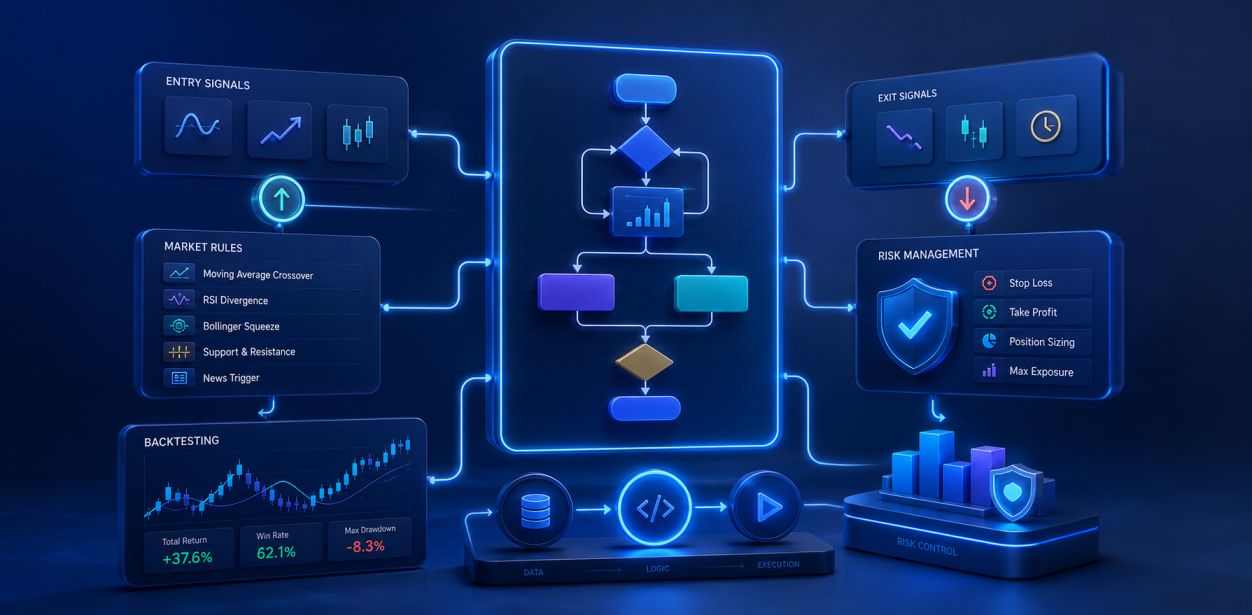
Now that you have a strategy, it's time to translate it into a structured set of logical rules. Think of this as creating a flowchart that your algorithm will follow every single time it scans the market.
Identify Entry and Exit Signals
Entry and exit signals are the heartbeat of your algorithm. These are the exact conditions that must be met before a trade is opened or closed. Common approaches used by forex algo traders include:
- Moving Average Crossovers — Simple, popular, and effective for trend-following strategies
- RSI Divergence — Great for identifying potential reversals in ranging markets
- Bollinger Band Squeeze — Captures breakouts when volatility compresses
- Support and Resistance Breaks — Works across all timeframes
- News-Based Triggers — Algorithms that react to economic data releases
Your signals should be specific and testable. "Buy when the market looks bullish" is not a signal. "Buy when the 20 EMA crosses above the 50 EMA on the 1-hour chart with RSI above 50" — that's a signal you can code.
Build In Risk Management Logic
Every trade your algorithm opens should have a corresponding plan for every possible outcome. Incorporate stop-loss orders that execute automatically. Consider trailing stops that lock in profits as the trade moves in your favour. Add a maximum open positions limit so the algorithm doesn't overexpose you during volatile sessions.
Backtest Before You Build
Backtesting is essentially running your algorithm against years of historical price data to see how it would have performed. This step is non-negotiable. A strategy that looks great on paper can fail catastrophically without proper historical validation. Use platforms like MetaTrader's Strategy Tester or Python-based libraries to simulate thousands of trades across different market conditions — trending, ranging, and high-volatility environments.
"Backtesting won't guarantee future profits, but skipping it almost guarantees future losses."
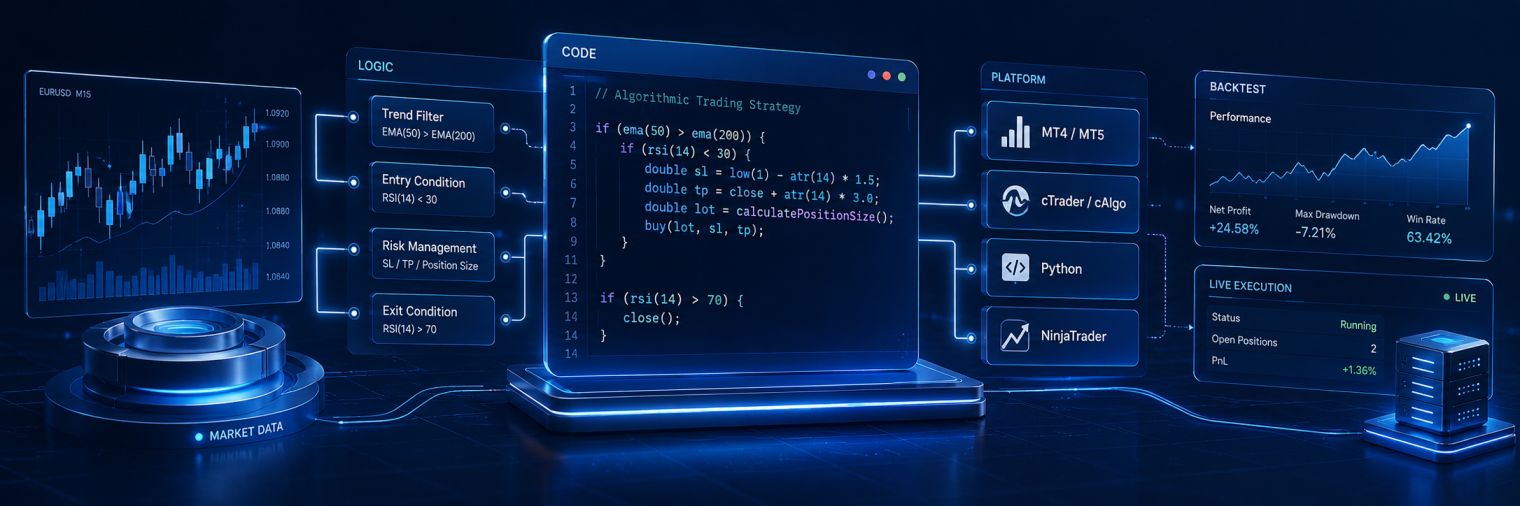
This is where your strategy becomes a living, breathing system. The good news: you have more choices and resources available today than ever before. You don't need a computer science degree — you need the right platform, some patience, and a willingness to learn.
Choose the Right Trading Platform
Platform selection depends on the markets you trade and the level of coding complexity you're comfortable with. Here are the most popular options for forex traders:
- MetaTrader 4 / 5 — Industry standard for forex. Uses MQL4/MQL5 language. Huge community and library of indicators
- cTrader (cAlgo) — Excellent execution quality and C#-based language for those with programming background
- Python + Backtrader or Zipline — Most flexible option for custom strategies; ideal if you want machine learning integration
- NinjaTrader — Popular for futures and forex; uses C# with extensive charting tools
Learn the Required Language (Faster Than You Think)
If you're starting with MetaTrader 5, MQL5 is essentially a stripped-down version of C++. If you're going the Python route, you'll find the language incredibly readable and beginner-friendly. Most traders with zero coding background have built functional algorithms within 4–8 weeks of focused learning. YouTube, official documentation, and communities like MQL5.com forums are incredibly valuable resources.
Write Clean, Tested Code
When coding your algorithm, structure matters. Break your logic into clear functions — one for signal detection, one for order management, one for risk calculation. Comment your code thoroughly. Test every module individually before combining them. Run your code against historical data and verify that every trade it executes matches what your strategy intends. Small bugs at this stage become expensive problems in live trading.
Actionable Tip
Start simple. A two-indicator strategy that you understand completely will outperform a complex multi-factor model that you can't debug when things go wrong. Complexity is the enemy of consistency.
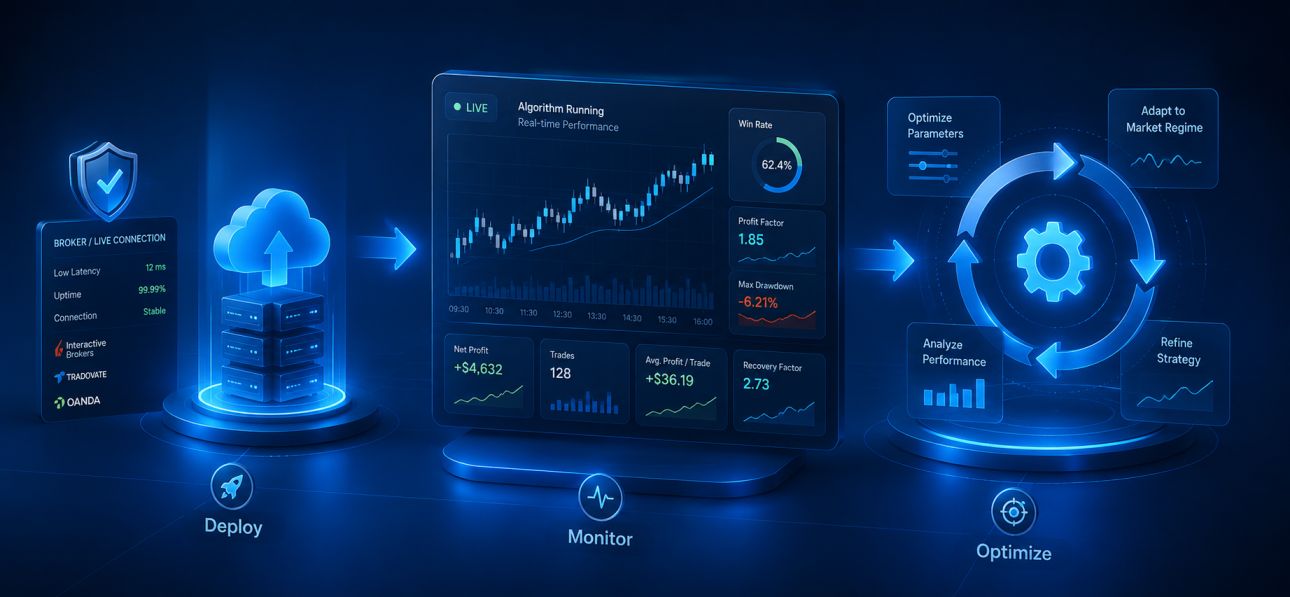
You've defined, designed, and coded your algorithm. Now comes the most exciting — and most disciplined — phase: taking it live. This is where most traders either succeed or make avoidable, costly mistakes.
Select a Reliable, Algorithm-Friendly Broker
Not all brokers support automated trading equally. When choosing your broker for algo deployment, prioritise execution speed and slippage minimisation. Look for ECN or STP execution models that don't trade against your positions. Verify that the broker explicitly allows and supports algorithmic or Expert Advisor trading. Check their VPS (Virtual Private Server) options for 24/7 uptime.
Start Small — Always
Resist the temptation to deploy with significant capital immediately, even if your backtesting results look incredible. Markets shift. Data curves fit. Start with a micro or mini account while your algorithm runs in live conditions. Compare real performance against your backtested expectations over at least 30–50 trades before increasing position sizes. This period also reveals latency issues, broker-specific quirks, and edge cases your backtest may have missed.
Monitor Performance Rigorously
Deployment is not a "set and forget" exercise — at least not at first. Track the following key performance metrics weekly:
- Win rate vs. expected win rate from backtesting
- Average profit per trade and average loss per trade
- Maximum drawdown and recovery time
- Profit factor (gross profit divided by gross loss)
- Sharpe ratio for risk-adjusted return measurement
- Number of trades per week — is it aligned with your strategy's intent?
When live performance deviates significantly from backtested performance, don't panic — investigate. Market regime changes (trending vs. ranging environments) are the most common culprit. Seasonal adjustments, central bank policy shifts, and changes in currency pair correlations all impact algorithm behaviour.
"Your algorithm is not a finished product — it's a living system. The traders who win long-term are the ones who keep refining, not the ones who set and forget."
Frequently Asked Questions
Do I need to know how to code to build a forex trading algorithm?
Not necessarily. While coding skills significantly expand what you can build, platforms like MetaTrader offer drag-and-drop "Expert Advisor" builders for basic strategies. For anything more customised, learning MQL5 or Python basics over a few weeks is very achievable and absolutely worth the investment.
How accurate is backtesting as a predictor of future performance?
Backtesting is a necessary validation tool, not a crystal ball. Good backtesting helps you weed out strategies that clearly don't work historically. However, past performance doesn't guarantee future results. Markets evolve, and a strategy that worked perfectly in 2019–2022 might need adjustment in today's conditions. Always forward-test on a demo account before going live.
What is the biggest mistake traders make when building algorithms?
Over-optimisation — also known as "curve fitting." This is when traders tweak their algorithm parameters so obsessively against historical data that the strategy becomes tailored to the past rather than robust for the future. A good algorithm should perform reasonably well across multiple market conditions, not just the specific period it was tested on.
How much capital do I need to start algorithmic forex trading?
You can technically start with as little as $100–$500 on a micro account to test your algorithm in live market conditions. However, for meaningful statistical analysis of performance, a starting capital of $1,000–$5,000 gives you enough room to measure results without disproportionate impact from spreads and commissions on small trades.
Can I use AI or machine learning in my forex trading algorithm?
Absolutely — and it's becoming increasingly accessible. Python libraries like scikit-learn and TensorFlow allow traders to incorporate predictive models that adapt to changing market conditions. That said, AI-powered algorithms require significantly more data, validation, and ongoing maintenance. For most forex traders starting out, a well-designed rule-based system is a better foundation than jumping straight to machine learning.
Conclusion: Your Edge Is Waiting to Be Built
Automated trading isn't a shortcut — it's a discipline. But it's one of the most powerful disciplines a forex trader can develop. By following the four steps outlined in this guide — defining your strategy, designing your algorithm logic, coding it with precision, and deploying it with careful monitoring — you're not just building a system. You're building consistency.
The traders who thrive long-term in forex markets are not necessarily the ones with the sharpest instincts. They're the ones with the most consistent, emotionless, well-tested processes. An algorithm is exactly that.
At fxTsignals.com, we believe every serious trader deserves the tools and knowledge to compete at the highest level. Whether you're on your first algorithm or optimising your fifth, the principles in this guide remain your foundation. Define it clearly. Design it thoroughly. Code it carefully. Deploy it patiently. Then refine it relentlessly.
The market is open — and so is the opportunity.
Ready to Automate Your Forex Edge?
Join thousands of traders using fxTsignals.com for premium signals, strategy insights, and algorithmic trading resources — all in one place.
Start Copy Trading →