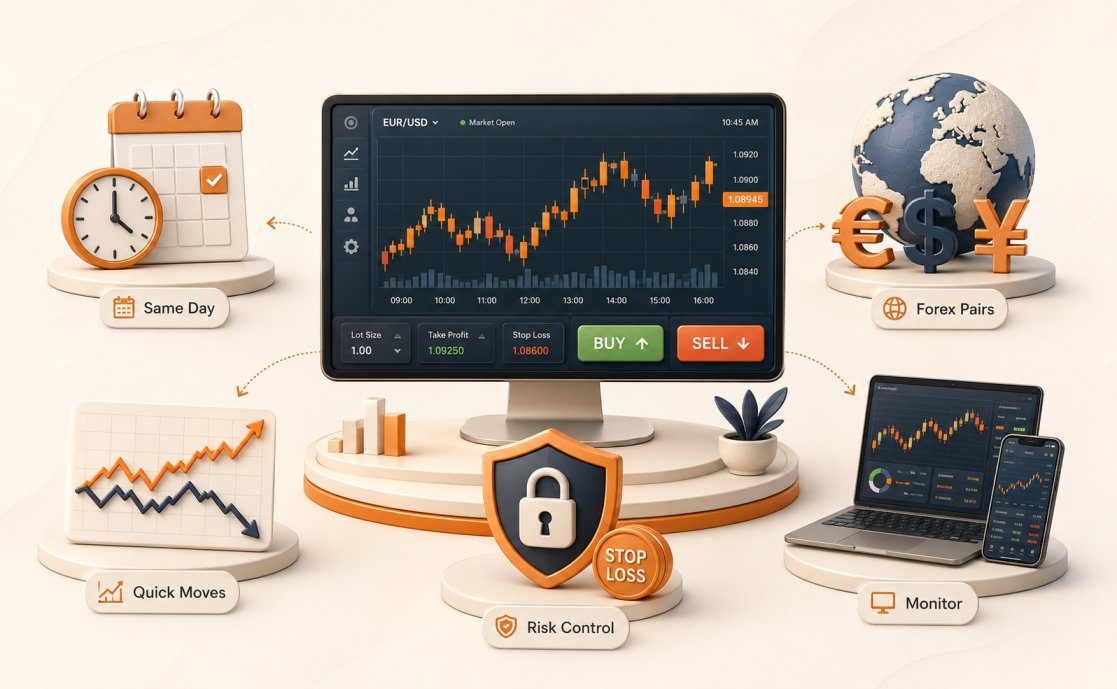
Day trading in the forex market offers unmatched liquidity, 24-hour access, and the potential for consistent daily profits — but only for those who approach it with the right knowledge, discipline, and risk controls. This guide covers everything you need to know: from understanding what day trading really means in forex, to technical analysis, risk management, building a trading plan, and knowing which instruments suit your style.
What Is Day Trading in the Forex Market?
Day trading in forex refers to the practice of opening and closing currency positions within the same trading day — meaning no trades are held overnight. Unlike swing traders or position traders who may hold for days or weeks, a forex day trader seeks to capitalise on short-term intraday price movements, typically capturing gains of 10–80 pips per trade.
The forex market is the ideal environment for day trading. With over $7 trillion in daily volume, it is the most liquid financial market in the world. Major pairs such as EUR/USD, GBP/USD, and USD/JPY move consistently during key sessions, providing ample opportunities every single trading day.
Key Characteristics of Forex Day Trading
- All positions opened and closed within the same trading session
- Focus on technical analysis and intraday chart patterns
- Typically uses timeframes of M1, M5, M15, H1, or H4
- Relies on leverage to amplify smaller intraday price movements
- Requires real-time execution and a fast, reliable trading platform
Risk Management Techniques for Day Traders

Risk management is the single most important skill in forex day trading. Regardless of how good your strategy is, without proper risk controls you will inevitably blow your account. The most successful day traders are not those who win the most — they are those who lose the least when they are wrong.
Every professional day trader operates within a strict risk framework that defines how much capital is at risk per trade, what the maximum daily drawdown is, and when to stop trading for the day.
Essential Risk Management Rules
- Never risk more than 1–2% of total capital on a single trade
- Always use a stop-loss — no exceptions, ever
- Target a minimum 1:2 risk-to-reward ratio on every entry
- Set a daily maximum loss limit (e.g. 3–5% of account) and stop trading if hit
- Avoid trading during high-impact news events unless specifically planned
- Keep position sizes consistent — never revenge trade after losses
If your account is $10,000, risk no more than $100 per trade. This means a losing streak of 10 consecutive trades only draws down your account by 10% — which is fully recoverable. Most traders who blow accounts break this rule repeatedly.
Developing a Solid Day Trading Plan

Trading without a plan is gambling. A forex day trading plan is your rulebook — it defines exactly what you trade, when you trade, how you manage risk, and what constitutes a valid entry signal. Traders who follow a written plan consistently outperform those who trade on instinct alone.
Your trading plan does not need to be complex. In fact, the simpler it is, the more likely you are to follow it under the pressure of live market conditions.
Core Elements of a Day Trading Plan
- Define which currency pairs you will trade (maximum 3–4)
- Specify which sessions you will be active during
- Write out your exact entry criteria — what triggers a trade?
- Define your stop-loss method (fixed pip, ATR-based, or structure-based)
- Define your take-profit method (fixed R:R, key level, or trailing stop)
- Set your maximum daily trade count (e.g. 5 trades per day)
- Write rules for when NOT to trade (news events, low volatility, emotional state)
- Include a post-session journaling requirement every day
Types of Securities Day Traders Can Trade
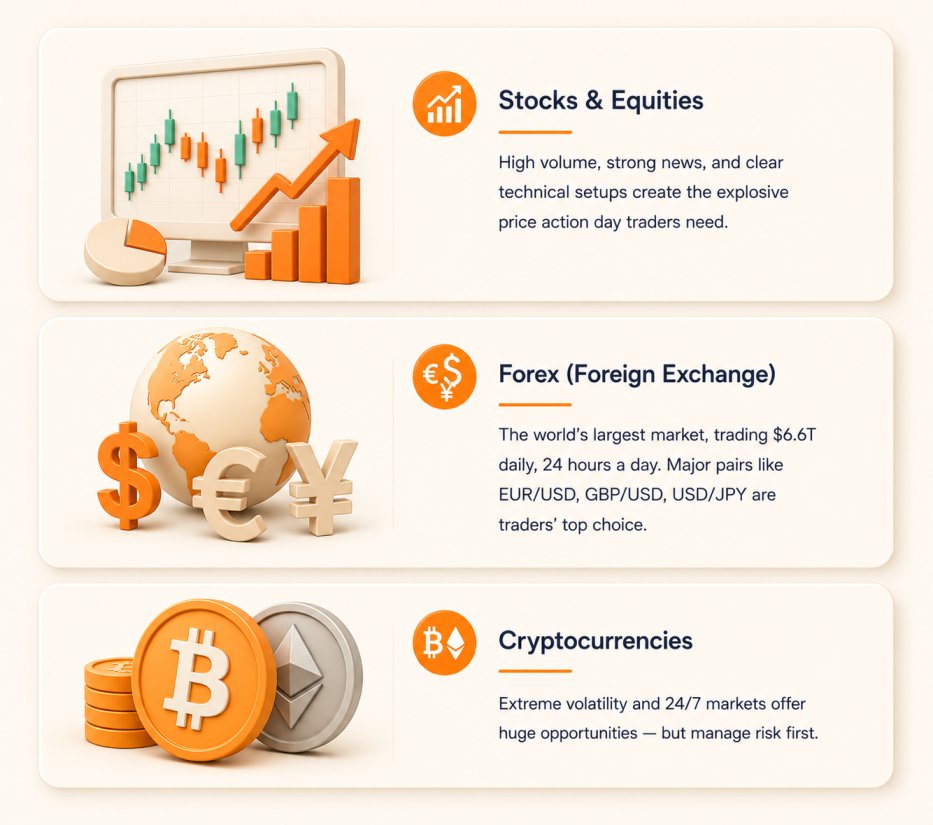
While this guide focuses on forex day trading, it is important to understand where forex fits within the broader universe of tradeable assets. Day traders operate across various markets, and understanding their differences helps you choose the right vehicle for your style and capital.
For most beginners, starting with 1–2 major forex pairs (EUR/USD or USD/JPY) is advisable before diversifying into other asset classes. Mastering one market deeply is far more profitable than spreading attention across many.
Technical Analysis: Identifying Entry & Exit Points
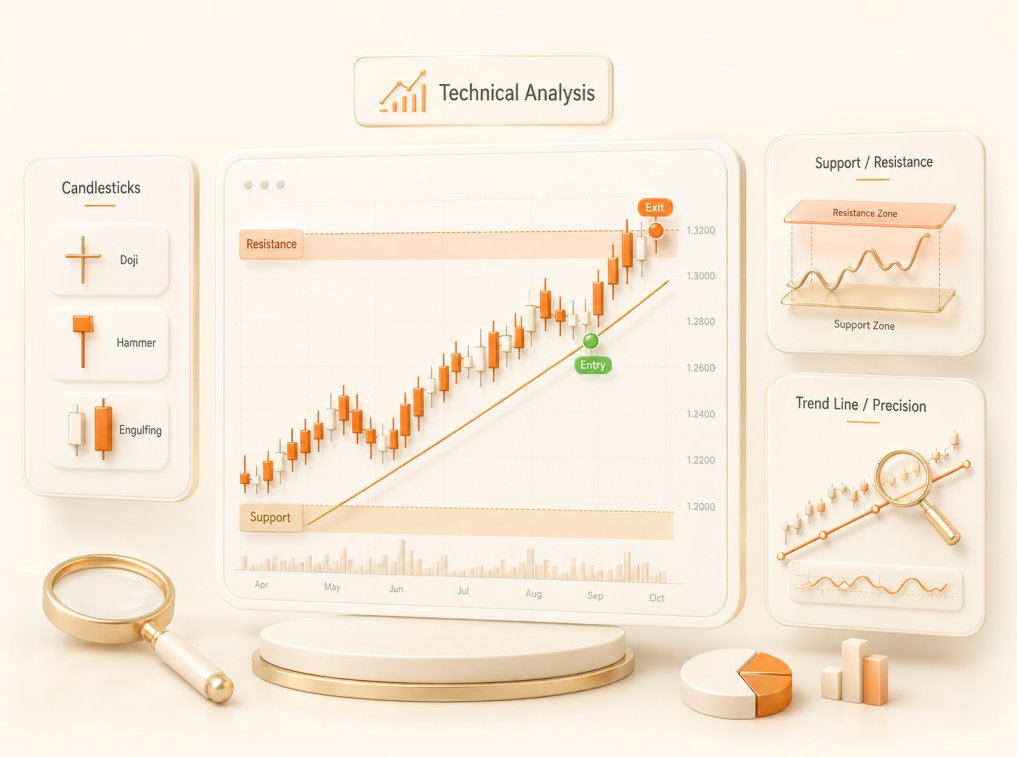
Technical analysis is the backbone of forex day trading. Unlike fundamental analysis — which examines economic data and central bank policy — technical analysis focuses entirely on price action, chart patterns, and mathematical indicators to forecast short-term price direction.
The goal is simple: identify high-probability setups where the potential reward significantly outweighs the risk, and execute with discipline at the right moment.
Key Technical Analysis Concepts for Day Traders
- Support & Resistance: Price levels where buying or selling pressure historically reverses
- Trend Lines & Channels: Visual guides for the current directional bias
- Candlestick Patterns: Pin bars, engulfing candles, and doji signal high-probability reversals
- Break & Retest: Wait for a breakout of a key level, then enter on the retest for confirmation
- Volume Analysis: Confirms the strength behind a price move or breakout
- Multi-Timeframe Analysis: Align M15 entries with H4 or daily trend direction
Common Technical Indicators Every Day Trader Should Know
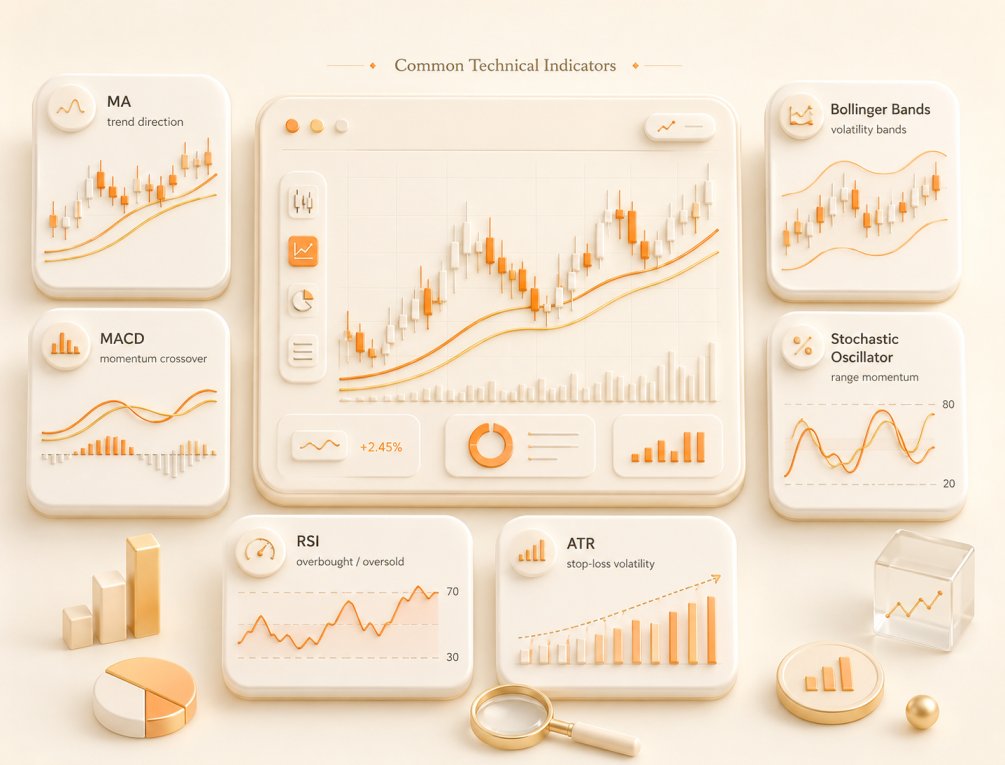
Indicators are mathematical tools applied to price data to help traders identify trends, momentum, overbought/oversold conditions, and volatility. The key is not to pile on as many indicators as possible — doing so leads to paralysis and conflicting signals. Most professional traders use a maximum of 2–3 indicators that complement each other.
Back-Testing and Paper Trading: Build Confidence Before Going Live
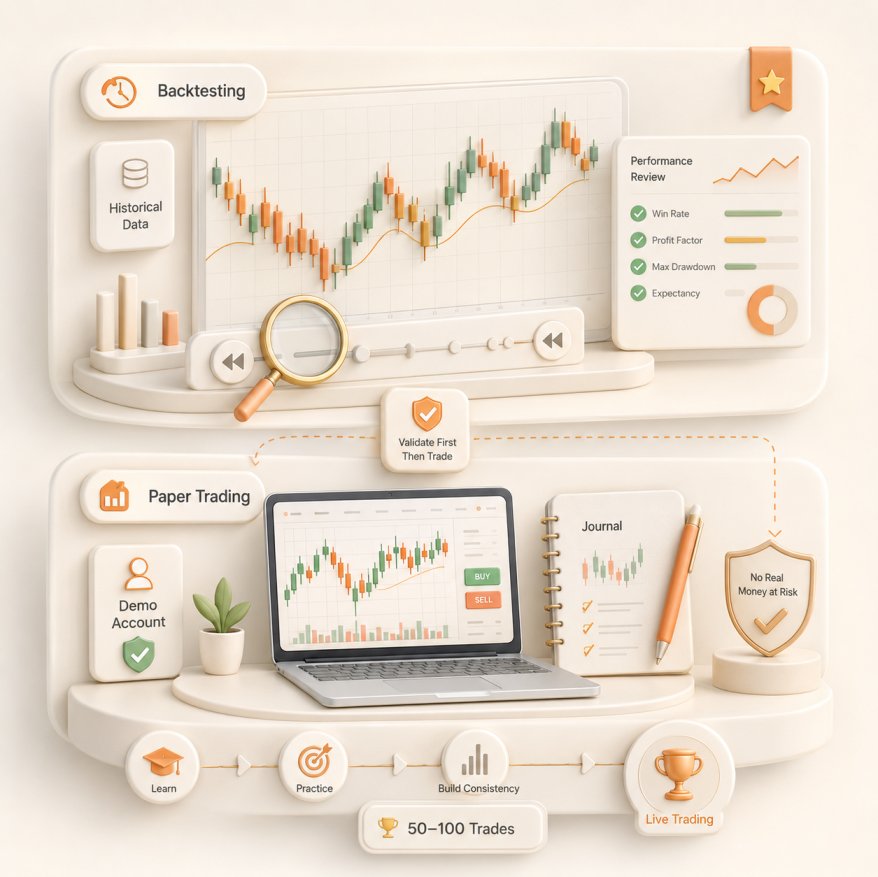
No professional trader deploys real capital on an untested strategy. Back-testing — reviewing your strategy against historical price data — and paper trading (simulated real-time trading without real money) are essential steps before committing your capital to the live market.
Back-testing reveals your strategy's win rate, average risk-to-reward, maximum drawdown, and overall expectancy. This data gives you the statistical confidence to execute your plan without hesitation during live sessions.
How to Back-Test a Forex Day Trading Strategy
- Define your entry and exit rules clearly in writing
- Open a historical chart of your chosen pair on MT4/MT5 or TradingView
- Scroll back 6–12 months and manually review each potential trade signal
- Record every entry, stop-loss, and take-profit in a spreadsheet
- Calculate win rate, average R:R, and monthly expectancy
- A strategy with 50%+ win rate and 1.5:1+ R:R is generally viable for live trading
Trade your demo account exactly as you would with real money. Use the same position sizes, same risk rules, and trade at the same times of day. Most traders should paper trade for at least 1–3 months and achieve consistent results before going live.
Sector and Market Analysis for Smarter Day Trading
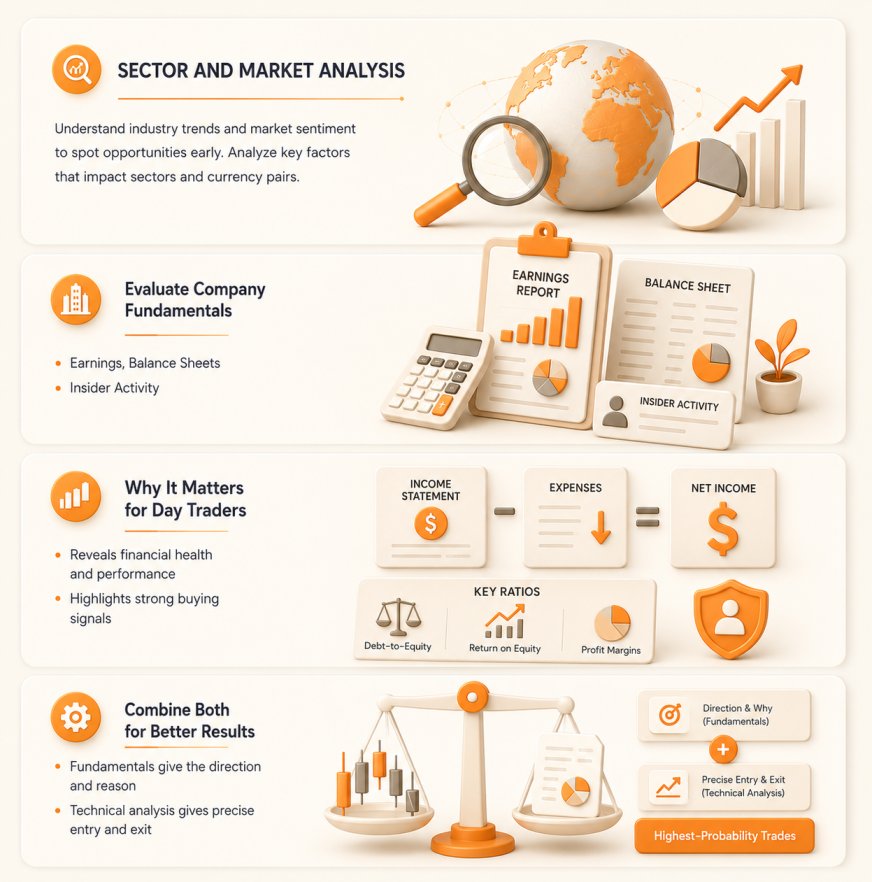
Even the most technically-focused forex day trader benefits from understanding the broader macroeconomic landscape. Knowing which economies are strong, which central banks are hawkish or dovish, and which sectors are driving risk sentiment can dramatically improve your trade selection and timing.
This is not about trading the news — it is about understanding the context within which your technical setups are forming. A bearish technical setup on a currency whose central bank just signalled rate cuts is a far higher-probability trade than the same pattern in a vacuum.
Key Areas of Market Analysis for Day Traders
- Central Bank Policy: Fed, ECB, BoE rate decisions drive major currency direction
- Economic Calendar: NFP, CPI, GDP releases create volatility windows to be aware of
- Risk Sentiment: Risk-on favours AUD, NZD; risk-off favours USD, JPY, CHF
- Intermarket Analysis: Correlations between gold, DXY, equities, and oil inform currency bias
- Session-Specific Themes: Asian session drives JPY; London drives EUR/GBP; NY drives USD pairs
Before opening any chart, spend 10–15 minutes reviewing the economic calendar, overnight news, and how correlated markets (gold, DXY, S&P 500) have moved. This gives you the macro context to filter your technical setups with far greater confidence.
Frequently Asked Questions
Professional Trading Edge
Ready to Trade With a Professional Edge?
Join thousands of traders who access institutional-grade forex signals and managed accounts through FXT Signals — built for performance, trusted by HNW investors.