
Why Market Mood Matters More Than You Think

Picture two traders staring at the same EUR/USD chart. Same candlesticks, same moving averages — yet they reach opposite conclusions. Why? One is reading the price. The other is reading the people behind the price. That second trader has a tool most beginners overlook entirely: forex sentiment analysis.
At its core, forex sentiment analysis is about understanding the collective mood of market participants — the fear, optimism, caution, and greed that drive billions of dollars in currency trades every single day. When you tap into that emotional undercurrent, you stop chasing the market and start anticipating it.
This guide breaks down exactly what forex sentiment analysis is, how it works in practice, which tools to use, and how to incorporate it into a strategy that actually performs. Whether you're placing your first trade or refining an existing approach, this knowledge will fundamentally change how you see the market.
What Exactly Is Forex Sentiment Analysis?
Forex sentiment analysis is the process of measuring the overall attitude of traders toward a particular currency pair. It answers a deceptively simple question: Is the crowd bullish or bearish right now?
Market Sentiment vs. Market Data
Market data tells you what prices have done. Sentiment analysis tells you what traders are likely to do next. The distinction is critical. A currency can be statistically overbought yet still climb because sentiment remains deeply bullish. Data explains the past; sentiment shapes the future.
Three primary forces shape market sentiment in forex trading:
- Economic data — GDP growth, inflation figures, and employment numbers can swing sentiment dramatically. Strong data breeds optimism; weak data triggers fear.
- News and geopolitical events — A surprise interest rate decision or political crisis can flip market mood within minutes, creating rapid sentiment shifts that technical analysis alone won't capture.
- Investor confidence — When confidence in an economy runs high, money flows into that currency. Uncertainty or instability drives the opposite — capital flight and bearish sentiment.
Understanding these forces means you can read the room before the price officially reacts. That time advantage, even if measured in hours rather than seconds, is extraordinarily valuable in a market as fast-moving as forex.
How Forex Sentiment Analysis Actually Works
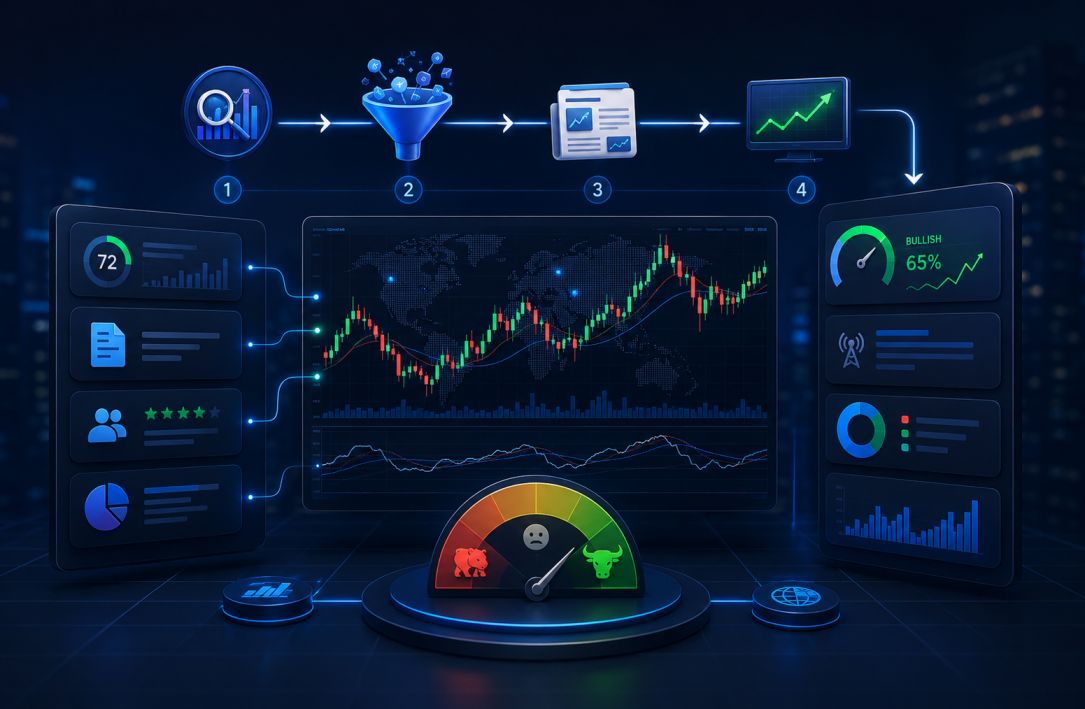
The process isn't a single action — it's a layered approach that combines several types of data to build a complete picture. Here's how experienced traders do it:
Step one is reading sentiment indicators. These tools give you quantified data on how traders are positioned. Are retail traders overwhelmingly long on USD/JPY? That's a meaningful signal — and often a contrarian one.
Step two is filtering through fundamental analysis. Sentiment doesn't exist in a vacuum. You need to understand the economic backdrop. If the Federal Reserve just signalled a rate hike, USD bullish sentiment is likely to surge. Matching sentiment to fundamentals confirms whether a move has legs.
Step three is monitoring news and social media. Financial news headlines and analyst commentary often reflect — and amplify — existing sentiment. They can also act as early warning signals before sentiment officially shifts in the indicators.
Step four is analysing price action. Volume spikes, breakouts, and candlestick patterns all carry sentiment information embedded in them. A long bullish wick on heavy volume tells a story about buyer conviction that no indicator fully captures on its own.
The Top Forex Sentiment Indicators Every Trader Needs
Not all sentiment tools are created equal. Here are the six that professional traders at FxT Signals rely on most:
COT Report
Published weekly by the CFTC, it reveals positions of commercial traders, non-commercial speculators, and retail traders — giving a transparent view of who's buying and who's selling.
Open Interest
Tracks the total number of active contracts. Rising open interest confirms a strong trend; falling open interest often signals a potential reversal approaching.
Sentiment Index
Aggregates long-vs-short positioning of retail traders on major pairs. When most traders are one-sided, the contrarian opportunity often emerges — markets love to punish the crowd.
Economic Releases
Jobs data, GDP reports, and central bank statements aren't just fundamental events — they're sentiment catalysts. How the market reacts (not just what the data says) tells you everything.
Price Patterns
Recognisable chart patterns like double tops or flags encode collective market psychology. A bearish engulfing candle shows the shift in control between buyers and sellers.
Broker Sentiment Tools
Many brokers now offer real-time dashboards showing client positioning. While limited, they provide useful immediate snapshots of retail sentiment in live markets.
A Real-World Example That Actually Makes Sense
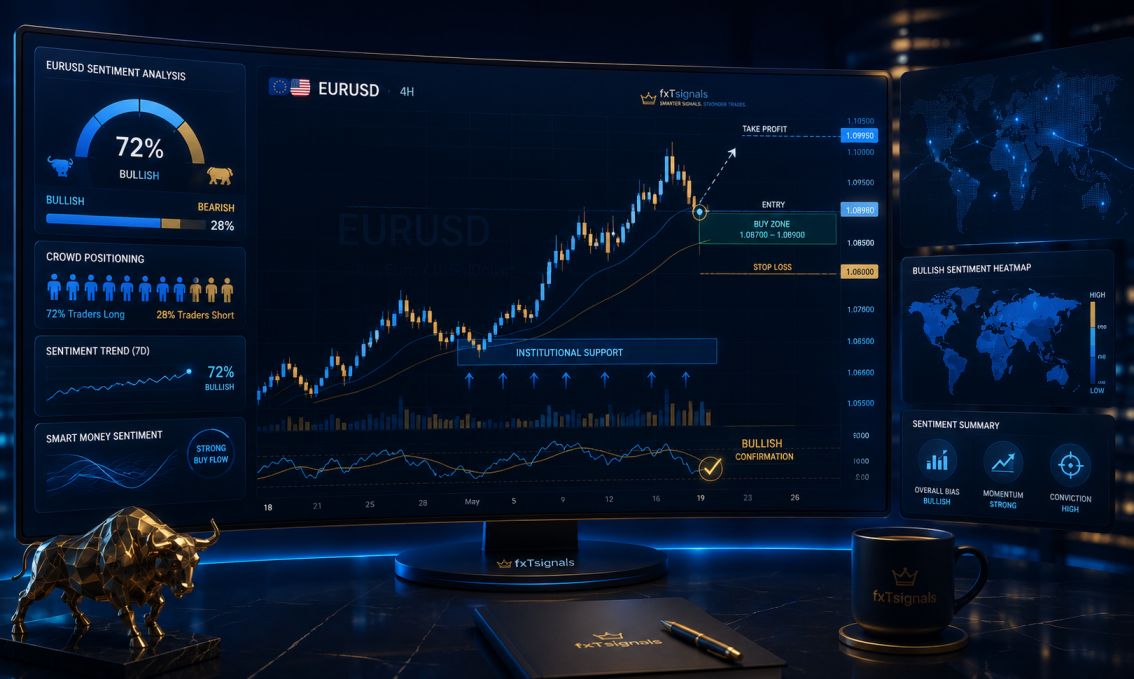
Let's walk through a practical scenario. Suppose you're watching the EUR/USD pair during a period of economic turbulence in the Eurozone. Headlines are negative, retail traders are piling into short positions, and the euro has been sliding steadily. General market mood? Deeply bearish.
The Contrarian Signal
Here's where it gets interesting. While retail traders are rushing to sell, the COT report reveals that large institutional speculators — the "smart money" — have actually been quietly increasing their long positions on the euro. This divergence between retail sentiment and institutional positioning is one of the most powerful signals in forex trading.
A trader reading this combination of signals — overwhelmingly bearish retail sentiment plus quietly bullish institutional positioning — could reasonably interpret it as a setup for a potential reversal. If the euro then shows a bullish price action signal (say, a strong rejection candle at a key support level), that's three separate indicators converging on the same trade.
In the weeks that follow in this example, the euro reverses and climbs significantly. The trader who combined sentiment analysis with smart technical entry points would have caught much of that move — while those relying on news headlines alone were still positioned short.
The market is not driven by numbers alone — it's driven by the people interpreting those numbers. Understand the crowd, and you understand what comes next.
— FxT Signals Trading Desk
The Real Benefits of Using Sentiment Analysis
Here's why integrating sentiment analysis into your trading approach is worth the learning curve:
- Better Trend Identification Sentiment analysis helps you spot whether a trend has genuine momentum or whether it's running out of steam. When sentiment aligns with price direction, you can trade with far more confidence.
- Early Reversal Detection Extreme sentiment readings — where an overwhelming majority of traders are on one side — often precede reversals. Getting in before the crowd turns around is where real profit lives.
- Stronger Risk Management Knowing how other traders are positioned helps you size risk appropriately. If you're trading against prevailing sentiment, smaller positions with wider stops make sense. If sentiment is on your side, you can scale up with more conviction.
- Smarter Entry and Exit Timing Sentiment indicators help you refine your timing. Entering a trade when sentiment is turning — rather than when it's already shifted — means better entries and more room to let profits run.
- Confirmation Layer When fundamental analysis and technical setup both align with sentiment, you have a genuinely high-conviction trade. That triple confirmation dramatically improves your win rate over time.
Limitations You Must Know (Honest Talk)
No tool is perfect, and sentiment analysis is no exception. Being aware of its weaknesses is what separates a disciplined trader from a reckless one.
- It's a lagging indicator. Sentiment data reflects past positioning. By the time you've identified a shift, the fastest part of the move may already be over. Pair it with leading indicators to offset this.
- Interpretation is subjective. Two traders looking at the same COT report can reach opposite conclusions. There's no single "correct" reading — context and experience matter enormously.
- Data quality varies. Not all sentiment sources are equally reliable or timely. Always verify where your data comes from and how recently it was updated.
- Markets can be manipulated. Large institutional players sometimes create false sentiment signals to flush retail traders out before reversing. Healthy scepticism is essential.
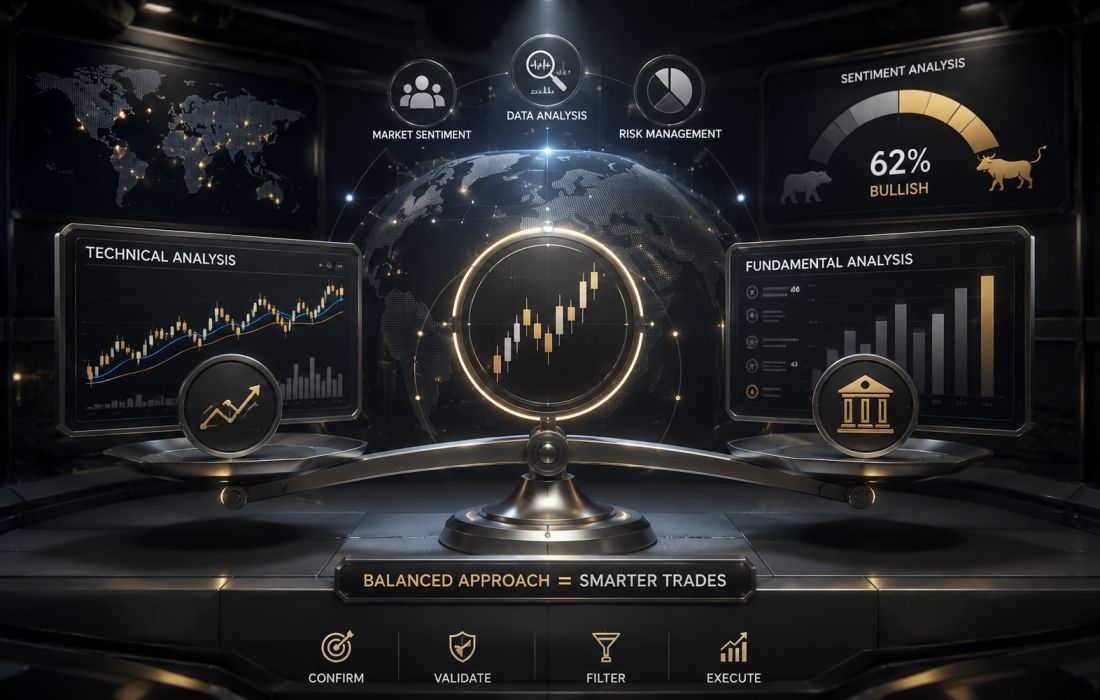
- Never use it in isolation. Sentiment analysis is a lens, not a complete strategy. The traders who succeed are those who integrate it intelligently with technical and fundamental analysis.
5 Actionable Tips to Start Using Sentiment Analysis Today
Ready to put this into practice? Here's how to get started without overwhelming yourself:
- Bookmark the CFTC COT Report Page It's free, published every Friday, and packed with positioning data on all major currency futures. Make it a weekly ritual to review it before markets open Monday.
- Choose One Currency Pair and Master Its Sentiment Don't try to track sentiment across 20 pairs at once. Pick EUR/USD or GBP/USD, understand what typical sentiment looks like, and you'll quickly develop an eye for abnormal extremes.
- Use Your Broker's Sentiment Dashboard Many reputable brokers provide free tools showing client long/short ratios. Check this before every trade entry to see if you're swimming with or against the retail crowd.
- Watch for Extreme Readings When 80%+ of retail traders are positioned on one side, be alert. These extremes don't always reverse immediately — but they're warning signs that a significant move may be coming.
- Journal Your Sentiment Calls Keep a trading journal that records the sentiment context of every trade. Over time, you'll develop pattern recognition that no indicator can teach you on its own.
Frequently Asked Questions
For beginners, the broker sentiment tool showing long vs. short ratios is the easiest to access and interpret. Once comfortable, graduate to the COT report, which provides deeper institutional-level insights. Start simple, then layer in complexity as your understanding grows.
Not reliably. Sentiment analysis works best as one component of a broader strategy. Relying on it alone ignores price action, economic fundamentals, and market structure — all of which are essential for making consistently profitable decisions.
Swing traders typically review sentiment weekly — especially the COT report — before planning the week's trades. Day traders may check broker sentiment dashboards before each session. The key is consistency: make it a structured part of your pre-trade routine.
Extreme retail sentiment — such as 85% of retail traders being long on a pair — is often interpreted as a contrarian signal. The reasoning: if most retail traders are already positioned one way, the majority of buying has already happened. Institutional players may be positioned opposite, setting up a potential reversal.
Yes, though in different ways. Swing and position traders benefit most from weekly COT data and macro sentiment shifts. Day traders lean more on intraday broker sentiment tools and news-driven sentiment spikes. Scalpers may find it less directly actionable but can still use it to confirm the broader directional bias.
Final Thoughts: Feel the Market, Don't Just Read It
Forex markets are ultimately a reflection of human behaviour — ambition, fear, confidence, and panic all expressed through buy and sell orders. When you learn to read that emotional landscape through sentiment analysis, you gain something no chart pattern or economic model can fully give you: context.
Use the COT report to track institutional positioning. Monitor your broker's sentiment dashboard before each trade. Watch for the extreme readings that signal potential reversals. And always, always combine what sentiment tells you with the broader technical and fundamental picture.
The traders who thrive long-term aren't the ones with the most complex systems. They're the ones who consistently understand why prices move — and sentiment analysis is one of the most powerful tools for answering exactly that question.
Ready to trade smarter? FxT Signals is here to help you every step of the way.
Start Trading with Sentiment Intelligence
Get real-time forex sentiment signals, COT analysis, and expert trade ideas delivered straight to your device. Join thousands of traders already using FxT Signals to stay ahead of the market.