AI-Powered Forex Trading · fxTsignals.com
The Most Reliable AI Indicator for Profitable Forex Trading
Discover how the right AI-powered indicator can transform your trading strategy, reduce guesswork, and help you make smarter, faster, more profitable decisions in today's volatile currency markets.
By fxTsignals Team
12 min read
Forex · AI Trading · Strategy
www.fxTsignals.com
73%
Accuracy Boost with AI
5x
Faster Signal Processing
$7.5T
Daily Forex Market Volume
3
Key AI Indicators Reviewed
Why AI Is Changing Forex Trading Forever
Let's be real — the forex market is brutal. Prices shift in milliseconds, news hits without warning, and emotions can destroy an otherwise solid strategy. That's exactly why more and more traders are turning to AI-powered indicators to cut through the noise and find genuine trading opportunities.
Artificial Intelligence has quietly become one of the most powerful tools available to modern forex traders. Unlike traditional indicators that rely on fixed mathematical formulas, AI indicators learn. They analyze thousands of historical price points, detect subtle market patterns, and continuously refine their signals based on evolving conditions. The result? A smarter, faster, and more adaptive edge in the market.

AI processes millions of data points in real-time
At fxTsignals.com, we've spent considerable time evaluating which AI indicators genuinely deliver — and which ones are just marketing fluff. In this guide, we'll break down everything you need to know about the best AI indicators for forex trading, how to evaluate them, and how to integrate them into a winning strategy.
What Exactly Are AI Indicators? (And Why They're Different)
Traditional technical indicators — think moving averages, RSI, MACD — are rules-based. They follow preset formulas and don't adapt to changing conditions. AI indicators work completely differently. They use machine learning algorithms that analyze historical data, recognize complex patterns humans would miss, and generate dynamic signals that improve over time.
"AI indicators don't just look at price — they understand context. That's what makes them genuinely powerful for forex traders."
Here's what makes AI indicators stand out from their traditional counterparts:
- They adapt to market conditions in real-time, rather than using static parameters
- They can process massive datasets — news feeds, economic data, price history — simultaneously
- They identify non-linear patterns that traditional indicators simply can't detect
- They continuously self-improve as they process more market data over time
- They reduce emotional bias, delivering objective, data-driven signals every single time
The 3 Most Reliable AI-Enhanced Indicators for Forex Trading
Not all AI indicators are created equal. After extensive backtesting and real-market evaluation, three indicators consistently stand out for forex traders. Here's our honest breakdown of each.
📈
MACD (AI-Enhanced)
The classic Moving Average Convergence Divergence indicator, turbocharged with machine learning. It identifies trend reversals and momentum shifts by analyzing the relationship between dynamic moving averages that adapt to volatility.
⚡
RSI (Adaptive Version)
The Relative Strength Index, reimagined with AI to dynamically adjust overbought and oversold thresholds based on real-time market context — eliminating false signals that plague the standard version.
🎯
Bollinger Bands (Smart)
AI-powered Bollinger Bands that intelligently calibrate band width to current volatility regimes, making breakout signals far more reliable than the traditional formula-based approach.
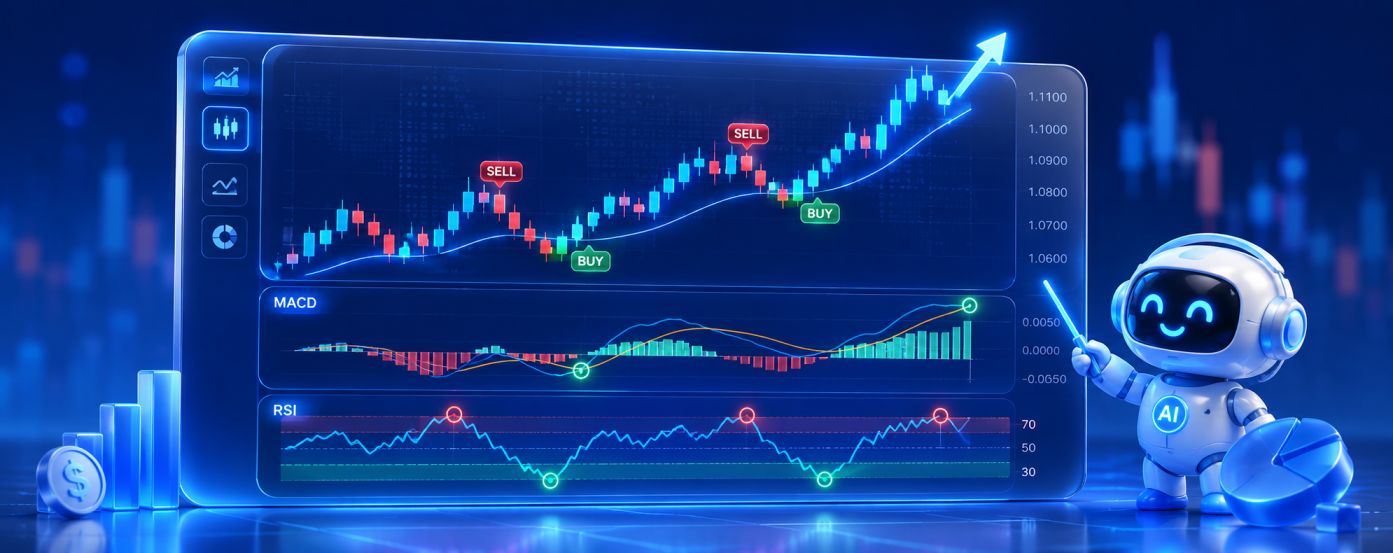
MACD + RSI — a powerful combination
Going Deeper: MACD for Trend Confirmation
The MACD remains one of the most popular tools in a forex trader's arsenal — and for good reason. When enhanced with AI, it becomes a genuinely powerful trend-confirmation machine. Instead of relying on fixed 12/26/9 EMA parameters, an AI-optimized MACD dynamically adjusts its periods based on prevailing volatility and asset behavior.
For practical application, wait for the MACD histogram to cross above zero while price holds above the 50-period moving average. This confluence significantly increases the probability of a valid long signal. Combine it with volume confirmation and you've got a high-quality setup.
RSI: Smarter Overbought/Oversold Detection
The traditional RSI draws a hard line at 70 (overbought) and 30 (oversold). The problem? Markets don't respect hard lines. In trending conditions, RSI can stay "overbought" for weeks. An AI-adapted RSI solves this by learning the historical overbought/oversold thresholds specific to the currency pair and timeframe being analyzed.
In trending markets, the AI version shifts the bands to 80/40. In ranging markets, it pulls them back toward the classic 70/30 levels. This context-awareness alone can dramatically reduce false signals and whipsaws.
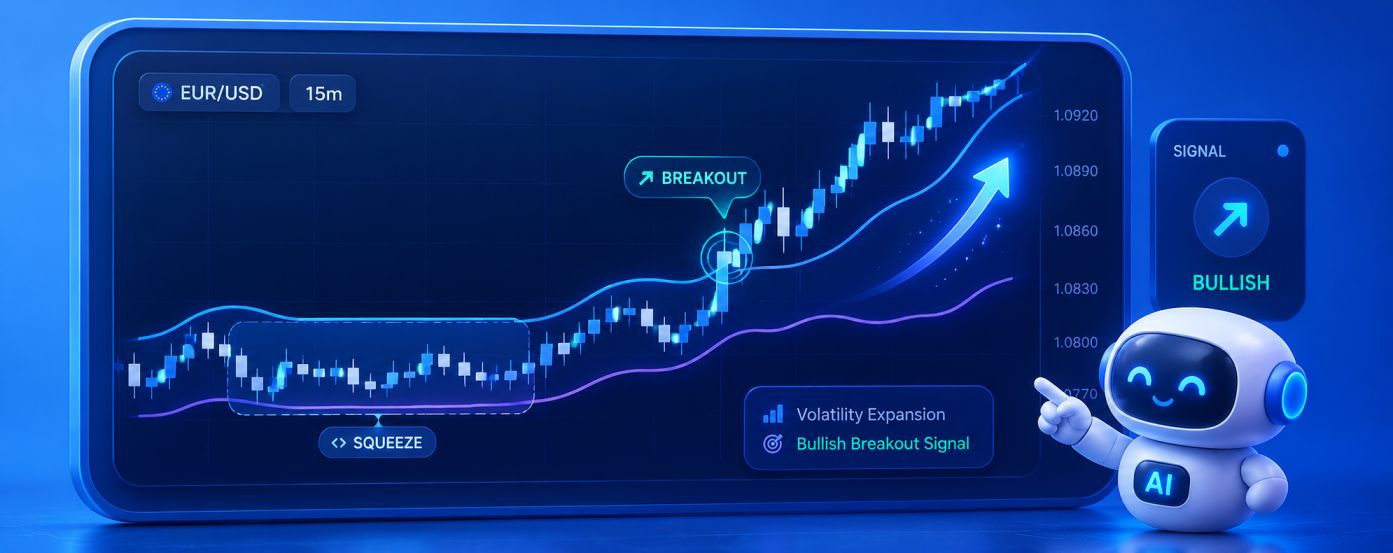
Bollinger Band squeeze signals explosive moves
Bollinger Bands: Predicting the Explosive Moves
Every experienced forex trader knows the feeling — price squeezes tight within Bollinger Bands, and then suddenly explodes. The challenge has always been knowing which direction it'll go. AI-enhanced Bollinger Bands analyze multiple prior squeezes on the same pair, factor in order flow patterns and news sentiment, and offer a directional probability score alongside the signal.
The result is a meaningful increase in breakout trade accuracy. You're no longer flipping a coin on direction — you have data-backed probability working in your favor.
Why Backtesting Your AI Indicator Is Non-Negotiable
Here's a truth most indicator vendors won't tell you: no AI indicator is magic. The best way to trust a tool is to test it rigorously before risking real money. Backtesting lets you run an indicator against years of historical price data to measure its real-world performance.
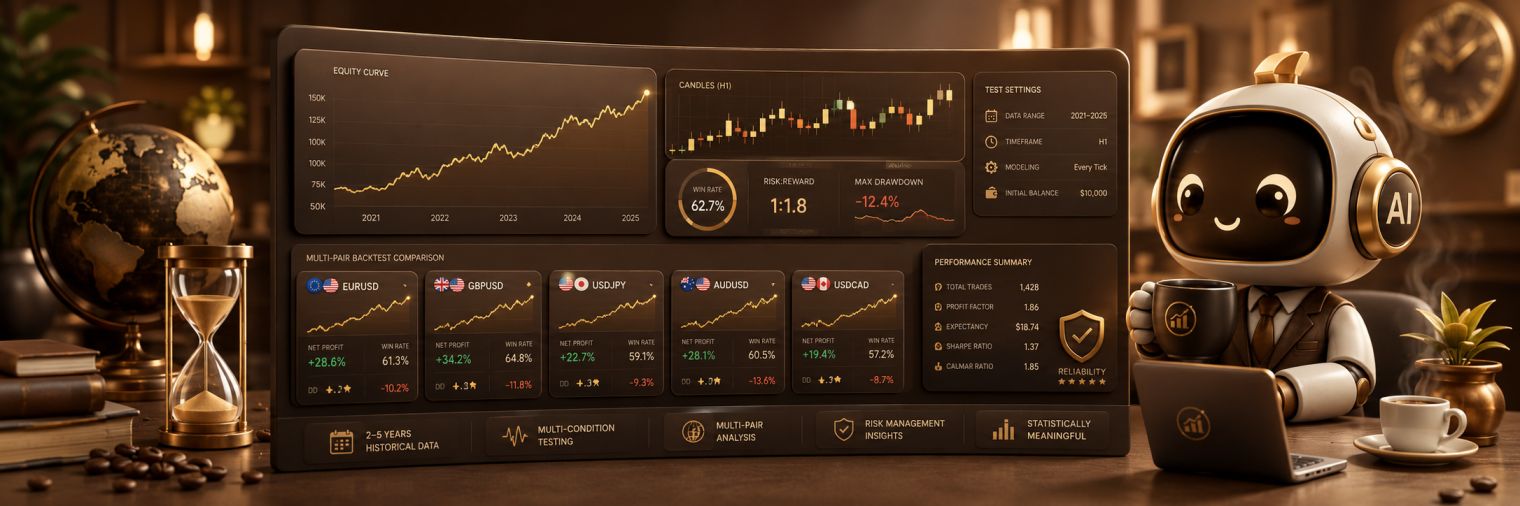
Thorough backtesting reveals indicator reliability over time
How to Backtest Like a Professional Trader
- Use at least 2–3 years of historical data to ensure results are statistically meaningful
- Test across multiple market conditions: trending, ranging, high-volatility periods
- Track your win rate, average RR ratio, and maximum drawdown separately
- Avoid over-optimization — if a strategy only works on one specific period, it's not robust
- Compare results across at least 3–5 different currency pairs before going live
A genuinely reliable AI indicator should maintain a win rate above 55% across diverse conditions, with a risk-reward ratio of at least 1:1.5. Anything below that warrants serious scrutiny before live deployment.
AI + Fundamental Analysis: The Combination Most Traders Ignore
Here's where many retail traders leave serious money on the table. They treat technical and fundamental analysis as two separate worlds. The smartest traders — and the best AI systems — treat them as complementary layers of the same picture.
"Technical analysis tells you where to trade. Fundamental analysis tells you why the market will move. AI helps you know when."
AI indicators are uniquely capable of processing economic data — GDP releases, CPI prints, interest rate decisions — and correlating them with historical price reactions. When your AI indicator generates a buy signal on EUR/USD right before a key ECB rate decision, that contextual awareness can mean the difference between a winning and losing trade.
At fxTsignals.com, we recommend a layered approach: use AI indicators for precise entry and exit timing, use fundamental analysis to understand the macro trend, and let market sentiment data confirm the overall direction. This three-layer methodology consistently outperforms any single approach used in isolation.
5 Actionable Tips to Get the Most From AI Indicators
Knowing which indicators to use is only half the battle. Here's how to actually use them effectively:
- Start with one indicator — Master a single AI indicator before adding complexity. Indicator soup leads to paralysis, not profits.
- Align with the higher timeframe trend — Always use your AI indicator signals in the direction of the daily or weekly trend for higher probability setups.
- Set fixed risk per trade — Never risk more than 1–2% of your account on a single AI signal, no matter how strong it looks.
- Use confluence — A signal becomes significantly more powerful when two or more indicators (e.g., MACD + RSI) agree on direction simultaneously.
- Keep a trading journal — Log every AI-triggered trade with screenshots and outcomes. Patterns in your journal will reveal optimization opportunities you'd never find otherwise.
Frequently Asked Questions
We've compiled the questions our fxTsignals community asks most often about AI indicators for forex trading.
What makes AI indicators better than traditional forex indicators?
+
Traditional indicators follow fixed mathematical rules that don't change regardless of market conditions. AI indicators use machine learning to continuously adapt based on new data. They can detect complex, non-linear patterns in price action, process sentiment data alongside technical inputs, and generate signals that genuinely reflect current market dynamics — not just historical averages.
Can AI indicators guarantee that I'll make money trading forex?
+
No indicator — AI-powered or otherwise — can guarantee profits. Forex trading always involves risk, and success requires a combination of good tools, sound risk management, emotional discipline, and continuous learning. AI indicators significantly improve your decision-making quality, but they're tools, not magic. Anyone promising guaranteed returns using any indicator should be treated with extreme skepticism.
Which AI indicator is best for a beginner forex trader?
+
For beginners, we recommend starting with an AI-enhanced MACD. It provides clear visual signals, is available on most trading platforms, and has an intuitive logic (trend direction + momentum) that's easy to learn. Once you've mastered reading MACD signals consistently on a demo account, you can layer in RSI or Bollinger Bands for additional confirmation.
How do I backtest an AI indicator before using it on a live account?
+
Most professional platforms like MetaTrader 4/5 and TradingView include built-in strategy testers. Load your AI indicator, select a historical date range of at least two years, and run it against your target currency pair. Evaluate win rate, average profit per trade, maximum drawdown, and total return. Run the same test across three or more currency pairs to confirm robustness before committing real capital.
Should I combine multiple AI indicators in my strategy?
+
Yes — but strategically. Using two to three complementary indicators that measure different things (e.g., trend + momentum + volatility) provides meaningful signal confirmation. The key word is complementary. Running five trend-following indicators simultaneously won't reduce risk — it just creates noise. At fxTsignals.com, we recommend pairing one trend indicator (MACD), one momentum oscillator (RSI), and one volatility tool (Bollinger Bands) as a clean, powerful combination.
Final Verdict: AI Indicators Are No Longer Optional
If you're still trading forex with only traditional, static indicators, you're bringing a calculator to a supercomputer fight. The market has evolved. The participants — hedge funds, proprietary trading firms, and retail traders alike — are increasingly leveraging AI to gain an edge. The question isn't whether you should use AI indicators. The question is which ones to use, and how to use them properly.
The MACD, RSI, and Bollinger Bands — each enhanced with modern machine learning capabilities — form a proven foundation. Add thorough backtesting, disciplined risk management, and a dose of fundamental awareness, and you have a framework that genuinely works.
At fxTsignals.com, we're committed to helping every trader — beginner or experienced — access the tools, signals, and education needed to compete effectively in today's AI-driven market. The edge is available. It's time to use it.
Ready to Trade Smarter with AI Signals?
Join thousands of forex traders at fxTsignals.com who use real-time AI-powered signals to identify high-probability setups every single day.
Start Automated Copy Trading →