Drawdown in Forex Trading:
What Every Trader Must Know
to Survive & Profit
What Exactly Is Drawdown — And Why Should You Care?
Picture this. You started the month with $10,000 in your trading account. After a strong run, your balance climbed to $13,500 — a dream streak. Then the market turned. A string of losing trades brought you back down to $10,800. That dip from your peak of $13,500 to $10,800? That's a drawdown of $2,700 — or roughly 20%.
Drawdown in forex trading measures the decline from an account's highest equity point to its lowest point over a specific period. It's expressed as a percentage and acts as one of the clearest indicators of how much risk you're taking on — and how well you're managing it.
Here's the uncomfortable truth: every trader, no matter how skilled, faces drawdown. The question isn't whether it'll happen. The question is how deep it gets, how long it lasts, and whether you have the strategy and discipline to climb back out.
The 3 Types of Drawdown Every Forex Trader Must Understand
Absolute Drawdown
This measures the loss from your original starting balance. If you deposited $5,000 and your lowest point is $4,200, your absolute drawdown is $800. It tells you how far below your starting point you've fallen.
Maximum Drawdown
This is the biggest peak-to-trough decline over your entire trading history. It's the number most professional traders and fund managers scrutinize. A high maximum drawdown signals higher risk exposure in your strategy.
Relative Drawdown
Expressed as a percentage of your peak balance, relative drawdown puts things in proper perspective. A $3,000 loss means very different things on a $5,000 account versus a $50,000 account — this type captures that difference clearly.
Always track all three types. Your absolute drawdown tells you about survival, your maximum drawdown tests your strategy robustness, and your relative drawdown shows your true risk profile as a percentage of wealth.
How Drawdown Quietly Destroys Traders — Even When the Strategy Is Sound
The math of drawdown recovery is sobering. Lose 10%, and you need an 11.1% gain to get back to even. Lose 30%, and you now need a 42.8% return. Lose 50% — which happens more than most traders admit — and you need to double your remaining account just to break even. This asymmetry is one of the most dangerous forces in trading, and very few beginners truly internalize it.
But the damage isn't just mathematical. Drawdown attacks you on three fronts at once:
- Psychological pressure. As losses mount, fear and frustration replace clear thinking. Many traders start revenge trading — taking impulsive, oversized positions to recover losses quickly — which almost always makes things worse.
- Capital erosion. A shrunken account limits your position sizes, reduces diversification options, and can even lock you out of certain trades. Your capacity to recover becomes physically smaller as the drawdown deepens.
- Extended recovery timelines. The deeper the drawdown, the longer the road back. Weeks can stretch into months. That lost time is lost opportunity — and lost income — in a market that doesn't wait for anyone.
- Confidence collapse. Even technically sound trading strategies can be abandoned mid-drawdown by a rattled trader. Many profitable systems get discarded right before their inevitable recovery phase.
5 Battle-Tested Strategies to Manage Drawdown Like a Pro
These aren't generic tips. These are the actual approaches used by funded traders, prop firm operators, and institutional money managers to keep drawdowns shallow and recoveries fast.
Hard Position Sizing Rules
Never risk more than 1–2% of your account on a single trade. This simple rule is what separates traders who survive for years from those who blow accounts in weeks. Use a position size calculator on every single trade — no exceptions.
Strategic Stop Loss Placement
Stop losses aren't just safety nets — they're architectural. Place them at technically meaningful levels: beyond key support and resistance zones, below recent swing lows, or outside the Average True Range. Arbitrary stops get hunted; strategic ones protect your capital while giving trades room to breathe.
True Portfolio Diversification
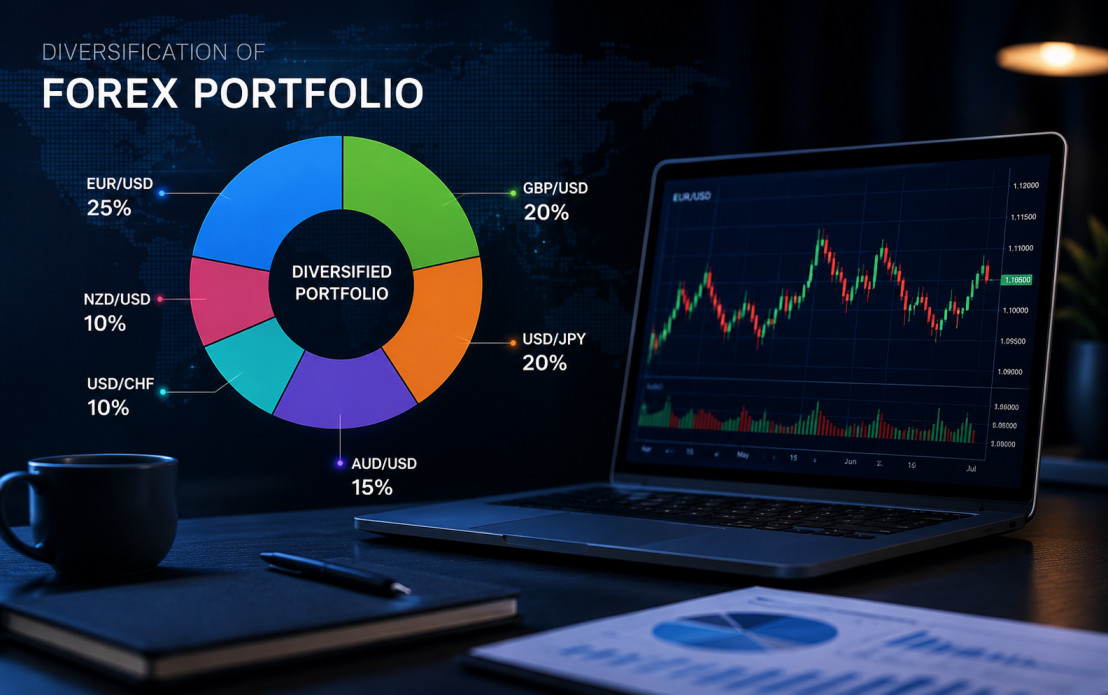
Don't just trade different currency pairs — look at their correlation. EUR/USD and GBP/USD often move together. Genuinely uncorrelated exposure across currencies, commodities, and timeframes can dramatically reduce the severity of drawdown periods when any single market turns against you.
Pre-Set Drawdown Limits
Decide in advance: "If my account drops by X%, I stop trading and reassess." This could be a daily limit (e.g., -3%) or a monthly limit (e.g., -10%). Setting rules when you're clear-headed protects you from decisions made in panic or desperation.
Journaling and Pattern Recognition
Keep a detailed trading journal. After every drawdown, go back and find the patterns: Was it a specific session? A news event? Overtrading after wins? The traders who recover fastest are the ones who understand exactly why they drew down — and systematically close those leaks.
When you hit a preset drawdown threshold, the best move is often to reduce your position size by 50% and slow down — not to stop entirely. Smaller sizes reduce emotional pressure and let you rebuild momentum without abandoning your edge.
The Right Way to Recover from a Drawdown
Recovery isn't just about making trades. It's about rebuilding your system, your mindset, and your process. Here's what a structured drawdown recovery actually looks like for a disciplined trader:
- Step back and diagnose first. Don't immediately try to trade your way out. Review every losing trade. Was it system failure, execution error, or just statistical variance? The answer determines your response.
- Scale down position sizes temporarily. Trade at 50% of your normal size during recovery. This preserves capital, reduces stress, and helps restore confidence through consistent smaller wins.
- Return to your most reliable setups only. During a drawdown, now is not the time to experiment. Stick to the 2–3 setups you understand best and have the highest historical win rate on.
- Set daily win and loss limits. A good day that ends early is better than a great morning followed by an impulsive afternoon that wipes the gains. Limit both wins and losses.
- Track your emotional state. Many experienced traders maintain a simple daily mood log. Stress, sleep quality, and external pressures directly impact decision quality. Knowing you're off mentally is a reason to sit out.
Frequently Asked Questions About Drawdown in Forex
Got questions? Here are the ones traders ask us most often at FxTsignals.com.
Most professional traders and prop firms consider a maximum drawdown of under 10–15% to be healthy for active forex trading strategies. Conservative managed accounts typically target under 5–8%. Once you exceed 20%, recovery becomes increasingly difficult — and above 30%, the mathematics of recovery become severe enough that most traders never fully come back. The key is to define your personal maximum drawdown threshold before you start trading and treat it as a hard rule, not a suggestion.
The formula is straightforward: Drawdown (%) = ((Peak Account Value – Current Account Value) ÷ Peak Account Value) × 100. For example, if your account peaked at $12,000 and is currently at $9,600, your drawdown is (($12,000 – $9,600) ÷ $12,000) × 100 = 20%. Most trading platforms like MetaTrader 4/5 will calculate this automatically in their performance reports, but understanding the formula helps you track it in real time during live trading sessions.
Not exactly — though they're related. A losing streak refers to consecutive losing trades, while drawdown measures the total decline in account equity from its highest point. You can have a losing streak with small losses that results in a minor drawdown, or you can experience drawdown from just one or two large losses. Drawdown is a broader, more comprehensive measure of the actual financial impact on your account, regardless of how many trades caused it.
Mathematically, yes — but it's brutally hard. A 50% drawdown requires a 100% return on your remaining capital just to return to breakeven. That means if you had $20,000 and lost half, you now need to double your $10,000 to get back to $20,000. While this is possible, it typically takes significantly longer than the drawdown itself occurred, often involves major psychological challenges, and requires a genuinely edge-positive strategy. The honest lesson here is prevention — the best approach to a 50% drawdown is never getting near one in the first place.
This is one of the most important — and difficult — questions in trading. A normal drawdown is typically within the historical range of a strategy's backtested performance. If your strategy has historically produced maximum drawdowns of 12%, a 10% drawdown is expected and manageable. However, if you're experiencing a 25% drawdown when history suggests 12%, or the losses are coming from a fundamentally different market condition than your strategy was built for, it may signal a strategy breakdown. Regular backtesting, forward testing, and careful journaling help you understand what "normal" looks like for your specific approach.
Ready to Trade Smarter and Protect What You've Built?
At FxTsignals.com, we give traders the signals, insights, and risk frameworks to trade with confidence — whether markets are running hot or pulling back hard.
Start Trading With Edge →