Position Trading Mastery:
How to Ride Long-Term
Forex Trends Like a Pro
Discover how patient, disciplined position traders consistently outperform reactive traders — and how you can build a strategy that works while you sleep.

What Is Position Trading — And Why Should You Care?

Most new forex traders jump straight into day trading or scalping — obsessively watching 5-minute charts, making dozens of micro-decisions every hour. The result? Exhaustion, emotional burn-out, and often losses that could have been avoided entirely. Position trading flips that script.
Position trading is a long-term forex strategy where you hold trades for weeks to months, aiming to capture major market trends rather than chasing every small price move. Think of it like investing in the currency market — you're not trying to be right every day, you're trying to be right about the bigger picture.
The beauty of this approach is its simplicity. You don't need to be glued to your screen all day. You analyze carefully, enter at the right moment, set your levels, and let the trade breathe. That's a genuinely powerful shift — both psychologically and financially.
"Position trading isn't about making more trades — it's about making the right ones, then having the patience to see them through to maximum potential."
Position Trading vs. Day Trading vs. Swing Trading
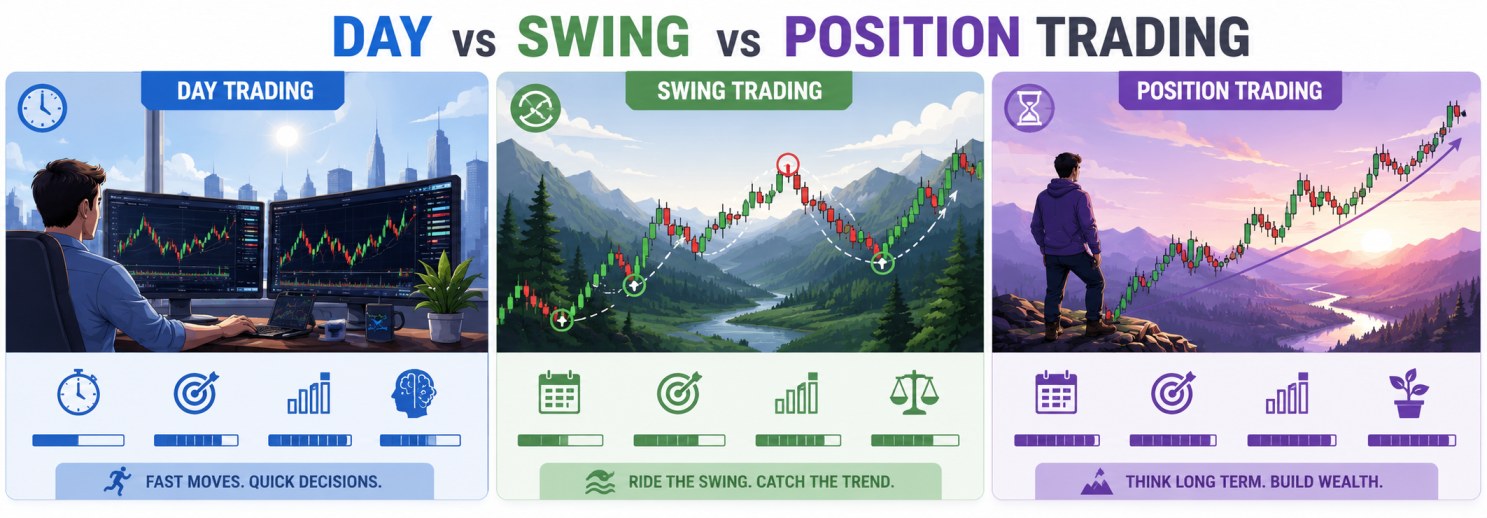
Before diving into how position trading works, it helps to understand where it sits in the trading spectrum. Each style has its place — and each demands very different skills.
A Quick Comparison
- Day Trading: Multiple trades daily, positions closed before market close, high time commitment and emotional intensity.
- Swing Trading: Holds for days to a couple of weeks, catches medium-term momentum shifts, moderate monitoring required.
- Position Trading: Holds for weeks to months, focuses on macro trends and fundamentals, very low time commitment once set up.
Position traders enter far fewer trades — sometimes just 4 to 8 per year — but each trade is built on deep analysis and carries the potential for hundreds to thousands of pips in profit.
How to Identify Long-Term Forex Trends
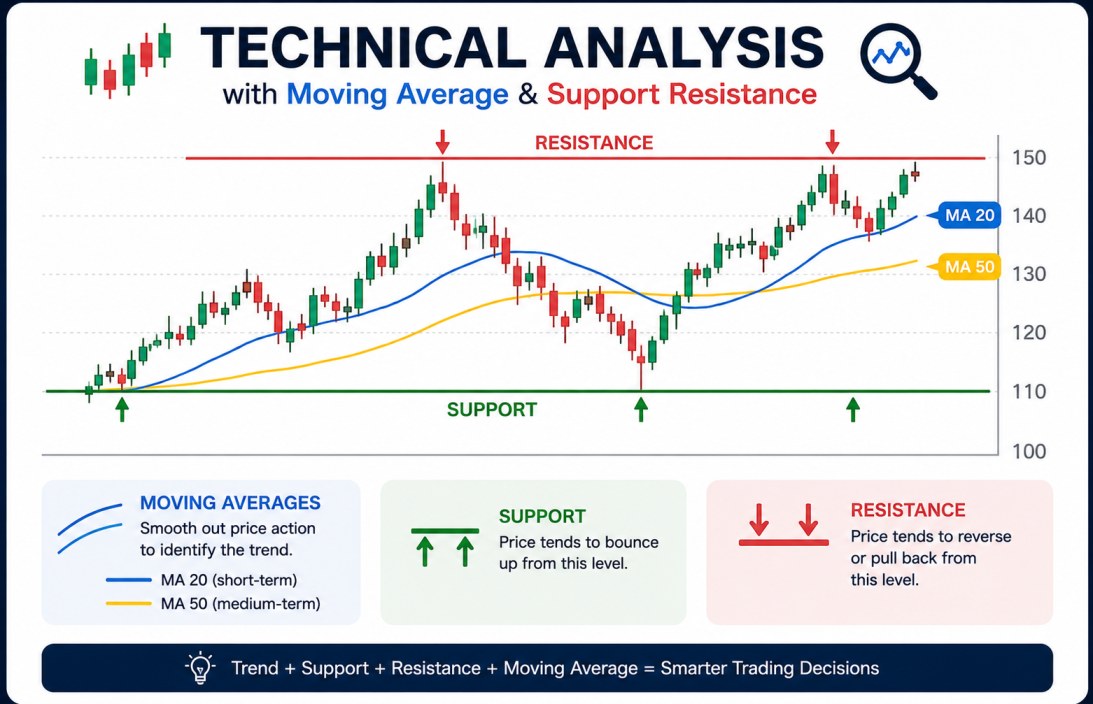
Identifying a genuine long-term trend is the foundation of every successful position trade. This requires a blend of technical and fundamental analysis — not just one or the other.
Technical Analysis Tools That Actually Work
For position traders, the weekly and monthly charts are your best friends. Start there before zooming into anything smaller. The 50-day and 200-day moving averages (MA) are particularly powerful — when the 50-day crosses above the 200-day (the "Golden Cross"), it's often a reliable signal that a long-term uptrend is forming.
- Support & Resistance Levels: Historical price zones where the market has repeatedly reversed — these act as guardrails for your trade.
- Moving Averages (50-day / 200-day): Smooth out noise and reveal the dominant trend direction clearly.
- RSI (Relative Strength Index): Helps spot whether a currency is overbought or oversold on a macro level.
- MACD: Great for confirming trend momentum and identifying potential reversals before they happen.
For example, if EUR/USD has been in a consistent uptrend for four months, is trading above its 200-day MA, and the MACD is showing positive momentum — that's a strong technical signal to consider a long position.
The Role of Fundamental Analysis in Position Trading
Here's where position trading truly diverges from shorter-term styles. Fundamentals matter enormously over the long run, and ignoring them is like navigating with a broken compass.
📊 Economic Indicators
GDP growth, inflation (CPI), employment data — these paint a picture of an economy's strength and directly drive currency demand over months.
🏦 Central Bank Policy
Interest rate decisions from the Fed, ECB, or BoJ can set or break multi-month trends. A rate hiking cycle is typically very bullish for a currency.
🌍 Geopolitical Events
Trade tensions, elections, and global crises influence long-term capital flows — the kind of moves that sustain trends for months.
A practical example: In 2022, as the US Federal Reserve began one of the most aggressive rate-hiking cycles in decades, the US Dollar surged broadly. Position traders who recognized this fundamental shift early rode USD/JPY from around 115 to over 150 — a 3,500+ pip move over several months. That's the power of fundamental-driven position trading.
Building Your Position Trading Strategy: Step by Step
Step 1 — Define Your Goals Clearly
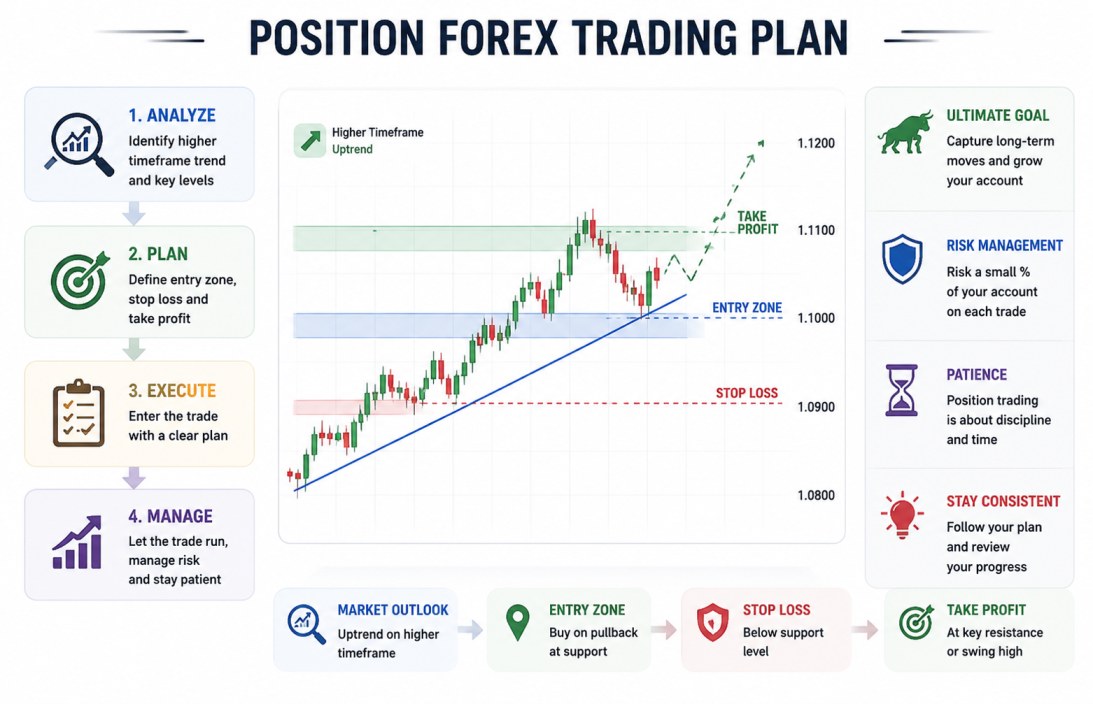
Before you place a single trade, write down your risk tolerance, target return, and time commitment. A position trading strategy built without clear objectives is just guessing with extra steps.
Step 2 — Choose the Right Currency Pairs
Stick to major pairs like EUR/USD, GBP/USD, USD/JPY, and AUD/USD. They have deep liquidity, tighter spreads, and more reliable long-term trends. Exotic pairs can be tempting but often carry unpredictable volatility that disrupts position trades.
Step 3 — Develop Clear Entry and Exit Rules
This is where discipline separates winners from losers. Your entry should be triggered by a confirmed trend signal — not a gut feeling. Your exit should be pre-planned: a profit target based on major resistance levels, or a trailing stop to lock in gains as the trend continues.
- Enter only when both technical and fundamental signals align.
- Use weekly chart closes as confirmation — don't react to intraday noise.
- Set a stop-loss at a level that invalidates your trade thesis — not just a round number.
- Consider interest rate differentials — carry can work for or against you.
Risk Management: The Non-Negotiable Foundation
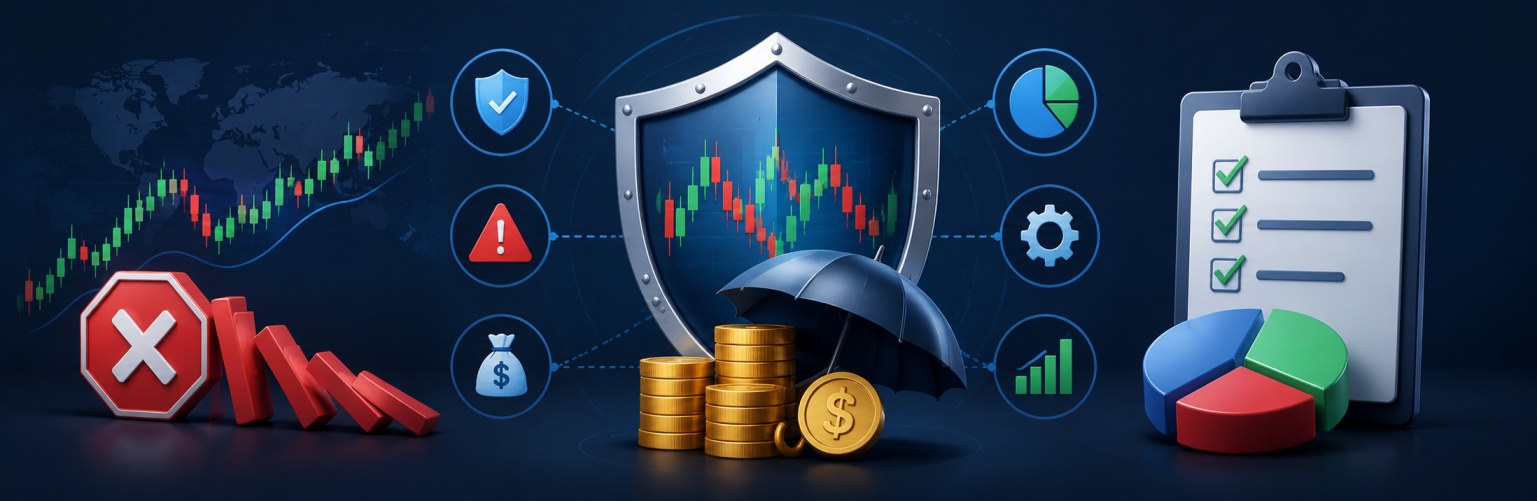
Every professional position trader will tell you the same thing: protecting your capital is more important than chasing profits. Without a solid risk management framework, even a great strategy will eventually blow up.
The Core Risk Rules Every Position Trader Needs
- Risk no more than 1–2% per trade: This keeps you in the game through inevitable losing streaks. A string of 10 losses at 1% risk only costs you 10% of your account — survivable and recoverable.
- Set your stop-loss before you enter: Never add to losing positions hoping for a reversal. Know your invalidation point before clicking "Buy."
- Maintain a minimum 1:3 risk-reward ratio: If you're risking 100 pips, your target should be at least 300 pips. This means you can be right only 30% of the time and still be profitable.
- Diversify across uncorrelated pairs: Don't load up on EUR/USD, GBP/USD, and AUD/USD simultaneously — they often move together. Spread risk across genuinely different setups.
- Review drawdowns honestly: When you're in a losing phase, reduce position sizes — don't try to "win it back" with bigger trades.
The Mindset of a Successful Position Trader
Technique alone won't make you a successful position trader. The psychological side of this strategy is just as demanding as the analytical side — perhaps more so.
⏳ Patience
The hardest part. Watching a trade float in drawdown for two weeks before turning in your favour requires genuine conviction in your analysis.
📋 Discipline
Sticking to your rules when the market seems to be screaming at you to "just close the trade already" is what separates professionals from amateurs.
🔄 Adaptability
When new data genuinely changes the macro picture, be willing to update your view. Confidence is good; stubbornness is destructive.
"Losses are inevitable. They are tuition fees in the school of trading. The professional's job is not to avoid all losses — it's to ensure no single loss is catastrophic and every lesson is learned."
Backtesting, Paper Trading, and Refining Your Edge
Never risk real money on an untested strategy. Backtesting — running your rules against years of historical price data — gives you statistical confidence before your capital is on the line.
After backtesting, move to paper trading (simulated trades with no real money). This tests your execution and discipline in real-time conditions without financial risk. Most traders underestimate how different it feels to manage a live position versus a backtested one — paper trading bridges that gap.
- Backtest across at least 5 years of data and multiple market cycles (trending, ranging, volatile).
- Track your win rate, average winner, average loser, and maximum drawdown.
- Paper trade for at least 3 months before going live — and treat it with the same seriousness as real money.
- After going live, keep a detailed trade journal. Review it weekly. Your journal is your greatest teacher.
Frequently Asked Questions
Still have questions about position trading in forex? Here are the most common ones we hear at fxTsignals.com.
Position trading can actually be a great starting point because it doesn't require lightning-fast decisions or constant screen time. That said, beginners should first build a solid foundation in basic forex concepts — reading charts, understanding pips and lots, and learning about macroeconomic drivers — before putting real money to work. Start with paper trading and take your time.
There's no universal minimum, but having enough capital to properly manage risk is essential. Since position trades can be held for months and may experience significant short-term drawdowns, you need a buffer. Many experienced position traders suggest a minimum of $2,000–$5,000 to trade responsibly with proper position sizing, though you can start with smaller amounts in a micro account while you develop your skills.
This is critical for position traders. Swap rates are daily interest charges (or credits) for holding positions overnight. They're based on the interest rate differential between the two currencies in your pair. If you're long a high-interest-rate currency against a low-rate one, you may actually earn a daily swap credit — known as a "carry trade." But if the differential works against you, swaps become a cost that erodes profit over time. Always factor swap rates into your long-term trade calculations.
The main risks are: (1) Black swan events — sudden geopolitical shocks or economic crises that invalidate your fundamental thesis overnight. (2) Trend reversals that aren't caught in time — this is why trailing stops are important. (3) Psychological wear from long drawdown periods before a trade moves in your favour. (4) Cumulative swap costs on unfavourable carry trades. Addressing all four with good risk management and a solid trading plan is essential.
Absolutely — and it's a smart combination. Professional forex signals can complement your own position trading analysis by offering an additional layer of confirmation before you commit to a long-term trade. At fxTsignals.com, our signals incorporate both technical and fundamental analysis, giving you the macro context that position trading demands. Use signals as confirmation, not as a replacement for your own research.
Conclusion: The Long Game Wins
Position trading is not for traders who want instant gratification. It demands patience, analytical rigour, and an iron discipline to follow your plan even when emotions are screaming otherwise. But for those who embrace these qualities, the rewards are real — fewer headaches, lower transaction costs, and the satisfaction of seeing a carefully-built thesis pay off over weeks or months.
The forex market is one of the most liquid and dynamic financial markets in the world. Long-term trends exist in every era — driven by interest rate cycles, economic growth differentials, and global capital flows. Your job as a position trader is simply to identify them early, enter with conviction, manage risk intelligently, and let the market do the rest.
Start slow. Backtest your strategy. Paper trade it. Then take calculated steps into the live market with proper risk management. And remember — at fxTsignals.com, you don't have to build your edge alone.
Ready to Trade With a Real Edge?
Join thousands of traders who use fxTsignals.com to get professional-grade forex signals, market analysis, and long-term trade setups delivered straight to them.