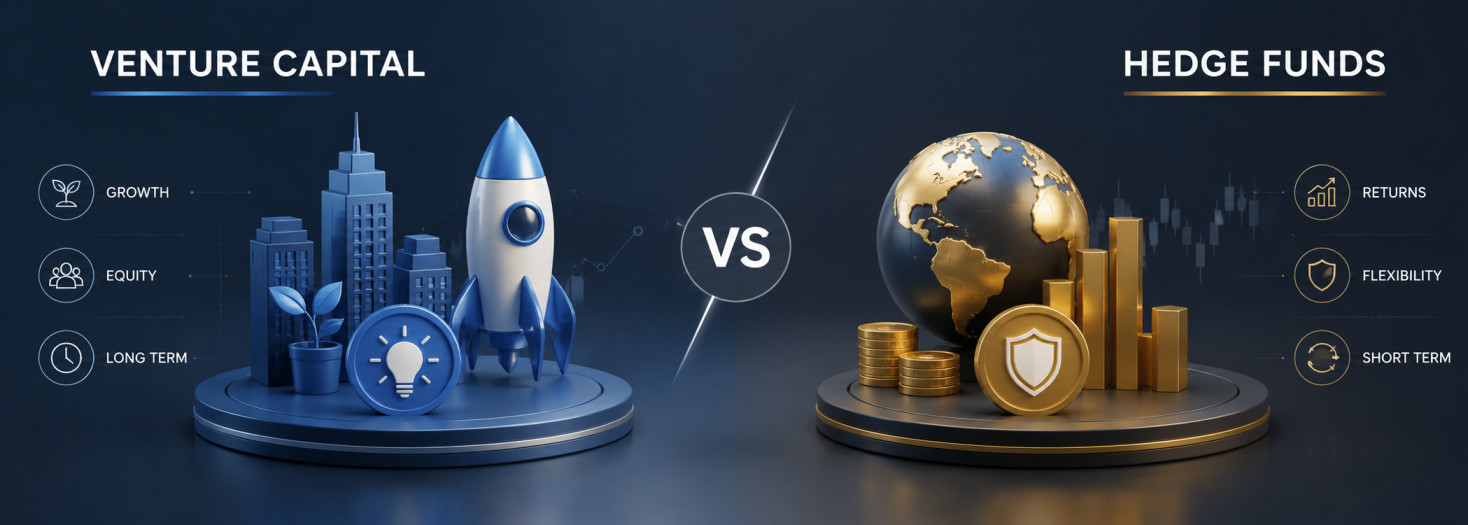
If you've spent any time in the world of finance, you've heard the terms thrown around at conferences, in financial news, and across trading forums. Venture capital and hedge funds — two giants of the alternative investment world, both capable of generating extraordinary returns, but built on entirely different foundations.
For forex traders especially, understanding how capital flows through these vehicles is not just academic. It shapes market liquidity, drives institutional behavior, and ultimately influences the currency pairs and assets you trade every single day. So let's break it all down — clearly, honestly, and without the jargon overload.
Understanding Venture Capital: Planting Seeds for Tomorrow
Venture capital is, at its core, the art of betting on potential. VC firms identify early-stage companies with disruptive ideas and provide them not just with money, but with mentorship, networks, and strategic direction. Think of it as nurturing a sapling into a tree — knowing full well that not every sapling makes it.

VC firms pool money from institutional investors, family offices, high-net-worth individuals, and occasionally corporations. That pooled capital gets deployed in tranches across a portfolio of startups — most of which may fail, but the few that succeed can return 10x, 50x, or even 100x the original investment.
The Risk-Reward Architecture of VC
What makes venture capital uniquely compelling is its asymmetric risk profile. You might lose everything on nine out of ten bets, but that tenth bet — the one that becomes the next industry disruptor — can make the entire fund extraordinarily profitable. This is why VC is fundamentally a long game.
Early investments happen when a startup has limited history and enormous uncertainty. There's no revenue track record, no proven market fit, often no finished product. Investors are buying into a vision — and paying a premium for the privilege of being early.
Patient Capital and the Long View
Unlike stocks you can sell tomorrow, VC investments are illiquid by design. Fund lifespans of 7 to 12 years are common. This "patient capital" approach forces alignment between fund managers and founders — both need the company to genuinely succeed, not just appear to succeed for a quarterly earnings call.
Venture capitalists don't just write checks — they become partners in the fullest sense. They take board seats, open doors, and shape strategy from the inside out.
Innovation as the North Star
VC firms aren't looking for businesses that do existing things slightly better. They want breakthrough concepts — technologies or models that could reshape entire industries. Artificial intelligence, biotech, clean energy, fintech — these are the playgrounds of venture capital. For forex traders, understanding where VC money flows can be an early signal of which sectors and currencies will gain momentum over the coming years.
Hedge Funds: Precision Instruments for All-Weather Returns
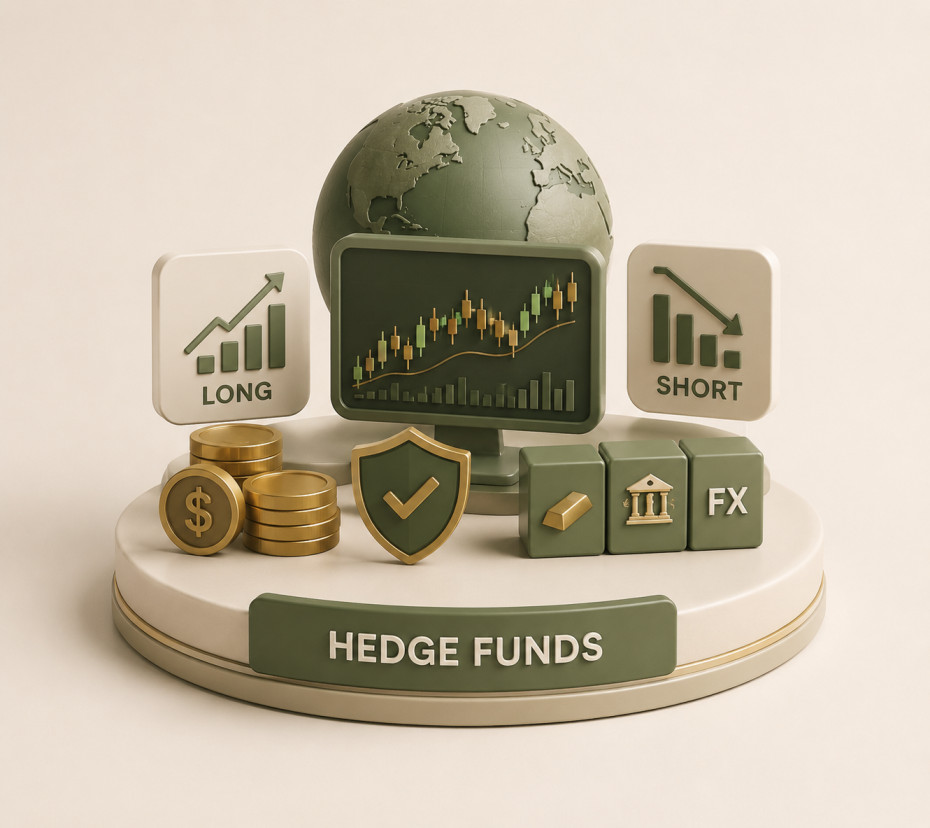
If venture capital is a long-distance marathon, hedge funds are more like Formula 1 racing — high performance, technically complex, and built for speed and agility in any conditions.
Hedge funds pool capital from accredited investors and deploy it across a wide variety of asset classes using sophisticated strategies. The defining mission is to generate positive returns regardless of what the broader market is doing — what's called "absolute return."
Multi-Asset, Multi-Strategy Flexibility
Unlike mutual funds that typically stick to one category, hedge funds roam freely. On any given day, a hedge fund might be:
- Going long on undervalued technology stocks while shorting overvalued competitors
- Trading currency pairs to exploit macro divergences between central banks
- Using derivatives to hedge against commodity price swings
- Arbitraging price differences between related securities across markets
- Deploying algorithmic strategies that execute hundreds of trades per minute
This breadth of activity is precisely why hedge funds are major players in forex markets. When a large macro hedge fund takes a view on US Federal Reserve policy versus the Bank of Japan, the ripple effect across USD/JPY can be felt immediately by every trader watching that pair.
Chasing Absolute Returns
The benchmark for a hedge fund is not "did we beat the S&P 500?" — it's "did we make money, full stop." This focus on absolute returns rather than relative performance creates a fundamentally different incentive structure. Hedge fund managers are paid performance fees (typically 20% of profits above a hurdle rate), which aligns their interests sharply with generating real gains.

The Accredited Investor Barrier
Hedge funds are not open to everyone. Regulatory frameworks typically require investors to meet specific wealth and income thresholds — often $1 million+ in net worth or $200,000+ in annual income. The logic is straightforward: these are complex, higher-risk vehicles that require investors to fully understand what they're signing up for. It's a world built for sophisticated capital.
| Factor | Venture Capital | Hedge Fund |
|---|---|---|
| Investment Focus | Early-stage startups | Multi-asset, multi-strategy |
| Time Horizon | 7–12 years | Days to a few years |
| Liquidity | Very illiquid | Relatively liquid |
| Risk Profile | Very high, concentrated | Managed, diversified |
| Return Target | 10x–100x (rare wins) | Consistent absolute returns |
| Forex Relevance | Indirect (sector flows) | Direct (major market player) |
| Regulatory Burden | Moderate | High |
What This Means for Forex Traders
Here's where theory meets your trading terminal. Both VC and hedge funds move markets, but they do so in very different ways — and recognizing those patterns can give you an edge.
- Large macro hedge funds drive significant forex volume — tracking their positioning through COT reports can reveal institutional bias
- VC activity in fintech and crypto sectors indirectly affects currency sentiment and capital flows
- Hedge fund redemptions during market stress often trigger sharp, fast currency moves — these create both risk and opportunity
- When VC money floods into a region (e.g., Southeast Asian tech), the local currency often strengthens due to capital inflows
- Hedge fund performance fees create "lock-up" periods that can reduce liquidity in certain instruments
Smart Diversification: Which Suits You?

For most forex traders, direct participation in VC funds is unrealistic — they require large minimum investments and very long lock-up periods. But hedge funds, particularly those with lower minimums or through fund-of-funds structures, can offer diversification that complements active trading strategies.
The real takeaway is this: understanding how these vehicles work makes you a smarter market participant. You'll recognize why institutional flow behaves the way it does, why certain currencies spike during risk-on or risk-off episodes, and why liquidity sometimes evaporates without warning.
Actionable Tips for Independent Investors
- Follow publicly available hedge fund 13F filings to track macro positioning shifts across major currencies and equities
- Monitor VC funding rounds in emerging markets — large deals often precede currency appreciation as foreign capital enters
- Watch for hedge fund industry news during quarter-end: redemptions and rebalancing create predictable volatility windows
- Use the Commitment of Traders (COT) report to see how large speculative funds (many are hedge funds) are positioned in forex futures
- Consider hedge fund ETFs as a lower-barrier way to gain exposure to diversified alternative strategies
The smartest traders aren't just watching price — they're understanding whose money is moving it, and why. That's where institutional literacy becomes your competitive edge.
The Regulatory Landscape: Why Rules Shape Strategy
Both venture capital and hedge funds operate within regulatory frameworks, but those frameworks are quite different — and the differences matter.
Venture capital faces relatively lighter-touch regulation in most jurisdictions. VC firms typically register as investment advisers but are exempt from many of the restrictions placed on public market funds. This flexibility allows them to take concentrated, illiquid positions in private companies without the same disclosure requirements.
Hedge funds, by contrast, operate in a more heavily regulated space — particularly post-2008. Dodd-Frank in the US, AIFMD in Europe, and equivalent frameworks globally have increased transparency requirements, stress-testing obligations, and reporting standards. These rules are designed to prevent systemic risk from building up in the shadows.
The core difference lies in what they invest in and when. Venture capital focuses exclusively on early-stage private companies with high growth potential, accepting illiquidity and high risk in exchange for potentially massive returns. Hedge funds, meanwhile, invest across a wide range of asset classes — stocks, bonds, currencies, derivatives — with the goal of generating consistent positive returns in any market condition. VC is about building companies; hedge funds are about navigating markets.
Absolutely. Large macro hedge funds are among the biggest participants in global forex markets. Tracking their positioning through tools like the COT (Commitment of Traders) report, monitoring fund news, and understanding their risk-on/risk-off behavior can provide valuable context for currency movements. When a major fund shifts its macro thesis, you often see it reflected in currency pairs before it shows up in mainstream financial media.
Traditional hedge funds typically require accredited investors who meet significant wealth thresholds — commonly a net worth of $1 million or more excluding primary residence, or annual income of at least $200,000. Minimum investments often start at $100,000 to $1 million. However, hedge fund ETFs and liquid alternative funds have made hedge-fund-like strategies accessible to retail investors with much lower minimums. Always consult a qualified financial advisor before investing.
Generally speaking, yes — venture capital carries significantly higher risk on a per-investment basis. Most startups fail, and the illiquid, long-duration nature of VC means capital is locked up for years. However, the potential upside can be transformative. Hedge funds use risk management techniques — diversification, hedging, stop-loss strategies — to aim for more consistent returns with controlled downside. That said, poorly managed hedge funds can still suffer significant losses, especially during extreme market events.
The answer depends entirely on your investment objectives, time horizon, and liquidity needs. If you can commit capital for 7–12 years and can absorb the risk of total loss on individual bets, venture capital offers access to transformative growth opportunities. If you need more liquidity and want strategies uncorrelated to stock market performance, hedge funds offer a compelling proposition. For most active traders, hedge fund exposure — even via ETFs — may be more practical as a complement to forex or equities trading.
Take Your Trading to an Institutional Level
Join thousands of traders on fxTsignals.com who combine sharp market intelligence with professional-grade signals to navigate forex markets with confidence.