
How to Start Forex Trading:
The Complete Beginner's Roadmap
Master the global currency market step by step — from choosing your first broker to managing risk like a seasoned professional.
What Is Forex Trading — And Why Does It Matter?
The foreign exchange market is the largest and most liquid financial market on Earth. Every single day, more than $7.5 trillion changes hands as banks, hedge funds, corporations, and individual traders exchange currencies across the globe. Unlike the stock market, which has a central exchange and fixed hours, forex operates around the clock five days a week — meaning opportunity is always within reach, no matter where you are or what time zone you call home.
For beginners, this scale can feel overwhelming. But here's the truth: forex trading is learnable. With the right knowledge, a disciplined plan, and genuine respect for risk, anyone can build a solid foundation in the currency markets. This guide, developed exclusively for the fxTsignals community, walks you through every essential step — clearly, honestly, and without the jargon overload.
Whether you're a complete newcomer or someone who has dabbled before and wants a structured restart, the roadmap below will give you real clarity on where to begin and how to progress.


Step 1
Educate Yourself Before You Trade a Single Dollar
The fastest way to lose money in forex is to start trading without understanding what you're doing. The market rewards preparation and punishes impatience. Before you open a single live trade, invest time in building real knowledge.
Forex trading involves speculating on the price movement of currency pairs — for example, buying EUR/USD means you're buying euros while simultaneously selling US dollars, betting that the euro will strengthen. Sounds simple, but prices are driven by a complex web of economic data, geopolitical events, central bank policy, and market sentiment.
Where to Begin Your Education
- Read structured books: Titles like "Forex For Beginners" by Anna Coulling provide a crystal-clear foundation on how currency markets actually function.
- Use free platforms: BabyPips.com offers a school-style curriculum specifically designed for beginner forex traders — completely free and highly respected.
- Follow trusted sources: Sites like Investopedia, DailyFX, and the fxTsignals blog publish market analysis, educational content, and strategy breakdowns regularly.
- Watch live charts: Even before trading, spend time watching how currency pairs move during major news events like NFP (Non-Farm Payrolls) or central bank announcements.
Traders who spend at least 30–60 days studying before live trading are dramatically more likely to survive their first year in the market. That time is an investment, not a delay.
Step 2
Choose a Regulated, Trustworthy Forex Broker
Your broker is your gateway to the market. A poor choice here can cost you not just profits, but your entire trading capital. Not all brokers are created equal — and in a space as competitive as forex, the differences matter enormously.
What to Look for in a Forex Broker
- Regulation first: Always verify that your broker is regulated by a recognized authority — the FCA (UK), ASIC (Australia), CySEC (Europe), or the CFTC/NFA (United States). Regulation means your funds have a layer of protection.
- Platform quality: MetaTrader 4 and MetaTrader 5 remain industry standards. Ensure the platform is stable, intuitive, and works seamlessly on both desktop and mobile.
- Spreads and commissions: Compare the cost of trading across brokers. Even a small difference in spread on major pairs like EUR/USD adds up significantly over time.
- Demo account availability: Any reputable broker offers a free demo account. If they don't, walk away immediately.
- Customer support: Test their live chat or phone support before depositing. You need a broker that responds quickly when something goes wrong.
Take your time here. Opening an account takes minutes; recovering from a bad broker choice can take months.

Step 3
Practice Relentlessly on a Demo Account
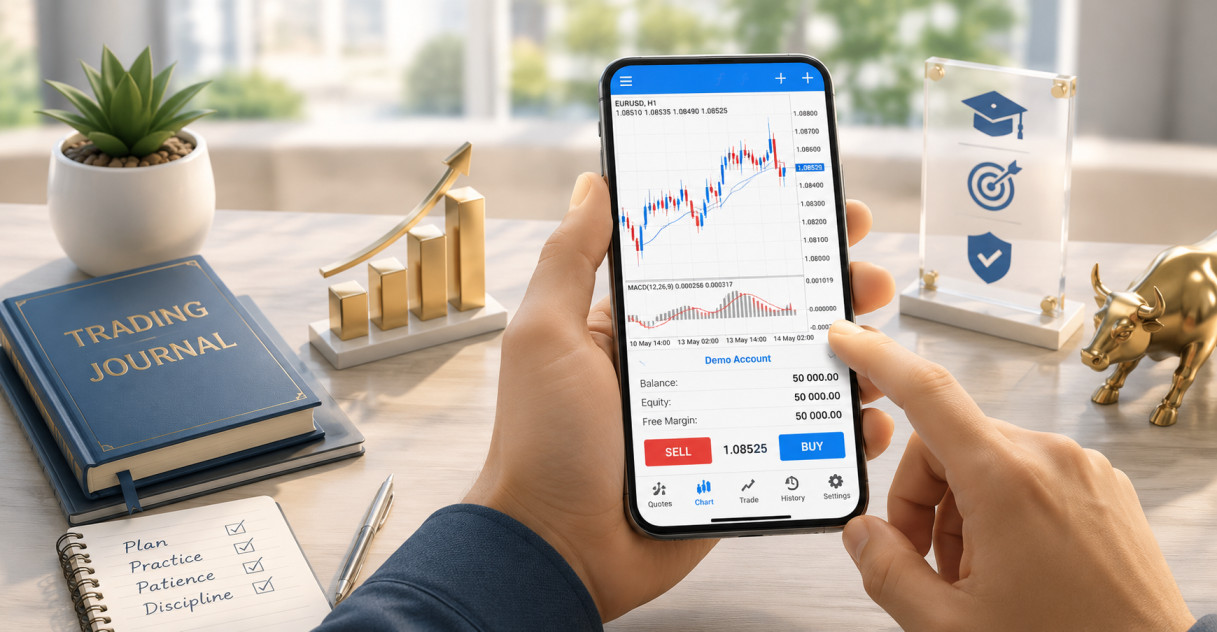
Here's a mindset shift that separates successful beginners from those who blow their accounts within weeks: a demo account is not just a toy. It is a professional simulation environment that lets you develop real trading discipline — without any financial consequences.
Most brokers provide demo accounts with virtual funds (typically $10,000–$100,000) that mirror live market conditions. Use this environment to test your strategies, understand how orders work, practise reading charts, and — critically — develop emotional control. Yes, even with fake money, many beginners experience the psychological pull of greed and fear. That's valuable data about yourself.
How to Get the Most from Demo Trading
- Trade it like real money — set position sizes as if your actual capital is at stake.
- Track every trade in a journal: entry, exit, reason, result, and emotional state.
- Spend at least 60–90 days on demo before even considering live trading.
- Test one strategy consistently rather than jumping between systems every week.

Step 4
Build a Concrete, Written Trading Plan
Professional traders don't just sit down and decide what to trade based on a hunch or a tweet. They follow a plan — a clear, written document that guides every decision before, during, and after a trade. Without one, you're not trading; you're gambling.
A solid trading plan removes emotional decision-making from the equation. When a trade is moving against you, your plan tells you exactly what to do. When a great-looking opportunity appears outside your strategy, your plan tells you to wait. That discipline is what separates consistently profitable traders from the majority who struggle.
Essential Elements of Your Trading Plan
- Clear financial goals: Define realistic monthly targets, keeping in mind that even professional traders often target 3–5% monthly returns.
- Chosen strategy: Whether you prefer trend following, breakout trading, or swing trading, commit to one approach and understand it deeply.
- Risk rules: Document maximum risk per trade (1–2% of capital), maximum daily loss limits, and when you'll stop trading for the day.
- Entry and exit criteria: Define precisely what conditions must be met before you enter or exit a trade. Vague rules lead to inconsistent results.
- Trading journal: Log every trade with full details — not to beat yourself up, but to identify patterns and improve systematically.
Step 5
Start Small and Master Risk Management
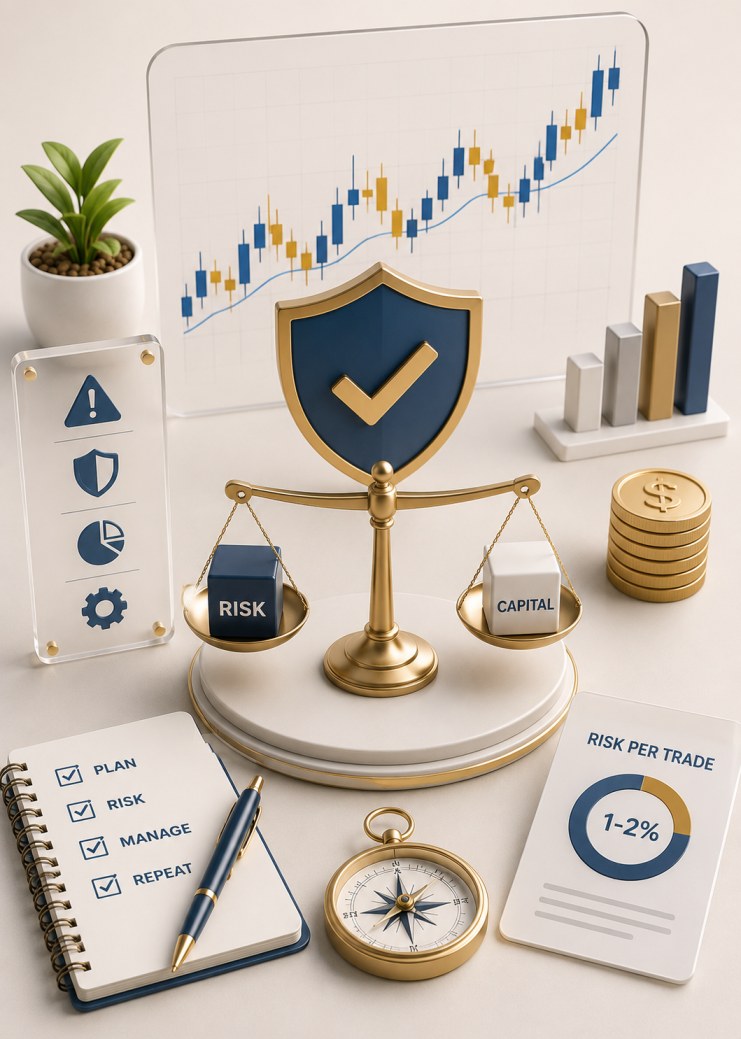
When you make the leap to live trading, resist the urge to go big. Your first objective as a live trader is not to make money — it's to not lose money. Preserving your capital while you develop real-world skills is the single most important job you have in your early months.
Risk management is, without question, the most critical skill in forex trading. New traders often focus entirely on finding the perfect entry signal, while ignoring the far more important question: how much can I afford to lose on this trade?
Core Risk Management Principles
- The 1–2% rule: Never risk more than 1–2% of your total trading capital on any single trade. This ensures that even a losing streak of 10 trades doesn't wipe you out.
- Stop-loss orders: Every trade needs a defined stop-loss before you enter. Not after. Before. Place it at a technically logical level, not just a round number.
- Risk/reward ratio: Aim for a minimum 1:2 risk-to-reward ratio. If you risk 50 pips, your target should be at least 100 pips. This means you can be wrong more than you're right and still make money.
- Avoid overleveraging: Leverage is a double-edged sword. Use it conservatively, especially early on. Many experienced traders use far less leverage than their broker allows.
Step 6
Never Stop Learning — The Market Always Evolves
One of the most refreshing and humbling things about forex trading is that learning never ends. Markets shift, strategies that worked brilliantly in one environment stop working in another, and new tools and data constantly emerge. The traders who thrive long-term are those who treat their trading career as a lifelong education.
Staying Sharp as a Forex Trader
- Follow economic calendars: Key events like central bank rate decisions, inflation data (CPI), and employment reports (NFP) move markets significantly. Always know what's coming.
- Review your trades weekly: Spend time each week going through your trading journal to identify what's working and what isn't. Data beats instinct every time.
- Join a trading community: Engaging with other traders through platforms like fxTsignals gives you access to live signal analysis, market commentary, and collective wisdom from experienced professionals.
- Backtest regularly: Run your strategies against historical data to validate them before deploying them in live markets.
- Stay psychologically fit: Read about trading psychology. Books like "Trading in the Zone" by Mark Douglas address the mental side of trading — arguably the hardest part for most people.
Frequently Asked Questions
New to forex? These are the questions we hear most often at fxTsignals.com — answered honestly.
Your Journey Starts With One Deliberate Step
The forex market isn't a lottery, a get-rich-quick scheme, or an exclusive club for financial professionals. It is a skill-based arena where knowledge, discipline, and consistent effort genuinely compound over time. The six steps outlined in this guide — educating yourself, choosing a regulated broker, practicing on demo, building a trading plan, managing risk carefully, and never stopping your development — aren't just good advice. They are the actual foundation of every successful forex trader's career.
At fxTsignals.com, we've seen countless traders transform from total beginners into confident, disciplined market participants by following exactly this kind of structured approach. The path isn't always smooth. There will be losing trades, frustrating periods, and moments of self-doubt. But every one of those experiences, when approached with the right mindset, makes you a sharper trader.
Start today. Study today. Open a demo account today. Your future self — trading with real confidence on a well-tested strategy — will be grateful you didn't wait.
Ready to Trade Smarter?
Join thousands of traders who rely on fxTsignals for professional-grade signals, market analysis, and educational resources. Stop guessing — start trading with confidence.