
What Exactly Is a Forex Hedge Fund?
Let's be honest — the forex market can feel like trying to read the weather. One day EUR/USD is climbing beautifully, and the next morning a central bank surprise wipes everything out. That's precisely where forex hedge funds come in, and why experienced traders and institutions have turned to them as one of the most sophisticated risk management tools available.
A forex hedge fund is a pooled investment vehicle that deploys hedging strategies inside the foreign exchange market. Unlike traditional funds that simply "buy low, sell high," these funds take carefully calculated positions on multiple sides of the market simultaneously. The goal isn't just profit — it's consistent profit with controlled downside. They thrive in volatile conditions where most retail traders bleed.
What sets them apart is the mindset: a defensive offense. These funds always have a plan B — a counter-position designed to cushion the blow if the primary trade moves against them.
How Forex Hedge Funds Actually Work
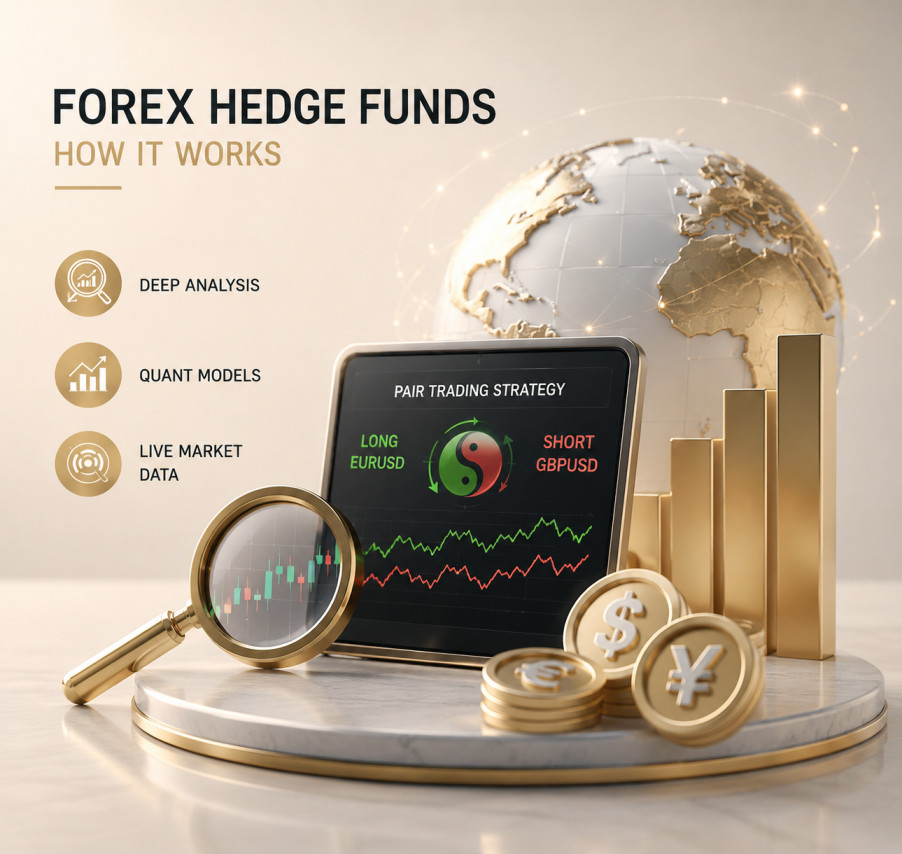
The mechanics behind a forex hedge fund go much deeper than simple buy/sell orders. Fund managers combine fundamental analysis, quantitative models, and live market data to construct layered positions that can profit in multiple scenarios simultaneously.
One of the most widely used tactics is pair trading — taking a long position in one currency pair while going short on a closely correlated pair. This isn't random guessing; it's based on statistical relationships between currencies that have held for years.
A Real-World Example That Makes It Click
Imagine a fund manager who is bullish on the Euro (EUR) against the US Dollar (USD), but is nervous about unexpected volatility — perhaps ahead of a Fed meeting. Instead of simply going long EUR/USD and hoping for the best, the manager adds a short position in USD/CHF, which historically moves in the opposite direction to EUR/USD.
- If EUR rises as expected → the EUR/USD long generates profit
- If volatility spikes unexpectedly → the USD/CHF short provides a cushion
- If both positions move favorably → returns are amplified
- Either way, catastrophic loss is minimized
That's the elegance of forex hedging — you're never fully naked in the market. There's always a counterbalance working in your favor.
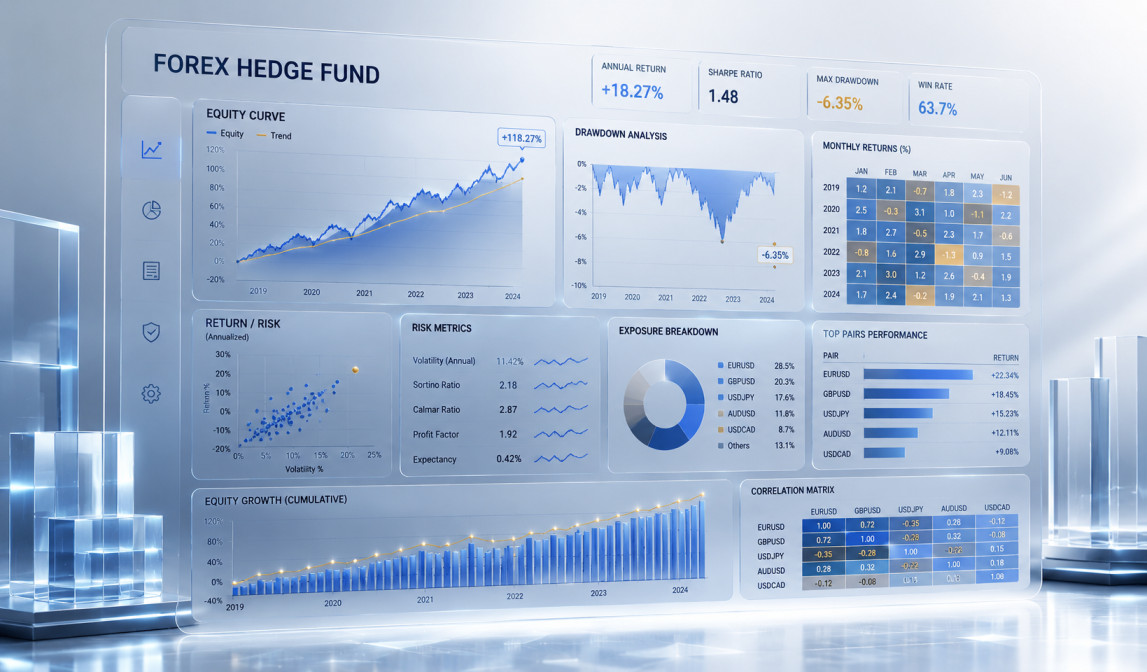
Professional fund managers use multi-layered strategies to navigate currency volatility
3 Core Benefits of Forex Hedge Funds
Traders from Qatar to New York are increasingly looking at forex hedge funds — not as a get-rich-quick vehicle, but as a mature, strategic approach to currency markets. Here's why:
Risk Management First
By neutralizing exposure through opposite positions, these funds dramatically reduce the chance of catastrophic losses — particularly in black swan events.
Wide Diversification
Top funds invest across dozens of currency pairs and regions — emerging markets, majors, exotics — capturing opportunities regardless of where growth appears.
Expert Management
You gain access to seasoned professionals who monitor markets 24/5, run proprietary algorithms, and pivot strategies in real time.
Consistent Returns
The overarching goal is not to win big once, but to win steadily — compounding gains through disciplined, rules-based strategies across all market cycles.
Risks You Should Never Ignore
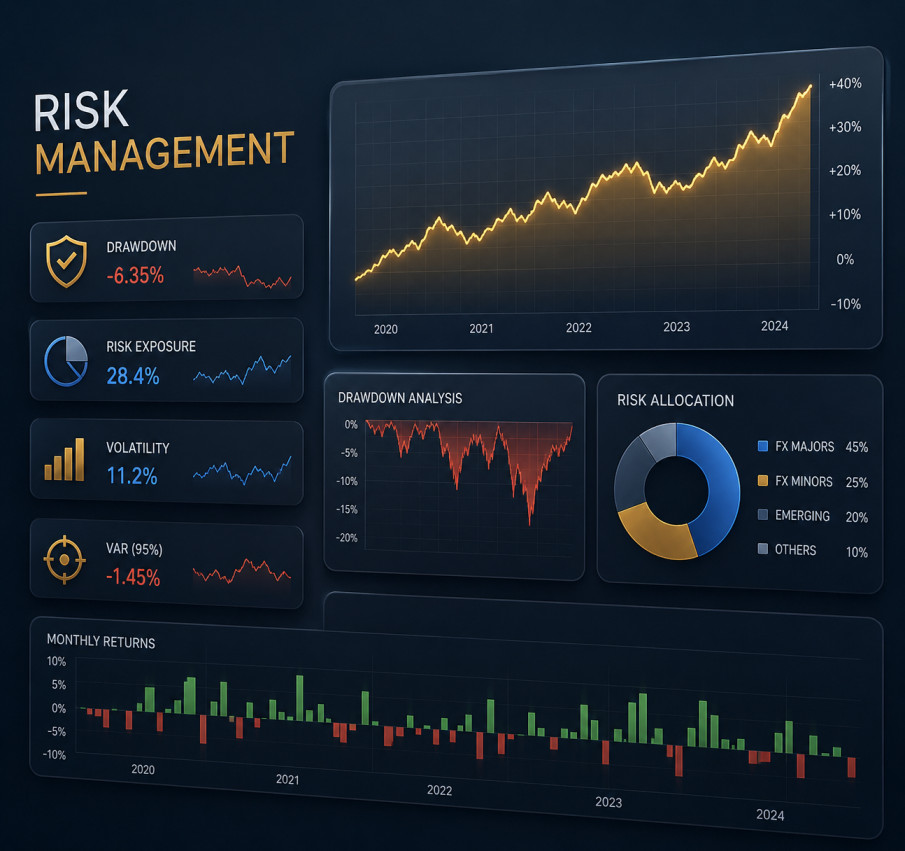
No investment strategy is bulletproof. Forex hedge funds come with their own set of challenges, and being aware of them is half the battle. Smart traders always assess risk before chasing reward.
1. Complexity Is a Double-Edged Sword
These funds operate in one of the world's most complex financial environments. Managers use technical analysis, macro-economic modeling, and correlation data that can take years to master. If you're evaluating a fund, make sure the team can explain their strategy in plain language. If they can't, walk away.
2. Liquidity Can Be Limited
Unlike ETFs or stocks where you can exit in seconds, many forex hedge funds have lock-up periods — sometimes months. Before investing, assess your own cash flow needs and ensure you won't need this capital at short notice. Redemption windows are real, and ignoring them is a costly mistake.
3. Track Record and Transparency Matter More Than Promises
The forex space has its share of bad actors. Always demand audited performance records, independent third-party verification, and clear fee structures before committing capital. High minimum investments mean nothing if the fund manager lacks accountability.
5 Actionable Steps Before You Invest in a Forex Hedge Fund
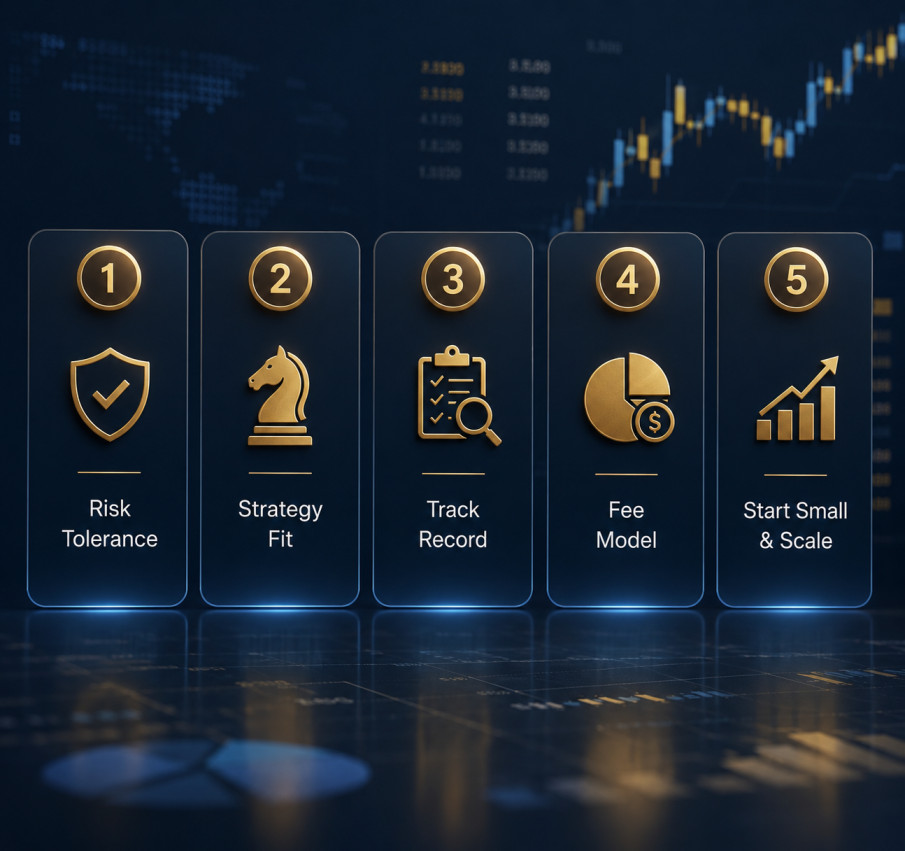
Whether you're a seasoned institutional player or an experienced retail trader looking to diversify, here's a practical framework to guide your decision-making:
- Define your risk tolerance clearly. Know exactly how much drawdown you can emotionally and financially absorb — 10%? 20%? This filters out immediately unsuitable funds.
- Study the fund's strategy in detail. Does it use pair trading, carry trade, momentum, or macro-overlay? Each has different risk-return profiles across market cycles.
- Verify the manager's credentials and track record. Ask for at least 3 years of audited performance. Look at Sharpe ratio, max drawdown, and monthly consistency.
- Understand the fee model. Standard is 2% management + 20% performance. Watch for hidden costs like redemption fees or excessive spreads in execution.
- Start small and scale with confidence. Never allocate your entire forex budget to one fund. Treat it as one part of a diversified portfolio until you've seen at least two full market cycles.
Popular Strategies Used Inside Forex Hedge Funds
Understanding what's happening "under the hood" helps you evaluate any fund with real confidence. Here are the main strategies you'll encounter:
Carry Trade Strategy
Borrow in a low-interest currency (like the Japanese Yen) and invest in a high-yield currency (like the Australian Dollar). The profit comes from the interest rate differential. It sounds simple, and it is — until a risk-off event causes a rapid unwinding of carry positions worldwide.
Global Macro Approach
Fund managers analyze broad economic trends — interest rate cycles, geopolitical events, central bank policy — and take positions that capitalize on major currency shifts. George Soros famously broke the Bank of England in 1992 using exactly this methodology.
Algorithmic / Quantitative Execution
Modern hedge funds increasingly run automated systems that scan hundreds of pairs simultaneously, executing trades at millisecond speeds when specific conditions are met. This removes emotion from the equation — which is one of the biggest advantages over manual trading.
- Momentum strategies — follow established trend direction with disciplined entries
- Mean reversion — profit when a currency pair returns to its historical average
- Statistical arbitrage — exploit tiny pricing inefficiencies across correlated assets
- Event-driven — position before high-impact news releases with defined risk parameters
Frequently Asked Questions
Here are the questions traders ask most about forex hedge funds — answered clearly.
Most institutional-grade forex hedge funds have minimum investment thresholds ranging from $100,000 to $1 million or more, targeting accredited investors and institutions. Some newer, regulated structures have lowered this to $10,000–$25,000 to attract a wider pool of qualified retail traders. Always verify the minimum during your due diligence process.
A regular forex trading account gives you direct access to the market, where you make all trading decisions yourself. A forex hedge fund is a managed vehicle — a professional team deploys capital on your behalf using complex hedging strategies, risk models, and quantitative systems that most individual traders simply don't have the tools or time to replicate independently.
No legitimate forex hedge fund guarantees profits — and any that claims to should be treated as a red flag. What well-run funds aim for is consistent risk-adjusted returns over time, with a disciplined approach to limiting drawdowns. Performance will vary across market conditions, but the goal is to outperform through superior risk management rather than pure speculation.
Pair trading involves simultaneously taking a long position on one currency pair and a short position on a correlated currency pair. The strategy profits from the relative movement between the two rather than a directional bet. For example, going long EUR/USD while shorting USD/CHF exploits their inverse relationship, providing a built-in hedge against broad market volatility while still capturing directional currency moves.
Start by verifying regulatory registration with bodies like the FCA, SEC, CFTC, or relevant local regulators. Request independently audited performance reports for at least 3 years. Review the fund's drawdown history — not just returns. Understand the fee structure, redemption terms, and capital protection measures. If possible, speak to existing investors. Transparency and regulatory compliance are non-negotiable minimum standards before any capital commitment.
Conclusion: Is a Forex Hedge Fund Right for You?
Forex hedge funds represent one of the most sophisticated tools available in currency markets today. They're not for everyone — they require capital, patience, and a willingness to let professional managers run the strategy. But for traders who are serious about growing and protecting wealth through the forex market, they offer something rare: a structured, disciplined path to consistent returns.
The key takeaways are straightforward. Understand the strategy. Verify the track record. Know your risk tolerance. Never skip due diligence. And never invest more than you can genuinely afford to have locked up for an extended period.
Whether you're exploring forex hedge funds as an investor or simply learning to apply hedging principles to your own trading at fxtsignals.com, the principles remain the same: protect the downside, stay disciplined, and let compounding do the work over time.
Ready to Trade Forex with an Edge?
Get professional-grade forex signals, hedging insights, and market analysis delivered directly to you — trusted by traders worldwide.
Start Trading with FxTsignals →