How to Research the BTCUSD Pair:
The Ultimate Trader's Playbook
Master the art of Bitcoin-USD analysis with proven research strategies — from on-chain fundamentals and macro forces to technical setups and sentiment signals that professional traders rely on.

If you've spent any time in the trading world, you already know that the BTCUSD pair is not just another asset — it is a phenomenon. Bitcoin against the US dollar is one of the most watched, most debated, and most volatile trading instruments on the planet. Every experienced trader will tell you the same thing: the difference between profit and loss often comes down to how thoroughly you research before you execute.
This guide from FXTsignals.com walks you through a complete, actionable framework for researching BTCUSD — the kind of framework that separates disciplined traders from impulsive gamblers. Whether you are a seasoned Forex professional venturing into crypto or a dedicated Bitcoin trader looking to sharpen your edge, these strategies will change how you approach the market.
Understanding Bitcoin and the BTCUSD Pair
Before you analyze a single chart or read a single news headline, you need a rock-solid foundation. Bitcoin is the world's first decentralised digital currency, introduced in 2009 by the pseudonymous Satoshi Nakamoto. Unlike fiat currencies controlled by central banks, Bitcoin operates on a peer-to-peer network with a fixed supply of 21 million coins — a feature that makes it fundamentally deflationary.
The BTCUSD pair represents how many US dollars one Bitcoin is worth at any given moment. It is traded around the clock on global cryptocurrency exchanges and increasingly through regulated Forex and CFD platforms. This means the pair is influenced by two very different sets of forces: the internal dynamics of the Bitcoin ecosystem and the broader macroeconomic environment surrounding the dollar.

Researching the Fundamentals
Fundamental analysis in crypto is different from traditional Forex, but it is equally powerful. The fundamentals that drive BTCUSD are rooted in both the Bitcoin network itself and the global economic landscape. Miss either side of this equation and you are trading half-blind.
1. Bitcoin Market Analysis
Start by building a daily habit around monitoring Bitcoin-specific data. This is not just about reading headlines — it is about tracking the numbers that tell the real story.
- Follow trusted sources like CoinDesk, Cointelegraph, and Bitcoin Magazine for news and network updates.
- Track Bitcoin's market capitalisation, daily trading volume, and 24-hour price changes across major exchanges.
- Study on-chain metrics such as hash rate, active addresses, exchange reserves, and miner outflows — these reveal what the real money is doing beneath the surface.
- Monitor the Bitcoin halving cycle. Historically, the 18–24 months following each halving have produced explosive upward price movements.
- Stay ahead of regulatory developments. New ETF approvals, government bans, or institutional adoption announcements can swing BTCUSD by thousands of dollars in hours.
🔍 Pro Tip: On-Chain Intelligence
Platforms like Glassnode, CryptoQuant, and Santiment provide on-chain data that the average retail trader overlooks entirely. When exchange reserves drop — meaning Bitcoin is flowing off exchanges — it often signals that large holders are accumulating and supply is tightening. That is bullish pressure building in silence.
2. Macroeconomic Factors That Move the Dollar Side
The USD half of BTCUSD deserves just as much attention. Bitcoin does not trade in a vacuum — it is priced in dollars, and dollar strength or weakness has a direct impact on how the pair moves.
- Watch the US Consumer Price Index (CPI) and Producer Price Index (PPI) — inflation data often drives the Federal Reserve's rate decisions, which in turn affect dollar value.
- Monitor Federal Reserve (Fed) statements, FOMC meeting minutes, and interest rate announcements closely. A hawkish Fed (higher rates) typically strengthens the dollar and can pressure risk assets including Bitcoin.
- Keep an eye on the US Dollar Index (DXY). A rising DXY often correlates with BTCUSD weakness, while a weakening dollar can fuel Bitcoin rallies.
- Geopolitical events — wars, sanctions, banking crises — can trigger safe-haven flows into Bitcoin, pushing BTCUSD sharply upward regardless of chart patterns.

Technical Analysis: Reading the BTCUSD Chart
Technical analysis is where most active traders spend the majority of their research time — and for good reason. BTCUSD charts are rich with information about supply and demand dynamics, market psychology, and probable future price movements. Here is how to approach it systematically.
Price Charts and Trend Identification
Begin with the higher timeframes before zooming in. The weekly and monthly charts reveal the dominant trend — the one that filters out the noise and tells you whether you should be primarily looking for long setups or short opportunities.
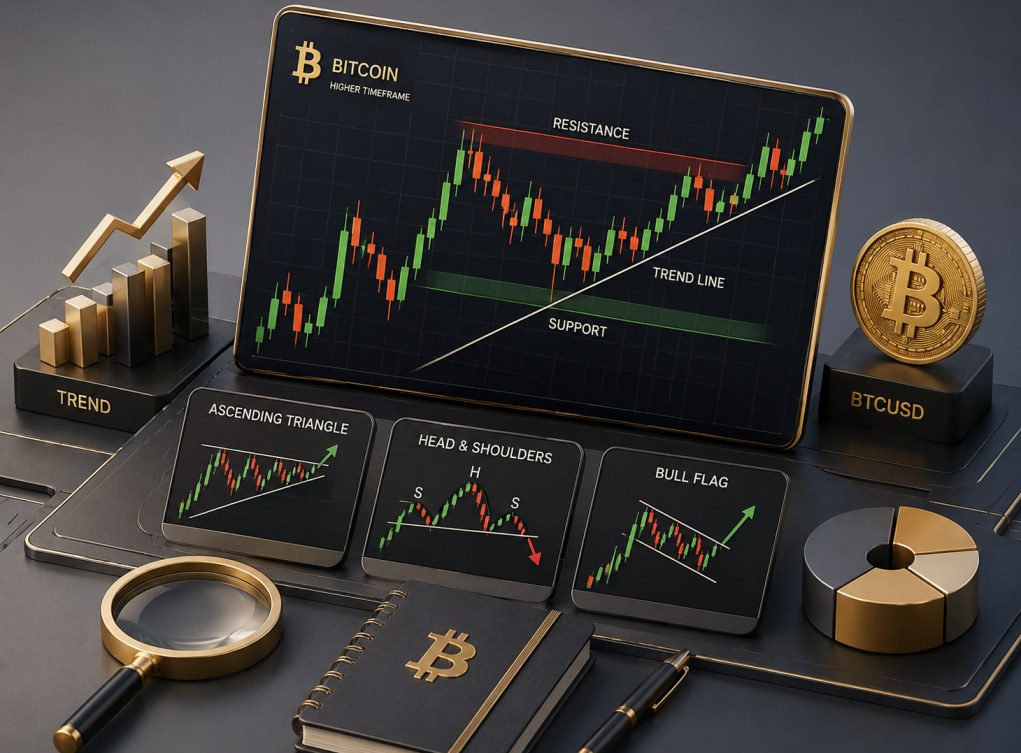
- Identify major support and resistance levels — price zones where buyers and sellers have historically clashed.
- Study trend lines across daily and weekly charts. A clean break of a multi-month trend line is one of the highest-probability signals in BTCUSD trading.
- Learn to recognise chart patterns: ascending triangles, head and shoulders, double bottoms, and bull flags appear repeatedly in Bitcoin's price history.
Key Indicators and Oscillators
- Moving Averages (MA): The 50-day and 200-day MAs are watched by institutional traders. A "Golden Cross" (50 MA crossing above 200 MA) is historically a strong bullish signal for BTCUSD.
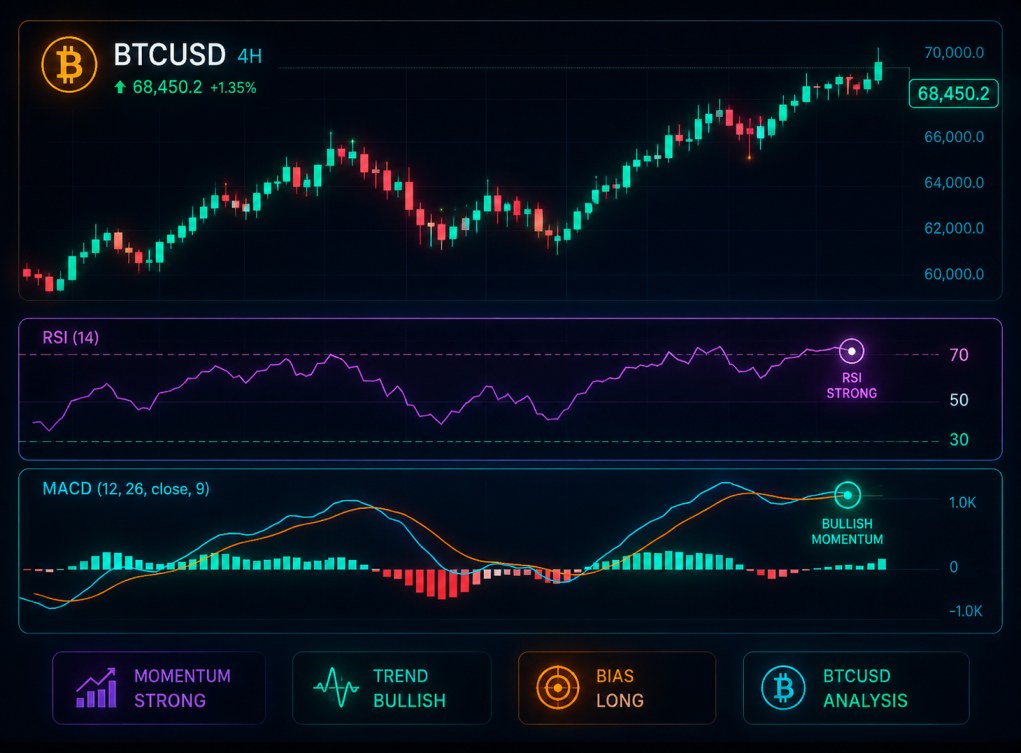
- Relative Strength Index (RSI): Readings above 70 suggest overbought conditions; below 30 signals potential oversold territory. RSI divergences are particularly powerful signals.
- MACD: The Moving Average Convergence Divergence helps confirm trend direction and momentum shifts — especially useful on the daily timeframe for BTCUSD swing trades.
- Bollinger Bands: Bitcoin's volatility makes Bollinger Bands especially useful. A squeeze (bands narrowing) often precedes an explosive directional move.
- Volume Analysis: Price moves accompanied by high volume are far more reliable. Platforms like TradingView display On-Balance Volume (OBV) and Chaikin Money Flow (CMF) — both help confirm whether institutional money is behind a move.
Practical tip: Never rely on a single indicator in isolation. A powerful entry signal is when RSI shows oversold conditions, price bounces from a key support level, and MACD begins crossing bullish — all simultaneously. That confluence of signals dramatically improves your probability of success.
Using Sentiment Analysis to Gain an Edge
In cryptocurrency markets, sentiment can move price far faster and farther than any technical indicator. When fear grips the market or euphoria takes over, rational analysis temporarily gives way to raw human emotion. Knowing how to read and act on this is a genuine competitive advantage.
Social Media and Community Monitoring
The Bitcoin community is extraordinarily vocal online. This creates a real-time window into collective psychology that traditional markets simply do not have.
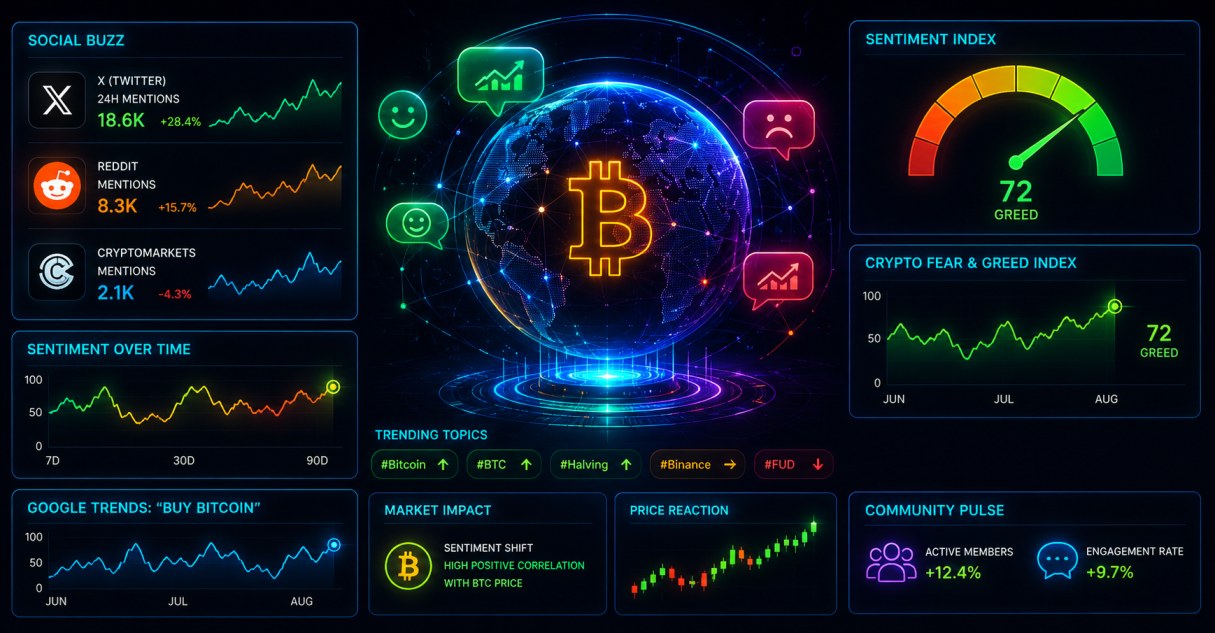
- Monitor Bitcoin-related discussions on X (Twitter) — particularly from influential analysts, on-chain researchers, and macro investors who move markets with a single post.
- Track activity on Reddit's r/Bitcoin and r/CryptoMarkets. Unusual spikes in engagement or tone shifts often precede price volatility.
- Use the Crypto Fear & Greed Index (available on Alternative.me) as a contrarian signal — extreme fear often marks buying opportunities, while extreme greed warns of potential reversals.
- Track Google Trends for "buy Bitcoin" searches. Retail FOMO (Fear of Missing Out) peaks tend to coincide with local market tops.
News and Media Literacy
Not all news is equal, and in crypto, misleading headlines can cause irrational price swings that create genuine trading opportunities — if you know how to read them correctly.
- Distinguish between genuine market-moving news (ETF approvals, exchange hacks, regulatory bills) and clickbait designed purely to generate traffic.
- Watch for narrative cycles — Bitcoin periodically gets painted as either a world-ending fraud or the solution to all financial problems. Neither extreme is useful for trading. Stay analytical.
- Pay attention to how institutional investors — hedge funds, sovereign wealth funds, and publicly listed companies — are positioning themselves. SEC filings, earnings calls, and Bloomberg reports often leak institutional intent before it shows up in price.
📈 The Research Stack That Works
Combine all three lenses — fundamentals, technicals, and sentiment — into a research ritual before any BTCUSD trade. When all three align (e.g. strong on-chain metrics + bullish technical breakout + positive macro backdrop + Fear & Greed Index at "Fear"), you have identified a high-probability setup. That is the signal professional traders wait for.
Your Practical BTCUSD Research Framework
Let's put all of this together into a repeatable daily process you can implement immediately:
Morning (15 min): Check overnight price action, read CoinDesk/Cointelegraph headlines, note the Fear & Greed Index reading, and review the DXY chart for any significant moves.
Analysis Session (30–45 min): Open TradingView and review BTCUSD on the weekly, daily, and 4-hour charts. Mark key levels. Check RSI, MACD, and volume. Note any pending catalyst events (Fed meetings, major economic releases).
On-Chain Check (10 min): Visit Glassnode or CryptoQuant. Check exchange netflows and miner behaviour. These data points confirm or challenge your technical thesis.
Evening Review (10 min): Journal your analysis, note what changed during the day, and update your key levels. Consistency in this process compounds into genuine expertise over time.
It depends on your trading style. Day traders often use the 15-minute to 1-hour charts for entries, while always maintaining awareness of the daily and weekly trend. Swing traders typically plan from the daily chart and enter on the 4-hour. For long-term position traders, the weekly chart is the most important reference. The key rule: always trade with the higher timeframe trend, not against it.
Bitcoin increasingly trades as a risk asset, similar to tech stocks. When the Federal Reserve raises interest rates aggressively, risk appetite falls and BTCUSD tends to decline. Conversely, when inflation fears rise and the dollar weakens, Bitcoin often attracts safe-haven and inflation-hedge buying. The correlation between BTCUSD and the NASDAQ has grown stronger since 2020, so watching US equity markets is now a legitimate part of Bitcoin research.
Start with three metrics: (1) Exchange Net Flow — negative netflows (Bitcoin leaving exchanges) indicate accumulation; (2) Hash Rate — a rising hash rate signals miner confidence and network health; and (3) HODL Waves — these show how long Bitcoin holders have been holding their coins, which reveals whether long-term believers are selling or accumulating. These three together give you a solid on-chain foundation.
Sentiment analysis is most powerful as a contrarian tool. Extreme readings — whether extreme greed or extreme fear — historically mark turning points in BTCUSD. It should never replace fundamental and technical analysis, but it adds a powerful third dimension. When all three agree (for example: bullish technicals + positive fundamentals + fearful sentiment that is starting to turn), the resulting signals tend to be among the highest probability in any market.
For active traders, a daily research review is the minimum. Crypto markets move fast and news cycles are 24/7. However, your strategic view — based on weekly and monthly analysis — should only be updated when there is genuinely new information that changes the big picture. Avoid the trap of "recency bias," where every short-term move convinces you to abandon your well-researched thesis. Build convictions slowly and update them deliberately.
Conclusion: Research Is Your Real Edge
In a market as fast-moving and emotionally charged as BTCUSD, the traders who consistently come out ahead are not the ones with the fastest execution or the most aggressive position sizing. They are the ones who have done the work — who understand the Bitcoin network, respect the macroeconomic context, read the chart with discipline, and listen to market sentiment without being ruled by it.
The framework in this guide is not a shortcut. It is a system. And like any system, its power compounds over time as you apply it consistently, adapt it to new market conditions, and layer your own experience on top of it. The BTCUSD market rewards patience and preparation above all else.
Stay curious. Stay disciplined. And when in doubt, do more research before you do more trading.
Ready to Trade BTCUSD With Confidence?
Join thousands of traders at FXTsignals.com who get professional-grade BTCUSD signals, market analysis, and real-time alerts delivered straight to their inbox and mobile.
🚀 Get Premium Signals Now No obligation · Cancel anytime · Used by 50,000+ traders worldwide