
Why Researching XAU/USD Deserves Your Full Attention

Ask any seasoned forex trader which pair keeps them up at night, and chances are XAU/USD comes up in the first sentence. Gold — represented by the ticker symbol XAU — is not just a commodity. It is a global barometer of fear, confidence, inflation expectations, and monetary policy. Paired against the U.S. Dollar, it becomes one of the most reactive and nuanced instruments in the entire financial market.
Whether you are just starting your trading journey or you have been reading charts for years, understanding how to properly research the XAU/USD pair is the foundation of every smart trade. Most losses in this market don't come from bad strategies — they come from incomplete research. Traders enter positions without fully understanding why gold is moving, and that is a costly mistake.
In this guide, we will walk you through exactly how professional traders approach their XAU/USD research. We will cover the macroeconomic forces that drive price, the technical tools that reveal market structure, the best data sources to rely on, and the key indicators you absolutely cannot ignore. By the end, you will have a clear, repeatable framework to use every single trading week.
Macroeconomic Factors That Drive XAU/USD
Before you place a single trade, you need to understand the big picture. Gold does not move in a vacuum — it reacts to the global economic environment in very specific, predictable ways once you understand the underlying logic.
Interest Rates and the Federal Reserve
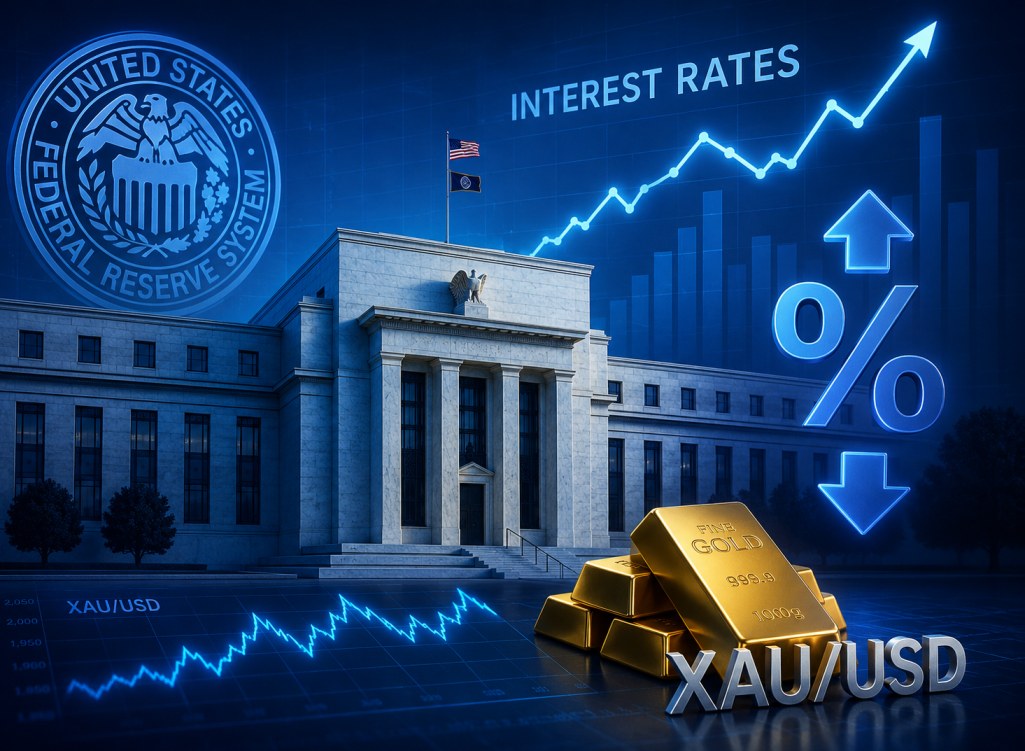
Interest rates are arguably the single most powerful force acting on the XAU/USD pair. Here is the relationship you must internalize: when the U.S. Federal Reserve raises interest rates, the dollar strengthens because higher rates attract capital looking for better returns. Gold, which pays no interest or dividend, becomes less attractive by comparison — and prices typically fall.
Conversely, when rates drop or the Fed signals a dovish outlook, the dollar weakens and gold climbs. This is why every Federal Open Market Committee (FOMC) meeting is circled on every serious gold trader's calendar. Even the language used in Fed statements can move XAU/USD by $20–$30 in minutes.
Practical tip: Track the CME FedWatch Tool to monitor the market's live probability of rate changes. This tool tells you what traders are already pricing in — and that gap between expectation and reality is where big moves happen.
Inflation and Real Yields
Gold has served as an inflation hedge for thousands of years, and that relationship remains intact in modern markets. When inflation rises faster than interest rates, real yields (interest rate minus inflation) turn negative. Negative real yields are a powerful catalyst for gold because investors prefer holding an asset that preserves value over a currency that is losing purchasing power.
Watch the U.S. 10-year Treasury Inflation-Protected Securities (TIPS) yield. When that yield falls — especially into negative territory — gold almost always rises. When it climbs, gold tends to struggle.
📌 Key Insight
The real yield on the 10-year TIPS is one of the most reliable leading indicators for XAU/USD direction. Bookmark the U.S. Treasury website and check it before major trades.
Geopolitical Uncertainty and Safe-Haven Demand
Gold earns its reputation as the ultimate safe-haven asset precisely because it performs when everything else is falling. Wars, banking crises, political elections, sanctions, pandemics — each of these events triggers a flight to safety that consistently lifts gold prices.
The interesting thing about safe-haven demand is that it is often short-lived. Gold spikes hard on a crisis headline, then slowly gives back gains as markets adapt. Smart traders recognize this pattern and avoid chasing breakouts based on fear alone.
Technical Tools Every XAU/USD Trader Must Know
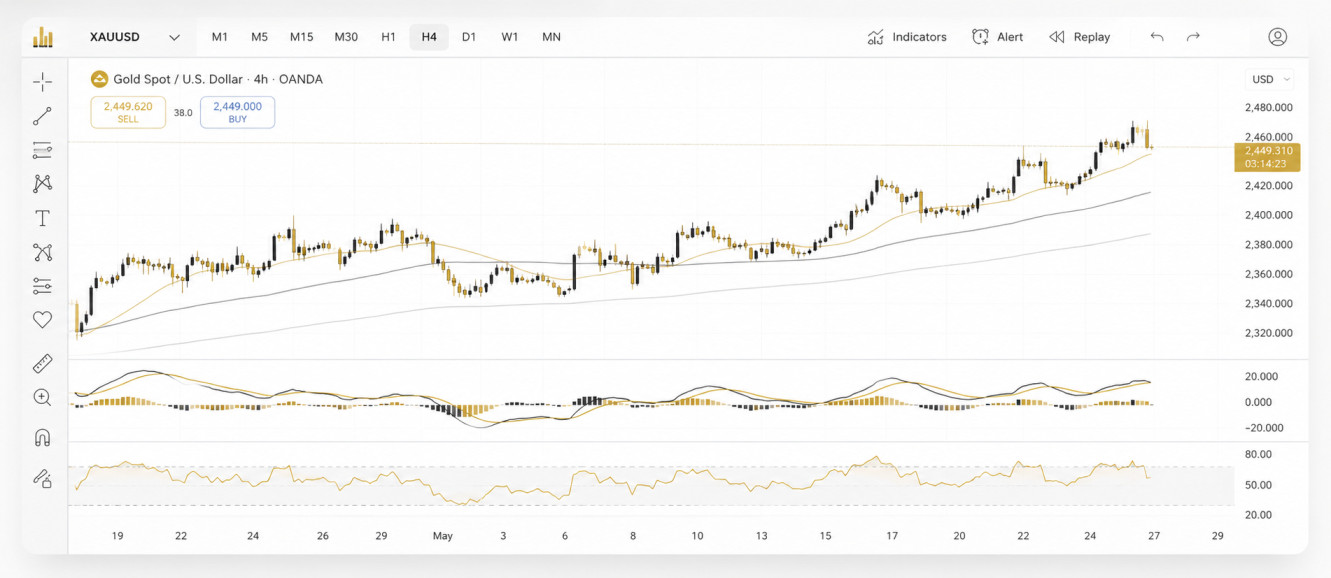
Fundamental research tells you why gold might move. Technical analysis tells you when and where. The most effective traders combine both — they identify the macro narrative, then use technical tools to find precise entries with defined risk.
Trend Lines and Market Structure
Before applying any indicator, learn to read raw price structure. Identify higher highs and higher lows in an uptrend, or lower highs and lower lows in a downtrend. Draw your trend lines along the swing points, not through candle bodies. A trend line break — especially on heavy volume — is one of the most reliable signals in XAU/USD trading.
Support and resistance zones carry particular weight in gold. Look for areas where price has reversed multiple times in the past — these become self-fulfilling levels because thousands of traders watch the same chart.
Moving Averages for XAU/USD
The 50-day and 200-day moving averages are the gold standard (pun intended) for trend identification. When the 50-day crosses above the 200-day, that is the classic "Golden Cross" — a bullish signal that has historically preceded extended rallies. The opposite — the 50-day crossing below the 200-day — is called the "Death Cross" and signals potential downside.
- 50 EMA: Excellent for spotting short-term momentum shifts and acting as dynamic support/resistance in trending markets
- 200 SMA: The long-term trend filter — if price is above it, bias long; below it, bias short
- 20 EMA: Useful for intraday and swing traders looking for pullback entries within the dominant trend
RSI — Reading Overbought and Oversold Conditions
The Relative Strength Index (RSI) is a momentum oscillator that measures the speed and magnitude of price changes on a scale of 0 to 100. Readings above 70 suggest XAU/USD may be overbought, while readings below 30 suggest oversold conditions. But here is the nuance most beginners miss: in a strong trend, RSI can stay overbought for extended periods. Use divergences — where price makes a new high but RSI does not — as your more reliable reversal signal.
The Best Data Sources for XAU/USD Research

Knowing what to research is only half the equation. The other half is knowing where to find reliable, fast, and unbiased information. Poor data sources lead to poor decisions — here are the sources professionals actually use.
Financial News and Analysis Platforms
Bloomberg and Reuters remain the gold standard for breaking economic news. However, for real-time XAU/USD commentary, platforms like Kitco News, FXStreet, and DailyFX publish dedicated gold analysis multiple times per day — often with technical levels, fundamental summaries, and institutional commentary all in one place.
Central Bank Communication
Do not just watch what central banks do — read what they say. The Fed's meeting minutes, Chair press conference transcripts, and regional Fed president speeches are all publicly available and contain language clues about future policy direction. Markets often begin pricing in moves weeks before they actually happen, so staying ahead of the narrative is a genuine edge.
Economic Calendars
Every professional trader runs an economic calendar every single Monday morning. High-impact events — marked in red on most calendar tools — can cause XAU/USD to move 50–150 points in seconds. Events to prioritize each week include:
- Non-Farm Payrolls (first Friday of every month)
- FOMC interest rate decisions and press conferences
- Consumer Price Index (CPI) and Producer Price Index (PPI) releases
- U.S. GDP data and jobless claims
- Fed Chair speeches and congressional testimony
Technical Platforms — TradingView and MetaTrader
For chart analysis, TradingView offers a browser-based platform with a huge community of gold analysts sharing their chart ideas daily — excellent for gaining alternative perspectives. MetaTrader 4 and 5 remain the dominant execution platforms for live trading, offering full indicator libraries and expert advisor support for algorithmic strategies.
Key Economic Indicators to Monitor Weekly
These three indicators have the most consistent, measurable impact on XAU/USD movements. Build a habit of reviewing each one and understanding how the actual release compares to market expectations — that gap is where the price action lives.
Non-Farm Payrolls (NFP)
Released monthly by the U.S. Bureau of Labor Statistics. Strong job numbers = strong dollar = gold pressure. Weak numbers = dollar sells off = gold rallies. One of the most volatile events on the calendar.
Consumer Price Index (CPI)
Measures average price changes over time — the benchmark inflation gauge. A hotter-than-expected CPI often sends gold higher initially, then can reverse if it triggers aggressive rate hike expectations.
Trade Balance & USD Index
The U.S. Dollar Index (DXY) has a near-perfect inverse correlation with XAU/USD. Monitor trade balance data and current account figures to gauge medium-term dollar strength or weakness.
Using Indicators Together — A Practical Approach
The real skill is not knowing each indicator individually — it is understanding how they interact. Imagine a week where CPI comes in higher than expected and the job market is strong. That combination typically strengthens the dollar, putting downward pressure on gold. But if geopolitical tensions are simultaneously escalating, safe-haven demand may counterbalance the dollar strength, creating a choppy, range-bound XAU/USD.
In that scenario, patience is your best trade — wait for the conflict between fundamentals to resolve before committing to a directional position. This kind of layered thinking is what separates profitable traders from reactive ones.
Actionable Research Habits for Consistent XAU/USD Trading

Knowledge without structure is just noise. Here is a practical weekly research routine that professional gold traders actually use:
- Sunday evening review: Check the economic calendar for the coming week. Identify all high-impact events and mark them in your trading journal so you know when NOT to trade and when to expect elevated volatility.
- Weekly chart first: Before any lower timeframe analysis, look at the weekly XAU/USD chart. Where is price relative to major support, resistance, and moving averages? This defines your bias for the week.
- DXY correlation check: Pull up the U.S. Dollar Index chart alongside XAU/USD. If DXY is in a clear trend, expect gold to mirror it in the opposite direction. Divergences between the two can signal key turning points.
- News sentiment scan: Spend 10 minutes on a reputable financial news site to absorb the prevailing sentiment around gold. Is the mainstream narrative bullish or bearish? Often, the trade is against the herd.
- Define your levels: Before the market opens on Monday, identify your key support and resistance zones, potential entry areas, and the levels that would invalidate your thesis. Write them down.
💡 Smart Trader Tip
Keep a research journal — not just a trade journal. Note your macro thesis each week, what the data actually showed, and how gold responded. Over months, patterns emerge that no strategy guide will ever teach you.
Building Your XAU/USD Research Framework
Trading XAU/USD profitably comes down to one thing: knowing more about what is driving the market than the person on the other side of your trade. That edge is built through consistent, disciplined research — not luck, not shortcuts, and definitely not chasing signals without context.
Start with the macroeconomic environment — understand where interest rates are heading, what inflation is doing, and what geopolitical forces are in play. Layer your technical analysis on top to identify structure, momentum, and precise entry levels. Use reliable data sources and never enter a high-impact news week without reviewing your economic calendar.
Remember: the XAU/USD market is not static. It evolves with the global economy, central bank policies, and human emotion. Your research process must be continuous, not a one-time exercise. The traders who win consistently are not the ones with the best strategy — they are the ones who understand the market best.
At fxTsignals.com, our analysts do this research every single day so you don't have to start from zero. Explore our live signal services to see how deep research translates into actionable trade setups delivered directly to your MT4 or MT5 account.
Frequently Asked Questions About XAU/USD Research
XAU/USD represents the price of one troy ounce of gold measured in U.S. Dollars. It is widely traded because gold is a globally recognized store of value, a safe-haven asset, and a hedge against inflation — making it attractive to a huge range of market participants from institutional investors and central banks to individual retail traders. Its 24/5 trading availability and high daily volatility offer consistent opportunities throughout every trading session.
When the Federal Reserve raises interest rates, it increases the opportunity cost of holding gold — because gold generates no yield, while bonds and savings accounts suddenly offer better returns. This typically causes gold to fall as investors rotate into dollar-denominated assets. When the Fed cuts rates or signals a more accommodative stance, the dollar weakens and gold becomes more attractive, driving prices higher. Even forward guidance from Fed officials can move XAU/USD significantly before any actual rate change occurs.
There is no single "best" indicator — professional traders combine multiple tools for confirmation. However, the most widely relied upon combination for XAU/USD includes the 50-day and 200-day moving averages for trend direction, RSI for momentum and divergence signals, and key horizontal support/resistance levels identified from price history. Trend lines connecting significant swing highs and lows also carry strong weight in gold markets, particularly on the daily and weekly timeframes.
The NFP report is released on the first Friday of every month and is among the highest-impact data events for XAU/USD. A stronger-than-expected jobs number signals economic health, which typically supports the dollar and pressures gold. A weaker-than-expected number raises concerns about economic growth, softens the dollar, and often triggers a gold rally. The key is not the number itself, but how it compares to market expectations — a miss of even 50,000 jobs from the forecast can send XAU/USD moving 40–80 points within minutes.
Absolutely, beginners can trade XAU/USD — but it requires learning before earning. Start by focusing on one or two macroeconomic factors, like interest rates and the DXY correlation, before adding complexity. Use a demo account to practice reading charts alongside news events. Platforms like TradingView provide excellent free charting tools with a large educational community. Many beginners also benefit from professional signal services — like those at fxTsignals.com — to see how experienced analysts approach research and identify setups while they are still building their own skills.
Ready to Trade XAU/USD with Confidence?
Let our professional analysts do the heavy research for you. Get live XAU/USD signals directly to your MT4 or MT5 — with clear entry, stop-loss, and take-profit levels, every single week.
Explore Live Signal Plans →