Reading the Market's Mind:
Advanced Sentiment Analysis Techniques
Every Forex Trader Needs Right Now

What if you could tap into the collective mood of millions of forex traders around the world — in real time? That's exactly what advanced sentiment analysis gives you. In a market where emotions drive billions of dollars in daily volume, understanding whether traders are fearful, greedy, optimistic, or uncertain isn't just useful — it's a genuine edge. At FxTsignals.com, we believe that mastering sentiment analysis is one of the most powerful skills any serious forex trader can develop. This guide breaks it all down in plain language, with real-world context and actionable strategies you can start applying today.
What Is Forex Sentiment Analysis — And Why Does It Matter?

Forex sentiment analysis is the process of measuring the overall attitude — the mood and expectations — of market participants toward specific currency pairs. Where fundamental analysis looks at economic data and technical analysis studies price charts, sentiment analysis digs into the human psychology behind the numbers.
Think of it this way: two traders can look at the same EUR/USD chart and reach completely opposite conclusions. What drives that gap? Sentiment. When fear dominates, even strong data can't push prices higher. When optimism is running hot, currencies can rally well beyond what fundamentals justify. Understanding this dynamic separates reactive traders from genuinely informed ones.
Modern sentiment analysis tools go far beyond gut feeling. They pull in massive streams of textual data from news articles, social media posts, financial forums, central bank communications, and earnings reports — then process it all using natural language processing (NLP) to generate actionable sentiment scores for each major currency pair.
Social Media Sentiment: The Pulse of the Market in Real Time
Social media has fundamentally changed the speed at which market sentiment moves. Platforms like X (formerly Twitter), Reddit's financial forums, and trading communities generate enormous amounts of sentiment data every single minute. A surprise central bank comment, a geopolitical shock, or even a viral financial meme can shift market mood in seconds.

Smart traders are now monitoring these platforms systematically rather than casually scrolling. Here's what makes social sentiment particularly valuable in forex:
- Speed advantage: Social sentiment often precedes official news cycles by 15–30 minutes, giving you a window to position before the crowd
- Volume signals: A sudden spike in mentions of a currency pair — positive or negative — frequently precedes significant price moves
- Retail trader exposure: Social platforms capture retail sentiment, which matters especially during periods of extreme greed or fear
- Crowdsourced analysis: Professional traders and analysts share real-time views, giving you access to distributed market intelligence
- Confirmation tool: Use social sentiment to confirm or challenge signals from your technical setup before entering a trade
Social media sentiment has become a genuine game-changer in forex trading, offering real-time insights into market psychology that simply weren't accessible to retail traders a decade ago.
— Forex Market AnalystNews Sentiment Analysis: Turning Headlines Into Trade Intelligence
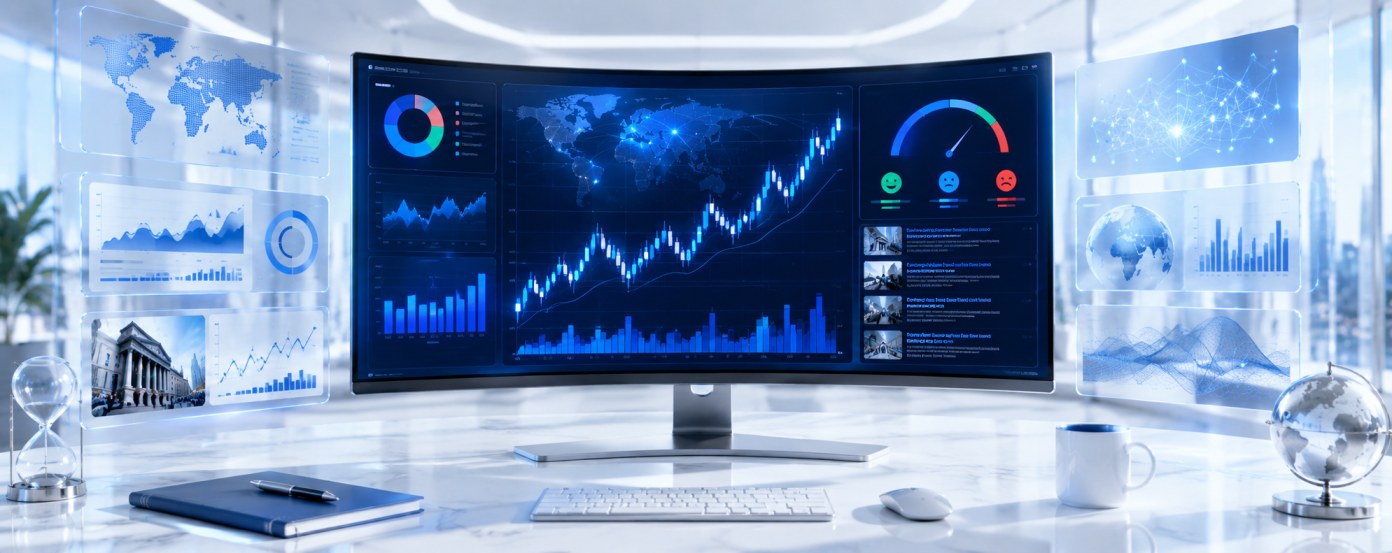
Every day, thousands of news articles touch on forex-relevant topics — from inflation reports and employment data to trade war escalations and political uncertainty. Most traders can't process all of it in time to act. That's exactly where news sentiment analysis steps in to do the heavy lifting.
Modern NLP models can scan and score hundreds of news articles per minute, categorizing each one as positive, negative, or neutral relative to a specific currency. The result is a live sentiment score that shifts in real time as the news cycle evolves. Traders who integrate this into their workflow get an immediate read on whether a news event is likely to push a pair higher, lower, or simply create volatility.
For example, if multiple credible outlets publish hawkish language around the Federal Reserve in the same hour, a news sentiment tool will register a strongly bullish signal for USD — often before the broader market has fully priced it in. That's the edge news sentiment analysis offers: not just knowing what the news says, but understanding its emotional weight and market direction.
4 Advanced Sentiment Analysis Techniques That Actually Work
Not all sentiment tools are created equal. As AI and machine learning have evolved, so too have the methods for extracting meaningful signals from raw textual data. Here are the four most powerful approaches used by institutional and sophisticated retail traders today.
Machine Learning Sentiment Models
Trained on millions of labeled financial texts, ML models identify subtle linguistic cues that basic keyword searches miss entirely. They distinguish between "dollar strengthens" and "dollar barely recovers" — nuances that matter enormously in fast markets.
Sentiment API Integration
Professional trading platforms can connect directly to sentiment analysis APIs, delivering live sentiment scores, trend alerts, and signal feeds alongside your existing charts — without switching tools or losing flow.
Sentiment + Technical Analysis Fusion
When a bullish sentiment signal aligns with a technical breakout — for instance, EUR/USD breaking resistance while social sentiment turns positive — the combined confirmation dramatically improves your probability of a successful trade.
Central Bank Communication Analysis
Fed statements, ECB press conferences, and Bank of England minutes move markets enormously. NLP tools can score the hawkishness or dovishness of central bank language in seconds, giving traders a head start on positioning.
Machine learning algorithms are transforming sentiment analysis in forex trading — enabling traders to leverage big data for more accurate, more timely predictions than ever before.
— Financial Analyst, Global Markets ResearchCentral Bank Sentiment: The Most Overlooked Signal in Forex

Of all the data sources for forex sentiment analysis, central bank communications remain the most powerful — and the most misread. When the Federal Reserve chair speaks, every word is deliberate. The shift from "considering rate hikes" to "actively exploring rate hikes" might look identical to the untrained eye, yet carries completely different market implications.
Advanced NLP models trained specifically on central bank language can score these communications almost instantly. They categorize tone shifts — from neutral to hawkish, from cautious to dovish — and translate them into actionable signals before most traders have finished reading the headline.
For forex traders, this is invaluable. If the Bank of Japan's latest statement shows a meaningful hawkish shift, a central bank sentiment tool flags it immediately — giving you time to position USD/JPY or EUR/JPY trades ahead of the broader reaction. At FxTsignals.com, integrating this kind of intelligence into your strategy is what separates informed trades from guesswork.
- Start with one currency pair and track its sentiment score daily for two weeks before trading on it
- Never trade on sentiment alone — always cross-reference with at least one technical indicator for confluence
- Set news sentiment alerts for your preferred pairs so you're notified of extreme readings instantly
- Monitor social media volume spikes — sudden increases often precede breakouts or reversals
- Pay special attention to central bank sentiment shifts in the 48 hours before major rate decisions
- Use sentiment as a contrarian tool during extreme conditions — when everyone is bullish, consider the risk of a reversal
- Review your sentiment-based trades weekly and log which sentiment sources gave you the most accurate signals
Combining Sentiment, Technicals, and Fundamentals: The Complete Trader's Approach
The most consistent forex traders don't rely on any single type of analysis. They build a layered picture of the market using fundamentals to understand the "why," technicals to identify the "when," and sentiment to gauge the "how strongly" — how much conviction is behind a potential move.
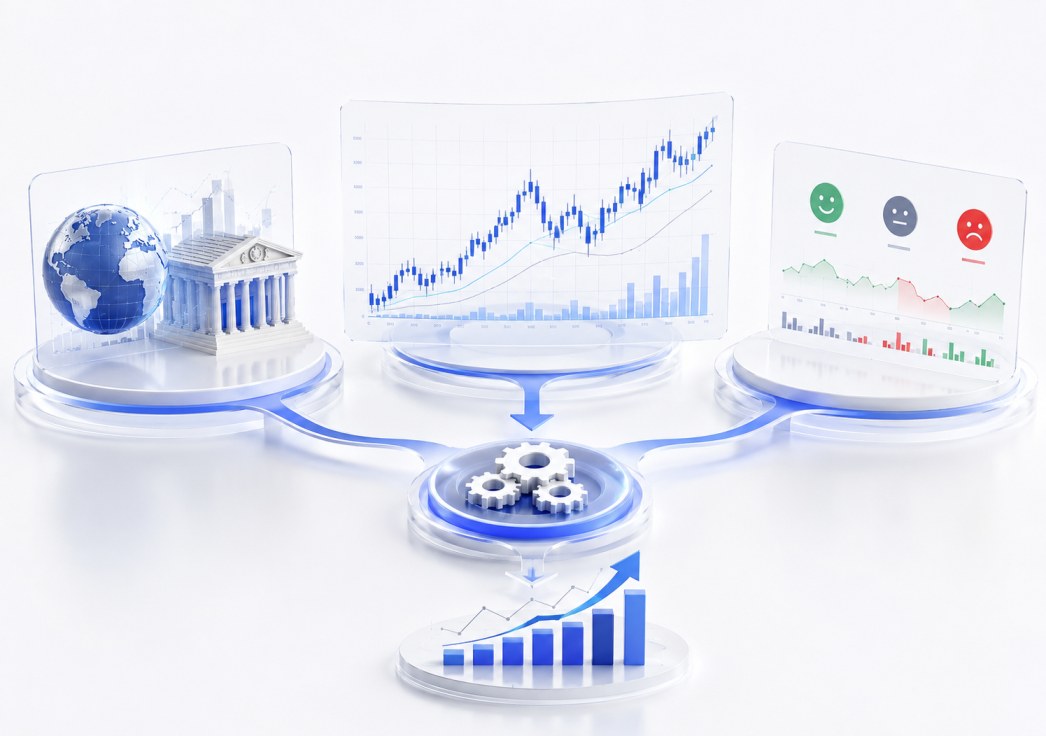
Here's a practical scenario: suppose your fundamental analysis shows that the US economy is outperforming expectations, and your technical charts show GBP/USD at a key resistance level. If your sentiment dashboard simultaneously shows increasingly negative sentiment toward the British Pound driven by political uncertainty headlines, you have three overlapping signals all pointing in the same direction. That's a high-confidence trade setup.
Contrast that with a setup where your technical signals look good, but sentiment is neutral or mixed. The lack of sentiment alignment is itself useful information — it suggests the move may lack the momentum needed to follow through, and you might want to wait for a clearer picture or reduce your position size accordingly.
This kind of multi-layered confirmation is what professional traders at institutional desks use every day. At FxTsignals.com, we build sentiment intelligence directly into our signal generation process so you don't have to piece it together manually.
Combining sentiment analysis with technical analysis gives traders a genuinely powerful approach to predicting market movements and elevating overall trading performance across all market conditions.
— Forex Strategist, FxTsignals.comFrequently Asked Questions: Forex Sentiment Analysis
The Market Speaks — Are You Listening?
Advanced sentiment analysis is no longer just a tool for hedge funds and institutional desks. It's accessible, powerful, and increasingly essential for any forex trader who wants to trade with more than just hope and charts. By monitoring social media sentiment, processing news flows, leveraging machine learning models, analyzing central bank communications, and combining it all with your existing technical framework, you gain a richer, more complete view of the market than most traders ever develop.
The forex market is ultimately a reflection of collective human psychology playing out across trillions of dollars of daily transactions. Sentiment analysis gives you the tools to read that psychology systematically, remove emotional bias from your own trading, and make decisions grounded in data rather than noise. That's not just a competitive advantage — it's a completely different way of experiencing the markets.
At FxTsignals.com, we integrate these exact techniques into every signal we generate — so you can trade with clarity, confidence, and a genuine edge every single session.
Ready to Trade With Sentiment Intelligence Behind You?
Join thousands of traders who use FxTsignals.com to get premium, sentiment-powered forex signals — delivered in real time, every trading day.
Start Copy Trading Now →