What Are Forex Signals — And Why Do They Matter?
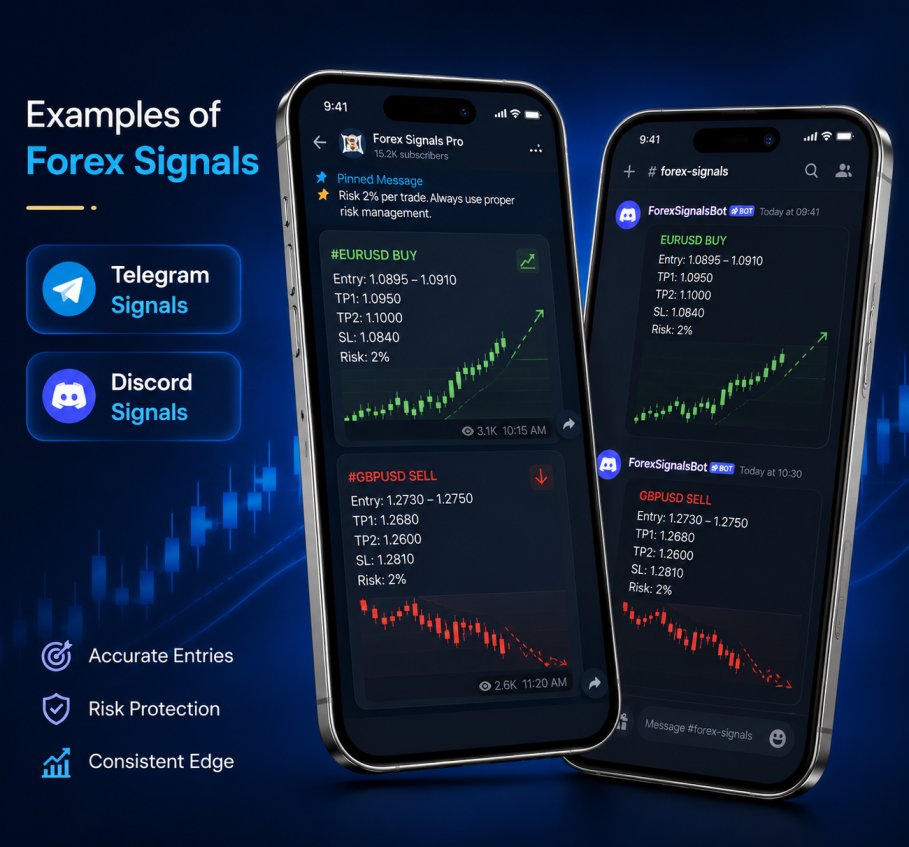
Walk into any serious trading room and you'll find two things on every screen: price charts and alerts. Forex signals sit at the exact intersection of those two tools. In the simplest sense, a forex signal is a trading recommendation — a specific prompt to buy or sell a currency pair at a defined price, with clear stop-loss and take-profit levels attached.
But for technical traders, signals mean something far more precise. They're not generic tips from an anonymous Telegram channel. They are structured outputs derived from technical analysis — the study of price action, chart patterns, and mathematical indicators applied to historical market data. When calibrated correctly, they give you a consistent, emotionless framework for decision-making in a market that rewards discipline above everything else.
The global forex market processes over $6.6 trillion in daily trading volume. Within that ocean of activity, technical traders face the constant challenge of separating signal from noise. This is exactly where well-designed forex signal systems earn their place in your strategy.
Three Real Benefits Most Traders Overlook
The surface-level benefit of forex signals is obvious: they tell you when to trade. But the traders who get the most out of signal services understand the deeper advantages. Let's look at what actually moves the needle.

1. Time Efficiency Without Sacrificing Quality
Scanning multiple currency pairs across multiple timeframes is a full-time job. A technical trader who monitors EUR/USD, GBP/JPY, USD/CHF, and AUD/USD across the 4H, Daily, and Weekly charts is looking at 12+ chart combinations before placing a single trade. Forex signals condense this work into actionable alerts, freeing your attention for trade management and strategy refinement rather than chart hunting.
2. Objective, Emotion-Free Analysis
Emotion is the number one account-killer in retail forex trading. Fear of missing out pushes traders into chasing entries. Overconfidence leads to oversized positions after a winning streak. Signals derived from systematic technical analysis bypass all of that. When your entry is based on an RSI divergence confirmed by a moving average crossover — not on gut feeling — your decision-making becomes structurally more consistent.
3. Continuous Learning Through Pattern Recognition
Every signal you receive is a case study. Compare the signal's reasoning to your own chart read. Did you spot the same harmonic setup? Did the indicator alignment match what you were seeing? Over weeks and months, this habit dramatically accelerates your technical analysis education — far faster than reading theory alone.
The best traders don't trade more — they trade better. Forex signals give technical traders the clarity to act precisely, protect their capital intelligently, and grow their edge one setup at a time.
The Three Core Types of Technical Forex Signals
Not all signals are built the same. The methodology behind a signal determines when it works best, what risk it carries, and how it fits your existing strategy. Here are the three primary categories every technical trader should understand.
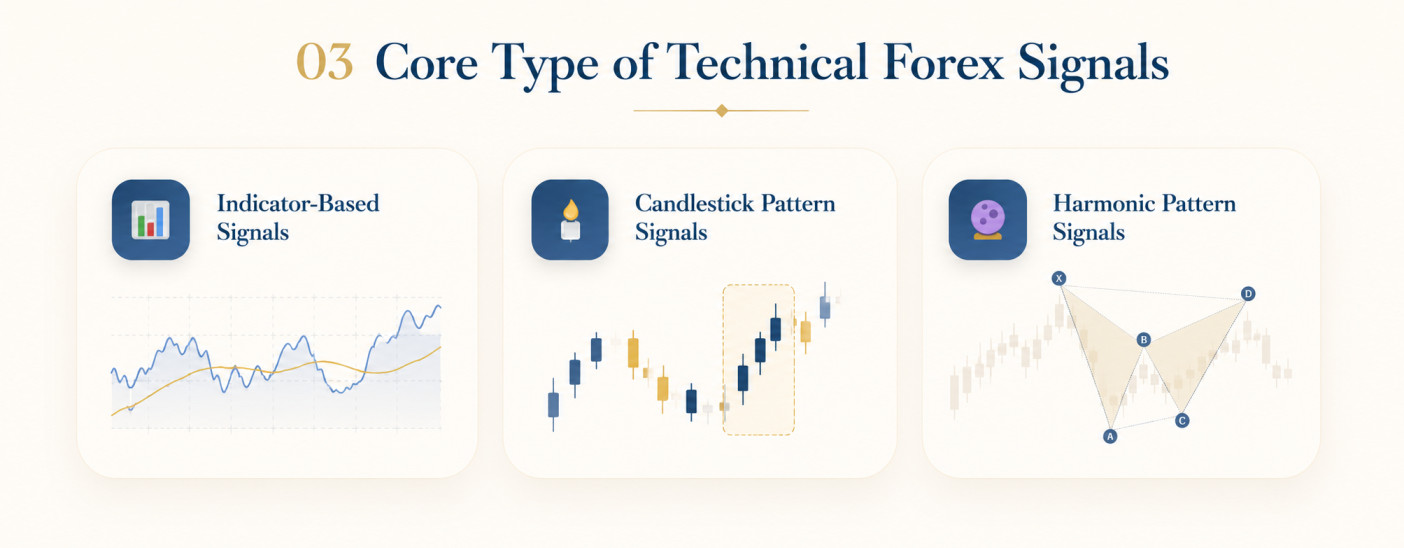
Indicator-Based Signals
Built from tools like RSI, MACD, Bollinger Bands, and moving averages. These signals fire when specific mathematical conditions are met — for example, when the 50 EMA crosses above the 200 EMA on the Daily chart, or when RSI reaches oversold territory during a defined trend. Ideal for traders who prefer quantifiable, repeatable setups.
Candlestick Pattern Signals
Derived from the shapes formed by individual or grouped candlesticks on a price chart. A bullish engulfing at a key support zone, a pin bar rejecting resistance, or a three-candle reversal at a Fibonacci level — these are the setups candlestick signal providers flag. Powerful when combined with higher-timeframe context.
Harmonic Pattern Signals
The most advanced category. Harmonic patterns — Gartley, Bat, Cypher, Butterfly — use precise Fibonacci ratios to identify high-probability reversal zones. These signals require deep chart knowledge to produce but offer excellent risk-reward ratios. Best suited for experienced technical traders who can validate the pattern geometry independently.
How to Incorporate Forex Signals Into Your Strategy — The Right Way

Receiving a signal is only step one. How you validate, size, and manage that trade determines whether signals actually improve your results or just add noise to your process. Here's the practical framework used by consistent technical traders.
Step 1 — Choose Your Signal Provider With Precision
Not all signal providers are created equal. Before subscribing to any service, look for these non-negotiables: a verifiable track record with trade-by-trade history, clear methodology documentation, consistent delivery frequency, and honest communication about drawdown periods. Avoid any provider who promises unrealistic win rates — professional signal services typically sit between 55–70% accuracy, not 90%.
Step 2 — Validate Signals With Your Own Analysis
Think of a signal as a second opinion, not a final verdict. When you receive a buy alert on USD/JPY, open your chart. Does the setup make sense within the current market structure? Is the signal aligned with the higher-timeframe trend? Does the entry sit near a meaningful support level? Traders who layer their own technical confluence over received signals dramatically reduce false signal risk.
Step 3 — Execute Proper Risk Management on Every Trade
This is where most retail traders fail, and where signal discipline becomes critical. No matter how strong a signal looks, position sizing must follow your pre-defined risk rules. The standard professional guideline: risk no more than 1–2% of your account balance on any single trade. Set your stop-loss at the signal's specified level — not where it feels comfortable, but where the setup is technically invalidated.
- Calculate position size in lots before every entry, not after
- Place stop-loss at technical invalidation, not round numbers
- Target a minimum 1:2 risk-reward ratio on all signal-based trades
- Never add to a losing position, even if the signal suggests strength
- Track every signal outcome in a trading journal — wins and losses both
Step 4 — Keep a Signal Performance Journal
One of the most underused habits in retail trading is the performance journal — specifically tracking how your signal provider's calls perform over time. Log the signal details, your entry, the outcome, and critically: whether your personal chart read aligned or contradicted the signal. After 30–50 trades, patterns emerge. You'll discover which signal types work best in trending versus ranging conditions, and which pairs your provider analyzes most accurately.
Key Takeaways for Technical Traders
To bring everything together, here's what separates traders who benefit from forex signals from those who don't:
- Signals supplement analysis — they don't replace it. The best use case is signal + personal confluence, not signal alone.
- Methodology match matters. Choose indicator-based signals if you're a momentum trader. Candlestick signals if you're a price action trader. Harmonic signals if you have the pattern recognition experience to validate them.
- Risk management is non-negotiable. Even the best signal provider will have losing streaks. Your account survives those through position sizing, not signal quality alone.
- Review and iterate regularly. The market evolves. A signal methodology that thrived in trending 2024 conditions may underperform in the choppy 2026 environment. Stay adaptive.
- Patience is the real edge. Not every signal needs to be acted on. Waiting for high-conviction setups where signal, analysis, and risk-reward all align is what professional traders do.
Forex signals act as a guiding light for technical traders — illuminating high-probability setups so you spend less time hunting and more time executing with confidence.
Frequently Asked Questions
A forex signal is a trade recommendation that specifies a currency pair, direction (buy or sell), entry price, stop-loss level, and take-profit target. For technical traders specifically, signals are generated through systematic analysis of price charts and indicators — such as RSI divergences, moving average crosses, or candlestick pattern formations — rather than fundamental news events. When you subscribe to a quality technical signal service, you receive real-time alerts via email, app notification, or direct platform integration, allowing you to evaluate and act on setups as they form.
Forex signals can benefit traders at every level, but in different ways. Beginners benefit from the structured trade ideas and the implicit education — seeing how a professional analyst identifies entries builds chart-reading skills over time. Experienced traders benefit from the time savings and as a second-opinion validation tool. The key distinction is that beginners should use signals as a learning framework rather than a copy-paste system, always seeking to understand the technical reasoning behind each recommendation before executing.
Look for four core indicators of trustworthiness: a verifiable trade history with real entry, exit, and outcome data (not just screenshot wins); transparent methodology explaining what technical tools they use to generate signals; consistent communication even during losing periods; and reasonable, realistic win rate claims. Legitimate signal providers typically achieve 55–70% accuracy over meaningful sample sizes. Any provider claiming consistent 85–95% win rates should be approached with significant skepticism. Free trial periods and community reviews on independent trading forums are valuable evaluation tools.
Absolutely — and this combination is generally considered the most effective approach. Rather than blindly following every signal, experienced traders use signals as a starting point and then apply their own multi-timeframe analysis to validate the setup. For example, if a signal calls a long on GBP/USD at a specific support level, you might verify that the Daily trend is upward, that the Weekly chart confirms the support zone significance, and that no major economic events are scheduled that could invalidate the technical picture. This layered approach significantly improves signal quality filtering.
The foundational rule is to risk no more than 1–2% of your total account balance on any single signal-based trade. Always use the stop-loss level provided in the signal — moving it to avoid a small loss is one of the most common and damaging habits in retail trading. Aim for setups where the potential profit is at least twice the risk (1:2 risk-reward minimum). Additionally, consider your total portfolio exposure: having five simultaneous trades open in correlated USD pairs means you're effectively taking one large USD bet, not five independent trades. Manage correlation risk as carefully as individual trade risk.
Ready to Add Precision to Your Technical Trading?
Join thousands of technical traders who sharpen their edge with professional, analysis-backed forex signals. No noise. No hype. Just high-probability setups delivered with clarity.
Explore FxTsignals Signal Service →