
The financial markets have always rewarded those who think differently. And right now, one of the smartest moves a forex trader can make is learning how CFD options trading actually works — not just the surface-level basics, but the real mechanics that separate casual traders from consistent performers.
Whether you've been trading forex for a year or a decade, adding Contracts for Difference (CFDs) to your options strategy can open doors that traditional trading simply can't. You get flexibility. You get leverage. And — done right — you get a cleaner way to manage risk across multiple asset classes simultaneously.
This guide breaks it all down for you — no jargon overload, no fluff. Just actionable insights you can take directly to your trading desk.
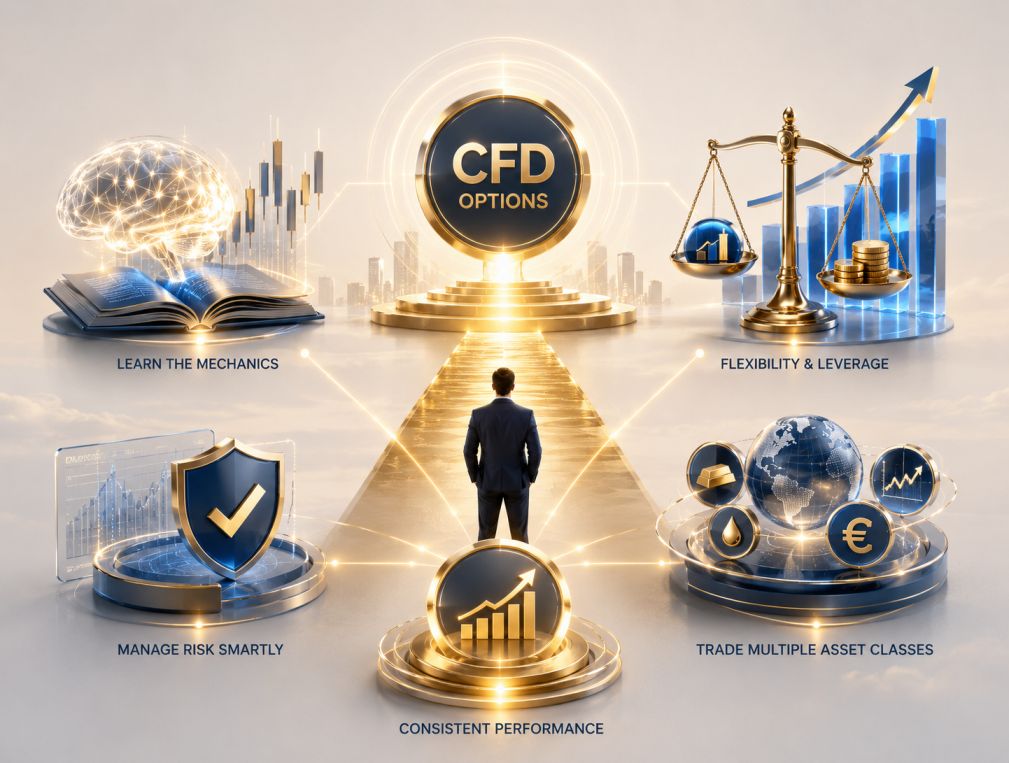
What Are CFDs and Why Do Options Traders Love Them?
Before diving into strategy, let's make sure we're on the same page. A Contract for Difference (CFD) is a derivative instrument — meaning you speculate on an asset's price without ever owning it. You open a contract based on where you think the price is heading, and your profit or loss is determined by the difference between your entry and exit price.
Here's what makes this powerful for options traders: CFDs mirror the price movement of the underlying asset — whether that's a stock, commodity, currency pair, or index — and they settle entirely in cash. No delivery of assets, no complicated ownership transfers.
When you combine this with options logic — the right but not the obligation to act — you get a uniquely flexible trading instrument. You're not locked into a position. You can go long, go short, use stop-losses, and exit on your own terms.
The 4 Real Benefits That Set CFD Options Apart
Plenty of financial instruments promise flexibility. CFDs actually deliver it. Here's why professional forex traders increasingly incorporate them into their broader options strategies:
Why CFD Options Work for Active Traders
- Accessibility without borders: CFDs are available on global platforms, giving retail traders access to markets previously reserved for institutional players. Forex, indices, commodities, individual stocks — all through one account.
- Leverage that multiplies opportunity: You can control a significantly larger market position with a smaller capital outlay. A 5% move on a leveraged CFD position can produce returns that would require a 25% move in a non-leveraged setup.
- Flexibility across timeframes: Unlike some derivative instruments with rigid expiry rules, CFDs can be held for intraday scalps or multi-week swing trades. Your strategy drives the timeline, not the contract.
- True portfolio diversification: CFDs provide a single gateway to equities, commodities, forex, and global indices. For traders who want genuine diversification without juggling multiple brokers and accounts, this is a game-changer.
- Two-directional profit potential: Markets fall more dramatically than they rise. CFDs let you short markets efficiently — and combined with put options logic, that's a real edge in volatile conditions.

Understanding Options Mechanics Inside CFDs
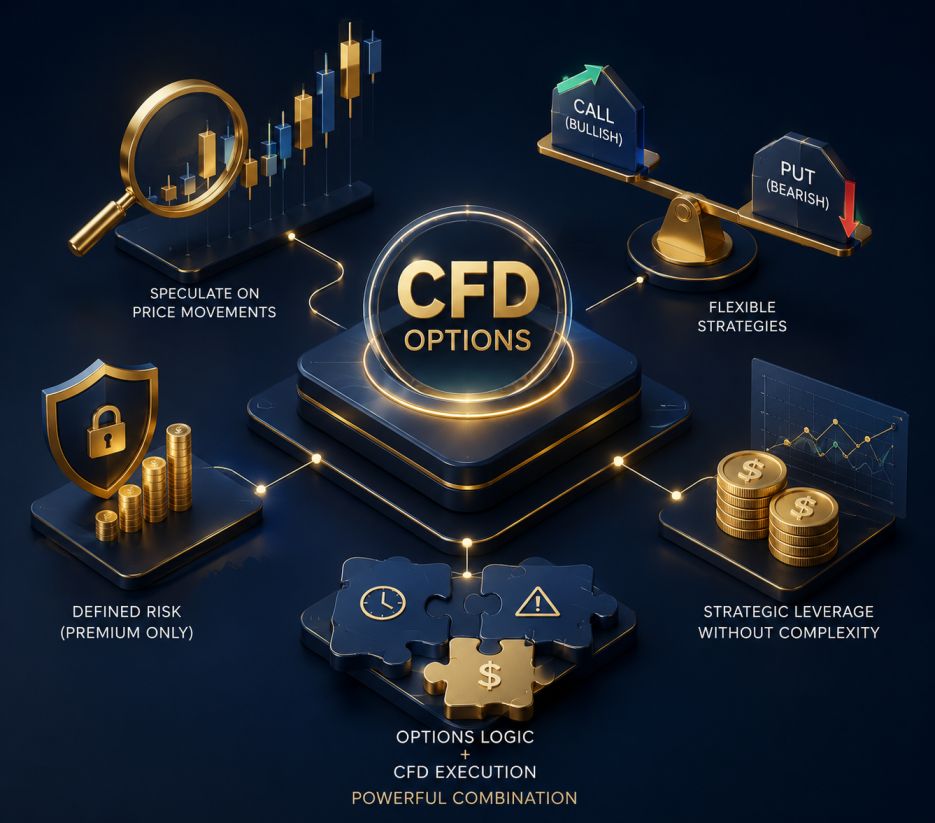
Options trading itself is about speculating on price movements without the obligation to actually buy or sell the underlying asset. The beauty? You can profit whether prices are rising, falling, or even staying range-bound — depending on the strategy you choose.
In traditional options, you'd pay a premium for a call (bullish) or put (bearish) option, and your maximum loss is limited to that premium. With CFDs mimicking these dynamics, you get similar strategic leverage without the complexity of options chains and strike selection used on traditional exchanges.
Think of it this way: options logic provides the framework — direction, timing, risk limit. CFDs provide the execution vehicle — liquidity, leverage, cash settlement. Together, they create a powerful combination for traders who understand how to use both.
4 Proven CFD Options Strategies (With Examples)
Strategy is where theory meets real money. These four approaches are battle-tested across different market environments, and each one suits a specific type of market outlook.
Covered Call Strategy
You already hold a long position on an asset. You sell a call option on it and collect a premium. If the price stays below the strike, you keep the premium as income. If it rises above, you exit with a capped but still profitable outcome. Ideal for flat to mildly bullish conditions.
Protective Put Strategy
You're long an asset but worried about a potential dip. You buy a put option as insurance. If the market drops, your put gains in value, offsetting losses in your main position. Think of it as a seatbelt for your trade — you pay a small premium for significant downside protection.
Straddle Strategy
Major economic data release coming up? Earnings season volatility? You buy both a call and a put at the same strike and expiration. You don't need to pick direction — you just need the price to move significantly either way. A big enough swing in either direction puts you in profit.
Long Call or Put Strategy
The most direct approach: buy a call if you expect a strong upward move, or a put if you expect a sharp decline. Leverage amplifies your returns if the market cooperates. If it doesn't, your loss is limited to the cost of the position. High reward, defined risk — but timing is critical.
Risk Management: The Part Most Traders Skip
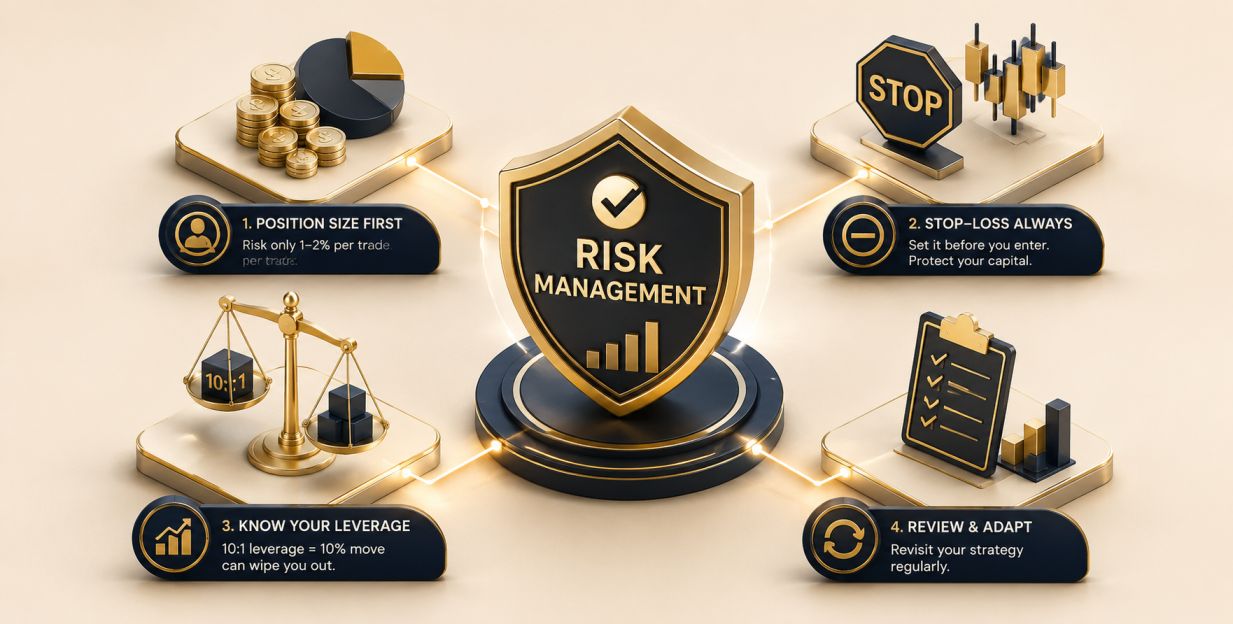
Here's an uncomfortable truth: most traders lose not because they pick the wrong direction, but because they manage risk poorly. Leverage makes CFD trading powerful — and it makes poor risk management catastrophic.
The following practices should be non-negotiable in your CFD options approach:
- Position sizing first: Never risk more than 1–2% of your account on a single CFD options trade. This keeps you in the game even through losing streaks.
- Stop-loss on every position: Set it before you enter. Not after. Emotion is the enemy when markets move fast.
- Understand your leverage ratio: 10:1 leverage means a 10% adverse move wipes out your entire position. Know your numbers before you click "buy."
- Diversify across uncorrelated assets: Don't put all your CFD exposure in one market. Stocks, forex, and commodities often move independently — use that to your advantage.
- Review and adapt regularly: What worked in a trending market may underperform in consolidation. Revisit your strategy monthly, not annually.
Is CFD Options Trading Right for You?
CFD options trading isn't a magic system. It's a toolkit — and like any toolkit, its value depends entirely on who's using it and how. If you're a forex trader who already understands leverage, can manage positions systematically, and is looking for more ways to profit from market volatility across multiple asset classes, then CFD options trading is likely a strong fit.
If you're new to leverage or still developing your core forex discipline, start conservatively. Use demo accounts to test strategies before committing real capital. The goal isn't to be in every trade — it's to be in the right trades, at the right size, with the right risk parameters.
Either way, the knowledge you gain from understanding CFD options mechanics will make you a sharper, more strategic trader — regardless of what instruments you ultimately focus on.
Frequently Asked Questions
Conclusion: Your Edge Is Built on Knowledge
CFD options trading isn't a shortcut to profits — but it is a shortcut to opportunity. When you understand how CFDs work, which strategies fit which market conditions, and how to manage risk like a professional, you gain an edge that most retail traders simply don't have.
The markets reward preparation. The traders who consistently perform aren't luckier than everyone else — they're better informed, more disciplined, and more strategic in how they deploy capital.
At FxTsignals.com, we exist to give you exactly that edge. From real-time signals to in-depth strategy breakdowns, we're in your corner every step of the way.
Ready to Put These CFD Strategies Into Action?
Join thousands of forex traders who get real-time signals, expert market analysis, and proven CFD strategies delivered directly from FxTsignals.com.