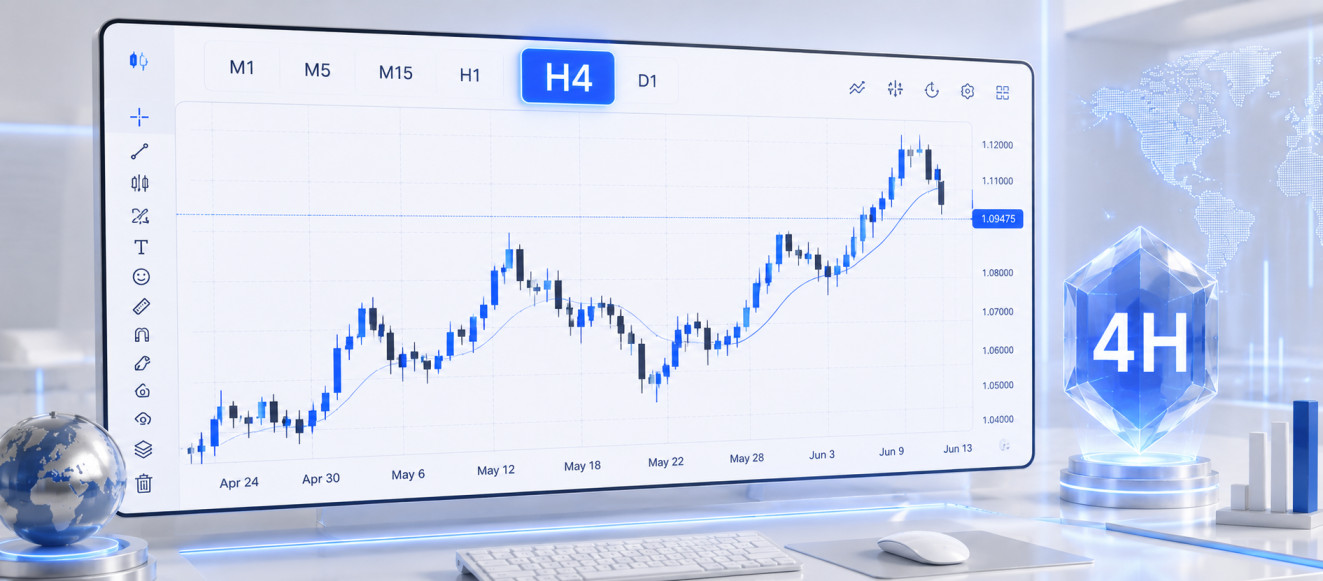
Why the 4H Chart Could Be Your Best Trading Decision Yet
Most traders start their Forex journey glued to the 5-minute or 15-minute chart. And it makes sense — the fast-paced action feels exciting. But here's the hard truth: shorter timeframes are noisy, stressful, and often misleading. The signals that look clean on a 5-minute chart? They're frequently shadows of random market movement.
That's exactly where the 4H Forex trading strategy steps in. By analyzing price action on the 4-hour chart, you get to see the market the way institutional traders and professional fund managers see it — with clarity, pattern, and purpose. You're not reacting to every tick; you're reading the story the market is telling.
Whether you're a beginner trying to build a reliable system or an experienced trader looking to reduce overtrading, the 4-hour chart strategy offers a compelling combination of reduced stress, higher-quality signals, and manageable time commitment. Let's break it all down.
What Exactly Is the 4H Trading Strategy?
The 4H trading strategy is a swing-style Forex approach where traders base their market analysis primarily on the 4-hour candlestick chart. Each candle represents four hours of price movement, which means a full trading day produces roughly six candles. This gives traders a much richer and more reliable picture than shorter-term charts — without the slow pace of daily or weekly analysis.
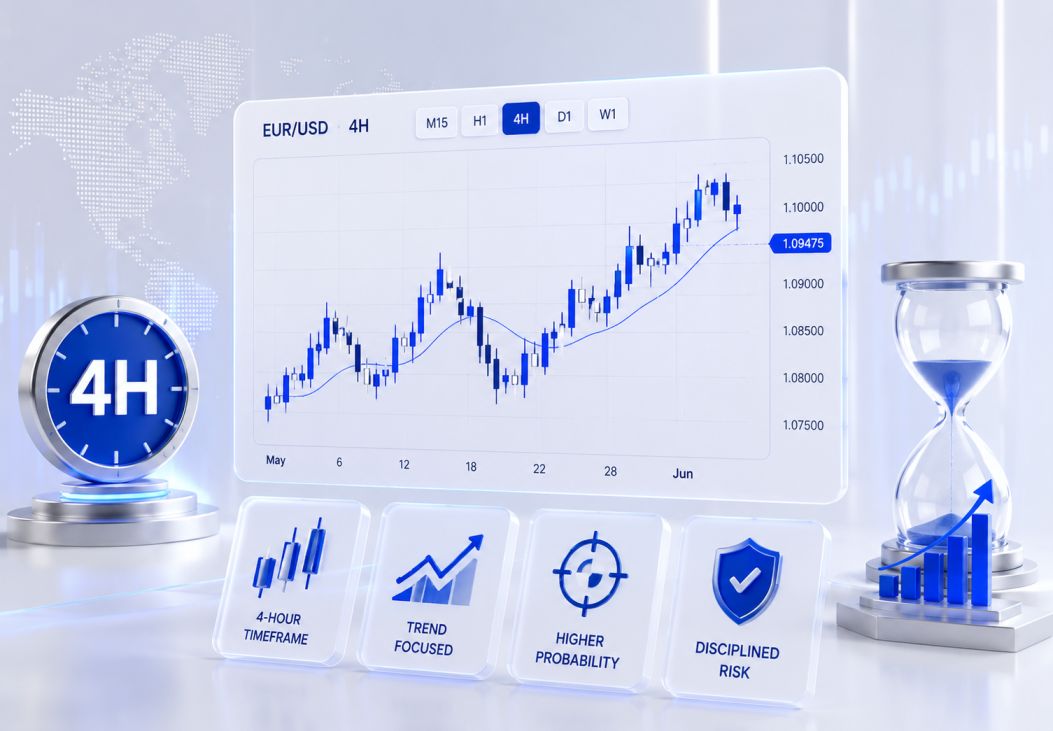
The beauty of this approach is its balance. You're not checking your phone every five minutes. You're also not waiting a week between setups. Check the chart a couple of times a day, make your analysis, set your orders — and let the trade breathe. That's a game-changer for traders who have jobs, families, or simply prefer a healthier relationship with the markets.
The strategy combines trend identification, technical indicator confirmation, and disciplined risk management — all anchored to the 4-hour timeframe. When these elements align, you get high-probability setups that are worth acting on.
Step 1: Identifying the Trend on the 4H Chart
Every successful trade starts with knowing where the market is heading. On the 4-hour chart, trend identification is refreshingly straightforward once you understand what to look for.
The Classic Structure Approach
An uptrend is defined by a sequence of higher highs (HH) and higher lows (HL). Price keeps climbing, and each dip stops higher than the last one. A downtrend is the opposite: lower highs (LH) and lower lows (LL). When you can see this structure clearly on the 4H chart, you have your directional bias — and your trades should flow in that direction.
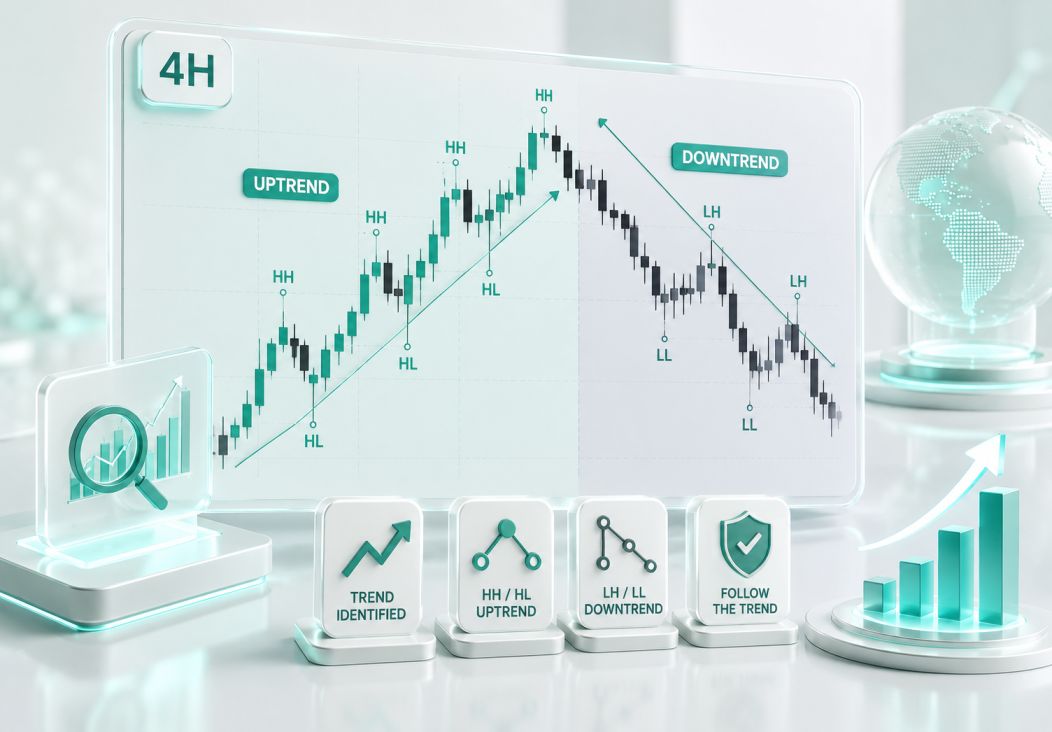
Avoid fighting the trend. This is one of the most common mistakes new traders make — trying to pick reversals before the structure confirms them. The 4H chart keeps you honest because false moves don't last long enough to fool the candles.
Using Moving Averages for Trend Clarity
Adding a 50-period or 200-period Moving Average (MA) to your 4-hour chart instantly gives you a visual trend filter. When price is above the MA, look for long opportunities. When it's below, focus on short setups. It's a simple rule, but it keeps countless traders out of bad trades.
"Trade in the direction of least resistance. On the 4H chart, the trend is your most powerful edge — don't fight it, ride it."
Step 2: Using Technical Indicators to Confirm Entry Points
Identifying the trend tells you the direction. But knowing when to actually enter — that's where technical indicators earn their keep. The 4H strategy typically relies on a small but effective toolkit.
RSI (Relative Strength Index)
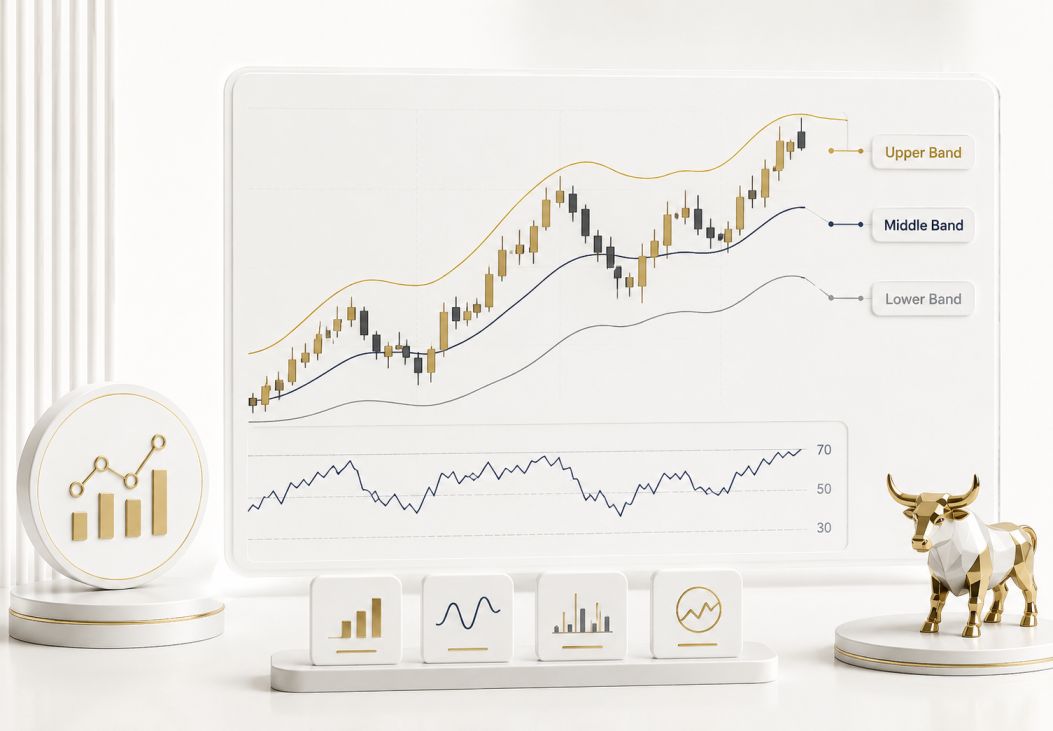
RSI measures momentum on a scale of 0–100. Readings above 70 suggest overbought conditions (potential sell opportunity), while readings below 30 indicate oversold conditions (potential buy opportunity). On the 4H chart, RSI divergence — where price makes a new high but RSI doesn't — is one of the most reliable reversal warning signs available.
Bollinger Bands
Bollinger Bands expand during high volatility and contract during consolidation. When price touches the lower band during an uptrend pullback, it can signal a strong entry point. Combined with candlestick confirmation, this becomes a high-probability setup on the 4H chart.
MACD for Momentum Confirmation
The MACD (Moving Average Convergence Divergence) is particularly effective on longer timeframes like the 4H chart. A bullish crossover — where the MACD line crosses above the signal line — aligned with an uptrend is a clean entry trigger. It's not perfect, but when combined with trend structure and a key support level, it adds meaningful confirmation.
Step 3: Setting Stop Loss and Take Profit Levels
No strategy is complete without a risk management framework. This is where most retail traders fall short — they find great setups but manage them poorly. The 4H approach demands discipline here.
- Stop Loss Placement: Place your stop loss just below the nearest significant support level (for longs) or above resistance (for shorts). On the 4H chart, these levels are well-defined and meaningful — not arbitrary.
- Risk-to-Reward Ratio: Aim for a minimum 1:2 risk-to-reward ratio. If you risk 50 pips, your target should be at least 100 pips. Over a series of trades, this protects your account even if your win rate is below 50%.
- Trailing Stops: As a trade moves in your favor, trail your stop loss to lock in profits. Move it to breakeven once price reaches a 1:1 level, then continue trailing as momentum carries the trade further.
- Position Sizing: Never risk more than 1–2% of your account on a single trade. The 4H strategy gives you patience — use it to wait for the right size, not just the right signal.
- Scaling Out: Consider closing half your position at the first target and letting the rest ride. This secures profit while keeping exposure to a bigger move.
The 5-Step Process: Implementing the 4H Strategy in Real Trades
Here's how the full trade process looks from start to finish — in practical, real-world terms:
Open your chart and identify the dominant trend. Mark key support and resistance zones. Note any major pattern forming — flags, wedges, or consolidation ranges. This context is your map.
Look for price pulling back to a key level within the trend. A retracement to the 50% Fibonacci level, a previous support turned resistance, or a moving average touch — these are your candidate setups.
Don't jump in on the first candle. Wait for your indicators to align. A bullish engulfing candle at support with RSI climbing from oversold — that's a confluence entry signal worth acting on.
Define your stop loss and take profit before you enter. Calculate your position size based on your risk tolerance. Then execute — and don't second-guess yourself mid-trade.
Check in at the close of each 4H candle. Move your stop to breakeven once safe. Trail it as the trade progresses. Know when to scale out and when to hold — your plan should define this in advance.
Advantages and Honest Limitations of the 4H Strategy

What Works in Its Favor
- Significantly less market noise compared to 5-minute or 15-minute charts, meaning fewer false signals.
- More time to think, analyze, and decide — no rushed entries under pressure.
- Suitable for traders who work a full-time job or have other commitments during the day.
- Trend signals are more reliable, reducing the frequency of losing streaks from choppy markets.
- Easier to backtest and refine, since historical 4H patterns are clear and well-documented.
Where You Need to Be Patient
- Setup frequency is lower — you may only get 1–3 quality trades per currency pair per week.
- Entries and exits occur with a slight delay compared to faster timeframes; some pip value is left on the table.
- Requires genuine patience — waiting for the right setup while the market moves without you is psychologically challenging.
Practical Tips for Getting the Most from the 4H Approach
Experience teaches traders a few hard lessons that are worth knowing before you pay for them in real money. Here are the most valuable ones:
- Trade multiple pairs: With fewer setups per pair, scanning 4–6 currency pairs increases your opportunities without lowering your standards.
- Respect economic calendar events: A high-impact news release (like NFP or FOMC) can invalidate a perfectly good 4H setup in minutes. Avoid entering just before major events.
- Keep a trading journal: Review your 4H trades weekly. Patterns in your wins and losses reveal your actual edge — not just what looks good in theory.
- Multi-timeframe confirmation: Check the daily chart to confirm the larger trend before taking a 4H signal. A 4H bullish setup against a daily downtrend is a low-probability trade.
- Be selective, not active: The 4H strategy rewards patience. If you don't have a clear setup, doing nothing is the right call. Overtrading is the strategy killer.
- Master one or two pairs first: EUR/USD, GBP/USD, or USD/JPY are the most liquid and technically reliable pairs for the 4H approach. Start there, then expand.
Frequently Asked Questions
Conclusion: Trade Less, Trade Better
The 4H Forex trading strategy isn't about being in the market all the time — it's about being in the right trades at the right time. By shifting your focus to the 4-hour chart, you gain a perspective that filters out the chaos of intraday noise and reveals the true momentum behind price movement.
You've now seen how to identify trends with structure and moving averages, confirm entries with RSI, MACD, and Bollinger Bands, and manage risk through disciplined stop-loss and take-profit placement. You have the five-step trade framework, practical tips, and honest insight into both the strengths and limitations of this approach.
The traders who succeed with the 4H strategy aren't necessarily the most talented — they're the most disciplined. They follow their plan, respect the signals, and stay out of the market when the setup isn't clear. That discipline, over hundreds of trades, is what builds a profitable trading account.
Start with one pair. Apply the strategy consistently for 30 days. Journal every trade. You'll have more clarity about what's working than most traders get in years of random screen time.
Ready to Take Your Forex Trading to the Next Level?
Join thousands of traders at FxTsignals.com — get premium 4H chart signals, strategy updates, and real-time market analysis delivered straight to you.
Start Trading Smarter at FxTsignals.com →