<!--
════════════════════════════════════════════════════════════════════════
FXT SIGNALS — ULTRA PREMIUM HEADER v10.5.1 "SOVEREIGN OBSIDIAN"
Elementor HTML Widget
v10.5.1 vs v10.5.0 — SHIMMER REMOVAL + DROPDOWN HOVER RESTORED
─────────────────────────────────────────────────────────────────────
CHANGES:
1. FXT wordmark shimmer — removed. Static gold gradient only.
2. CTA button shimmer — removed. Static gold gradient only.
3. Dropdown link hover — restored original drop-shadow() glow.
(Hover-only filter is safe — fires once on mouseenter, not idle.)
SCROLL BEHAVIOUR: Identical to v10.4.3
— Show only when scrollY < SCROLL_HIDE_PX (80px).
— Hide on scroll past threshold, stay hidden until top.
— No scroll-up reveal.
─────────────────────────────────────────────────────────────────────
EDIT HINTS
─────────────────────────────────────────────────────────────────────
SCROLL HIDE THRESHOLD : var SCROLL_HIDE_PX = 80;
LOGO TEXT : .B-wm-fxt "FXT"
LOGO SUB TEXT : .B-wm-sig "Signals"
TAGLINE : .B-wm-sub "Trade Like A Big Boy"
CTA LINK : href on .B-cta / .B-mob-cta
CTA TEXT : "Join Community"
NAV ITEMS :
inside .B-nav
MOBILE NAV :
Master the 30-Minute Forex Trading Strategy | fxTsignals.com
fxTsignals.com · Trading Strategies
How to Master the 30-Minute Forex Trading Strategy and Capture Real Market Moves
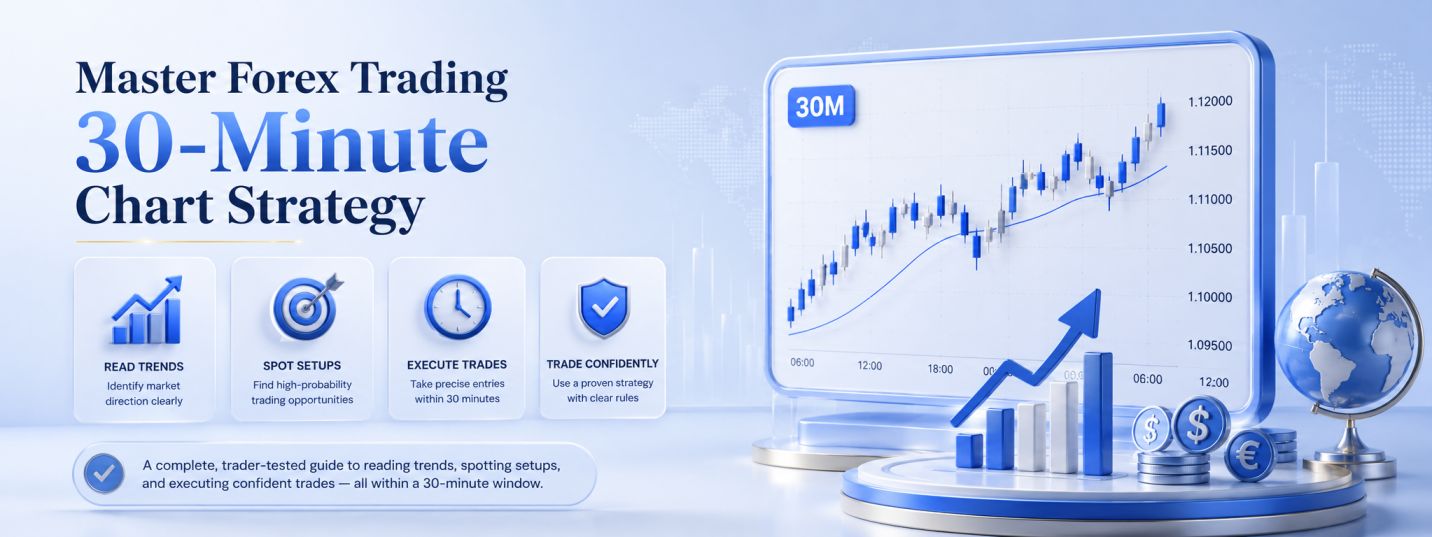
A complete, trader-tested guide to reading trends, spotting setups, and executing confident trades — all within a 30-minute window.
By fxTsignals Team10 min readForex Strategy
The 30-minute chart — where precision meets opportunity in every candle.
30MOptimal Trade Window
5+Setups Per Session
3:1Target Risk/Reward Ratio
24hForex Market Coverage
Why the 30-Minute Timeframe Changes Everything
Most beginner traders either go too fast — scalping every 1-minute flicker — or too slow, staring at daily charts waiting for something that may take weeks to develop. The 30-minute forex trading strategy sits in a powerful middle ground. It gives you enough data to see structure, enough speed to stay relevant, and enough breathing room to actually think.
Whether you trade EUR/USD, GBP/JPY, or exotic pairs, this timeframe captures meaningful price movements without burying you in noise. It's the strategy used by thousands of active traders worldwide — and once you understand its logic, it stops feeling complicated and starts feeling natural.
At fxTsignals.com, we've worked with traders at every level — beginners who freeze at their first trade and seasoned professionals who over-complicate what should be simple. Time and again, the 30-minute strategy delivers. Here's why: it respects both the market's rhythm and your schedule. You don't need to sit glued to a screen all day. A focused 2–3 hour session on the right pairs can yield cleaner setups than a dozen hours of random watching.
The Real Benefits Most Traders Never Talk About
Everyone mentions the obvious perks — more trade setups, quicker decisions, reduced overnight risk. But there are subtler advantages that make the 30-minute strategy genuinely powerful.
You build pattern recognition faster. When you trade 30-minute charts consistently, you see dozens of quality setups per week. That repetition sharpens your eye in months, not years.
Risk management becomes instinctive. Each candle represents a defined, manageable slice of time. Setting stop losses relative to recent highs and lows feels intuitive rather than guesswork.
It works in trending and ranging markets. Unlike 1-minute charts that get chopped in ranging conditions, the 30-minute frame usually provides enough clarity to distinguish trend from consolidation.
Emotional control is easier to maintain. You aren't reacting to every tick. Instead, you wait for the 30-minute candle to close and let the structure guide you — far less stressful than watching price jump every few seconds.
Capital preservation improves naturally. The slightly wider stops required by this timeframe actually filter out bad trades more effectively. You stop chasing entries and start waiting for confirmation.
"The 30-minute chart is the sweet spot where technical analysis becomes most reliable — structured enough to trust, fast enough to profit."
Step-by-Step: Implementing the Strategy Like a Professional
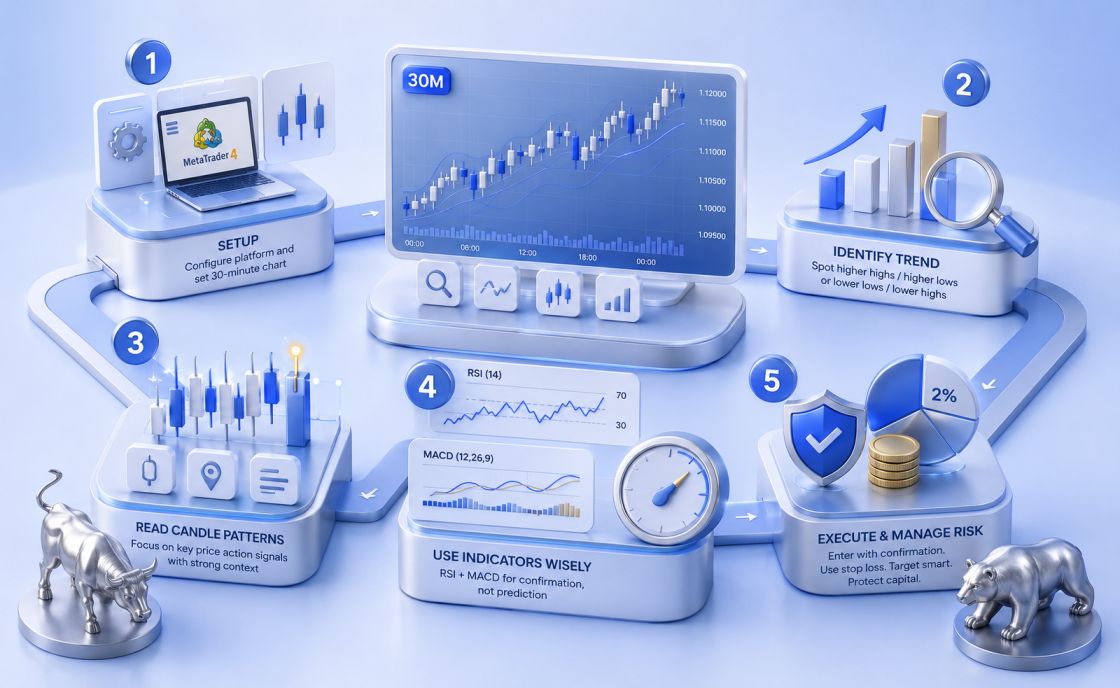
Let's break this down into five actionable steps. Follow these in sequence and you'll avoid the most common mistakes traders make when first switching to this timeframe.
1
Setting Up Your Trading Chart
Open your platform — MetaTrader 4 (MT4), cTrader, or TradingView all work well — and set the chart to the 30-minute timeframe. Choose your currency pair carefully. Majors like EUR/USD or USD/JPY offer tighter spreads and more liquidity, which is crucial when trading shorter windows. Make sure your chart is clean: remove any cluttered default indicators. Start fresh and add only what you'll actually use.
2
Identifying the Trend
Before any trade, zoom out to the 4-hour or daily chart for context. Then return to your 30-minute chart and look for higher highs with higher lows (uptrend) or lower highs with lower lows (downtrend). A 50 EMA overlaid on your chart acts as a reliable dynamic trend filter — price consistently above it suggests bullish bias, while price staying below points bearish. Never fight the trend on a short timeframe; it's where most accounts quietly bleed out.
3
Reading Candlestick Patterns With Context
Candlestick analysis isn't about memorizing 50 patterns. On the 30-minute chart, focus on a handful that consistently deliver signals: the engulfing candle, the pin bar (hammer/shooting star), and the inside bar. What matters more than the pattern itself is location — a bullish engulfing at a key support level carries dramatically more weight than one appearing mid-range with no structure nearby. Context transforms a pattern from a guess into an informed decision.
4
Applying Technical Indicators Intelligently
Keep your indicator suite simple. A popular and highly effective combination for the 30-minute chart is the RSI (14) paired with MACD (12, 26, 9). Use RSI to detect overbought (above 70) and oversold (below 30) conditions. Use MACD crossovers to time entries within the trend direction. The Stochastic Oscillator (14,3,3) works well as a secondary confirmation — especially in ranging conditions where RSI can give false signals. Remember: indicators confirm what price already suggests. They're not crystal balls.
5
Placing Trades and Managing Risk
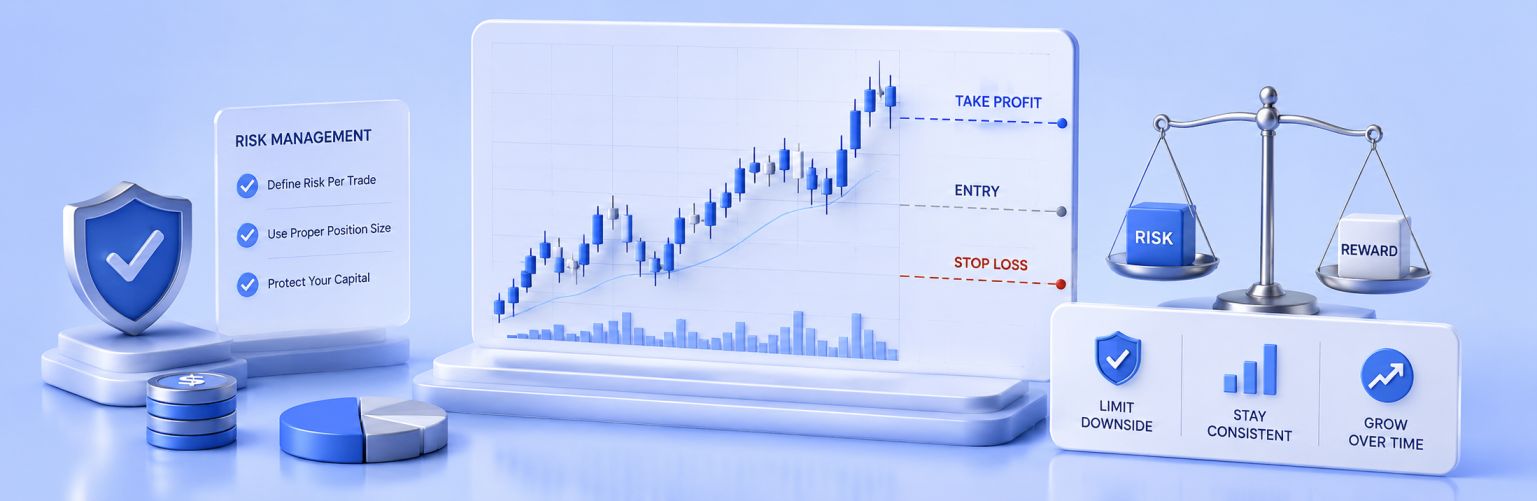
Enter only when trend, candlestick, and indicator signals align. Place your stop loss just beyond the most recent swing high or low — this keeps it logical rather than arbitrary. For profit targets, aim for a minimum 2:1 reward-to-risk ratio. If you're risking 20 pips, your target should be at least 40. Some professional traders using this strategy on liquid pairs regularly target 3:1. Use hard stop losses, not mental ones — the market will always find a way to exploit hesitation.
The Honest Challenges — and How to Overcome Them
No strategy works perfectly out of the box. These are the real friction points traders encounter when adopting the 30-minute approach, along with practical ways to handle them.
Emotional Control Under Pressure
Short timeframes are psychologically demanding. Price moves fast, setups appear quickly, and the urge to jump in — or jump out — can feel overwhelming. The solution isn't willpower; it's structure. Write down your entry rules, your stop rules, and your exit rules before you open any trade. If a setup doesn't check all your boxes, you don't take it. Period. Trading a pre-session checklist eliminates at least 60% of emotional decisions.
Navigating High-Volatility Windows
News releases — NFP, CPI, central bank decisions — can turn a clean 30-minute setup into a random noise event in seconds. Check your economic calendar (Forex Factory or Investing.com) at the start of every session. Avoid entering trades within 30 minutes before a major release for your currency pair. Once the dust settles and a new structure forms post-news, that's often when the real opportunity begins.
The Overtrading Trap
Active charts equal active temptation. Set a hard limit: two to three quality trades per session maximum. If your first trade hits target, consider calling it a day. Protecting a winning session matters more than squeezing out one more questionable setup.
Essential Tools Every 30-Minute Trader Should Use
Your strategy is only as good as the tools supporting it. These three categories cover everything you need without overcomplicating your setup.
Trading Platforms
MetaTrader 4 (MT4) remains the industry standard — it's reliable, highly customizable with thousands of indicators and Expert Advisors, and available on any device. cTrader is an excellent alternative with a cleaner interface and more advanced order management, particularly for ECN-style brokers. TradingView is ideal for chart analysis and community-shared ideas, though you'll still need a broker's platform for execution.
Economic Calendars
Forex Factory and Investing.com both offer excellent, free economic calendars with impact ratings (low, medium, high). Bookmark the high-impact events for the pairs you trade and build a pre-session routine around checking them. Treat an upcoming high-impact release the same way a careful driver treats a yellow traffic light — slow down, don't accelerate.
Forex News and Analysis Sites
ForexLive and DailyFX deliver timely market commentary and analysis that can contextualize what your charts are showing. Use them to understand macro sentiment — dollar strength, risk-on versus risk-off themes — but never let news alone drive your trade decisions. Your chart is your primary source of truth. News helps explain; price tells you what to do.
Practical Tips That Actually Move the Needle
Demo trade first — seriously. Spend at least four weeks trading the 30-minute strategy on a demo account before risking real capital. This isn't about fear; it's about building muscle memory so that when money is on the line, execution feels automatic.
Keep a trading journal. Record every trade: entry reason, entry price, stop, target, outcome, and emotional state. Review it weekly. Patterns in your mistakes will appear quickly, and fixing them accelerates growth faster than any course or signal service.
Use trailing stops on running trades. Once a trade moves 1.5× your risk in profit, move your stop to breakeven. Let the market work for you. Many of the best 30-minute setups run much further than the initial target if you give them room.
Trade fewer pairs, more deeply. Mastering EUR/USD completely beats watching eight pairs half-attentively. Deep familiarity with one or two pairs — their average daily range, typical behavior around key levels, reactions to news — gives you a genuine edge over generalists.
Review end-of-week, not end-of-day. Daily P&L reviews often cause emotional turbulence. One bad day triggers self-doubt; one great day triggers overconfidence. Weekly reviews smooth out the noise and reveal the actual quality of your process.
Monitoring and Refining Your Strategy Over Time
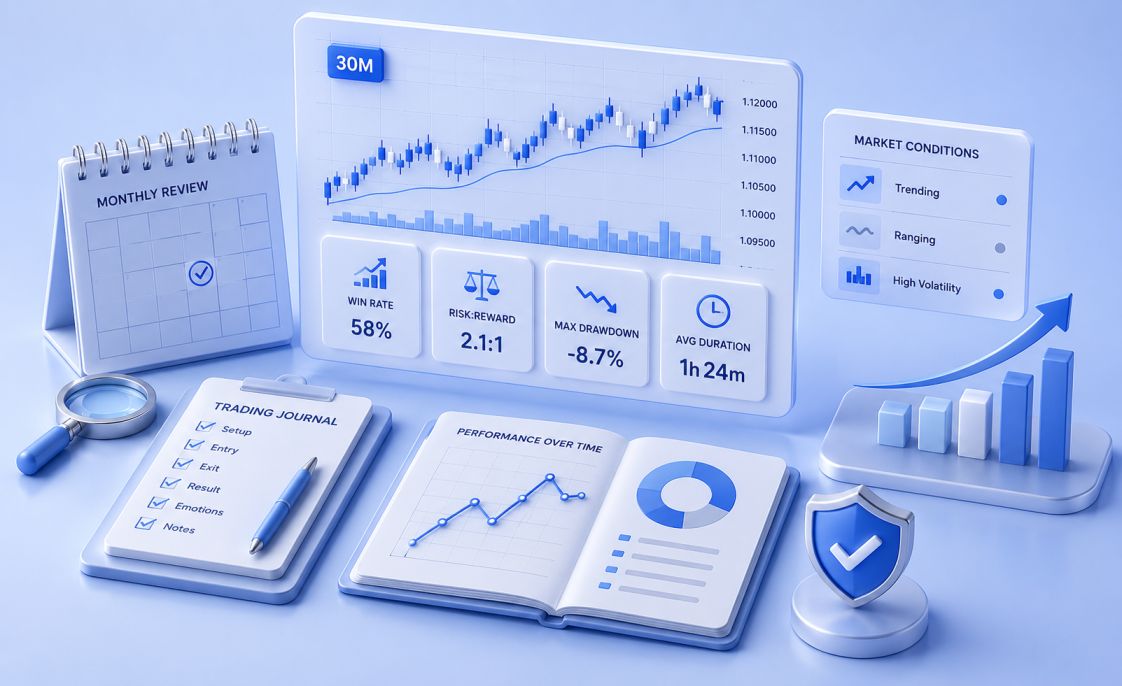
The forex market isn't static, and your strategy shouldn't be either. Markets shift between trending and ranging phases, volatility expands and contracts, and correlations between pairs evolve. A strategy that worked flawlessly in a strong USD trend year may require adjustment when the market enters a low-volatility consolidation phase.
Set aside time every month to review your performance metrics: win rate, average reward-to-risk, maximum drawdown, and average trade duration. If your win rate is dropping below 40% while maintaining 2:1 R:R, examine your entries — are you entering too early before confirmation? If your R:R is shrinking, look at your exit rules. Are emotions pulling you out of winners prematurely?
The traders who consistently grow accounts over years aren't necessarily more talented — they're more systematic. They treat their strategy like a business: measuring, adjusting, and refining based on data rather than feelings. That's the mindset the 30-minute strategy rewards most generously.
Frequently Asked Questions
Is the 30-minute forex strategy suitable for beginners?
+
Absolutely. In fact, the 30-minute timeframe is one of the most beginner-friendly approaches in forex trading. It strikes a balance between having enough time to analyze setups clearly and moving fast enough to stay engaged. Beginners should start on a demo account, focus on one currency pair, and practice the five steps outlined above until entries feel consistent before switching to live trading.
How many trades should I take per day with this strategy?
+
Quality always beats quantity. Two to three well-selected trades per session is a realistic and sustainable target. Taking more than five trades in a single 30-minute session is almost always a sign of overtrading — and overtrading is one of the fastest ways to erode an account. Set a daily limit and respect it, especially on days when early trades go wrong and the urge to "make it back" kicks in.
Which currency pairs work best with the 30-minute strategy?
+
Major pairs — EUR/USD, GBP/USD, USD/JPY, and AUD/USD — are ideal for the 30-minute strategy because of their high liquidity, tight spreads, and reliable technical behavior. These pairs respect key support and resistance levels more consistently and produce cleaner candlestick patterns. Minor pairs can also work but typically carry wider spreads and slightly more erratic behavior around news events.
Do I need to trade all day to use this strategy?
+
Not at all — and that's one of the strategy's greatest practical advantages. The best setups on 30-minute charts tend to cluster around the London open (8:00–11:00 GMT) and New York open (13:00–16:00 GMT) sessions, when liquidity and volatility are highest. A focused 2–3 hour session during one of these windows is typically more productive than watching charts all day.
How long before I see consistent results with this strategy?
+
Realistically, plan for three to six months of serious, consistent practice before seeing reliable results in a live account. This isn't discouraging — it's honest. The 30-minute strategy requires building habits: pre-trade routines, journaling, pattern recognition, and emotional discipline. Traders who rush from demo to live too early often sabotage progress by letting emotions override their rules during normal drawdown periods.
Final Thoughts: The Edge Is in the Consistency
The 30-minute forex trading strategy isn't a shortcut to overnight riches — and any resource suggesting otherwise isn't being straight with you. What it is, however, is a genuinely reliable framework for capturing real market movements in a manageable, repeatable way.
The traders who succeed with it share common traits: they prepare before the session, they follow their rules during it, and they review honestly after it. They use the right tools, they don't overtrade, and they understand that consistency beats occasional brilliance every single time in this market.
Whether you're just starting or looking to sharpen an existing approach, the 30-minute strategy gives you everything you need: a clear time structure, well-defined entry and exit signals, and a built-in framework for managing risk. Combine that with the resources at fxTsignals.com, and you're not just trading — you're building a sustainable edge.
"Every expert trader was once a beginner who refused to quit. The 30-minute chart is where beginners become professionals — one well-executed trade at a time."
Ready to Trade Smarter?
Join thousands of traders already using fxTsignals.com to sharpen their strategy, access premium signals, and stay ahead of every major market move. Your next great trade starts with the right information.