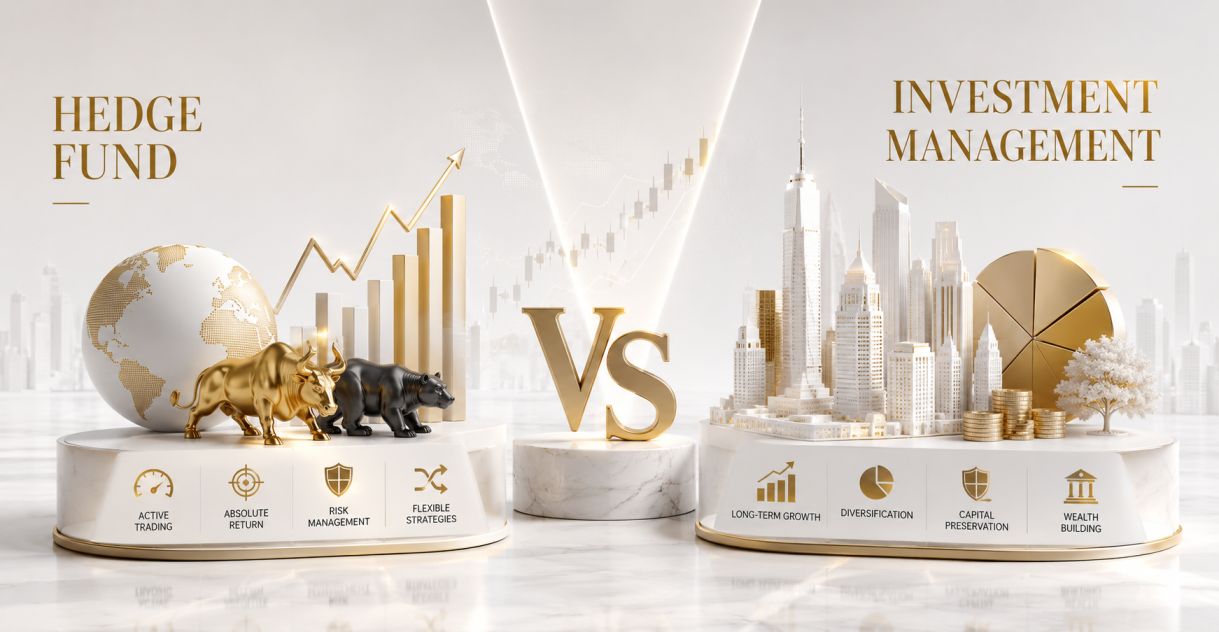
Introduction: Two Worlds, One Goal
If you have spent any time in the financial markets — particularly forex trading — you have almost certainly come across the terms "hedge fund" and "investment management." They get tossed around interchangeably, but they are fundamentally different animals.

Think of it this way: a hedge fund is like a high-performance sports car — powerful, fast, and thrilling, but demanding in every sense. Investment management, on the other hand, is more like a well-engineered executive sedan — consistent, reliable, and designed for the long road.
At fxTsignals.com, we work with forex traders across experience levels, and the question we hear most often is: "Which one is better for someone like me?" The honest answer? It depends entirely on your risk tolerance, your capital, and your financial goals. This blog breaks it all down — clearly, practically, and without the jargon overload.
What Is a Hedge Fund, Exactly?

A hedge fund is a pooled investment vehicle — typically structured as a limited partnership — designed for high-net-worth individuals and institutional investors. Unlike conventional mutual funds, hedge funds operate with significantly fewer regulatory restrictions, which gives their managers the freedom to pursue aggressive and sophisticated strategies.
These strategies can include leveraged positions, short-selling stocks, trading derivatives, arbitrage plays, and even global macro bets on currency movements — something many forex traders will find familiar.
Core Characteristics of Hedge Funds
- High minimum investment: Most hedge funds require $1 million or more to enter, with some elite funds demanding $5M+.
- Accreditation requirements: Investors must meet specific income or net worth thresholds — typically $200K+ annual income or $1M+ net worth.
- Complex strategies: Long/short equity, global macro, event-driven trades, and quantitative algorithms are common.
- Limited transparency: Hedge fund managers are not obligated to disclose full holdings or performance metrics publicly.
- Performance-based fee model: The classic "2 and 20" structure — 2% management fee plus 20% of profits.
What Is Investment Management?
Investment management is the professional administration of financial assets with the goal of meeting specified investment objectives on behalf of clients. It is a broader, more inclusive discipline — one that serves everyone from retirees saving for their future to active traders looking for diversified exposure beyond forex markets.

Investment managers build and manage portfolios using strategies such as value investing, growth investing, index fund investing, and income-focused approaches. The hallmark of good investment management is not flashy returns — it is consistent, risk-adjusted performance over the long term.
Core Characteristics of Investment Management
- Accessible to a wider audience: Many investment management firms accept clients with as little as $10,000 or even less through managed accounts.
- Regulated and transparent: Investment managers are bound by fiduciary duties and regulatory requirements to disclose holdings and performance.
- Diversification-first approach: Spreading risk across asset classes — equities, bonds, real estate, commodities — is central to the model.
- Lower fees: Management fees typically range between 0.25% and 1.5% of assets under management — a fraction of hedge fund costs.
- Long-term orientation: Success is measured in years and decades, not quarters — a fundamentally different mindset to the short-term alpha hunt of hedge funds.
The Key Differences: Head-to-Head
A. Risk and Return — The Trade-Off That Defines Everything
Hedge funds chase outsized returns — and to do that, they accept outsized risk. Leveraging 5× or 10× a position is not unusual in a well-run hedge fund, and when the trade goes right, the rewards are spectacular. When it goes wrong, losses can be devastating — as the infamous collapses of LTCM and Archegos Capital showed the world.
Investment management takes the opposite philosophy. It prioritises protecting capital first, growing it second. A diversified portfolio might not triple your money in 18 months, but it is also unlikely to wipe out half your savings in a single bad week.
B. Investment Strategies — Where They Really Diverge

Hedge funds are famous for their creative, often secretive strategies. A global macro fund might take massive currency positions based on geopolitical forecasts — something that resonates deeply with forex traders. Arbitrage funds exploit tiny price inefficiencies across markets, often using high-frequency algorithms to execute trades in milliseconds.
Investment management strategies, by contrast, are far more conventional but no less effective over time. Value investing, growth investing, and index fund replication all fall under this umbrella. Legendary investors like Warren Buffett and John Bogle built generational wealth with them.
C. Investor Accessibility — The Velvet Rope Problem
Hedge funds are deliberately exclusive. Regulatory frameworks in the US, UK, and EU require investors to be "accredited" or "sophisticated" — meaning they must demonstrate significant personal wealth or professional expertise before they are allowed through the door.
This creates a two-tier system in global investing. For forex traders specifically: if you are building your account, investment management may be the more practical route for long-term savings while your trading skills generate short-term income.
D & E. Transparency and Fees — What You See and What You Pay
Hedge fund opacity is a feature, not a bug — at least from the manager's perspective. Revealing your trading strategy too openly invites copycats and erodes your edge. But for investors, this lack of visibility can be deeply uncomfortable.
On fees: the "2 and 20" model can significantly erode returns over time. If a hedge fund earns 15% in a year, you pocket roughly 10.7% after fees. By comparison, an investment management fee of 0.75% on the same return leaves you with 14.25% — a staggering difference over a decade.
Choosing the Right Path for Your Goals

Here is a framework that works for most forex traders and investors:
- Assess your risk tolerance honestly: Not what you think it should be — what it actually is when your portfolio drops 20% in a month.
- Know your liquidity needs: Hedge funds often lock capital for 1–2 years. Investment management accounts are typically liquid within days.
- Match strategy to timeframe: If your goal is a retirement nest egg in 20 years, a diversified managed portfolio is almost always more appropriate.
- Understand fee drag: Calculate what 2% annual management fees — compounded over 15 years — cost versus a 0.75% alternative. The numbers are eye-opening.
- Seek professional advice: A regulated financial advisor can map out which vehicles align with your capital, goals, and tax situation.
Frequently Asked Questions
Conclusion: Knowledge Is Your Biggest Edge
Whether you are just starting your journey in forex trading or you are a seasoned market participant looking to diversify, understanding the difference between hedge funds and investment management is not optional — it is essential.
Hedge funds offer the potential for extraordinary returns, but they come with real costs: high barriers to entry, significant risk, heavy fees, and limited transparency. Investment management offers a more accessible, transparent, and cost-efficient path to wealth — one that suits the vast majority of investors far better.
The smartest traders we work with at fxTsignals.com do not see these as competing choices. They see them as complementary tools — using active forex trading to generate income and professionally managed investments to build lasting wealth. That combination, executed with discipline and guidance, is what separates long-term winners from those who burn bright and fade fast.
Ready to Trade Smarter and Invest Wiser?
Join thousands of forex traders who use fxTsignals.com to get professional-grade signals, market analysis, and investment insights — all in one place. Do not leave your financial future to chance.
Start Investing in Copy Trading →