What Makes Hedge Fund Forex Trading Different?
Most retail traders approach the forex market with modest capital, basic tools, and gut instinct as their primary compass. Hedge fund traders operate in a fundamentally different world. At a hedge fund, trading forex means access to institutional-grade research, multi-million-dollar positions, and a team of analysts working in unison toward one objective: consistent, risk-adjusted returns.
Hedge funds pool capital from high-net-worth individuals and institutional investors, deploying it across multiple strategies — and forex is frequently one of the most active. The liquid, 24-hour nature of the foreign exchange market makes it an attractive arena for deploying large capital without causing significant price disruption.
What separates winners from the rest isn't luck. It's a rigorous framework: a written trading plan, systematic risk controls, and the psychological discipline to execute that plan even when markets are screaming otherwise. Understanding this framework is the first step toward elevating your own trading approach.
Core Strategies Used by Hedge Fund Forex Traders
There's no single playbook. The best hedge fund traders blend multiple methodologies, adapting their edge to market conditions rather than forcing the market to fit a pre-built model. Here are the strategies that matter most:
Quick Checklist: Before You Enter Any Trade
- Is your stop-loss defined before your entry — not after?
- Does the trade align with the higher timeframe trend?
- Is your risk per trade within your pre-set maximum (typically 1–2% of capital)?
- Have you checked upcoming high-impact news events?
- Is this a setup you've tested, or an impulse trade?
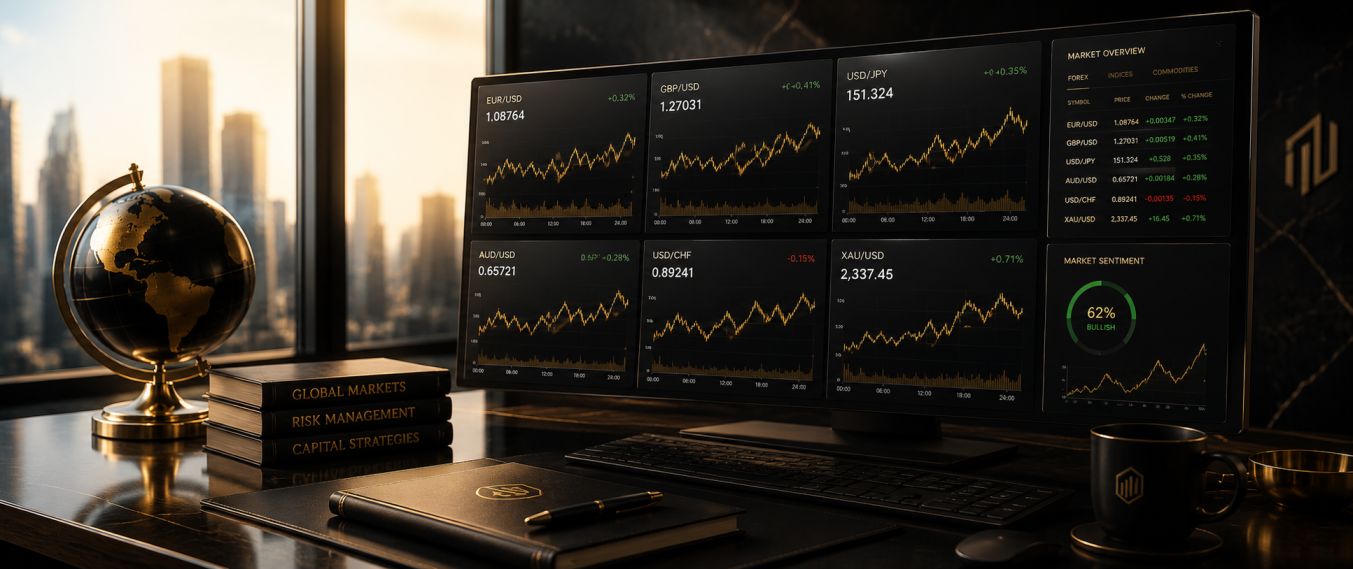
Reading Market Trends and Economic Indicators Like a Pro
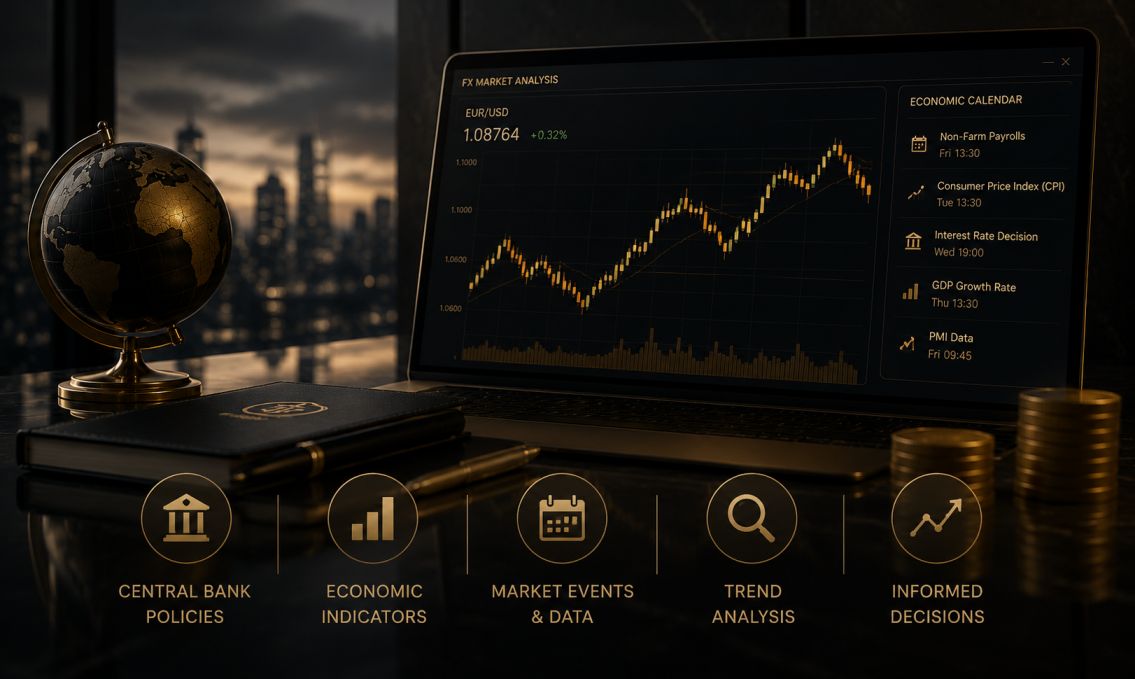
The forex market is a living reflection of global economic health. Interest rate decisions by central banks — particularly the Federal Reserve, the European Central Bank, and the Bank of England — move currencies more than almost any other factor. A single press conference from Jerome Powell can shift EUR/USD by 150 pips in minutes.
Hedge fund traders don't just watch these events; they build scenarios around them. They ask: "If inflation data comes in hot, what's the most likely Fed response? How does that change the USD against the Yen?" This kind of second-order thinking is what separates institutional traders from reactive retail participants.
Key Economic Indicators Every Forex Trader Must Monitor
- Non-Farm Payrolls (NFP) — The single most watched US data release; massive USD volatility every first Friday.
- Consumer Price Index (CPI) — Inflation data that directly shapes central bank rate decisions.
- GDP Growth Rate — Signals economic strength or contraction for a currency's underlying economy.
- Interest Rate Announcements — The nuclear option of fundamental analysis; rate hikes strengthen, cuts weaken.
- PMI Data — Manufacturing and services purchasing managers index gives early economic trend signals.
"The market doesn't care about your opinion. It cares about data, sentiment, and capital flow. Understand those three forces and you understand the forex market."
Technology: The Competitive Edge in Modern Forex Trading
If the 1990s hedge fund trader relied on Bloomberg terminals and telephone order execution, today's trader operates in a world of algorithmic co-location, AI-driven sentiment analysis, and sub-millisecond execution. Technology is no longer an advantage — it's a baseline requirement.
What Technology Do Hedge Fund Forex Traders Use?
- Institutional Trading Platforms — Bloomberg Terminal, Refinitiv Eikon, and institutional FIX protocol execution systems.
- Algorithmic Systems — Custom-coded strategies that scan, filter, and execute trades based on rule-based conditions without emotional interference.
- Sentiment Analysis Tools — Tracking COT (Commitment of Traders) reports, options market positioning, and social sentiment for an edge.
- Risk Management Software — Portfolio-level VaR (Value at Risk) calculations and dynamic position sizing across correlated pairs.
- Mobile Monitoring Apps — Staying connected to open positions and news flows through platforms like MetaTrader 5, cTrader, or proprietary mobile interfaces.
Practical Tip for Independent Traders
You don't need a Bloomberg Terminal to trade like a professional. Tools like TradingView for charting, Myfxbook for performance tracking, and the Economic Calendar on Investing.com give retail traders access to institutional-quality information. What matters is how consistently you apply them — not how expensive they are.
Building a Diversified Forex Portfolio
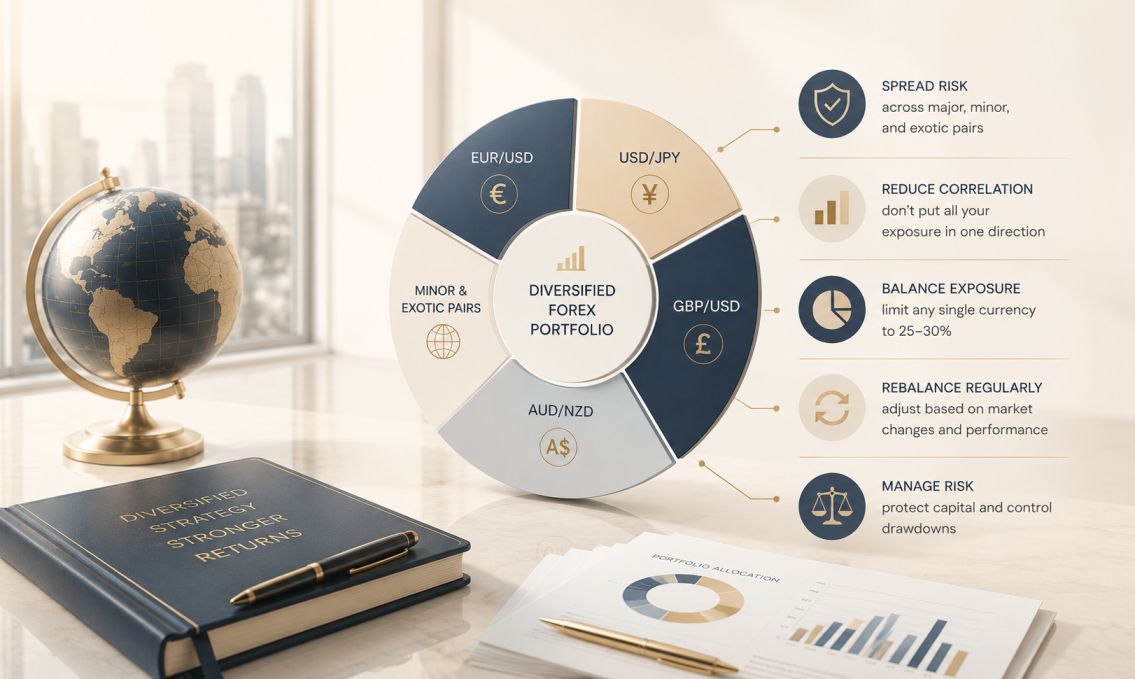
One of the most dangerous habits in trading is overconcentration. Putting 80% of your capital into a single currency pair — however confident you feel about it — violates one of the most fundamental rules of professional risk management.
Hedge funds typically spread exposure across major pairs (EUR/USD, USD/JPY, GBP/USD), minor pairs (EUR/GBP, AUD/NZD), and sometimes exotic pairs for higher-yield opportunities. The key is correlation awareness: EUR/USD and GBP/USD often move in the same direction, so holding large positions in both doesn't provide real diversification.
Diversification Best Practices
- Evaluate correlation matrices between your currency pairs monthly.
- Limit exposure to any single currency to no more than 25–30% of portfolio risk.
- Mix strategies — carry trades alongside trend-following systems reduce drawdown.
- Consider adding uncorrelated assets (gold, commodity currencies) as a hedge during risk-off events.
- Rebalance quarterly based on performance and changing market correlations.
The Psychology of Forex Trading: Your Biggest Battle is Internal
Hedge fund managers who have survived multiple market cycles will tell you the same thing: the market is the easy part. Managing your own psychology — the fear, the greed, the revenge trading after a loss, the overconfidence after a winning streak — that's where the real battle is fought.
Professional traders build systems precisely to limit the influence of emotions. A written trading plan, pre-defined position sizes, and automatic stop-losses are not just risk management tools; they're psychological guardrails that prevent impulsive decisions when adrenaline is running high.
Five Disciplines of Psychologically Resilient Traders
- Keep a detailed trading journal — review weekly, not just monthly.
- Define your maximum daily loss limit. Hit it? Stop trading for the day.
- Practice detachment: a losing trade doesn't make you a losing trader.
- Use mindfulness or structured breaks after large wins and losses.
- Invest in education continuously — confidence born of competence is calm, not reckless.
Frequently Asked Questions
Conclusion: Bring Institutional Thinking to Your Trading
Trading forex at a hedge fund represents the pinnacle of professional currency market participation. The resources, the discipline, and the systematic approach used by institutional traders didn't develop by accident — they evolved through hard-won lessons about what actually produces consistent, long-term results in one of the most unforgiving financial markets in the world.
Whether you're an independent trader looking to sharpen your edge or someone aspiring to a career in institutional trading, the principles covered here form the foundation: a comprehensive strategy, rigorous risk management, market awareness, smart use of technology, genuine diversification, and the psychological discipline to execute your plan under pressure.
The forex market rewards preparation and punishes impulsivity. Start treating your trading like a business — because that's exactly what the professionals opposite you are doing.
Ready to Trade with a Professional Edge?
Join thousands of traders at fxTsignals.com who access institutional-grade forex signals, in-depth market analysis, and strategy updates delivered directly.
Best Copy Trading Ever