Hedge Funds Exposed: Wealthy Playground or a Risky Gamble for Forex Traders?
The world's most powerful investment vehicles decoded — what forex traders must understand before the next market move.
The Double-Edged Sword of Modern Finance
If you've spent any time in the forex markets, you already know that capital flows don't happen in isolation. Behind many of the biggest currency moves you see on your charts — sudden spikes, unexplained reversals, aggressive breakouts — there's a good chance a hedge fund is involved. These financial powerhouses manage trillions of dollars, use strategies most retail traders never encounter, and operate with a freedom that regulated mutual funds simply don't have.
But are hedge funds genuinely the golden ticket the financial media makes them out to be? Or are they a sophisticated form of organised risk that can rattle markets and burn unprepared investors? At fxTsignals.com, we believe every serious forex trader needs to understand the mechanics, the myths, and the very real market impact of hedge funds — because that knowledge directly affects how you read price action every single day.

The Exclusivity Myth — Busted
For decades, hedge funds carried an almost mythological aura of exclusivity. You'd hear about them in the same breath as billionaire family offices, sovereign wealth funds, and old-money dynasties. The reality, though, is more nuanced — and increasingly accessible.
Historically, hedge funds did cater almost exclusively to institutional investors: pension funds, university endowments, and the very wealthiest individuals. The barrier to entry was steep — often $1 million or more just to get in the door. But the industry evolved. Today, some hedge funds accept high-net-worth individuals, and sophisticated retail access now exists through vehicles like:
- Hedge fund replication ETFs that mirror popular strategies
- Liquid alternatives offered through traditional brokerages
- Fund-of-funds structures that pool smaller investor capital
- Publicly traded hedge fund managers (e.g., Man Group, Pershing Square)
The perception of exclusivity lives on — but for the informed forex trader, understanding hedge fund behaviour is accessible to anyone willing to study it.
Unique Strategies That Move Your Charts
Why Forex Traders Must Pay Attention
What truly separates hedge funds from your average mutual fund or index fund isn't pedigree — it's strategy flexibility. While conventional funds typically go long and hope for the best, hedge funds play both sides of the market simultaneously. This is where things get particularly relevant for forex traders.
Hedge funds can go short (selling borrowed assets expecting price drops), apply heavy leverage, use complex derivatives, and execute strategies that span equities, commodities, bonds, and — crucially — currencies. Some of the most common hedge fund strategies you should know:
- Global Macro — Bets on big-picture economic trends across currencies and rates. George Soros famously broke the Bank of England using this approach.
- Long/Short Equity — Long winners, short losers — often with significant currency exposure as a byproduct.
- Carry Trade Strategies — Exploit interest rate differentials between countries. Sound familiar? It should — this is bread and butter for forex markets.
- Quantitative / Algorithmic — Data-driven models that fire trades at machine speed, moving markets before human traders can react.

The GameStop Lesson: Hedge Funds and Market Power
If there's one recent event that perfectly illustrated the raw power — and vulnerability — of hedge funds, it was the GameStop saga of early 2021. A major hedge fund had taken a massive short position on GameStop's stock, betting the struggling retailer would continue its decline. The position was publicly exposed, and what happened next was financial history in the making.
Retail traders on Reddit's WallStreetBets coordinated a buying frenzy that sent the stock soaring from under $20 to nearly $500 in days. The hedge fund was caught on the wrong side of a short squeeze and reportedly lost billions. For forex traders, the takeaway isn't about meme stocks — it's about understanding that even the giants can be wrong, and when they get squeezed out of positions, liquidity and volatility events ripple through every correlated market, including FX pairs.
What This Means for Your Forex Trading
- Sudden, unexplained currency volatility often traces back to large fund position unwinds
- Watching Commitment of Traders (COT) reports reveals when institutional money is building or cutting positions
- Risk-off events triggered by hedge fund losses ripple into safe-haven currencies like JPY and CHF
- Leverage-driven liquidations can cause gap moves that invalidate technical analysis levels overnight

Market Volatility: Friend or Foe?
The Stability Paradox
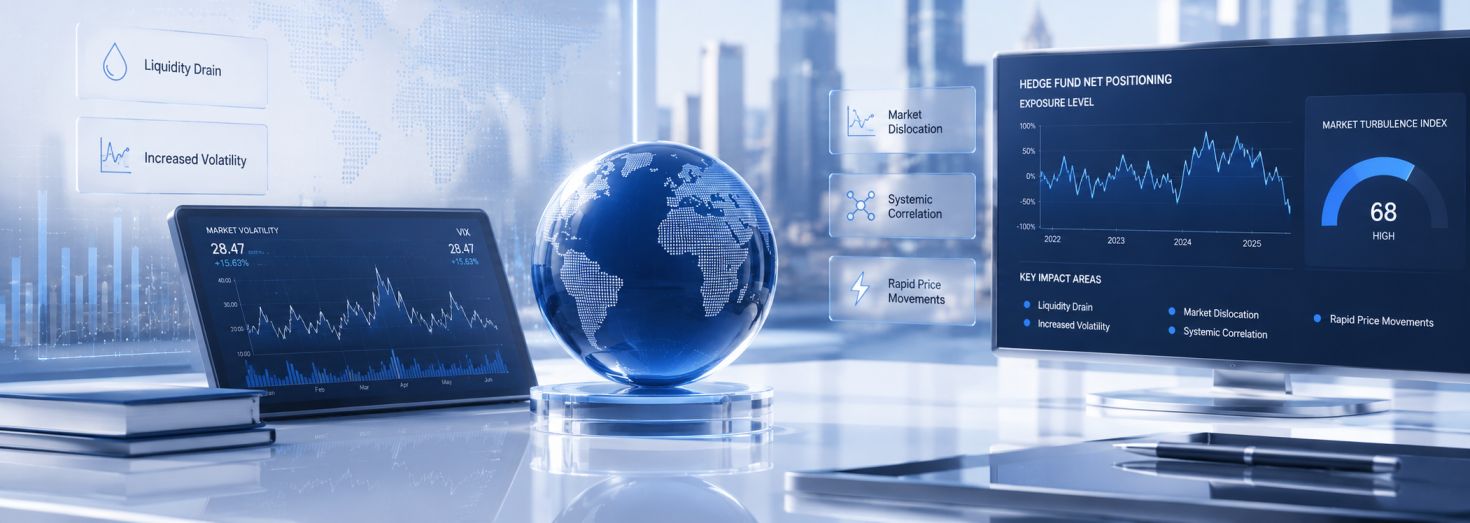
Hedge funds are designed to hunt inefficiency. They thrive in markets where mispricings exist — and that means volatility is often their operating environment of choice. But this creates a fascinating paradox: do hedge funds reduce market volatility by correcting inefficiencies, or do they amplify it by piling into momentum trades simultaneously?
The honest answer is: both, depending on the strategy and the market cycle. During calm, trending conditions, hedge fund activity can add liquidity and smooth out price discovery. But during stress events — think the 2008 financial crisis, COVID market crash, or flash crashes in forex pairs — coordinated hedge fund exits can drain liquidity at precisely the wrong moment.
As a forex trader, you're not powerless against this. The traders who navigate these episodes well tend to share one thing in common: they understand the macro picture well enough to anticipate where institutional pressure is building.
The "2 and 20" Fee Structure — What It Really Costs
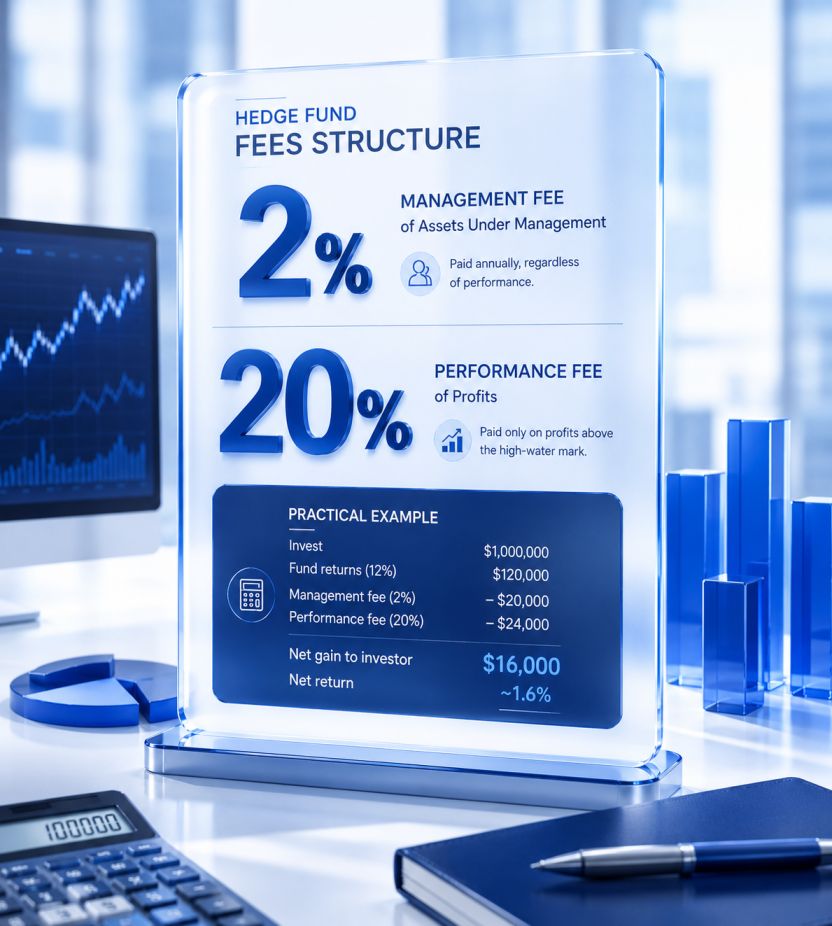
Few things in finance are as simultaneously admired and criticised as the hedge fund fee model known as "2 and 20." The structure is simple: investors pay a 2% annual management fee on their total assets — regardless of whether the fund makes money — plus a 20% performance fee on any profits generated.
On paper, this incentivises fund managers to generate returns. In practice, critics point out serious flaws. The management fee means managers profit even in flat or negative years. The performance fee can encourage excessive risk-taking in pursuit of the bonus. And in years where returns barely beat benchmark indices, investors can end up net negative after fees.
Practical Example
Imagine investing $1,000,000. In a year where the fund earns 12%, you'd owe $20,000 in management fees plus $24,000 in performance fees (20% of the $120,000 profit). That's $44,000 out of a $120,000 gain — leaving you with roughly 6.4% net return. A low-cost index ETF might have given you 10% for almost no fees.
5 Actionable Insights for Forex Traders
Understanding hedge fund behaviour isn't academic — it directly sharpens your edge in the forex market. Here's how to apply it:
- 1. Read the COT Report Weekly — The Commodity Futures Trading Commission publishes institutional positioning data every Friday. When large speculators (hedge funds) are heavily long or short on a currency pair, it often precedes a major move — or a reversal when positions get crowded.
- 2. Follow Global Macro Themes — Hedge fund macro trades are driven by interest rate differentials, inflation divergence, and geopolitical risk. Align your forex trades with these same forces rather than fighting them.
- 3. Respect Liquidity Events — When major hedge funds report quarterly losses or redemption spikes, expect unusual volatility in correlated pairs. Don't over-leverage during these windows.
- 4. Learn to Spot Accumulation Patterns — Large funds build positions gradually to avoid detection. Understanding Wyckoff accumulation/distribution logic helps you identify when smart money is loading up before a trend begins.
- 5. Use News Catalysts as Fund Triggers — Central bank decisions, NFP reports, and inflation prints are often the catalysts hedge funds wait for to execute pre-planned positions. Trading these events without knowing the institutional context is trading blind.
Verdict: Playground, Gamble, or Necessary Force?
The hedge fund industry is neither purely a privileged playground for the elite nor simply a reckless gambling den. It's something more complex — and more interesting. These investment vehicles have evolved from exclusive enclaves into influential market forces that shape price action across every major asset class, currencies included.
For most retail forex traders, directly investing in a hedge fund may remain out of reach. But understanding how they think, how they position, and when they move is 100% within your grasp — and it can transform the way you read the market. When you see a sudden, violent move in EUR/USD or GBP/JPY that makes no sense on the surface, there's often a $500 million hedge fund trade sitting quietly behind it.
At fxTsignals.com, we help you bridge that gap — giving you the institutional context, the signals, and the analysis that put you on the right side of these big-money moves. Because in forex, knowledge isn't just power. It's profit.
Frequently Asked Questions
-
A hedge fund is a private investment partnership that pools capital from accredited or institutional investors and employs a wide range of advanced strategies — including short selling, leverage, and derivatives — to generate returns regardless of market direction. Mutual funds, by contrast, are publicly available, heavily regulated, typically long-only, and designed for everyday retail investors. Hedge funds have far greater flexibility, fewer regulatory constraints, and typically charge much higher fees in exchange for the promise of superior, uncorrelated returns.
-
Hedge funds — particularly global macro funds — are among the largest participants in currency markets. They execute multi-billion-dollar trades on currency pairs based on interest rate expectations, geopolitical events, and economic divergence. These flows create the institutional-level price moves that retail traders experience as sudden spikes, strong trends, or sharp reversals. Understanding hedge fund positioning through COT data and global macro analysis gives forex traders a significant edge in anticipating where currency pairs are headed.
-
The traditional "2 and 20" model (2% management fee + 20% performance fee) remains the benchmark, but competitive pressure has pushed many funds to negotiate. Some now charge "1.5 and 15" or even lower, particularly for larger institutional allocations. Meanwhile, smaller or newer hedge funds sometimes charge higher performance fees to attract talent. The fee debate has intensified following periods of underperformance relative to passive index strategies, prompting calls for greater fee transparency and alignment of manager incentives with long-term investor outcomes.
-
Absolutely — and many sophisticated retail traders already do. Carry trades (exploiting interest rate differentials), trend-following strategies based on momentum, and global macro analysis are all approaches retail forex traders can implement at their scale. Tools like the COT report, central bank policy calendars, and institutional order flow analysis help retail traders position alongside the same macro forces driving hedge fund trades. The key difference is scale and access to information speed, not the underlying strategy logic.
-
Hedge funds can amplify market moves but are rarely the sole cause of currency crises. George Soros and Quantum Fund famously accelerated the collapse of the British pound in 1992, but the fundamental cause was an unsustainable currency peg. Similarly, during the 2008 financial crisis, hedge fund liquidations intensified currency volatility but didn't create the underlying imbalances. Think of hedge funds as powerful amplifiers — when fundamental weaknesses exist, large-scale fund positioning can transform gradual deterioration into rapid, dramatic repricing.
Trade Alongside Institutional Intelligence
Stop guessing what's moving the market. Get professional-grade forex signals, macro analysis, and institutional-level insights delivered to you daily — free to start.