<!--
════════════════════════════════════════════════════════════════════════
FXT SIGNALS — ULTRA PREMIUM HEADER v10.5.1 "SOVEREIGN OBSIDIAN"
Elementor HTML Widget
v10.5.1 vs v10.5.0 — SHIMMER REMOVAL + DROPDOWN HOVER RESTORED
─────────────────────────────────────────────────────────────────────
CHANGES:
1. FXT wordmark shimmer — removed. Static gold gradient only.
2. CTA button shimmer — removed. Static gold gradient only.
3. Dropdown link hover — restored original drop-shadow() glow.
(Hover-only filter is safe — fires once on mouseenter, not idle.)
SCROLL BEHAVIOUR: Identical to v10.4.3
— Show only when scrollY < SCROLL_HIDE_PX (80px).
— Hide on scroll past threshold, stay hidden until top.
— No scroll-up reveal.
─────────────────────────────────────────────────────────────────────
EDIT HINTS
─────────────────────────────────────────────────────────────────────
SCROLL HIDE THRESHOLD : var SCROLL_HIDE_PX = 80;
LOGO TEXT : .B-wm-fxt "FXT"
LOGO SUB TEXT : .B-wm-sig "Signals"
TAGLINE : .B-wm-sub "Trade Like A Big Boy"
CTA LINK : href on .B-cta / .B-mob-cta
CTA TEXT : "Join Community"
NAV ITEMS :
What Is Swing Trading — And Why It Changes Everything
Let's be real. Most forex traders want consistent profits without spending every waking hour staring at charts. That's exactly where swing trading steps in — and why it's become one of the most popular strategies among successful forex traders worldwide.
Swing trading sits in the sweet spot between day trading and long-term investing. You hold positions from a few days to a few weeks, giving you enough time to ride meaningful price movements without the nerve-wracking pressure of intraday noise. Applied across forex, stocks, and commodities, it's a strategy built for traders who want results without burning out.
In this guide, we break down every core technique: trend reversals, breakout setups, pullback entries, risk management, and the psychological discipline that separates profitable traders from the rest. Whether you're just starting or looking to sharpen your edge, this is the practical playbook you've been waiting for.
3–10Days avg. trade hold
1:3+Ideal risk-reward ratio
3 CoreSwing trading strategies
The Foundation: Technical Analysis Done Right
Technical analysis isn't optional in swing trading — it's your entire edge. The traders who consistently profit aren't lucky; they've mastered reading charts the way a pilot reads instruments. Price action, support and resistance, trend lines, and momentum indicators all work together to reveal what the market is about to do next.
Chart Patterns Every Swing Trader Should Know
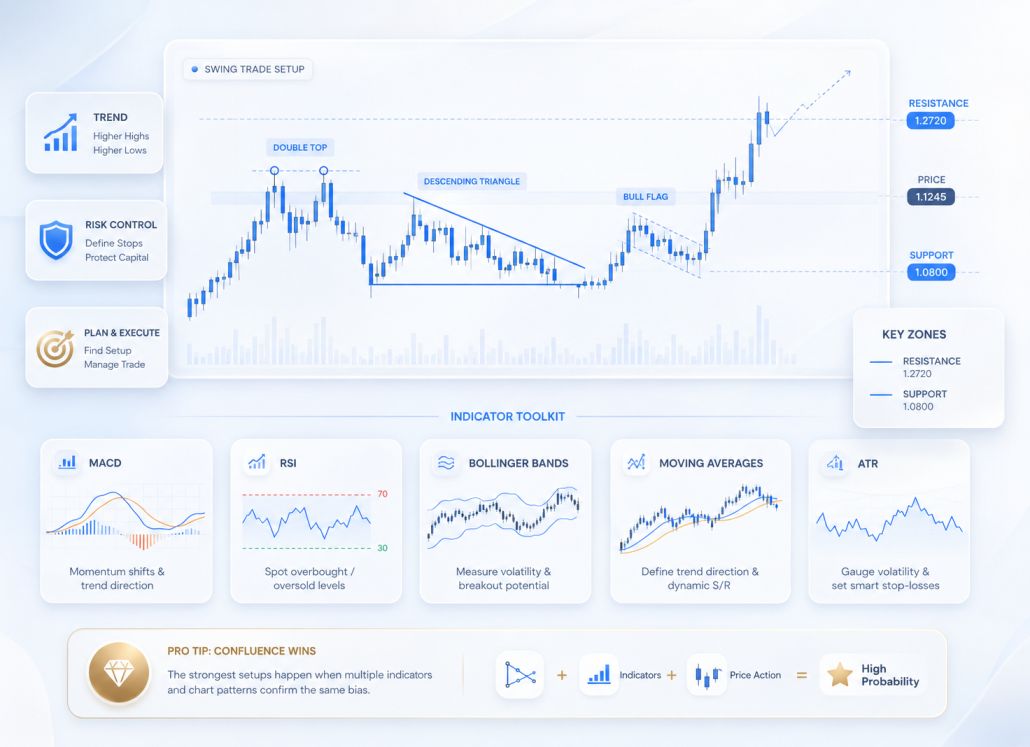
Double tops and bottoms signal potential reversals before most traders even notice the shift. Flags and pennants show continuation setups mid-trend. Triangles — symmetrical, ascending, descending — compress price volatility before a decisive breakout. Learning to spot these reliably is your first major milestone.
Key Indicators to Add to Your Setup
MACD — Identifies momentum shifts and trend direction changes with crossovers
RSI (Relative Strength Index) — Spots overbought/oversold conditions before reversals
Bollinger Bands — Measures volatility and highlights breakout potential
Moving Averages (SMA & EMA) — Define trend direction and dynamic support/resistance
ATR (Average True Range) — Helps size stop-losses based on real market volatility
Pro Tip: Never rely on a single indicator. The most reliable signals come when multiple indicators confirm the same setup — a confluence approach dramatically improves your win rate.
The 3 Fundamental Swing Trading Strategies
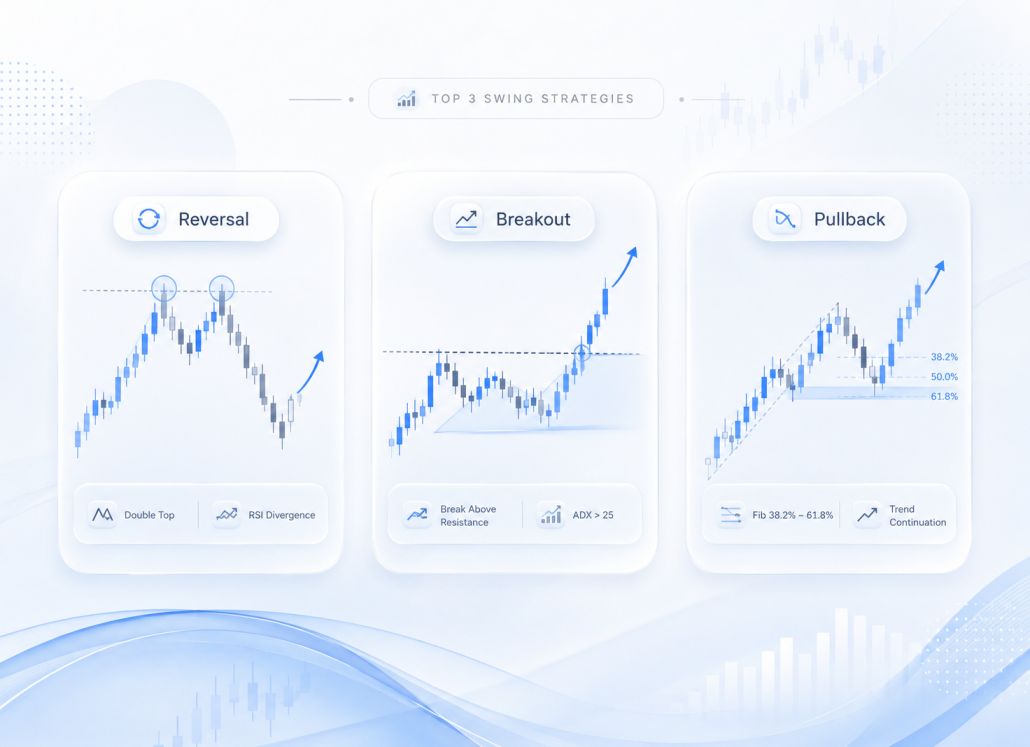
Every profitable swing trader has a small arsenal of proven strategies. Here are the three core approaches that consistently deliver results in forex markets.
Strategy 1: Trend Reversal Trading
Trend reversals are where big money moves happen. The market shifts direction, and if you're positioned correctly, you ride the entire new wave. The challenge? Confirming that a reversal is real and not a temporary pullback.
Look for price patterns like double tops or bottoms, combined with trendline breaks. Then confirm with indicators: if RSI shows divergence while price forms a double top, that's a powerful reversal signal. Add a MACD crossover, and you've got strong confirmation to enter.
Actionable Tip
Once you identify a reversal, set entry orders just above or below the key confirmation level. Place your stop-loss on the other side of the pattern to define your maximum risk before you ever enter the trade.
Tools like the Parabolic SAR, Ichimoku Cloud, and Stochastic Oscillator add extra confirmation. The more signals aligning in the same direction, the higher your probability of a successful trade.
Strategy 2: Breakout Trading
When price breaks through a significant support or resistance level, powerful momentum often follows. Breakout trading aims to catch that momentum early — entering just as the market commits to its new direction.
Chart patterns like triangles, rectangles, and channels are your hunting grounds. The key is confirmation: a genuine breakout typically shows increased volume and expanding ATR. Without volume confirmation, many breakouts fail and reverse — these are the "false breakouts" that trap impatient traders.
Wait for a candle close above/below the breakout level — not just a wick
Check volume: a valid breakout usually shows above-average participation
Use ADX above 25 to confirm the market has directional strength
Set stop-loss just inside the broken level — if price reclaims it, the breakout has failed
Strategy 3: Pullback Trading
Pullbacks are the retail trader's best friend. When a strong trend temporarily retraces to a support or resistance zone, it offers a second-chance entry at a much better price than chasing the initial move.
Fibonacci retracement levels (38.2%, 50%, 61.8%) are your primary tool here. When price pulls back to the 61.8% level and coincides with a moving average or trendline, you have multiple layers of confirmation supporting your entry.
Entry Tactics
Wait for price to reach the Fibonacci level, then look for a reversal candlestick — a hammer, bullish engulfing, or pin bar — before entering. This confirms buyers are stepping back in.
Exit Planning
Set your profit target at the recent high (for long trades) or recent low (for shorts). Place your stop-loss just below the Fibonacci level — if price breaks it convincingly, the pullback has turned into a reversal.
Once you've mastered the fundamentals, these advanced techniques will sharpen your entries, protect your capital, and dramatically improve your consistency.
Reading Support and Resistance Like a Professional
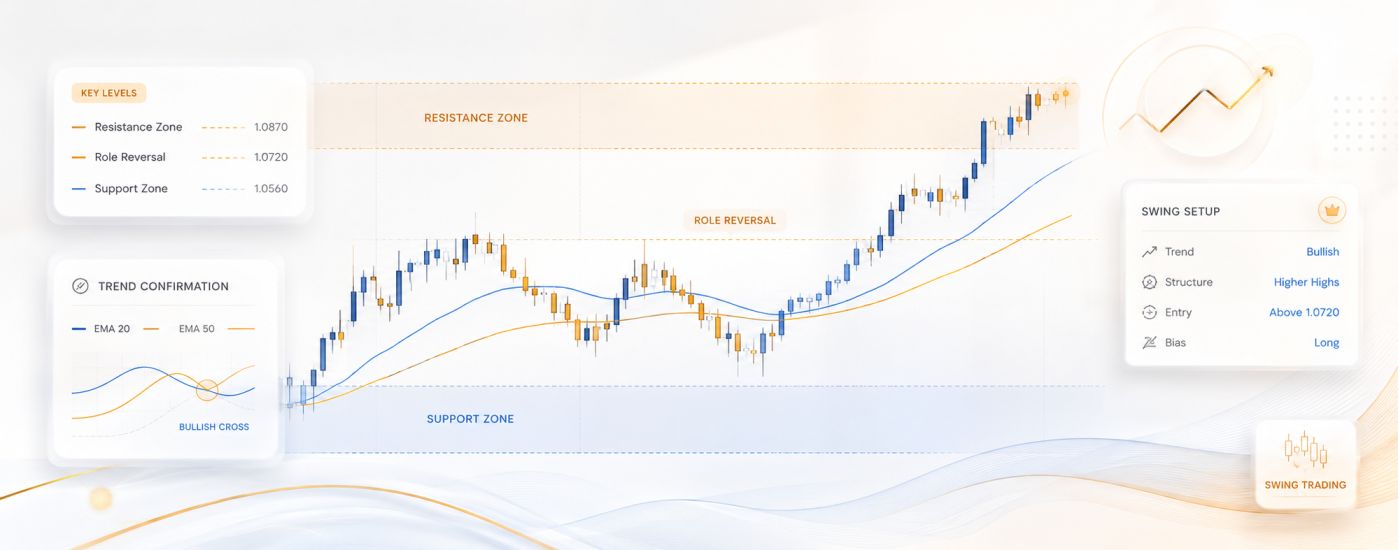
Support and resistance levels are the backbone of advanced swing trading. These price zones have memory — the market respects them repeatedly because they represent areas where large institutional orders accumulate. When a support level breaks and price closes below it convincingly, that former support often becomes new resistance — a concept called "role reversal." This is one of the most reliable re-entry signals in all of swing trading.
Using Moving Average Crossovers for Trade Timing
Moving averages smooth out price action and reveal the underlying trend with remarkable clarity. The two most effective combinations for forex swing traders are the 20 EMA + 50 EMA pairing and the 50 SMA + 200 SMA pairing.
When the shorter EMA crosses above the longer — a "golden cross" — it signals potential bullish momentum
Price bouncing off the 50 EMA during a pullback is a classic, high-probability long entry in an uptrend
Trailing your stop-loss just below the 20 EMA lets you capture extended trend moves
Candlestick Patterns as Trade Confirmation
Candlestick patterns reveal the battle between buyers and sellers in real time. A pin bar at resistance tells you buyers tried to push higher but were rejected hard. An engulfing candle at support shows that buyers overwhelmed sellers in a single session.
The most reliable candlestick signals occur at key levels with indicator confirmation. A hammer at a 61.8% Fibonacci level, coinciding with oversold RSI, is far stronger than a hammer forming in the middle of nowhere.
Risk Management: The Real Secret to Long-Term Profits
Here's the uncomfortable truth most trading courses skip: technical analysis gets you into trades, but risk management keeps you in the game. Without it, even a 70% win rate can destroy your account.
Setting the Right Risk-Reward Ratio
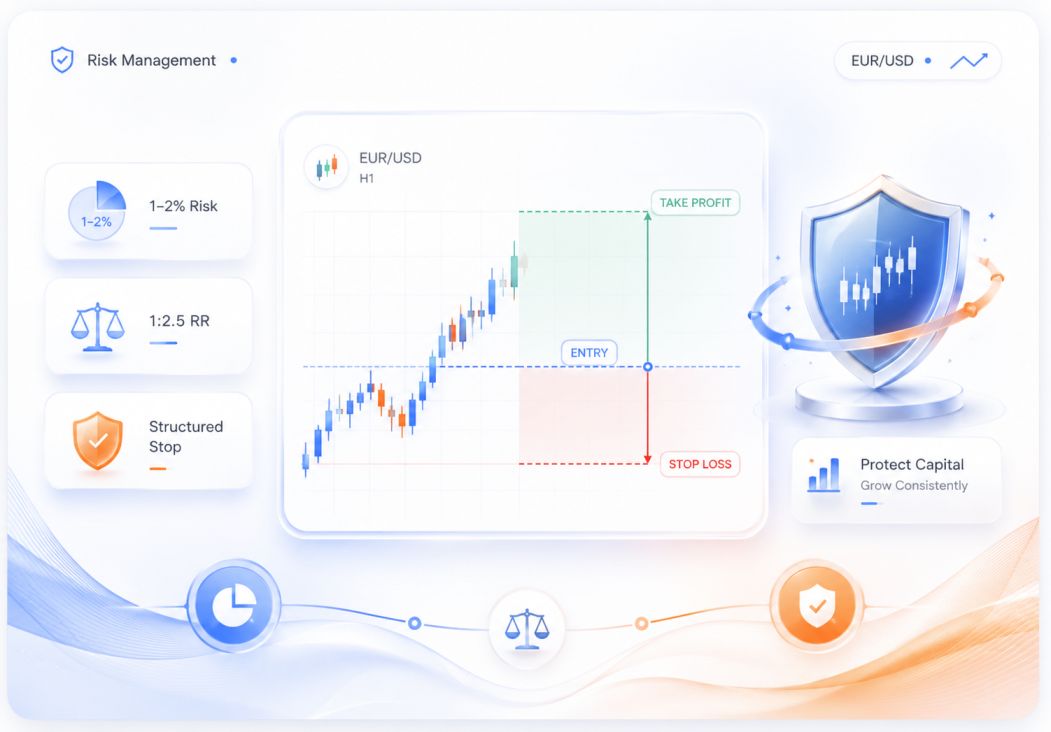
Always calculate your risk-reward ratio before entering any trade. Divide your potential profit (distance to target) by your potential loss (distance to stop-loss). A minimum of 1:2 is standard; targeting 1:3 gives you the cushion to be profitable even when you lose more trades than you win.
Position Sizing That Protects Capital
Position sizing is arguably the most underrated skill in trading. A simple rule: never risk more than 1–2% of your total account on any single trade. If your account is $10,000, your maximum loss per trade should be $100–$200. This keeps a losing streak from becoming a catastrophic drawdown.
Stop-Loss Placement That Actually Makes Sense
Place stops based on market structure, not arbitrary pip amounts
In volatile markets, widen stops slightly to avoid being shaken out prematurely
Trailing stops lock in profits as a trade moves in your favor
Never move your stop further away to avoid being stopped out — that's how small losses become account killers
The Psychology of Profitable Swing Trading
Every experienced trader will tell you: the hardest part isn't finding setups. It's managing your own mind. Fear and greed are the two forces that destroy more trading accounts than any bad strategy ever will.
Overtrading — The Silent Account Killer
Taking too many trades dilutes your edge. Quality over quantity is the principle. Wait for setups that tick every box on your checklist. If nothing qualifies, staying out is a legitimate decision.
Patience as a Competitive Advantage
Markets don't always cooperate with your timetable. The traders who wait patiently for high-probability setups consistently outperform those who force trades out of boredom.
Mindset Tip
Keep a trading journal. Writing down every trade — the setup, entry, exit, and your emotional state — creates powerful self-awareness over time. You'll start spotting your own patterns and what conditions produce your best results.
Frequently Asked Questions
There's no fixed minimum, but most professional traders recommend starting with at least $1,000–$5,000 to give yourself meaningful position sizing flexibility. The key is ensuring your account size allows you to risk only 1–2% per trade while still trading standard or mini lots. Trading with too little capital relative to your lot sizes is one of the fastest ways to blow an account.
Most forex swing traders use the 4-hour and daily charts for analysis and entry confirmation, with the weekly chart for big-picture trend direction. The daily chart is particularly powerful because it filters out intraday noise and shows you clean, institutionally-driven price action. You can then drill down to the 4-hour chart to time entries more precisely.
Absolutely. In trending markets, you use trend-following strategies — riding pullbacks back in the trend direction or entering on breakouts of key levels. In ranging markets, you buy near support and sell near resistance, taking advantage of price oscillations. The key is correctly identifying which market condition you're in before choosing your strategy.
The most reliable setups involve confluence — multiple factors aligning at the same price level. For example: price reaching a Fibonacci level that coincides with a key support zone, where a bullish candlestick pattern forms, confirmed by RSI showing oversold conditions. The more factors converging, the higher your probability of success.
The most common mistakes include: trading without a clear plan, risking too much per trade (over 2%), moving stop-losses in the wrong direction, overtrading out of impatience, chasing trades after missing the entry, and ignoring the broader trend on higher timeframes. Most are psychological, which is why discipline and a solid trading journal are essential from day one.
Conclusion: Your Swing Trading Edge Starts Here
Swing trading is one of the most balanced and accessible approaches to forex trading — and when done correctly, one of the most consistently profitable. The strategies we've covered here — trend reversals, breakouts, pullbacks, advanced support/resistance analysis, moving average strategies, and candlestick confirmation — are the same techniques used by professional traders every single day.
But knowledge alone doesn't create profits. Execution does. Build your trading plan, follow your rules with discipline, manage your risk meticulously, and keep refining your approach with every trade. The edge compounds over time.
At fxTsignals.com, we're dedicated to giving every forex trader — from beginner to advanced — the tools, analysis, and signals they need to trade with confidence. Your next profitable swing trade is closer than you think.
Ready to Trade Smarter?
Join thousands of forex traders who trust fxTsignals for precision swing trade signals, real-time market analysis, and expert strategies. Your edge in the forex market starts with the right signals.