Decoding Hedge Fund Performance: The Secrets Every Smart Forex Trader Must Know
What separates a hedge fund that prints consistent double-digit gains from one that quietly dissolves after its second year? The answer is never just one thing — it's a cocktail of sharp strategy, airtight risk management, market-timing instinct, and cutting-edge technology. And for forex traders navigating today's volatile markets, understanding these performance drivers isn't optional. It's your edge.
In this deep-dive, we break down exactly how hedge funds operate, what fuels their performance, and how you — as an active forex trader — can borrow from their playbook to sharpen your own results.
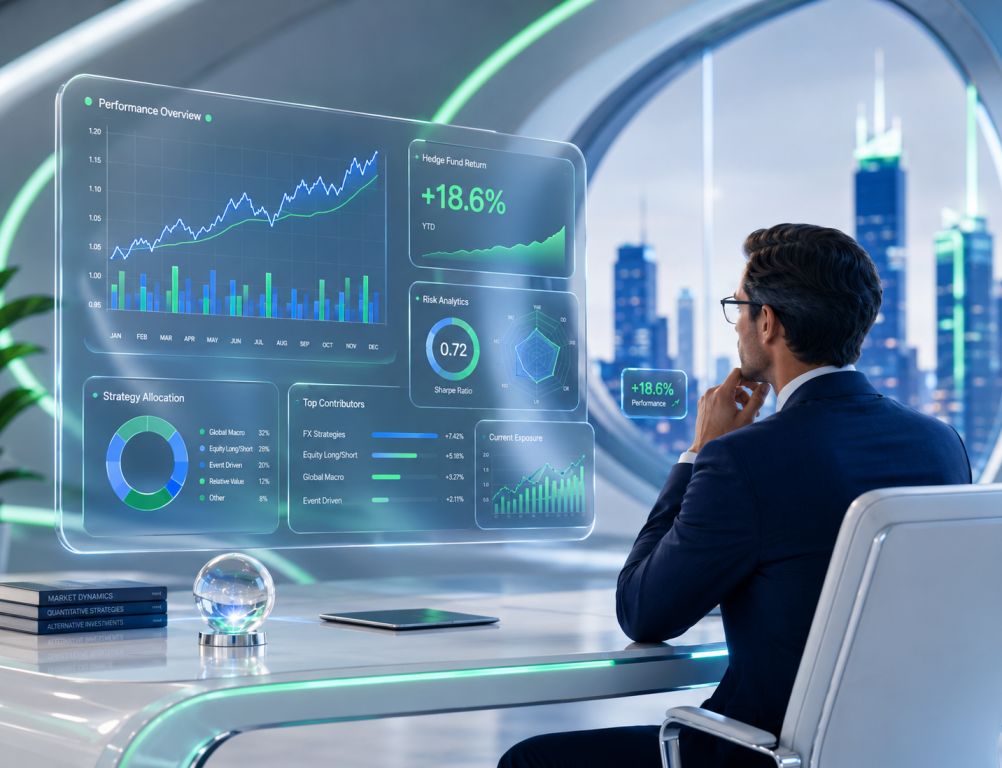
Why Hedge Funds Are Unlike Any Other Investment Vehicle
Hedge funds operate in a league of their own. While mutual funds follow strict regulatory scripts — diversified portfolios, daily liquidity, conservative mandates — hedge funds write their own rules. They can go long, go short, use leverage, trade derivatives, hold private equity, and pivot strategy mid-quarter if market conditions demand it.
This flexibility is precisely what makes them so fascinating — and so instructive for active traders. A well-run hedge fund isn't just deploying capital. It's running a sophisticated, adaptive war room where every position serves a purpose and every risk is deliberate.
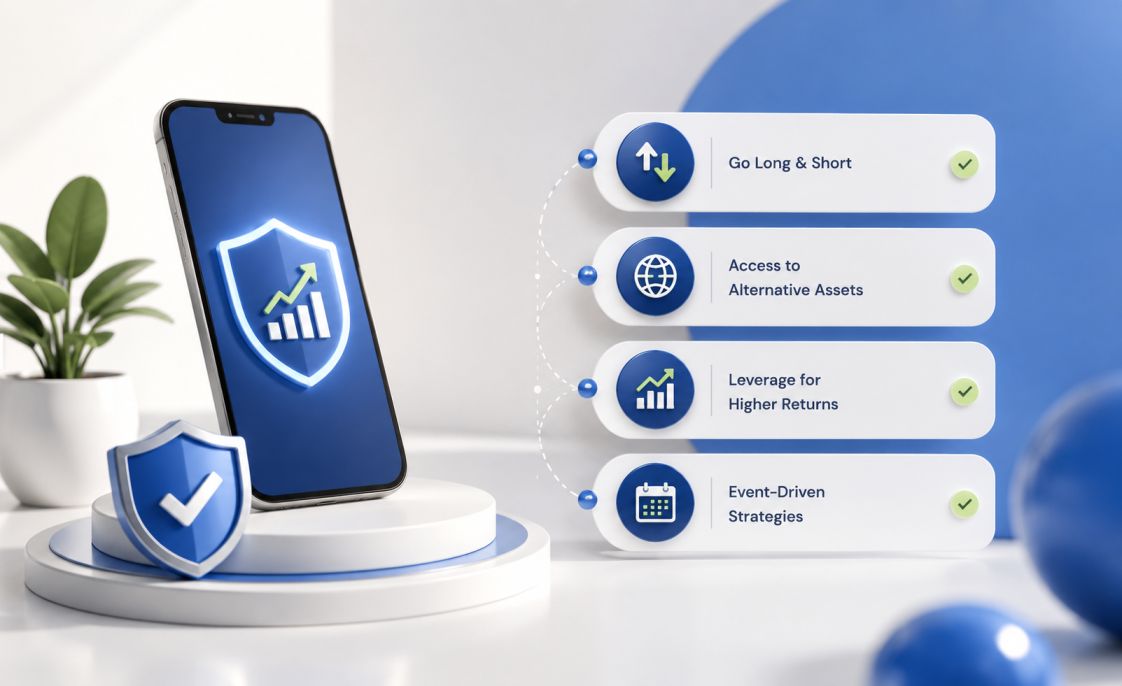
- Freedom to go long and short simultaneously, capturing gains in rising and falling markets
- Access to alternative assets: commodities, currencies, crypto, real estate debt, and beyond
- Leverage tools that amplify returns — and demand even stricter discipline
- Event-driven strategies: mergers, earnings plays, central bank announcements
"The hedge fund industry is built on the premise of unlocking opportunities that traditional investors overlook — speed, information, and decisiveness separate the best from the rest." — Institutional Investor Insight, 2025
The Six Pillars That Drive Hedge Fund Success
1. Investment Strategy: Playing a Different Game
There is no single "hedge fund strategy." That's the point. The best funds are masters of a specific approach — whether it's global macro bets on currency swings, statistical arbitrage between correlated assets, or pure-play long/short equity books.
For forex traders, the global macro strategy is perhaps the most relevant. Managers in this space are essentially running the same analysis you do — reading central bank signals, monitoring geopolitical risk, tracking capital flows — but with billions on the line and entire research teams feeding the model.
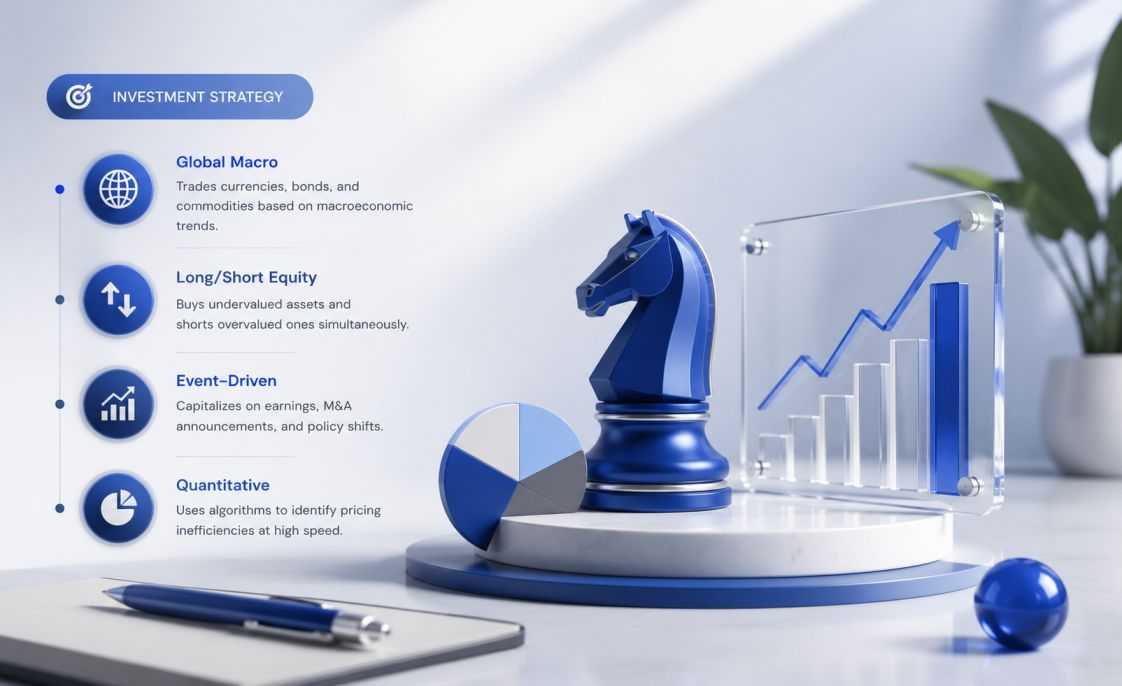
- Global Macro: Trades currencies, bonds, and commodities based on macroeconomic trends
- Long/Short Equity: Buys undervalued assets and shorts overvalued ones simultaneously
- Event-Driven: Capitalizes on earnings, M&A announcements, and policy shifts
- Quantitative: Uses algorithms to identify pricing inefficiencies at high speed
2. The Fund Manager: Where Alpha Is Born
Behind every great hedge fund is a great decision-maker. Fund managers don't just pick stocks or currencies — they architect entire risk frameworks, allocate capital across strategies, and adapt positioning in real time. Their edge is rarely just intelligence. It's process, discipline, and the willingness to cut losses faster than their competitors.
For retail forex traders, this translates directly: building a personal trading framework — entry rules, sizing models, drawdown limits — mimics the discipline that separates institutional managers from those who blow up their accounts.
🎯 Actionable Tip: Build Your Own "Fund Manager" Framework
- Define your maximum drawdown threshold — and hard-stop when you hit it
- Size positions as a percentage of account equity, not fixed-dollar amounts
- Review every closed trade weekly, not just winning ones
- Keep a written thesis for every open position — if you can't explain it, exit it

Effective risk management remains the single biggest differentiator between top-performing funds and the rest of the field.
3. Risk Management & Diversification: Protecting the Downside
Ask any veteran fund manager what separates long-term survivors from one-hit wonders, and the answer is almost always the same: risk management. It's not the most glamorous topic, but it's the backbone of everything.
Top funds diversify across asset classes, geographic regions, and time horizons. They stress-test portfolios against scenarios — 2008-style credit crunch, pandemic shock, flash crash — and maintain liquidity buffers so they can rebalance without being forced sellers.
For the active forex trader, this means thinking in correlations. If you're long EUR/USD, long GBP/USD, and long AUD/USD simultaneously, you're not diversified — you're just leveraged USD short with extra steps.
4. Technology & Data: The New Competitive Moat
The best hedge funds today run as much on code as they do on conviction. Quantitative models sift through petabytes of market data — tick data, satellite imagery, credit card transaction volumes, social media sentiment — to generate signals invisible to the naked eye.
Machine learning models don't just identify patterns. They adapt as markets evolve, continuously refining their edge. AI-driven execution systems enter and exit positions at speeds measured in microseconds, minimizing slippage and maximizing fill quality.
As a forex trader on platforms like those offered through fxTsignals.com, you can tap into this same philosophy by using algorithmic signal services, backtesting your strategies rigorously, and letting data — not emotion — drive your execution decisions.
5. Market Intelligence: Knowing Before the Crowd
Information asymmetry is one of the most powerful forces in financial markets. Hedge funds spend millions on proprietary research — analysts embedded in industries, relationships with management teams, subscriptions to alternative data providers tracking everything from foot traffic to shipping container volumes.
The speed and depth of this intelligence pipeline allows top funds to position ahead of market-moving events, rather than reacting to them after the fact. By the time CNBC runs the headline, the smart money has already moved.
Your edge as a forex trader? Stay ahead of the economic calendar. Use high-quality signal services. Watch central bank communications with the same obsession institutional macro traders do. Timeliness is everything.
6. Fee Structure: Skin in the Game
The classic hedge fund fee model — 2% management fee plus 20% performance fee — is designed to do one thing: align manager incentives with investor outcomes. When managers only get paid handsomely if they generate returns above a high-water mark, their interests and their investors' interests become identical.
This "skin in the game" principle is something every trader should internalize. When your own real capital is on the line — when you feel every pip — your decision-making sharpens dramatically. Paper trading builds skill; live trading builds character.
- Always trade with capital you can psychologically afford to risk — panic selling is the silent account-killer
- Track your return-to-risk ratio, not just raw profits — consistent 1.5R+ trades beat sporadic home runs
- Set monthly performance goals the way a fund manager would — and review them honestly
Applying institutional-grade thinking to your forex trading strategy can dramatically improve consistency and long-term performance.
Market Conditions: The Wild Card No One Can Ignore
Even the most brilliant strategy can produce ugly results if deployed in the wrong market regime. Trend-following strategies crush it in strongly directional markets but bleed in choppy, range-bound conditions. Mean-reversion approaches work beautifully in consolidating markets but get steamrolled during breakouts.
The best hedge funds don't just have a strategy — they have a process for knowing when to deploy it, when to scale back, and when to sit in cash. That situational awareness is arguably the rarest and most valuable skill in trading.
For forex traders, this means calibrating your approach to current conditions. High volatility, event-heavy weeks call for tighter stops and reduced size. Trending environments after a major central bank shift call for position-building and holding your winners longer. The market tells you what it wants to do — your job is to listen.
Quick Checklist: Adapting to Market Conditions
- Check the VIX or FX volatility indices before sizing positions
- Reduce exposure 24–48 hours before major data releases (NFP, FOMC, CPI)
- In trending markets, use wider stops and higher targets; in ranging markets, do the opposite
- Keep a weekly "macro map" noting key upcoming events and consensus expectations
- Don't fight a strong trend just because your entry was wrong — the market is always right
Frequently Asked Questions
The Bottom Line for Forex Traders
Hedge funds don't succeed by accident, and neither do great forex traders. The factors that drive fund performance — disciplined strategy selection, skilled management, adaptive risk frameworks, intelligent use of technology, superior market intelligence, and properly aligned incentives — are the same principles that separate profitable retail traders from the 70% who wash out.
The forex market is the largest, most liquid financial market on Earth. Every day, over $7 trillion changes hands. Institutional players — hedge funds, central banks, sovereign wealth funds — are your counterparties. Understanding how they think, how they position, and what drives their performance is not just interesting. It's essential.
Before entering any trade, ask yourself: would a disciplined fund manager take this position? Do I have a clear thesis? Is my risk defined and acceptable? Is the market environment aligned with my strategy? If you can answer yes to all three, you're already trading at a higher level than most.
Start Trading With Institutional-Grade Signals Today
Join thousands of forex traders who use fxTsignals.com to access professional-grade market analysis, real-time signals, and strategy insights inspired by the world's top hedge funds.
Get Hedge Funds Trial SignalsAlways trade responsibly. Past performance is not indicative of future results. All trading involves risk.