Hedge Fund Due Diligence: The Smart Forex Trader's Complete Playbook
Before you commit capital to any hedge fund, the real edge lies in what you investigate — not what you assume. This guide walks forex traders through every layer of due diligence that separates informed investors from expensive mistakes.

Why Hedge Fund Due Diligence Matters for Forex Traders
In the world of forex trading, information is the sharpest weapon you can carry. Hedge funds have evolved into powerful investment vehicles, but they're not all built the same way. Some run disciplined, transparent strategies that can complement your forex portfolio. Others mask volatility behind glossy pitch decks and inconsistent reporting.
Hedge fund due diligence is your structured process for separating the two. It's a deep-dive investigation into how a fund works, who runs it, how risks are managed, and whether the returns you're shown are real — and repeatable. For active forex traders looking to diversify or collaborate with institutional-grade vehicles, skipping this process is like entering a trade without checking your charts.
This guide will break down every critical step with practical examples and actionable tips, so you walk away ready to evaluate any fund with professional-grade confidence.
1. Decoding the Fund's Investment Strategy
Understanding What You're Actually Buying Into
Every hedge fund operates on a strategy — but not every strategy is what it appears on paper. As a forex trader, you know how quickly market conditions shift. So must you understand how a fund adapts its strategy when those conditions change.
Start by asking these questions: Does the fund use directional bets, arbitrage, or macro positioning? How does it allocate across asset classes, and does forex exposure play a role? How does it manage drawdowns during low-volatility periods versus crisis events?
Actionable Tips
- Request the fund's offering memorandum and investment policy statement — not just the marketing deck
- Ask specifically how the strategy performs during trending vs. ranging market conditions
- Check if the fund has clearly defined risk parameters, or if the manager has wide discretionary latitude
- Compare the stated strategy against actual portfolio holdings over time — inconsistencies are red flags
"Understanding a hedge fund's strategy is less about reading the brochure and more about stress-testing the logic behind every position they've ever taken."
2. Evaluating the Track Record — The Numbers Don't Lie (Usually)
Reading Performance Data Like a Professional
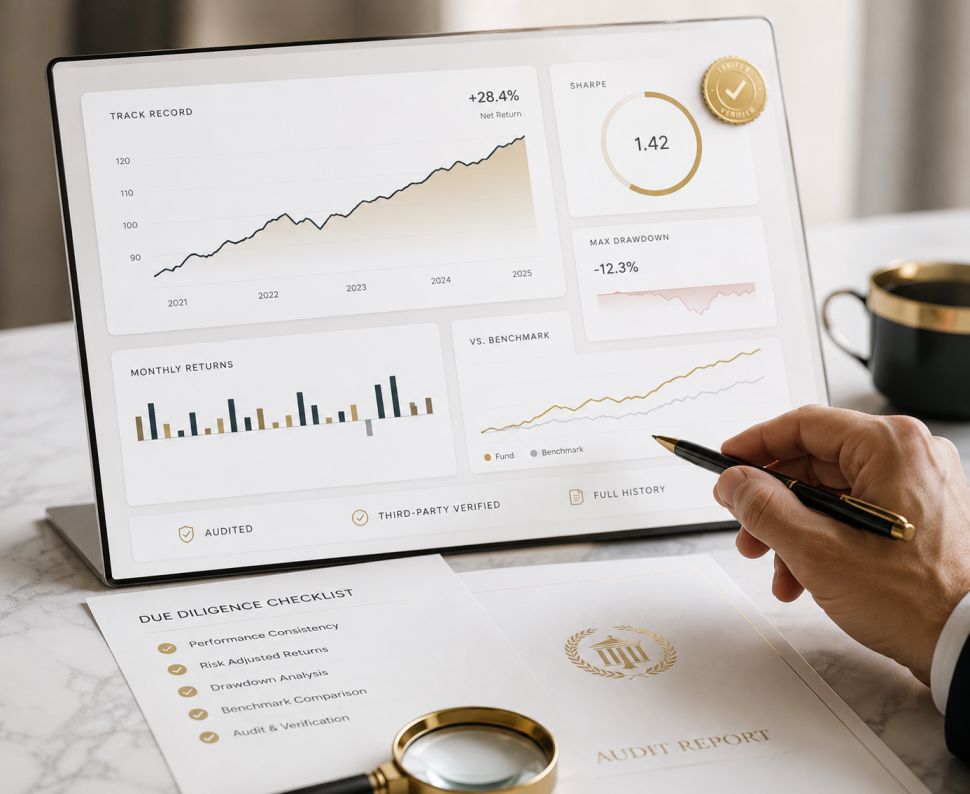
Past performance isn't a guarantee of future results — but it is your best available evidence. The key is knowing what to look for beyond the headline return numbers. Any fund can post a great quarter. Far fewer can maintain disciplined performance through a full market cycle.
For forex traders especially, understanding how a fund performs across different volatility regimes matters deeply. A fund that thrives in trending FX markets but collapses during range-bound periods may not complement your trading style at all.
What to Examine in a Track Record
- Sharpe Ratio: Risk-adjusted returns — look for a sustained ratio above 1.0 over at least three years
- Maximum Drawdown: The worst peak-to-trough decline. Anything beyond 25% warrants serious explanation
- Calmar Ratio: Annual return divided by max drawdown — a figure above 1.0 is strong
- Monthly Return Distribution: Look for consistency, not just high average returns with wild swings
- Correlation to Benchmarks: Does the fund truly offer diversification or just repackage beta?
Always verify reported returns with a third-party auditor's confirmation. Funds with unaudited track records, or those that cherry-pick performance start dates, deserve extra scrutiny.

3. Scrutinizing the Management Team
People Manage Money — Not Algorithms Alone
Behind every fund's returns is a team of humans making decisions under pressure. The quality, experience, and stability of that team is one of the most predictive factors of long-term fund performance. Ironically, it's also one of the most overlooked areas in standard due diligence.
For a forex trader considering hedge fund exposure, ask yourself: Would you follow this portfolio manager's trade thesis in your own account? Their methodology, risk philosophy, and track record as individuals — not just as a collective — should hold up under scrutiny.
- Research key managers' backgrounds on LinkedIn, Bloomberg, and FINRA BrokerCheck or relevant regulatory databases
- Look for continuity — frequent key-person turnover often signals internal instability or compensation disputes
- Evaluate succession planning: what happens if the lead PM leaves tomorrow?
- Check for prior regulatory actions, litigation history, or conflicts of interest
- Assess whether the team co-invests with their own capital — "skin in the game" alignment matters
"A track record belongs to a team. When the team changes, the track record may no longer mean what you think it does."

4. Analyzing Risk Management Practices
How a Fund Behaves When Markets Break
In forex trading, you've probably experienced firsthand what happens when risk management is treated as an afterthought. Currency flash crashes, central bank policy shocks, and liquidity crises can unravel even profitable positions in minutes. The same logic applies to hedge funds — except the consequences scale with institutional capital.
What separates elite funds from average ones is not how they perform in calm markets, but how rigorously they contain losses when things go wrong. A strong risk management framework includes systematic controls, defined position limits, and pre-established rules for crisis scenarios.
Key Risk Management Questions
- What are the fund's maximum position size limits and sector concentration rules?
- How frequently does the fund conduct stress tests, and what scenarios do they model?
- What risk monitoring tools are used — VaR, CVaR, scenario analysis, factor models?
- Who has veto authority on risk decisions — the PM, a separate risk officer, or a committee?
- How did the fund perform during real stress events like COVID-19 in March 2020?
5. Conducting Operational Due Diligence
The Infrastructure Behind the Trades
Operational due diligence (ODD) is where institutional investors spend enormous time — and where most retail or semi-professional investors stop short. This is a mistake. Some of the most catastrophic hedge fund failures in history weren't caused by bad investment decisions; they were caused by operational failures, accounting fraud, and cybersecurity breaches.
At FxTsignals.com, we know that the same discipline you apply to a forex trade setup — confirming the setup, checking your broker's execution quality, verifying your risk parameters — applies to evaluating the operational health of any fund you consider.
Operational Areas to Investigate
- Fund Administrator: Is it an independent, reputable third party like SS&C or State Street, or is it handled in-house?
- Prime Broker Relationships: Which banks or institutions provide custody and financing?
- Legal & Compliance Structure: Is the fund registered in a credible jurisdiction with proper regulatory oversight?
- Cybersecurity Protocols: In the age of digital finance, data security is a material risk factor
- Auditor Independence: Who audits the fund's books and how long have they worked together?
- Redemption Terms: What are the lock-up periods, notice periods, and gates on redemptions?
"Operational excellence is invisible when everything works. It's catastrophic when something doesn't. Due diligence is how you find the cracks before capital is at risk."

Frequently Asked Questions
Everything forex traders typically want to know about hedge fund due diligence — answered directly.
A thorough due diligence process typically runs between three and six months for institutional-grade investors. Individuals can conduct a meaningful preliminary review in four to eight weeks if they're systematic. The timeline depends on how quickly the fund provides documentation, the complexity of its strategy, and whether third-party verification is needed for performance data.
At minimum, request the offering memorandum (OM), the limited partnership agreement (LPA), audited financial statements for the past three years, the fund's DDQ (due diligence questionnaire), performance attribution reports, and the compliance manual. Any fund that resists sharing these documents transparently should raise immediate concern.
Yes, and many active forex traders do exactly this. Hedge funds with macro or systematic strategies can provide exposure to assets and structures that complement a forex trading portfolio. The key is ensuring the fund's risk profile and correlation to your existing positions is understood — you don't want to be doubling down on the same directional bets unknowingly. Diversification is the goal.
The most serious red flags include: unaudited performance records, in-house fund administration (no independent custody), refusal to provide a DDQ or audited financials, suspiciously smooth return curves with little or no losing months, frequent key-person changes, and overly complex fund structures that obscure actual holdings. If a manager resists transparency on any of these points, treat it as disqualifying.
Investment due diligence focuses on the fund's strategy, portfolio, performance, and risk management approach — essentially, how they make money. Operational due diligence examines the infrastructure around those decisions: fund administration, legal structure, compliance, technology, cybersecurity, and service providers. Both are essential. Madoff is the most famous example of a fund that passed investment scrutiny but should have failed operational checks spectacularly.
Conclusion: Due Diligence is Your Greatest Edge
Hedge fund due diligence isn't a bureaucratic checkbox — it's the process that distinguishes disciplined capital allocation from blind trust. For forex traders who already think rigorously about risk, entry conditions, and market structure, applying that same analytical mindset to hedge fund evaluation is a natural extension of your skillset.
The five pillars we've covered — understanding the strategy, evaluating the track record, scrutinizing the management team, analyzing risk management practices, and conducting operational due diligence — give you a complete framework to work through before committing a single dollar.
Markets reward preparation. The traders who build informed, systematic processes around every decision — whether executing a EUR/USD trade or evaluating a multi-billion-dollar fund — are the ones who compound wealth over time rather than learning expensive lessons.
Ready to Trade with Institutional-Grade Insight?
Join thousands of serious forex traders who rely on FxTsignals.com for precision signals, market analysis, and strategies that actually perform. Start making smarter, data-backed decisions today.
Get Premium Signals Now →