Hedge Fund Risk Analysis:
Your Edge in the World of Forex Trading
How smart traders use institutional risk frameworks to protect capital, maximize returns, and trade with unshakeable confidence.
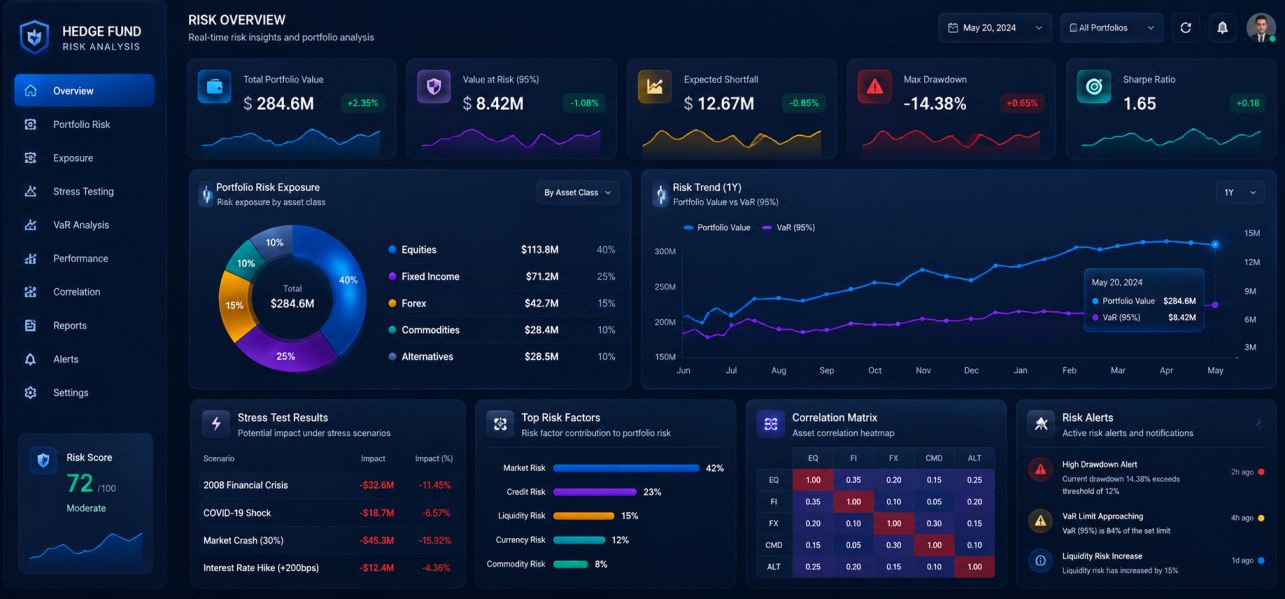
Why Every Serious Forex Trader Needs to Think Like a Hedge Fund
The best hedge funds in the world do not win because they predict markets perfectly. They win because they manage risk better than anyone else in the room. That is a critical insight — and it applies just as powerfully to individual forex traders as it does to billion-dollar institutions.
"Risk analysis is not about avoiding trades. It is about understanding exactly what you are getting into before you enter — and having a plan before the market moves against you."
Hedge fund risk analysis is the structured process of identifying, measuring, and managing the dangers embedded in investment decisions. In forex trading, where leverage amplifies both profits and losses, a disciplined risk framework is not optional — it is the difference between long-term profitability and blowing up an account.
In this guide, we break down exactly how hedge funds approach risk, what tools they use, and how you — as a forex trader — can apply the same strategies starting today.

What Is Hedge Fund Risk Analysis — And Why Should Forex Traders Care?
Hedge funds operate in an environment where a single miscalculated position can wipe out years of gains. To prevent this, they build entire departments dedicated to risk analysis — examining every investment through the lens of "what could go wrong" rather than "how much can we make."
For forex traders, the parallel is exact. You are your own risk department. The currency markets move 24 hours a day, five days a week. Without a structured approach to risk, you are simply gambling with a chart in front of you.
The Five Pillars of Hedge Fund Risk Analysis
Professional risk management is built on five interconnected pillars. Mastering each one will transform how you approach forex trading.
1. Risk Identification & Assessment
Before you can manage a risk, you have to see it. Hedge funds systematically catalog every source of danger — from macro-level threats like interest rate shifts and geopolitical tensions, to micro-level concerns like counterparty defaults or liquidity crunches.
In forex, your risk identification checklist should include currency pair volatility, upcoming economic releases, correlation between open positions, and your broker's margin requirements. Knowing these factors before you open a trade is what separates professionals from gamblers.
- Map market, liquidity, and counterparty risks before each session
- Check the economic calendar for high-impact events (NFP, CPI, FOMC)
- Assess correlation between open positions to avoid doubled exposure
- Review your broker's swap rates and margin requirements

2. Quantitative Analysis — Let the Numbers Lead
Quantitative analysis means using hard data — historical price action, volatility statistics, and correlation coefficients — to make disciplined trading decisions rather than emotional ones. Hedge funds rely on mathematical models to understand exactly how much risk they are taking on for every dollar invested.
For a forex trader, this translates into powerful habits: tracking your average risk-to-reward ratio, measuring historical volatility of each pair you trade, and using position sizing formulas like the 1% or 2% rule to ensure no single trade can seriously damage your account.
3. Scenario Analysis — Prepare for the Unexpected
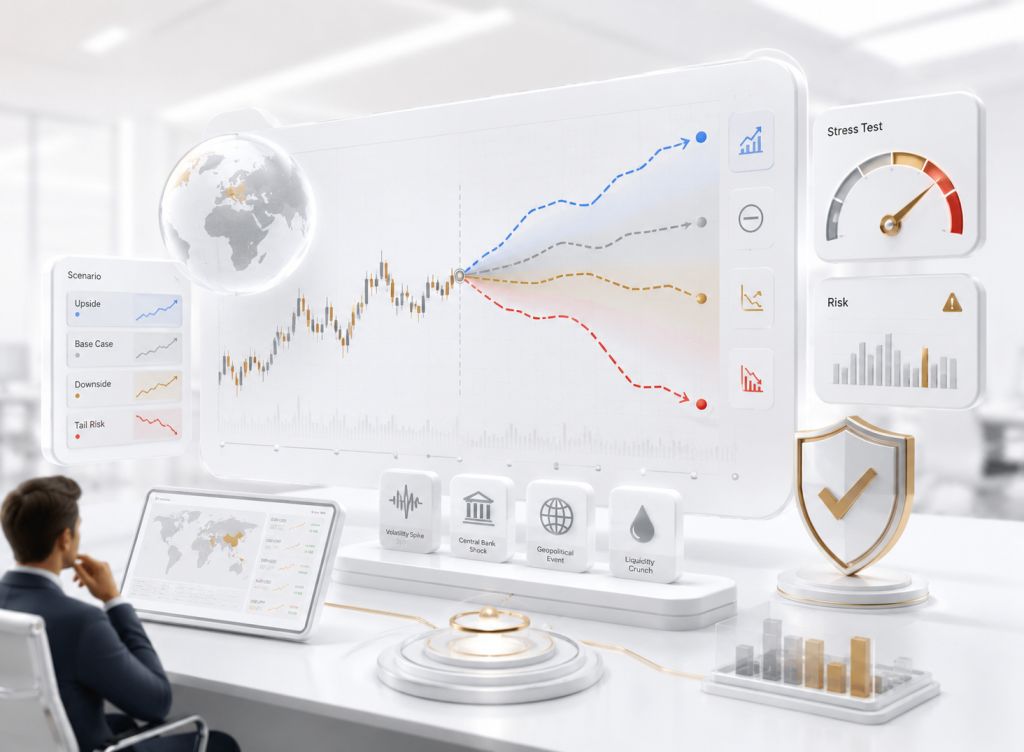
The smartest hedge fund managers do not just plan for the most likely outcome. They stress-test against multiple scenarios — including those they hope never happen.
Think about the Swiss franc crisis of 2015, when the SNB suddenly removed its currency peg and EUR/CHF collapsed 30% in minutes. Traders who had considered that tail-risk scenario survived. Many who had not were wiped out entirely. Scenario analysis is your mental rehearsal for extreme market events.
Practical tip: Every week, ask: "What happens to my open positions if the Fed surprises the market?" Walk through the logic. Size your trades accordingly.
4. Stress Testing Your Portfolio
Stress testing means subjecting your current portfolio to a simulated worst-case scenario. Ask yourself: "If the market moves 200 pips against me on every open position simultaneously, how much do I lose?" If the answer makes your stomach turn, your position size is too large.
5. Risk Mitigation — Building Your Defense System
Once risks are identified, you need a plan to contain them. This includes hard stop-losses on every trade, diversification across uncorrelated currency pairs, hedging strategies during high-volatility events, and a clear rule about maximum daily or weekly drawdown before you stop trading entirely.
- Always use a hard stop-loss — no exceptions, no "I'll watch it"
- Never risk more than 1–2% of account equity per trade
- Diversify across different currency pairs with low correlation
- Reduce position size during major news events
- Define a weekly drawdown limit — when hit, close all trades and step back
The Professional Toolkit — Risk Analysis Instruments That Actually Work
Hedge funds have an arsenal of analytical tools. Here are the three that translate most directly into actionable forex trading improvements:
Quantitative Models
Statistical regression and factor analysis tools reveal hidden relationships between market drivers and your portfolio. They strip away noise and show what is actually moving your positions.
Monte Carlo Simulation
Run thousands of random market scenarios simultaneously to understand the full distribution of possible outcomes from your strategy. Many forex platforms offer simplified versions of this analysis.
Value at Risk (VaR)
VaR tells you the maximum expected loss over a given period at a defined confidence level. Set limits and trade within them — it is the clearest way to quantify acceptable risk per trade.
Integrating Risk Analysis Into Your Forex Strategy
Risk analysis is not a checklist you run before a trade. It is a mindset that shapes every trading decision — from what pairs you watch, to how large you size, to when you walk away.
Diversification in Forex
Trading EUR/USD and GBP/USD simultaneously is not diversification — they often move in the same direction. Pairing a major with a commodity currency like AUD/USD or USD/CAD gives you more genuine exposure spread.
Risk-Adjusted Returns: The Right Scorecard
Stop measuring success by profit alone. A trade that makes $500 with $200 of risk is far superior to one that makes $500 with $1,000 of risk. Track your Sharpe Ratio or simply your win rate weighted by average R:R.
Regulatory Awareness
Regulatory changes directly affect leverage, margin, and available instruments. Stay informed about rulings from the FCA, ESMA, and CFTC in your jurisdiction. Compliance is not bureaucracy — it is protecting your ability to trade.

7 Best Practices Every Forex Trader Should Steal from Hedge Funds
These are habits used daily by professionals managing hundreds of millions of dollars. Borrow them shamelessly.
- Review your risk profile weekly — market dynamics change; your exposure limits should too
- Blend quantitative and qualitative analysis — charts tell you what; fundamentals tell you why
- Write down your risk management rules — a written plan is harder to abandon under pressure
- Build a risk-aware trading culture — if you trade with a partner or mentor, make risk talk part of every session
- Stress-test your open positions every Sunday — before the week opens, know your worst-case scenario
- Never add to a losing position without logic — "hoping it comes back" is not a strategy
- Track every trade with full context — entry, exit, risk taken, outcome, and what you would do differently
Frequently Asked Questions
Hedge fund risk analysis is a structured process of identifying, measuring, and managing the risks embedded in investment positions. For forex traders, it means applying the same discipline — using tools like VaR models, position sizing rules, and scenario planning — to protect capital and make smarter decisions rather than relying on gut feel alone.
VaR estimates the maximum potential loss on a position over a specific period at a given confidence level. As a forex trader, calculate: based on the pair's historical volatility and your position size, what is the most I could realistically lose in one trading day? Set a hard stop if that number exceeds your tolerance.
At a minimum, review your risk parameters weekly — ideally every Sunday before the market opens. Reassess after any major market event (Fed decision, significant geopolitical development) and whenever your account balance changes significantly. Risk management is a living process, not a set-and-forget checklist.
Scenario analysis evaluates how your portfolio performs under a range of plausible market conditions. Stress testing pushes those scenarios to extremes — a market crash, a flash crash, a sudden central bank intervention. Both are essential, but stress testing specifically targets your vulnerabilities under worst-case circumstances.
Absolutely. The core principles — sizing positions at a fixed percentage of equity, maintaining a risk-to-reward ratio above 1:1, diversifying across uncorrelated pairs, and reviewing exposure weekly — require nothing more than discipline and a simple spreadsheet. The mindset matters far more than the tools.
Ready to Trade with a Hedge Fund Mindset?
Thousands of traders are already using fxTsignals.com to get institutional-grade analysis, real-time signals, and risk-aware trading setups delivered straight to their screens. Stop trading blind. Start trading with the edge that professional risk analysis gives you.