
Hedge Fund Types Every
Serious Trader Must Know
From equity long/short to global macro strategies — a clear, jargon-free breakdown of how the world's most powerful investment vehicles actually operate, and what it means for your trades.
Why Forex Traders Need to Understand Hedge Funds
If you've been in the forex markets for any meaningful stretch of time, you already know: big moves rarely happen in a vacuum. Currencies spike, reverse, and consolidate — and often, it's the institutional players that light the fuse. Hedge funds are among the most powerful of those players.
Understanding how hedge funds are classified isn't just academic. When you know which type of fund is active in a given market environment, you gain a significant edge — you can anticipate the kind of pressure they're placing on price, and position accordingly.
These are privately managed investment vehicles with one core mandate: generate strong risk-adjusted returns, regardless of market direction. Unlike mutual funds, they can go long and short, use leverage, and trade derivatives — which makes them uniquely influential in the forex space.

Equity Hedge Funds
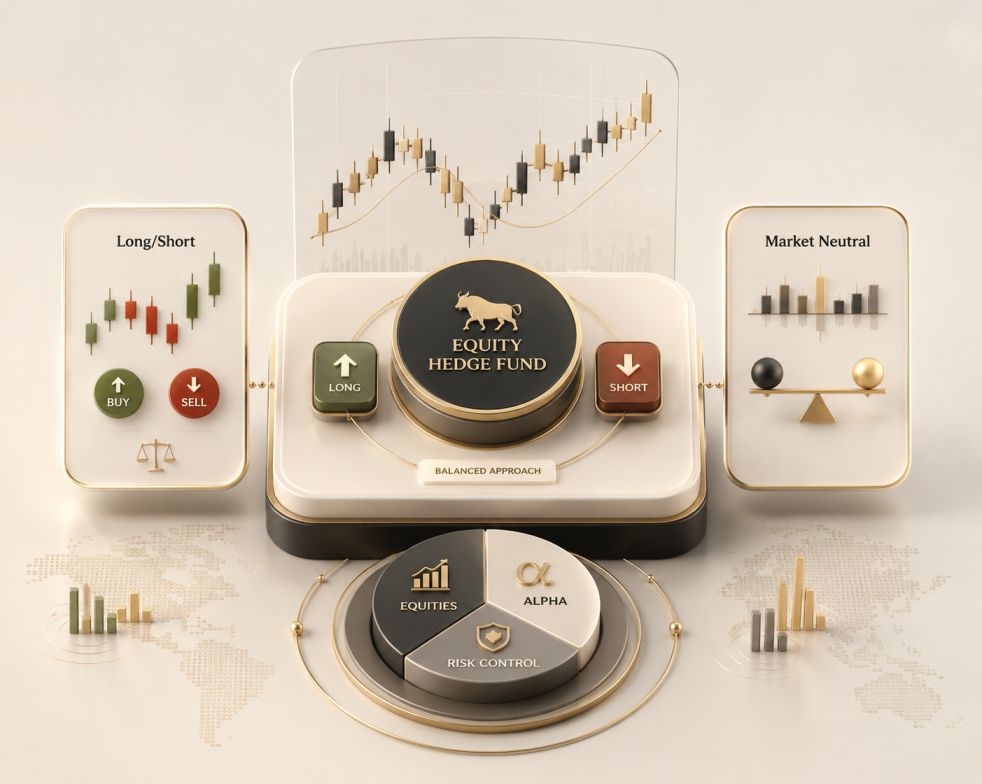
Equity hedge funds are the classic, the OG of the hedge fund world. They're also the most widely discussed — and for good reason. These funds operate primarily in stock markets, taking both long and short positions to generate returns regardless of whether the broader market is rising or falling.
Key Strategies
Long / Short Equity
The manager simultaneously buys stocks expected to rise and shorts stocks expected to fall. The result is a portfolio that's hedged against broad market swings — hence the name. Profits come from being right on both sides of the bet.
Market Neutral
Here, the fund maintains roughly equal long and short exposure. The goal isn't to ride the market — it's to isolate pure alpha through stock selection. Beta is neutralized. If the market crashes, a true market-neutral fund barely flinches.
What This Means for Forex Traders
When equity hedge funds aggressively rotate into or out of international stocks, they create significant cross-border capital flows — which directly affect currency pairs. A major sell-off in European equities, for example, often signals risk-off pressure on the Euro. Watch equity fund flows as a leading indicator.
Event-Driven Hedge Funds
These funds thrive on chaos — or more precisely, on the disruption created by major corporate events. Mergers, acquisitions, bankruptcies, spin-offs, earnings surprises — event-driven managers live for these moments. They analyze the likely outcome of an event before the market has fully priced it in, then position for the move.
Distressed Securities
Buying debt or equity in companies facing financial difficulty — bankruptcy, restructuring, or severe credit stress. The thesis: the market has over-punished the asset, and recovery will generate outsized returns.
Merger Arbitrage
When a merger is announced, the target's stock usually trades at a small discount to the deal price. Merger arb funds buy the target and short the acquirer, capturing the spread if the deal closes — and managing the risk if it doesn't.
Special Situations
Any corporate event that creates a pricing dislocation — spin-offs, asset sales, regulatory changes. Managers look for scenarios where the market's short-term reaction creates a medium-term opportunity.
Global Macro Hedge Funds — The Most Relevant for Forex Traders
If there's one hedge fund type that directly drives currency markets, it's global macro. These funds take a top-down view of the world — analyzing interest rates, GDP growth, inflation, political stability, and geopolitical risk — then position across multiple asset classes to profit from macroeconomic shifts.
Think of legendary traders like George Soros breaking the Bank of England in 1992. That was a global macro trade. The fund identified a fundamental misalignment between the Pound's value and UK economic conditions — and bet billions on the correction.
Today's macro funds operate with similar conviction but greater sophistication — using quantitative models, satellite data, and alternative data sources to form their views.

Core Macro Strategies
- Currency Trading: The most direct connection to forex. Macro funds take large directional positions in currency pairs based on interest rate differentials, inflation outlooks, and capital flow projections. When a major macro fund builds a position, you'll feel it in price action.
- Commodity Trading: Oil, gold, agricultural commodities — macro funds trade these based on supply/demand fundamentals and geopolitical risk. Commodity moves often lead currency moves, especially in commodity-linked pairs like AUD/USD and USD/CAD.
- Rates & Bonds: Central bank policy drives macro fund positioning more than almost anything else. When a fund anticipates a rate hike cycle, they'll position in currencies, bonds, and equities simultaneously.
- Geopolitical Positioning: Elections, sanctions, trade wars — macro funds model political risk into every position. Understanding their framework helps you anticipate how markets will react to geopolitical events.
Practical Trading Tip
When you see a currency pair moving without a clear catalyst in the news, check if there's a macro fund theme developing. Large, sustained moves in majors — especially moves that break long-term technical levels on high volume — are often the fingerprints of macro fund positioning. Use COT (Commitment of Traders) data to track institutional positioning changes.
Relative Value Hedge Funds
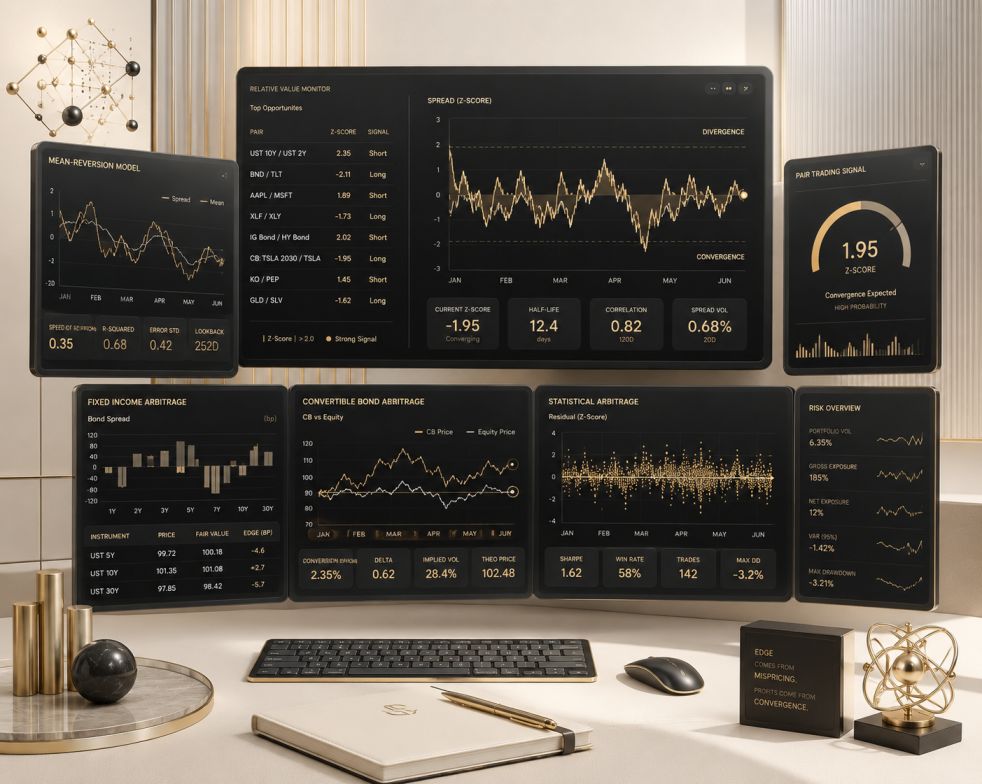
Relative value funds are the quants of the hedge fund world. Rather than making directional bets on markets, they identify mathematical mispricings between related securities and position to profit when those prices converge back to their historical relationship.
The edge here is statistical — not gut-feel. These funds typically run sophisticated models and rely on mean-reversion dynamics. The risk? If the mispricing widens before it converges, you can face severe drawdowns. LTCM's 1998 collapse is the cautionary tale every quant knows well.
Key Sub-Strategies
- Fixed Income Arbitrage: Exploiting price differences between bonds, derivatives, and credit default swaps. Requires enormous leverage to generate meaningful returns from tiny spreads.
- Convertible Bond Arbitrage: Buying convertible bonds and hedging the equity component — capturing the spread between the bond's fair value and its market price.
- Statistical Arbitrage: Using quantitative models to identify pairs or baskets of securities that historically move together, then trading the divergence.
How to Use Hedge Fund Knowledge in Your Forex Trading
Understanding hedge fund classifications isn't just interesting theory — it's a practical tool for better trade decisions. Here's how to apply this knowledge directly to your forex strategy:
Follow the COT Report
The CFTC's Commitment of Traders report shows large speculator positioning in currency futures. These are predominantly macro and equity hedge funds. Extreme positioning often precedes reversals.
Watch Equity Fund Flows
When equity hedge funds rotate into emerging markets, their local currencies tend to strengthen. When they exit, the currency weakens. Capital flow analysis is a powerful currency valuation tool.
Track Central Bank Divergence
Global macro funds build positions based on interest rate divergence. When you identify two central banks on divergent policy paths, you're thinking like a macro fund — and positioning with the smart money.
Monitor Risk-On / Risk-Off Flows
Event-driven and macro funds both influence risk sentiment. When a major corporate event or geopolitical shock hits, watch how safe-haven currencies (JPY, CHF, USD) behave — it reflects fund repositioning in real time.
The Smart Money Advantage
Hedge funds aren't infallible — they blow up, they chase losses, they have redemption pressures. But they do have more information, more capital, and more sophisticated models than the average retail trader. Understanding their strategies doesn't guarantee you'll trade like them. But it does help you avoid getting caught on the wrong side of their moves — and occasionally, to ride alongside them.
Frequently Asked Questions
The most common questions forex traders have about hedge funds, answered clearly.
Trade Smarter.
Think Like the Institutions.
Knowledge is your edge. At fxTsignals, we break down complex market structures, institutional strategies, and high-probability trade setups — so you can navigate the forex markets with confidence.
Join thousands of traders already using our daily signals and educational content to level up their game.