The Top 5 Forex Traders Who Rewrote the Rules of the Market
From betting against the British pound to turning $400 into $200 million — these five legends didn't just trade forex. They changed it forever. Here's what every trader can learn from their journeys.
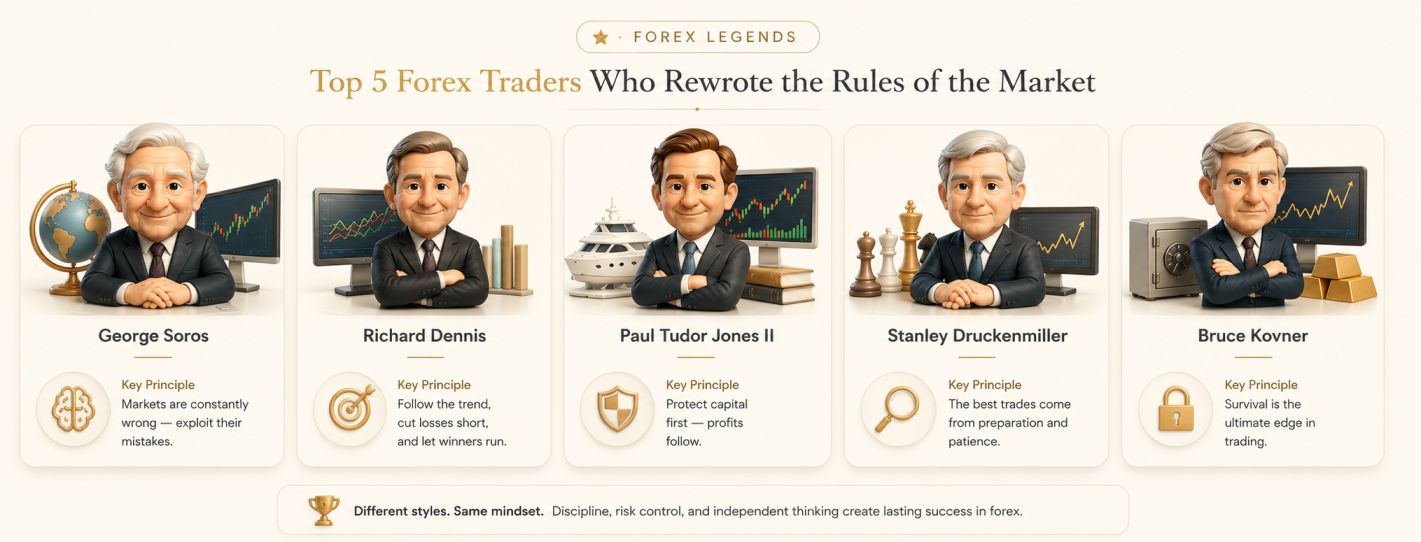
What Separates Great Forex Traders from the Rest?
Most people who enter the forex market leave empty-handed. The statistics are sobering — and yet, a handful of traders have consistently beaten the odds, turned small accounts into empires, and in some cases, moved entire national currencies. What's their secret?
It's not luck. It's not inside information. It's a rare blend of disciplined strategy, psychological toughness, and an almost obsessive understanding of global markets. At fxTsignals.com, we believe every trader — beginner or pro — can extract real, actionable lessons from the careers of these five legends.
So let's meet them. These are the five most successful forex traders in history, and here's exactly what made them extraordinary.
George Soros — The Man Who Broke the Bank of England
Black Wednesday: A $1 Billion Bet
In September 1992, George Soros executed what is arguably the single most famous currency trade in history. He shorted the British pound against the Deutsche mark — and when the UK was forced to withdraw from the European Exchange Rate Mechanism, Soros pocketed over $1 billion in a single day.
But it wasn't recklessness. Soros had spent months analyzing the structural weakness of the pound, studying economic fundamentals, inflation gaps, and the political pressure on the UK government. He understood that the market was mispricing risk — and he bet enormous capital on being right.
Key Lessons from Soros
- Study macroeconomic trends and geopolitical shifts — they drive currency values more than any indicator
- Understand market sentiment: what traders believe is as powerful as what is actually true
- Conviction-based trading — once your research is solid, size your position accordingly
- Know when the risk-reward tilts heavily in your favor, then commit decisively
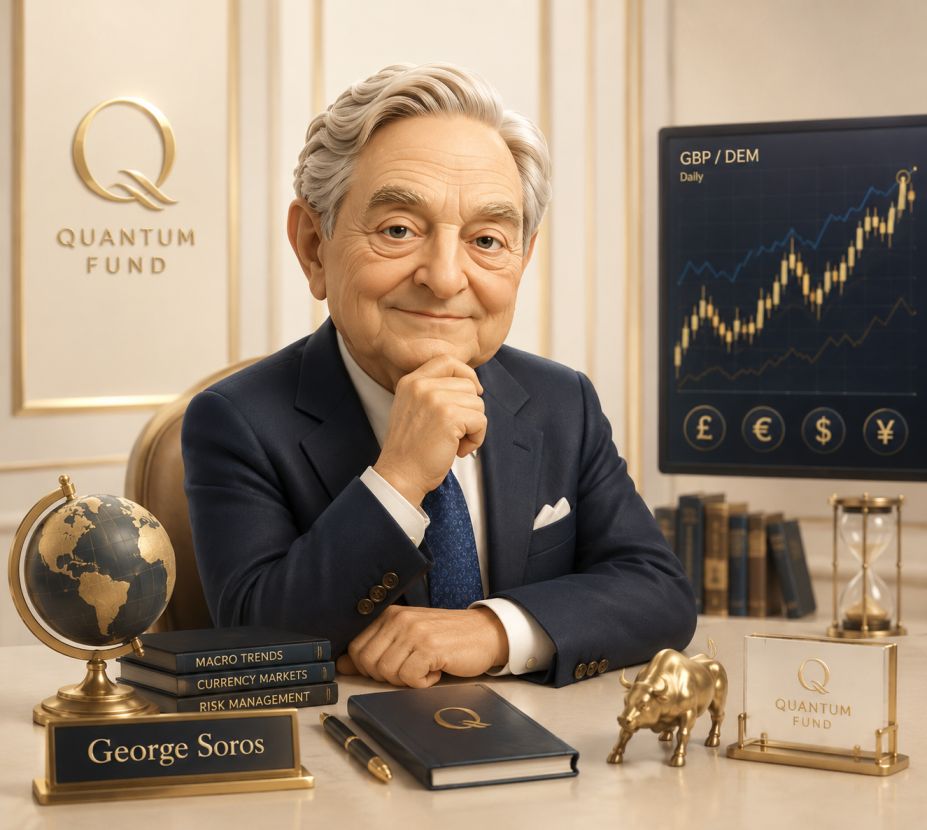
George Soros — Founder of the Quantum Fund
Richard Dennis — Proof That Trading Can Be Taught
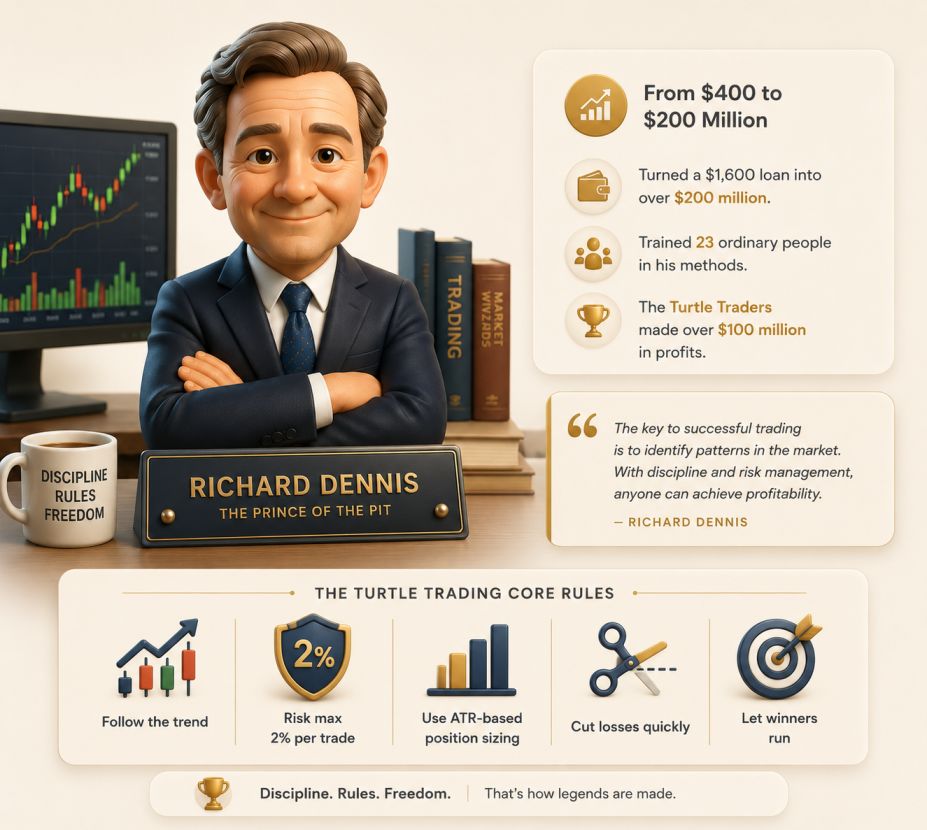
Richard Dennis — The "Prince of the Pit"
From $400 to $200 Million
Richard Dennis started with a borrowed $1,600 — and turned it into over $200 million through systematic, rule-based trading. But his most remarkable contribution to the trading world wasn't his own fortune. It was a famous experiment that changed how we think about trading talent entirely.
In the early 1980s, Dennis made a bet with his partner William Eckhardt: he believed trading skills could be taught to anyone. So he recruited 23 ordinary people — no financial background required — and trained them in his methods for two weeks. The result? Those students, later known as the Turtle Traders, generated over $100 million in profits over the following years.
The Turtle Trading Core Rules
- Follow the trend — enter when price breaks out to a 20-day or 55-day high or low
- Risk no more than 2% of capital on any single trade
- Use volatility-adjusted position sizing (ATR-based)
- Cut losses quickly; let winning trades run as far as possible
- Consistency beats brilliance every time
Paul Tudor Jones II — Seeing the Crash Before It Happened
The 1987 Black Monday Call
On October 19, 1987, global stock markets collapsed in one of the most dramatic single-day crashes in financial history. For most investors, it was catastrophic. For Paul Tudor Jones II, it was a career-defining moment — because he had seen it coming.
Months before the crash, Jones meticulously studied market indicators, investor psychology, and historical parallels from 1929. He built short positions ahead of the collapse and tripled his money while others lost everything. His fund reportedly returned 200% in a single year.
Risk Management — Jones Style
- Never risk more on any trade than what you can psychologically afford to lose
- Place stop-losses before entering any position — not after
- Monitor macro signals: interest rates, volume anomalies, cross-market divergence
- The mental game is 50% of success — manage your emotions as tightly as your trades
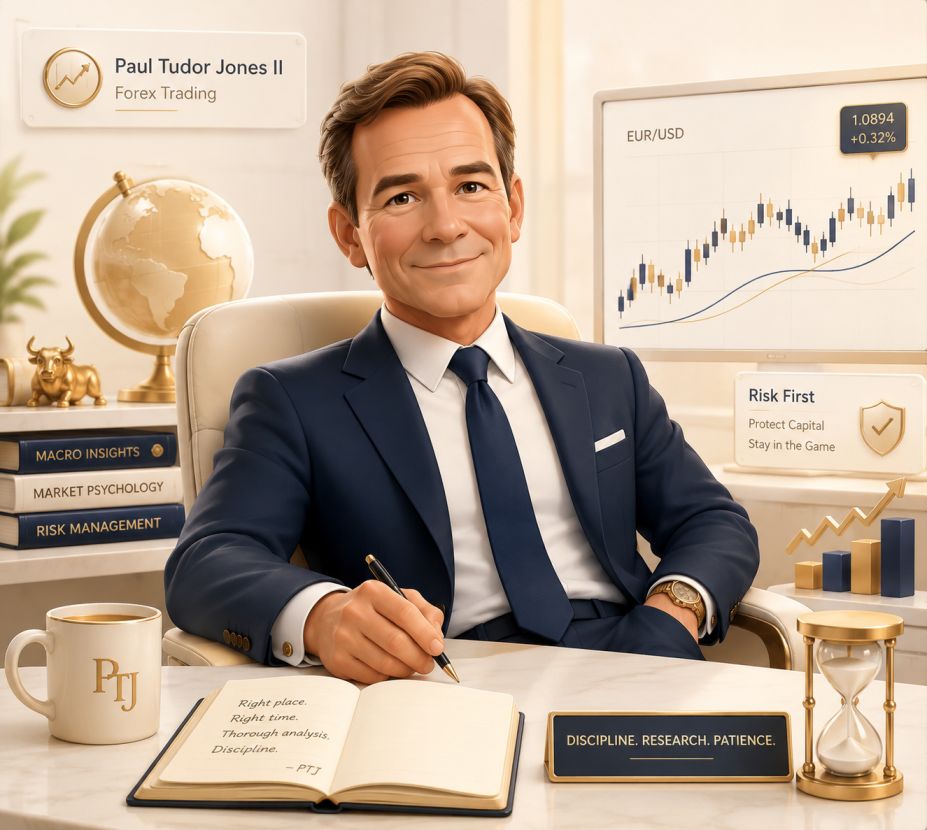
Paul Tudor Jones II — Tudor Investment Corp
Stanley Druckenmiller — The Art of Reading the Economy
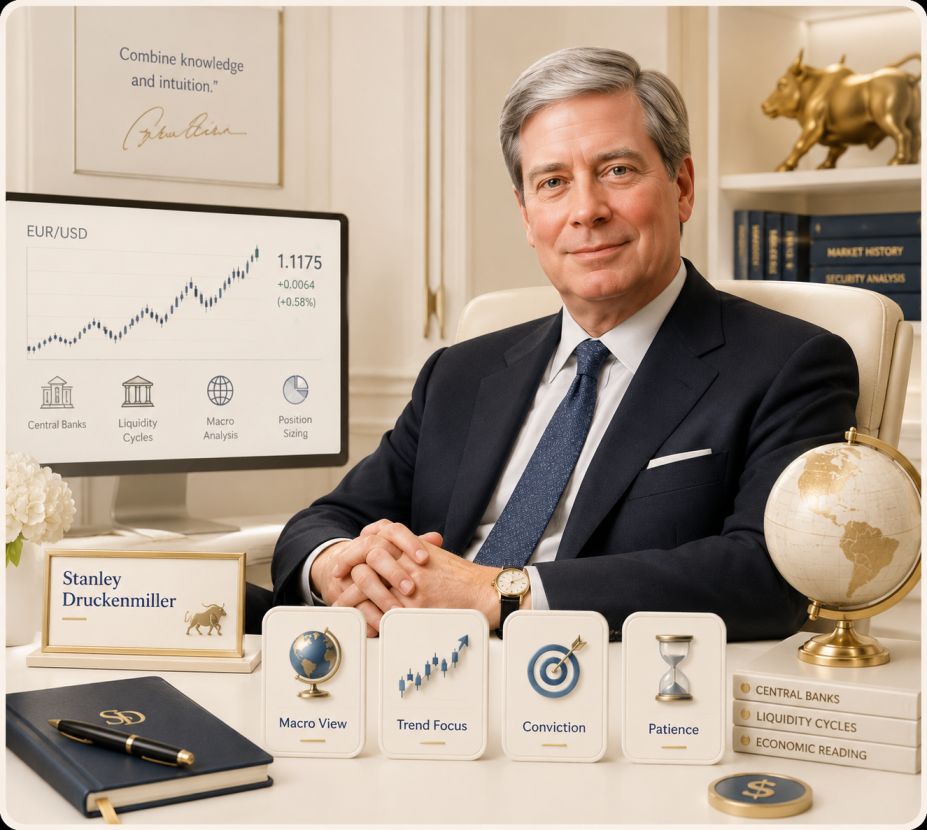
Stanley Druckenmiller — Duquesne Capital
The Soros Partnership
While George Soros often takes the spotlight for the pound trade, it was Stanley Druckenmiller who actually conceived and proposed the trade first. As the lead portfolio manager at the Quantum Fund under Soros, Druckenmiller identified the opportunity — and Soros encouraged him to scale up the position far beyond initial plans.
This collaboration reflects one of Druckenmiller's greatest strengths: his ability to combine precision economic analysis with bold, high-conviction execution. He is widely regarded as one of the most consistently successful macro traders ever to operate, with an average annual return of roughly 30% over three decades.
Druckenmiller's Core Framework
- Read central bank liquidity cycles — they drive nearly every major market move
- Identify the dominant trend, then concentrate capital — don't over-diversify
- Be willing to sit in cash for extended periods when opportunities aren't clear
- Know when to be aggressive; do not nibble when conviction is high
Bruce Kovner — The Self-Made Billionaire Trader
An Unlikely Beginning
Before Bruce Kovner became one of the most respected names in global macro trading, he was driving taxis in New York City. He had no finance degree, no trading mentors, and almost no capital. What he had was an extraordinary curiosity, self-discipline, and a relentless drive to understand how markets work at a fundamental level.
Kovner taught himself trading by reading everything he could find — economic theory, market history, central banking policy. He started with a borrowed $3,000, turned it into $45,000 (and briefly back down to $23,000, a lesson in risk he never forgot), then built Caxton Associates into one of the largest and most consistently profitable hedge funds on the planet.
Kovner's Practical Trading Principles
- Combine technical chart analysis with deep fundamental research — neither alone is enough
- Define your risk before entering any trade. Know your exit before your entry
- Visualize what happens if the market moves against you — be prepared emotionally
- Never let early losses spiral — discipline in drawdowns protects the account to trade another day
- Self-education compounds over time, just like capital
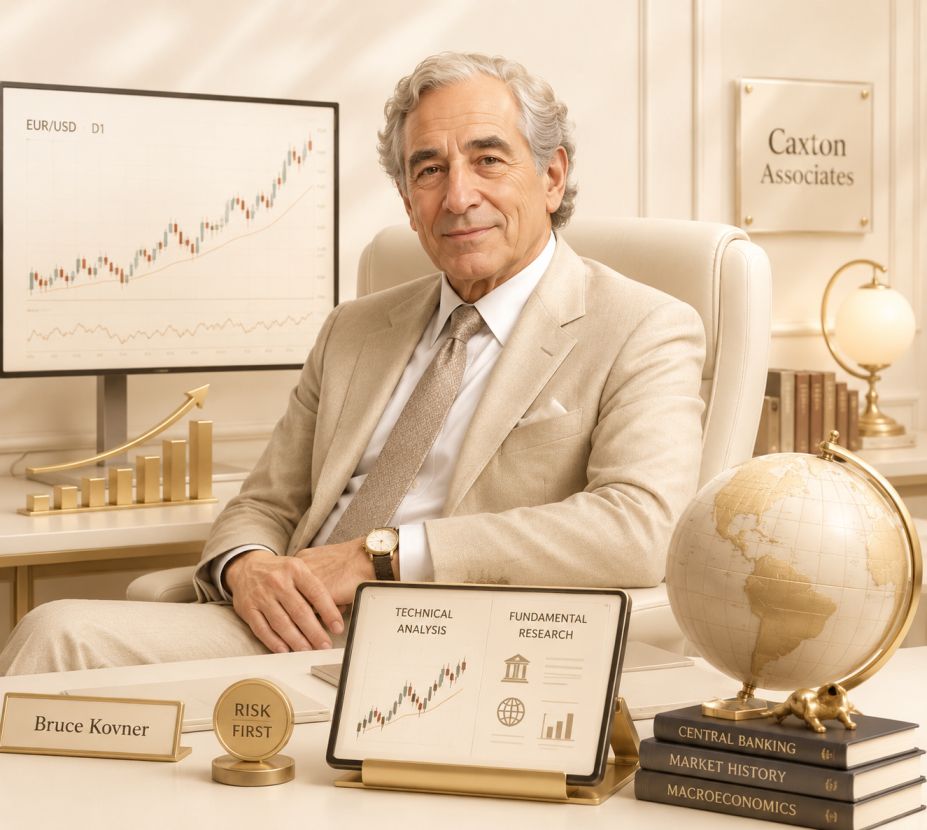
Bruce Kovner — Founder of Caxton Associates
What Every Great Forex Trader Has in Common
Five very different personalities, backgrounds, and strategies — and yet, when you study all of them together, clear patterns emerge. These aren't tips from a random blog post. These are principles extracted from careers spanning decades and billions in verified returns.
- They all prioritized capital preservation. Every single one of these traders spoke about risk management as their highest priority — not returns.
- They had a defined, repeatable process. Whether it was Dennis's Turtle Rules or Kovner's technical-fundamental blend, they didn't trade on gut feeling alone.
- They studied history obsessively. From Druckenmiller's macro cycles to Jones's 1929 parallels, they all understood that markets rhyme.
- They embraced failure as data. Each one suffered major losses at some point — and treated those losses as tuition, not disasters.
- They never stopped learning. The forex market is not a fixed puzzle. It evolves, and so did they.
Frequently Asked Questions
Got questions about forex trading and these legendary traders? Here are the answers most traders are searching for.
The Journey to Forex Mastery Starts Here
George Soros didn't break the Bank of England on a whim. Richard Dennis didn't build $200 million by luck. Paul Tudor Jones didn't predict Black Monday by accident. Stanley Druckenmiller didn't deliver 30 years of superior returns by feeling his way through. And Bruce Kovner didn't go from taxi driver to billionaire without an enormous amount of purposeful study, discipline, and resilience.
What connects them is a mindset — one that treats trading as a serious, learnable craft, not a casino. They respected the market, respected risk, and respected the process far more than they chased profits.
You don't need to be a genius to succeed at forex. You need a system, the discipline to follow it, and the humility to keep learning. That's the real secret the legends share — and it's available to every trader willing to do the work.
The journey to success in forex trading begins with a single step. Embrace the challenge, learn from the greats, and let your passion drive you towards greatness.
Ready to Trade Like the Legends?
Join thousands of traders at fxTsignals.com — where professional-grade forex signals, market analysis, and trading education meet. Stop guessing. Start trading with clarity.
Hedge Fund Copy Trading