Hedge Fund Strategies Every Forex Trader Must Understand
Unlock the same powerful investment frameworks that elite hedge funds use — and discover how to apply them to your forex trading journey.

The global financial markets never sleep — and neither do the minds behind some of the world's most powerful investment vehicles: hedge funds. Whether you're an active retail forex trader or a seasoned institutional player, understanding how hedge funds operate can completely transform the way you read markets, manage risk, and spot high-probability trades.
In this guide, we break down the four cornerstone hedge fund strategies — Long/Short Equity, Global Macro, Event-Driven, and Relative Value — in plain English. No jargon overload. No walls of text. Just clean, actionable insights you can actually use.
At fxTsignals.com, we believe knowledge is as important as the signal itself. The more you understand about the big players moving these markets, the sharper your trading edge becomes.
Long/Short Equity: The Art of Balancing Risk and Reward
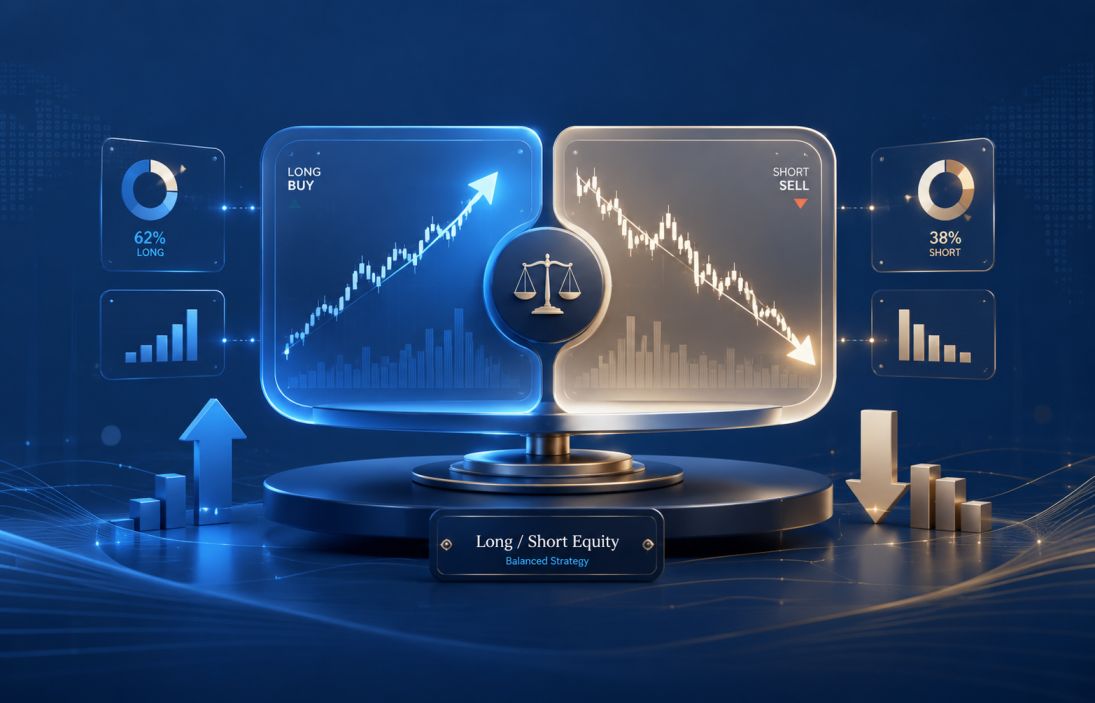
This is the bread and butter of the hedge fund world. Long/short equity is elegant in its simplicity: buy what you think will go up, sell short what you think will fall. The real skill is in doing both simultaneously with discipline and precision.
For forex traders, this translates directly into paired currency trades. When you go long on EUR/USD and simultaneously hedge with a short on GBP/USD, you're essentially running a crude version of this strategy. The hedge fund version is just far more sophisticated and data-driven.
How It Works in Practice
Imagine a hedge fund analyst who spots a tech company with strong earnings momentum. She takes a long position in that stock. At the same time, she identifies a competitor burning through cash reserves with weak guidance — and shorts it. If the market moves broadly upward, her long position gains. If it crashes, her short position cushions the blow. This is market-neutral magic.
💡 Forex Trader Takeaway
Apply this logic to your currency pairs. When the USD shows macro weakness but the JPY shows safe-haven strength, a short USD/JPY trade is essentially a long/short equity move — translated into FX. This pairs well with our signal alerts at fxTsignals.com.
Key Advantages
- Reduces overall market exposure by balancing directional risk
- Profits in both bull and bear markets with the right pair selection
- Focuses on relative performance rather than absolute market direction
- Allows capital efficiency through leveraged short positions
Global Macro: Reading the World's Financial Pulse
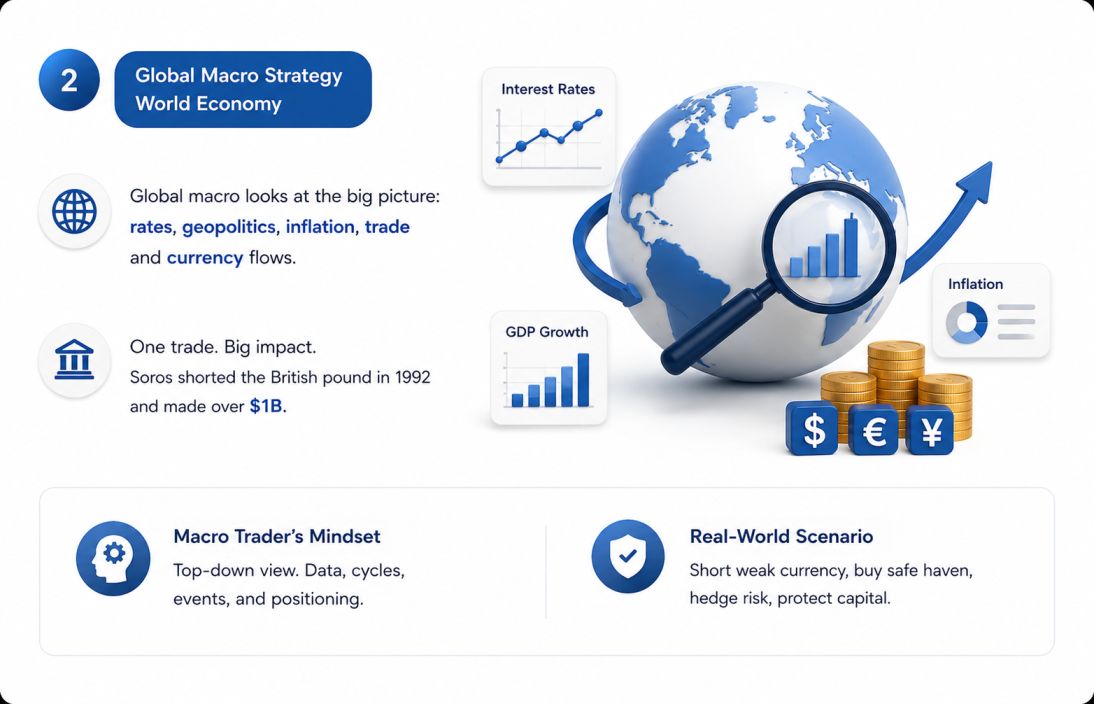
If long/short equity is a scalpel, global macro is a wrecking ball — and the most relevant strategy for forex traders by far. Global macro funds analyze the big picture: interest rate cycles, geopolitical events, inflation data, trade balances, and currency flows. They position across multiple asset classes including forex, commodities, fixed income, and equities.
Think of the legendary George Soros breaking the Bank of England in 1992 by shorting the British pound. That was global macro at its finest — a single trade worth over $1 billion in profit by reading macroeconomic conditions better than the market.
The Macro Trader's Mental Model
A macro hedge fund manager doesn't just look at a price chart. She looks at GDP growth differentials, central bank meeting minutes, political election cycles, commodity supply chains, and even satellite images of oil storage tanks. It's a top-down, big-picture approach to positioning capital.
📊 Real-World Scenario
A fund manager anticipates a recession in a country with high debt levels and political instability. She shorts that country's currency, buys gold as a safe-haven hedge, and reduces equity exposure in that region. If the macro thesis plays out, the returns can be extraordinary — and the losses are managed because the gold position offsets equity downside.
What Forex Traders Can Learn From This
- Follow central bank rate decisions — they move currencies more than any technical signal
- Monitor inflation differentials between two currency nations before trading a pair
- Watch commodity prices (oil, gold) as leading indicators for commodity currencies like CAD and AUD
- Track geopolitical risk premiums — tensions spike safe-haven demand for USD, CHF, and JPY
- Use economic calendars as your macro trading blueprint, not an afterthought
Event-Driven Strategy: Capitalizing on Corporate Catalysts

Markets are efficient — most of the time. But when a major corporate event hits — a merger, an unexpected bankruptcy, a regulatory decision — markets temporarily lose their composure. Event-driven hedge funds exist to step into that chaos and profit from the mispricing.
This strategy revolves around monitoring corporate actions like mergers and acquisitions (M&A), earnings surprises, dividend announcements, leadership changes, or even whistleblower revelations. The edge comes from deeper research and faster reaction than the average market participant.
The Merger Arbitrage Play
When Company A announces it's acquiring Company B at a 20% premium, Company B's stock immediately jumps — but usually not all the way to the offer price. Why? Because the market prices in the risk that the deal could fall apart. A hedge fund that's done deep due diligence on deal completion probability can buy the gap and profit when the merger closes.
🎯 How Forex Traders Apply This
Event-driven thinking in forex means paying attention to central bank policy announcements, NFP releases, CPI prints, and political election outcomes. A surprise rate hike is an "event." An unexpected inflation spike is an "event." Position yourself before the event with a defined risk plan — just like a hedge fund does.
- Trade the expectation, not just the outcome — positioning before major events is where the edge lives
- Use options or tight stop-loss orders to cap downside on event-based plays
- Study historical price reactions to similar events to calibrate your risk/reward
- Don't overtrade events — quality event selection beats quantity every time
Relative Value: Profiting From Price Discrepancies
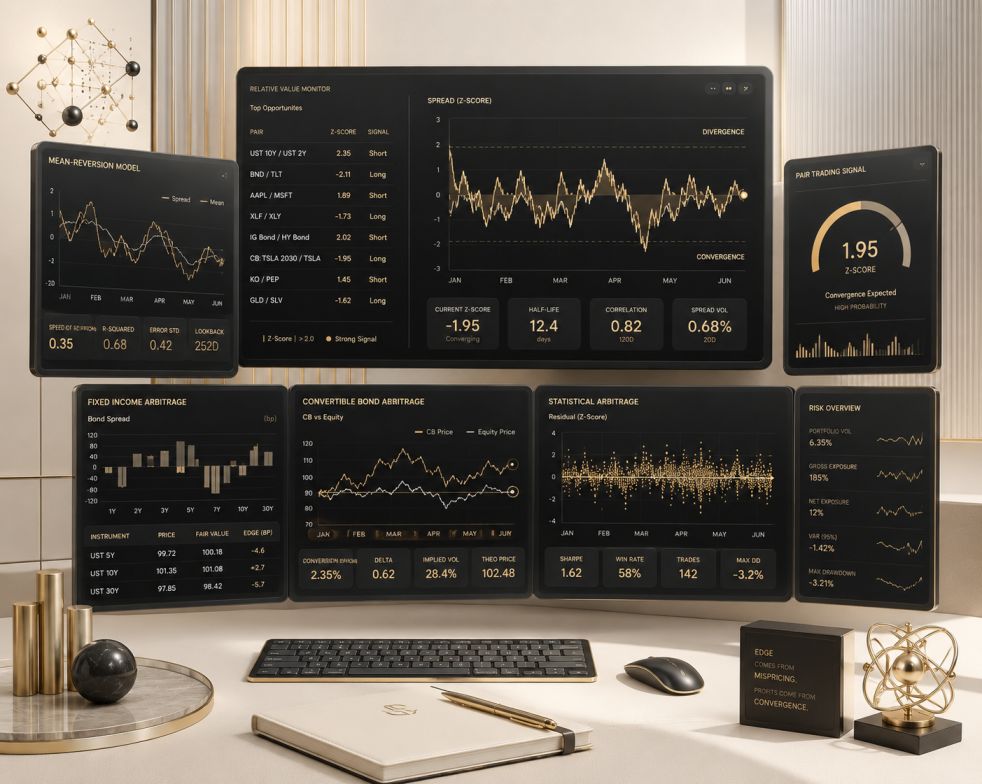
Markets are not perfectly efficient. Sometimes, two assets that should be priced similarly diverge — temporarily. Relative value funds exist to identify these gaps and position themselves to profit when prices converge back to their historical relationship.
This strategy is sometimes called "pairs trading" in retail circles. The logic is simple: if two highly correlated assets diverge in price due to a short-term anomaly, buy the underpriced one and short the overpriced one. Profit when they re-align.
Currency Correlation Plays in Forex
AUD/USD and NZD/USD typically move together because both currencies are commodity-linked and positively correlated with global risk appetite. When one pair suddenly diverges from the other — perhaps due to a single central bank statement — a relative value trader will step in.
⚡ Actionable Tip
Study the correlation matrix of major pairs. When EUR/USD and GBP/USD diverge significantly from their historical correlation (usually 0.80+), there's a relative value trade available. Go long the lagging pair, short the outperformer — and ride the convergence.
- Use a correlation heatmap to find unusually diverged pairs in real time
- Set entries at 2-standard-deviation divergence and targets at mean reversion
- Risk is that divergence can persist — always use stops on both legs
- Combine with macro context: don't fade a divergence driven by structural change
How to Blend These Strategies Like a Pro
The best hedge funds don't rely on a single strategy. They combine approaches based on current market conditions. A volatile, macro-driven environment might call for global macro positioning with event-driven overlays. A stable, range-bound market is perfect for relative value trades.
As a forex trader, think of each strategy as a tool in your kit. Your job is to identify which market environment you're in — trending, ranging, event-volatile — and deploy the right tool accordingly.
Your 4-Step Framework
- Step 1 — Macro scan: Identify the dominant economic narrative driving your target currency pairs this week
- Step 2 — Event calendar: Mark all high-impact events and pre-plan your trade setup for each
- Step 3 — Correlation check: Run a relative value check — are any correlated pairs unusually diverged?
- Step 4 — Position sizing: Apply long/short logic — size your positions based on conviction and hedge where appropriate
Frequently Asked Questions
The Global Macro strategy is the most directly applicable to forex trading. It focuses on macroeconomic factors like interest rates, inflation, and geopolitical events — the same forces that drive currency movements. Understanding how macro funds think gives you a huge edge in predicting major currency trends before they develop.
Absolutely. While retail traders can't replicate hedge funds at full scale, the underlying principles — pair selection, macro analysis, event positioning, and relative value identification — are fully accessible. The key is to simplify the framework and apply it with disciplined risk management. Platforms like fxTsignals.com help bridge this gap with professional-grade signals.
Global macro is top-down — it starts with big-picture economic analysis and works down to specific trades. Event-driven is more specific — it identifies particular corporate or geopolitical events as the catalyst for a trade. In forex, global macro might mean trading a rate cycle thesis over weeks; event-driven might mean positioning ahead of a central bank announcement with a defined entry and exit.
Hedge funds manage risk through diversification across strategies, strict position sizing rules, hedging with options and derivatives, and often maintaining a cash buffer. They also use systematic risk limits — if a trade moves against them by a defined amount, they cut it. Retail traders can adopt the same discipline: never risk more than 1-2% of capital per trade and always define your exit before entry.
fxTsignals.com provides professional-grade forex signals built on macro and technical confluence analysis — the same kind of multi-layered thinking that institutional traders use. Our community channels on Telegram, Discord, and WhatsApp deliver real-time signals with clear entry, stop, and target levels so you can trade smarter, not harder.
The Smart Trader Studies the Smart Money
Hedge funds didn't become trillion-dollar powerhouses by accident. Their strategies — long/short equity, global macro, event-driven, and relative value — are battle-tested frameworks refined over decades by some of the smartest minds in finance.
As a forex trader, your edge lies not in trading harder, but in thinking at a higher level. When you understand why currencies move — not just that they do — you stop reacting and start anticipating. That mental shift is the difference between consistently profitable traders and everyone else.
At fxTsignals.com, we translate institutional-grade market intelligence into clear, actionable forex signals. Whether you're just starting out or scaling your trading operation, our community is built to give you the insights and tools that the big players use — without the hedge fund price tag.
Start Trading With Institutional Intelligence
Join thousands of forex traders who trust fxTsignals.com for professional signals, education, and real-time market analysis — delivered directly to your phone.
No spam. No fluff. Just premium signals — Telegram · Discord · WhatsApp