<!--
════════════════════════════════════════════════════════════════════════
FXT SIGNALS — ULTRA PREMIUM HEADER v10.5.1 "SOVEREIGN OBSIDIAN"
Elementor HTML Widget
v10.5.1 vs v10.5.0 — SHIMMER REMOVAL + DROPDOWN HOVER RESTORED
─────────────────────────────────────────────────────────────────────
CHANGES:
1. FXT wordmark shimmer — removed. Static gold gradient only.
2. CTA button shimmer — removed. Static gold gradient only.
3. Dropdown link hover — restored original drop-shadow() glow.
(Hover-only filter is safe — fires once on mouseenter, not idle.)
SCROLL BEHAVIOUR: Identical to v10.4.3
— Show only when scrollY < SCROLL_HIDE_PX (80px).
— Hide on scroll past threshold, stay hidden until top.
— No scroll-up reveal.
─────────────────────────────────────────────────────────────────────
EDIT HINTS
─────────────────────────────────────────────────────────────────────
SCROLL HIDE THRESHOLD : var SCROLL_HIDE_PX = 80;
LOGO TEXT : .B-wm-fxt "FXT"
LOGO SUB TEXT : .B-wm-sig "Signals"
TAGLINE : .B-wm-sub "Trade Like A Big Boy"
CTA LINK : href on .B-cta / .B-mob-cta
CTA TEXT : "Join Community"
NAV ITEMS :
inside .B-nav
MOBILE NAV :
Who Are the Big Boys in Forex Trading? | fxTsignals.com
fxTsignals.com — Forex Education
Who Are the Big Boys of Forex Trading —
And Why Every Trader Needs to Know
The forex market doesn't move by accident. Behind every sharp spike and quiet consolidation zone, institutional giants are placing their bets. Understanding who these players are — and how they think — could be the single most important edge you ever develop.
$7.5TDaily Forex Market Volume
73%Volume Driven by Institutional Players
180+Currency Pairs Actively Traded
The Forex Market Has a Hidden Power Structure
If you've ever placed a trade that seemed perfectly set up — clean breakout, strong momentum, clear pattern — only to watch it reverse sharply the moment you entered, you weren't imagining things. You were likely caught in the wake of what professional traders call the "Big Boy" effect.
In forex trading, "Big Boys" is the industry's informal term for the institutional titans who control the majority of market flow. These aren't day traders glued to laptops. They're central banks, multinational hedge funds, prime brokerage desks, and commercial banking giants whose single trade orders can be worth billions of dollars.
Retail traders account for a small fraction of total forex volume. The overwhelming majority belongs to these institutional behemoths. Understanding their behavior, their entry zones, and their manipulation tactics isn't just useful — it's essential for surviving in today's forex landscape.
"The forex market is the most liquid financial market on earth, but liquidity doesn't mean fairness. Big institutional players shape price action — and smart retail traders learn to follow, not fight, that current."
The Main Players: Who Exactly Are the Big Boys?
Before you can trade with — or around — the Big Boys, you need to know who they are. Each player type has a different motive, timeline, and method of operating in the market.
1. Central Banks: The Ultimate Market Movers
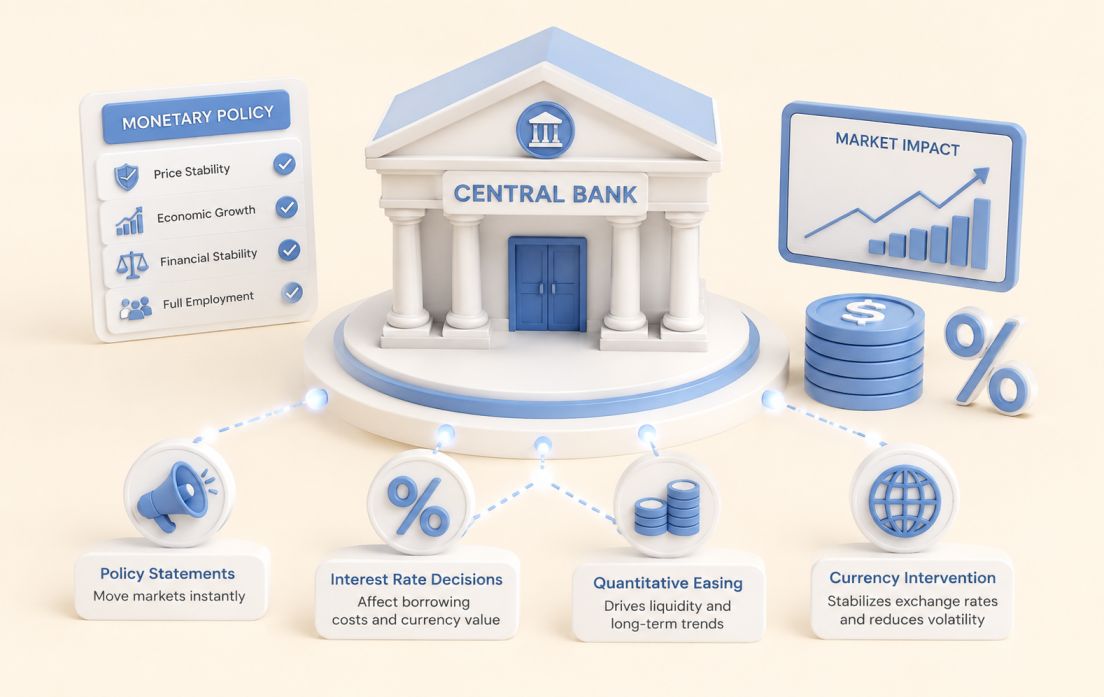
No entity in the forex market wields more raw power than central banks. The U.S. Federal Reserve, European Central Bank (ECB), Bank of Japan (BoJ), and their counterparts globally can move entire currency pairs by simply issuing a statement — let alone actually intervening in the market.
Central banks manage monetary policy, set interest rates, and at times directly buy or sell their own currency to stabilize exchange rates. When the BoJ decides it wants a weaker yen to boost exports, it doesn't ask permission. It acts — and the market follows. These interventions can produce 200–300 pip moves within minutes.
Monetary policy statements and rate decisions move markets instantly
Direct currency intervention can reverse months of price action in hours
Forward guidance shapes trader expectations even before any action is taken
2. Hedge Funds: The High-Stakes Speculators
Hedge funds are investment vehicles that pool enormous capital from ultra-high-net-worth individuals and institutional investors. The largest hedge funds — think Bridgewater Associates or Renaissance Technologies — manage hundreds of billions of dollars and actively speculate in forex markets.
Unlike central banks, hedge funds are primarily motivated by profit. They employ teams of economists, quantitative analysts, and algorithmic systems to identify and capitalize on currency mispricings. When a hedge fund takes a multi-billion dollar position, it leaves a mark on the market — visible in unusual volume spikes and order flow patterns that savvy traders learn to read.
3. Commercial Banks: The Market's Engine Room
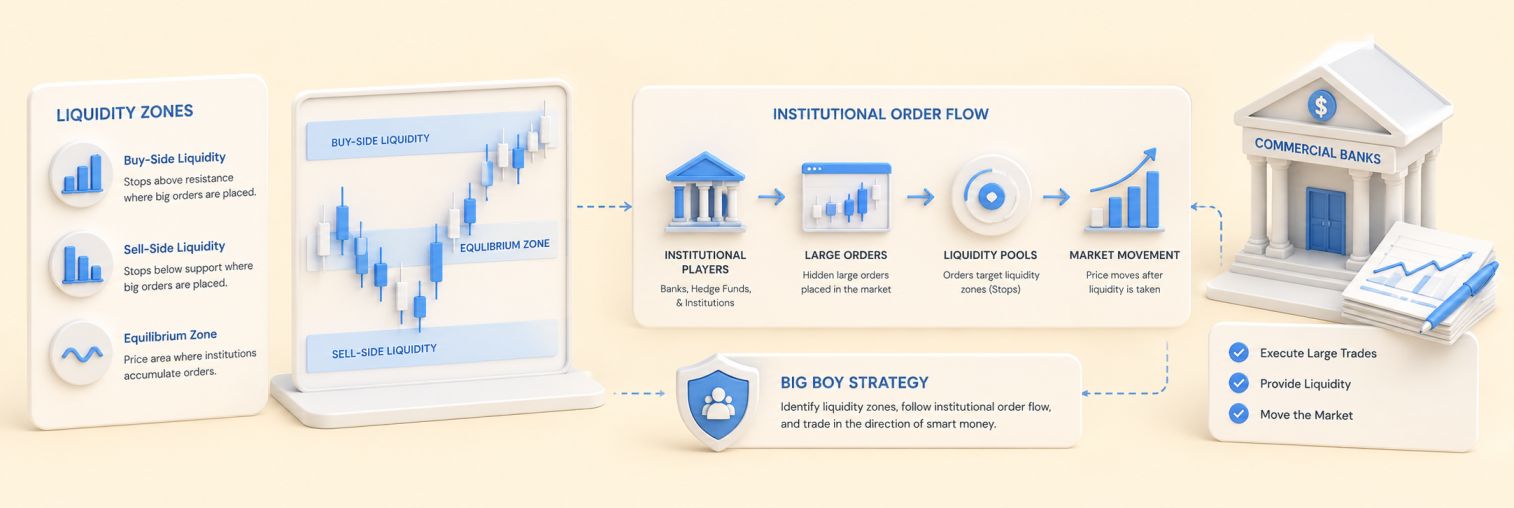
Large commercial banks like JPMorgan Chase, Deutsche Bank, and Citibank serve dual roles in forex markets. They trade on their own account for profit, and they facilitate currency transactions for corporations, governments, and smaller financial institutions. Their privileged access to order flow data gives them an informational advantage that retail traders simply cannot replicate.
How Big Boys Move the Market: Strategies You Must Understand
The Big Boys don't just show up and click buy or sell like the rest of us. They operate with surgical precision — using strategies designed to accumulate or distribute massive positions without tipping their hand to the wider market.
Speculative Trading at Scale
When institutional players speculate, they analyze both technical and fundamental factors — but at a much deeper level than most retail traders. They may spend weeks building a position, entering incrementally across multiple sessions to avoid moving the market against themselves.
This is why you'll often see prices consolidate in a range for extended periods, then break sharply in one direction. The consolidation phase is typically the accumulation phase — the Big Boys quietly loading up before pushing price with authority.
The Carry Trade: Borrowing at Scale
One of the most powerful tools in the institutional playbook is the carry trade. This strategy involves borrowing a currency with a low interest rate — historically the Japanese yen or Swiss franc — and investing those funds in a currency offering a higher yield, such as the Australian or New Zealand dollar.
For a retail trader, a carry trade might generate modest swap income. For a hedge fund managing $50 billion, the same differential generates enormous daily returns. When carry trade positions are unwound — as they often are during risk-off events — entire currency pairs can move hundreds of pips in a single session.
Interest rate differentials between currencies drive massive carry trade flows
Watch for yen and franc strength during periods of global risk aversion
Carry trade buildup creates slow persistent trends — while reversals are violent and fast
Market Manipulation: Stop Hunts and Liquidity Grabs
Institutional players sometimes engineer short-term price moves specifically to trigger retail stop losses. By pushing price briefly below a well-known support level, they trigger a cascade of stop orders — generating the liquidity they need to fill their own massive buy orders at better prices.
This is known as a liquidity grab or stop hunt, and it's one of the most consistent patterns in forex price action. Once you recognize it, you'll see it happening on almost every major currency pair, almost every week.
"If your stop is sitting right at the obvious support level that every trader in the world can see — it's not a stop, it's a target. The Big Boys know exactly where retail traders place their stops, and they use that knowledge deliberately."
What This Means for You: Practical Implications for Forex Traders
Understanding the Big Boys is genuinely useful — but only if it changes how you trade. Here's how to apply this knowledge in practical, actionable terms starting from your very next trade.
Trade With the Trend, Not Against It
Never fight a trend backed by institutional conviction. If central bank policy, strong fundamentals, and technical momentum all align in one direction, that's likely where Big Boy money is flowing. Align with it — not against it.
Avoid the Most Obvious Trade Setups
If a trade looks too obvious — price at a clean round number, perfect double top, textbook head and shoulders — ask yourself: is this so obvious that institutional players will use it against me? Consider placing your entry slightly beyond the obvious level, and your stop in a less predictable location.
Use Volatility to Your Advantage
Monitor high-impact economic events on a forex calendar — these are when institutional moves are most visible
Look for false breakouts followed by sharp reversals — a classic Big Boy signature
Use larger stop losses during high-volatility periods to avoid being hunted out of good trades
Consider trading the Asian session for calmer, more technical price action before London institutions enter
Watch for volume anomalies in currency pairs — unusual spikes often precede major directional moves
Risk Management Is Non-Negotiable
Given that institutional players can move markets dramatically and often without warning, robust risk management isn't optional — it's the foundation of your trading career. Never risk more than 1–2% of your trading capital on any single trade, and always respect the fact that even the best setups can be overridden by institutional intervention.
How to Follow Smart Money: Actionable Tips for Retail Traders
You don't need to work at a hedge fund to think like one. Here are concrete techniques used by professional-minded retail traders to identify and align with institutional activity.
Monitor the COT Report: The Commitment of Traders report, published weekly by the CFTC, shows how large commercial and speculative traders are positioned in forex futures — a valuable proxy for institutional sentiment
Follow central bank communications: Don't just trade the rate decision — read the statement, study the press conference, and track changes in language between meetings
Identify key liquidity zones: These are price levels where large numbers of stop orders cluster, making them attractive targets for institutional order filling
Study order flow concepts: Terms like "imbalance," "order block," and "fair value gap" come from the Smart Money Concept (SMC) framework, built around how institutional players leave footprints in price action
Watch intermarket relationships: Gold, bonds, and equities often provide early signals about where institutional money is flowing and which currencies will benefit
Use fxTsignals.com for curated institutional-grade analysis: Our team monitors Big Boy activity across all major pairs daily — so you don't have to do it alone
"The goal isn't to outthink the Big Boys — it's to read their footprints clearly enough that you can walk in the same direction before the crowd catches on."
Frequently Asked Questions About Big Boys in Forex
Still have questions? Here are the most common things traders ask about institutional players and how to trade alongside them.
Who exactly qualifies as a "Big Boy" in forex trading?
+
The term "Big Boy" refers to any institutional participant with enough capital to meaningfully impact currency prices. This includes central banks, large hedge funds, major commercial banks, multinational corporations managing currency exposure, and sovereign wealth funds. These entities typically trade in lot sizes millions of times larger than the average retail trader, which gives them the ability to push prices in their desired direction.
Can retail traders realistically profit by following institutional activity?
+
Absolutely — and many professional retail traders build entire strategies around this concept. Approaches like Smart Money Concepts (SMC) and Inner Circle Trader (ICT) methodology are specifically designed to help retail traders identify institutional footprints in price action. By learning to recognize order blocks, liquidity grabs, and fair value gaps, retail traders can align their entries with the direction institutional money is flowing, dramatically improving their risk-to-reward ratios.
How do I know when a Big Boy move is happening in real time?
+
There are several real-time signals to watch. Unusual volume spikes on a currency pair (especially during off-peak hours) often indicate institutional activity. Sudden, sharp price moves that reverse key technical levels before continuing — known as liquidity grabs — are a strong institutional signal. Major economic data releases and central bank communications are scheduled events when institutional positioning is especially visible. Platforms that show DOM (Depth of Market) or Level 2 data can also reveal unusually large order clusters.
Are stop hunts and liquidity grabs really done deliberately by big institutions?
+
While it's difficult to prove intent on a case-by-case basis, price behavior patterns consistent with stop hunting are well-documented and consistently observable across major currency pairs. Institutional traders need liquidity — retail stop orders provide that liquidity. Whether this constitutes "deliberate" manipulation or is simply an emergent result of how large orders interact with market structure is a matter of perspective, but the practical trading implication is the same: don't put your stop at the most obvious level on the chart.
What tools or resources help retail traders track institutional forex activity?
+
Several reliable resources help retail traders stay connected to institutional flows. The CFTC's weekly COT (Commitment of Traders) report provides futures positioning data from large commercial and speculative traders. Central bank websites and meeting calendars (Fed, ECB, BoJ, BoE) are essential reading. Economic calendars from reputable providers flag high-impact data releases. And following platforms like fxTsignals.com, which curate and interpret institutional-grade analysis for retail audiences, can save significant research time.