<!--
════════════════════════════════════════════════════════════════════════
FXT SIGNALS — ULTRA PREMIUM HEADER v10.5.1 "SOVEREIGN OBSIDIAN"
Elementor HTML Widget
v10.5.1 vs v10.5.0 — SHIMMER REMOVAL + DROPDOWN HOVER RESTORED
─────────────────────────────────────────────────────────────────────
CHANGES:
1. FXT wordmark shimmer — removed. Static gold gradient only.
2. CTA button shimmer — removed. Static gold gradient only.
3. Dropdown link hover — restored original drop-shadow() glow.
(Hover-only filter is safe — fires once on mouseenter, not idle.)
SCROLL BEHAVIOUR: Identical to v10.4.3
— Show only when scrollY < SCROLL_HIDE_PX (80px).
— Hide on scroll past threshold, stay hidden until top.
— No scroll-up reveal.
─────────────────────────────────────────────────────────────────────
EDIT HINTS
─────────────────────────────────────────────────────────────────────
SCROLL HIDE THRESHOLD : var SCROLL_HIDE_PX = 80;
LOGO TEXT : .B-wm-fxt "FXT"
LOGO SUB TEXT : .B-wm-sig "Signals"
TAGLINE : .B-wm-sub "Trade Like A Big Boy"
CTA LINK : href on .B-cta / .B-mob-cta
CTA TEXT : "Join Community"
NAV ITEMS :
inside .B-nav
MOBILE NAV :
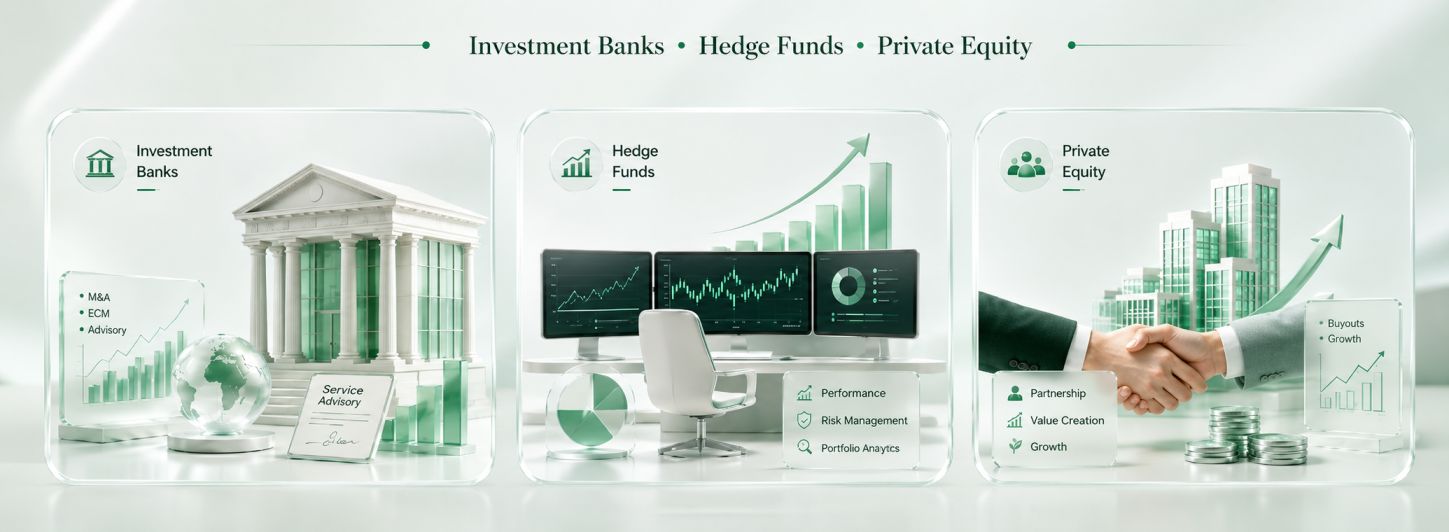
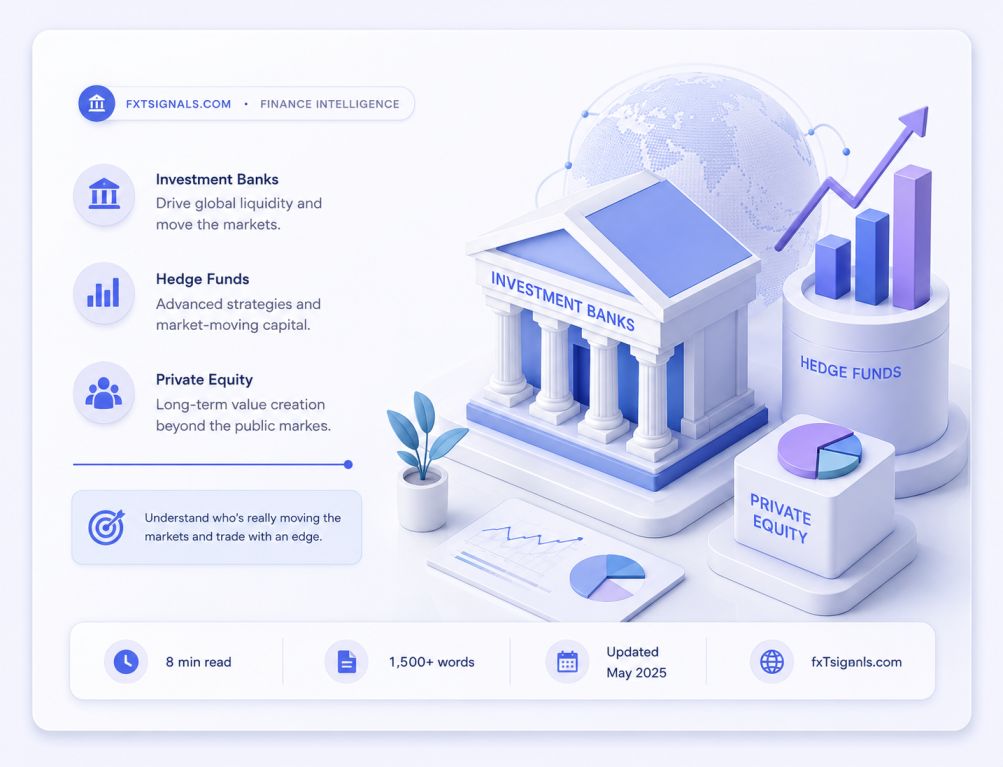
Investment Banks, Hedge Funds & Private Equity: What Every Forex Trader Must Know | fxTsignals
Before placing your next trade, understand who's really moving the markets.
From Wall Street's most powerful institutions to secretive private equity giants —
this guide breaks it all down in plain, actionable language.
Why Every Forex Trader Should Understand These Financial Giants
If you're trading forex — whether you're scalping the EUR/USD at 2am or swing trading commodity currencies — the moves you see on your charts are not random. Behind every major market shift are the colossal institutions that manage trillions of dollars: investment banks, hedge funds, and private equity firms. Understanding how they operate isn't just academic knowledge. It is a strategic edge.
Think of it this way: when Goldman Sachs's trading desk makes a significant currency bet, or when a major hedge fund unwinds a massive position in risk assets, the ripple effects cascade through every forex pair you trade. The liquidity, the spreads, the sudden volatility spikes — these are their fingerprints. Knowing whose hand is on the wheel changes how you read the market entirely.
This guide was built for traders on fxTsignals.com who want more than just signal alerts. It's for those who want to understand the WHY behind price action. Let's strip away the jargon and get to what really matters.
Chapter 1
What Are Investment Banks — And How Do They Move Forex Markets?
From Bond Issuance to Global Currency Desks
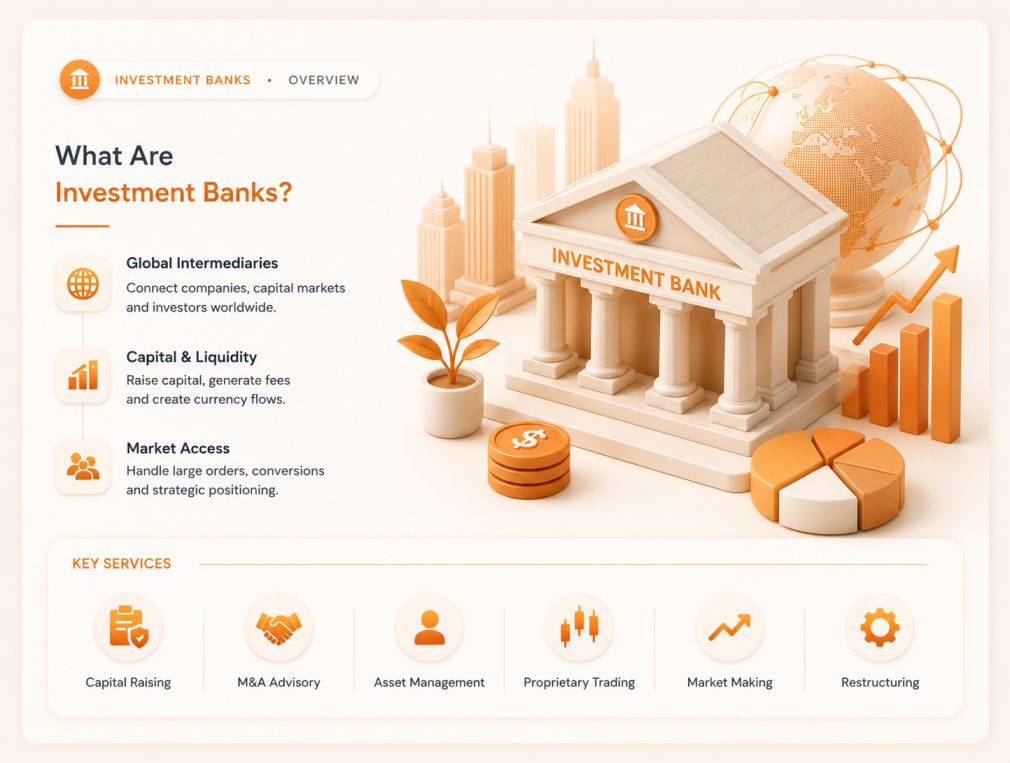
Investment banks are among the oldest and most powerful financial institutions on earth. Their history stretches back several centuries, beginning as facilitators of government bond issuances and gradually evolving into full-spectrum financial powerhouses. Today, institutions like JPMorgan Chase, Morgan Stanley, Barclays, Deutsche Bank, and Citigroup offer an extraordinarily wide range of services that touch virtually every corner of the global economy.
At their core, investment banks serve as vital intermediaries between companies and capital markets. When a major corporation needs to raise capital — whether through an Initial Public Offering (IPO), a bond issuance, or a leveraged buyout — the investment bank structures the deal, prices the securities, and places them with institutional buyers. This capital-raising function generates enormous fee income and, more importantly for forex traders, it creates currency flows.
Here's what makes them directly relevant to your trading desk: investment banks run some of the largest proprietary trading operations and currency dealing desks in the world. Their forex desks handle client orders from multinationals converting revenues, sovereign wealth fund transactions, and speculative positioning from their own books. When they accumulate or distribute positions, they leave patterns in the order flow that sharp traders can read.
Key Services Investment Banks Provide
Underwriting equity and debt securities for corporations and governments — generating massive cross-border currency flows
Asset management for institutional clients including pension funds and sovereign wealth funds
Proprietary trading across equities, fixed income, commodities, and currencies
Market making in forex — providing liquidity and influencing bid-ask spreads daily
Restructuring services for distressed companies, often involving multi-currency balance sheet management
Pro Trader Insight: Watch for large M&A announcements involving cross-border companies. The acquirer typically needs to buy the target's currency — sometimes billions worth — and this creates sustained directional pressure on the relevant forex pairs.
Chapter 2
Demystifying Hedge Funds: The Aggressive Capital That Drives Volatility
Why Hedge Funds Are Every Forex Trader's Most Important Market Participant
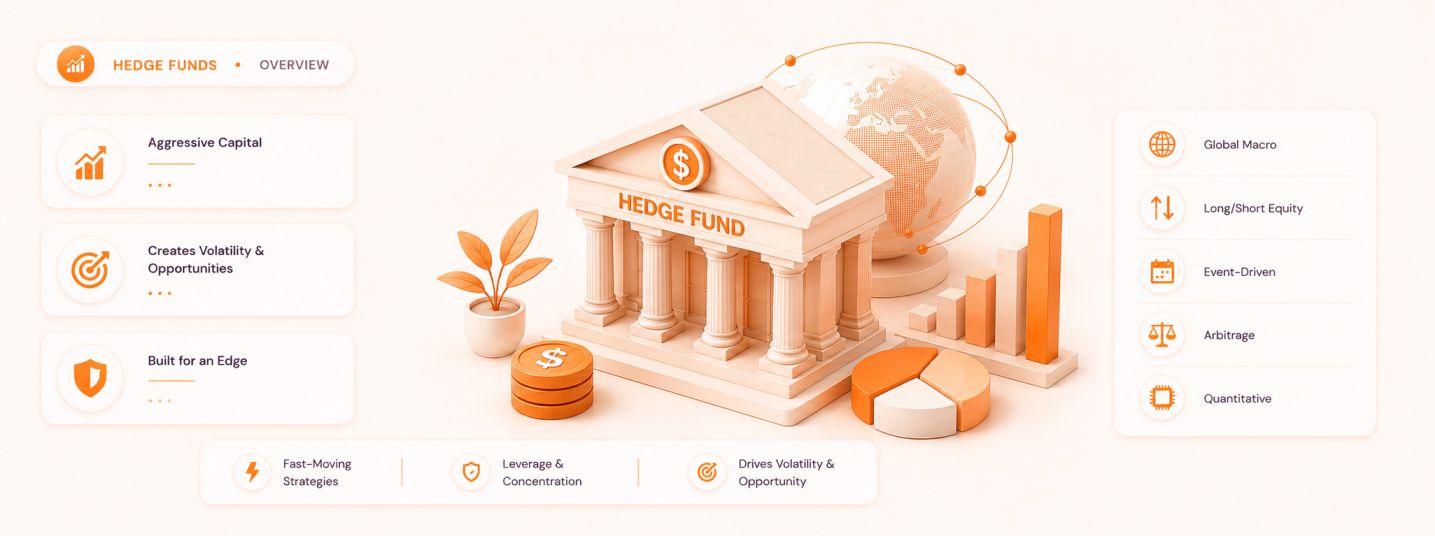
If investment banks are the steady giants of finance, hedge funds are the hungry, fast-moving predators of the capital markets. These are alternative investment vehicles that pool capital from high-net-worth individuals and institutional investors, then deploy it using sophisticated, often aggressive, strategies designed to generate positive returns regardless of whether markets are rising or falling.
Unlike the mutual fund your retirement account might sit in, a hedge fund manager faces virtually no restrictions on what they can do. They can short currencies, use leverage aggressively, trade derivatives, and take concentrated positions that would make a traditional fund manager sweat. The result? When a major macro hedge fund like Bridgewater or Millennium takes a conviction trade in forex, they can move markets.
Common Hedge Fund Strategies That Impact Forex
Global Macro: Trading based on macroeconomic themes — interest rate differentials, inflation dynamics, political risk. These funds are the biggest currency market participants after banks.
Long/Short Equity: While primarily equity-focused, large cross-border positions generate significant currency hedging flows.
Event-Driven: Trading around mergers, earnings surprises, central bank decisions — creating sharp, short-term forex volatility.
Arbitrage: Exploiting price discrepancies between related instruments including currency pairs and cross rates.
Quantitative/Algorithmic: High-frequency models that trade currency pairs in milliseconds, contributing to the modern forex microstructure.
The potential for high returns in hedge fund strategies comes precisely from the same thing that creates risk: concentrated, leveraged positions that move fast and hit hard.
For forex traders, the most critical takeaway is this: hedge funds are often the "smart money" that front-runs central bank pivots, economic trend shifts, and geopolitical risk events. Tracking Commitment of Traders (COT) reports — which show net speculative positioning — gives you a window into where large macro funds are positioned. That data, combined with the signals from fxTsignals.com, gives you a genuine edge.
The Risk Side of Hedge Fund Investing
Investing in hedge funds — or trading like one — comes with significant risk. Market volatility can amplify losses when leverage is involved. The lack of transparency means retail traders often can't see what the big funds are doing until after the damage is done. Limited liquidity in crisis periods means even well-positioned trades can get stopped out. Always manage your risk accordingly.
Chapter 3
Private Equity Unveiled: Long-Term Capital That Shapes Entire Industries
How PE Activity Creates Macro Themes for Forex Traders
Private equity operates in a different world from the daily hustle of trading screens. These firms raise massive pools of capital from pension funds, endowments, and wealthy families, then deploy it to acquire privately-held companies — businesses not listed on any stock exchange. The goal: buy at a reasonable price, improve operations dramatically, then exit at a significant profit, typically over a 3–7 year horizon.
Private equity's relevance to forex traders is less immediate than hedge funds but no less important. Large PE buyouts — especially cross-border deals involving companies in emerging markets — generate significant, sustained currency demand. A $20 billion buyout of a European company by a US-based PE firm, funded with dollar-denominated debt, creates real EUR/USD flow that shows up in the market.
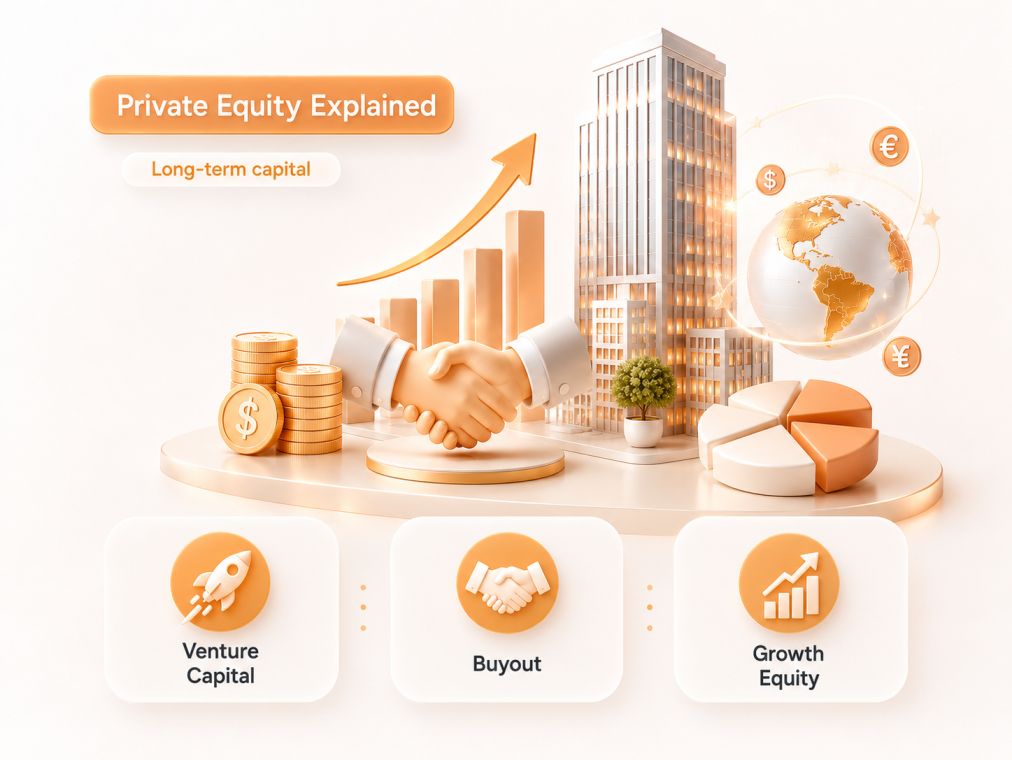
The Three Core Types of Private Equity Firms
Venture Capital (VC) Firms: Focus on early-stage, high-growth startups. Think Sequoia Capital funding the next generation of fintech in emerging markets — those deals drive capital flows into local currencies.
Buyout Firms: Acquire mature, established companies using significant leverage. The debt issuance and eventual IPO create multi-year forex themes, especially when cross-border.
Growth Equity Firms: Invest in profitable, scaling businesses that need expansion capital. Often active in high-growth emerging economies — a key watch area for EM forex traders.
Private equity also plays a broader macroeconomic role that indirectly affects currency values. By injecting capital and operational expertise into businesses, PE firms accelerate growth, create employment, and improve productivity — factors that central banks watch closely when setting monetary policy. Stronger economic performance from PE-backed firms can support a currency over the medium term.
Key Differences
Investment Banks vs. Hedge Funds vs. Private Equity: The Definitive Comparison
Understanding how these three types of institutions differ is essential for interpreting market flows correctly. Each plays a distinct role, operates on different time horizons, and impacts forex markets in different ways.
Feature
Investment Banks
Hedge Funds
Private Equity
Primary Function
Capital raising, advisory, market making
Active investment management for returns
Acquiring & transforming private companies
Investment Horizon
Transaction-based (days to months)
Short to medium term (days to 2 years)
Long term (3–10 years)
Forex Market Impact
Daily via client flows & dealing desks
High — speculative positioning moves markets
Medium — cross-border deal flows
Investor Type
Corporate & institutional clients
HNW individuals & institutions
Pension funds & endowments
Liquidity
High (public market instruments)
Lock-up periods (quarterly/annual)
Illiquid (multi-year commitment)
Regulation
Heavily regulated (Basel III, Dodd-Frank)
Lighter touch regulation
Moderate regulation
Trader Relevance
Track order flow & M&A announcements
Monitor COT data & macro positioning
Watch for cross-border deal announcements
Practical Application
How to Use This Knowledge as a Forex Trader
Turning Institutional Awareness into Trading Decisions
Understanding these institutions intellectually is one thing. Using that knowledge to make better trades is another. Here's how to bridge the gap practically:
Track the COT Report: The CFTC's weekly Commitment of Traders report shows net speculative positioning — a direct window into what macro hedge funds are doing. Extreme positioning often precedes reversals.
Monitor M&A News: Large cross-border M&A deals create sustained currency demand. When a USD-funded firm acquires a EUR company, EUR demand can persist for weeks as hedging is put in place.
Watch Investment Bank Research: Major banks like Goldman Sachs and Morgan Stanley publish currency outlooks that are self-fulfilling — if their clients act on them, the prediction shapes the market.
Respect Institutional Levels: Investment bank algorithmic trading often clusters around key technical levels. Understanding where they're likely to enter or exit improves your own trade location.
Assess Your Risk Profile: Unlike hedge funds, retail traders can't absorb unlimited drawdowns. Define your risk tolerance, set hard stop-losses, and size positions accordingly — always a priority before any trade.
Remember: these institutions have unlimited research budgets, millisecond execution, and teams of PhDs. Your edge isn't competing with them directly — it's reading their footprints in the market and positioning alongside them at the right moments.
FAQ
Frequently Asked Questions
Investment banks run massive currency dealing desks that process orders for corporate clients, governments, and their own proprietary positions. Their order flow — especially large client transactions like a multinational converting revenue from a foreign subsidiary — creates real supply and demand that moves prices. They also act as market makers, setting bid-ask spreads and influencing perceived liquidity in currency pairs.
Direct investment in hedge funds is typically restricted to "accredited investors" — individuals with net worth exceeding $1 million (excluding primary residence) or annual income above $200,000. However, retail traders can access hedge-fund-like strategies through certain ETFs, mutual funds with hedge-style mandates, or by studying and adopting macro hedge fund approaches in their own trading, as outlined in resources at fxTsignals.com.
The simplest distinction is liquidity and time horizon. Hedge funds invest in liquid, publicly-traded instruments and can enter and exit positions quickly — often holding positions for days, weeks, or months. Private equity invests in privately-held companies and commits capital for years, typically 3–10 years, before exiting via IPO or sale. Hedge funds chase market returns; PE firms chase operational transformation returns.
Cross-border private equity deals generate real currency demand. When a US-based PE firm acquires a company in the Eurozone, they need to convert USD to EUR for the purchase — creating sustained EUR buying pressure. Additionally, PE firms often issue debt in local currencies to finance acquisitions, which can influence local interest rate dynamics and, consequently, currency valuations over the medium term. Monitoring major PE deal announcements in financial news is a useful part of a macro forex research routine.
Investment bank currency research and forecasts can provide valuable context, but they should never be your sole basis for trading decisions. These banks have inherent conflicts of interest — their own trading desks may be positioned opposite their published research. Use their macro outlook as one input among many: combine it with technical analysis, COT data, economic calendar awareness, and the professional signals available at fxTsignals.com for a well-rounded approach. Always apply your own risk management regardless of who's making the call.
Conclusion
Navigate the Financial Landscape With Confidence
The world of investment banks, hedge funds, and private equity can feel distant from the day-to-day reality of forex trading. But these institutions are the invisible hand shaping the very markets you trade in. Understanding their motivations, time horizons, and market impact transforms you from a reactive trader chasing price to a proactive one understanding flow.
Investment banks provide the liquidity and infrastructure of global forex markets. Hedge funds — particularly macro funds — are the speculative force that drives the biggest trends and reversals. Private equity creates longer-term macroeconomic themes through cross-border capital deployment. Together, they paint a picture far richer than any single chart pattern or indicator ever could.
The key to successful forex trading, as with all investing, is thorough research, disciplined risk management, and the patience to align your positions with market reality rather than wishful thinking. Build your knowledge from the ground up, leverage professional tools like fxTsignals.com, and approach every trade with both confidence and humility.
The smartest traders aren't the ones who predict the future. They're the ones who understand the present clearly enough to act decisively when opportunity arrives.
Ready to Trade Smarter?
Join thousands of forex traders who combine institutional market intelligence with
professional signals at fxTsignals.com.
Stop guessing. Start understanding.